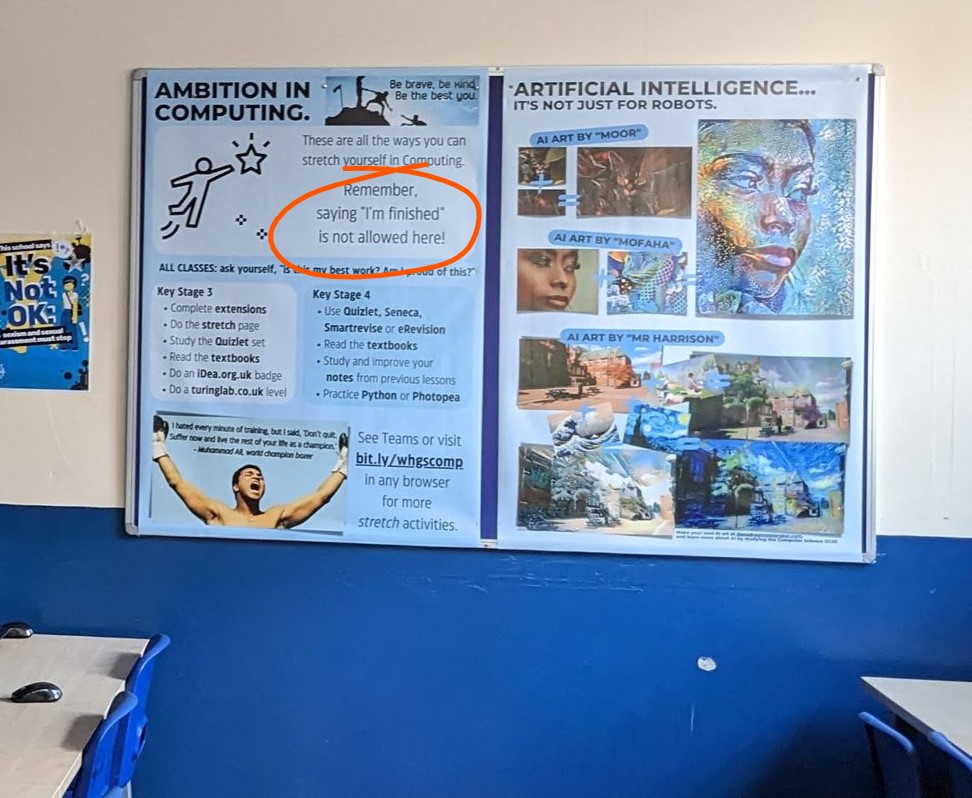
There are two words I hate to hear in the classroom. So much that I banned them. I banned the phrase, “I’m finished”. Here’s the proof, a poster in my most recent classroom:
Why did I ban “I’m finished?” Surely you want pupils to finish their work in lesson time, and if they finish early, what’s the harm if they find something less stressful to do? Like going online to play Chess with their mates, as one Tweeter told us her pupils do (or did, until the IT technicians blocked Chess.com, forcing them to “go on YouTube” apparently.)
Allowing “free time” at the end of a lesson encourages poor performance. Many pupils will rush the work to get it “done” in plenty of time to play games or watch videos. In my early career I often responded positively to the plea “Sir, if we get finished early can we go on coolmathgames ?” But I learned that dangling that carrot of “free time” just ensured poor concentration: a tendency to fill boxes on worksheets with the bare minimum, and importantly, ensured a poor ratio (proportion of pupil-minutes thinking hard about the topic, instead of other things).
Worse, though, than the direct effect of encouraging a poor work ethic, is the meta-message sent by the “rewarding” of completion with something “more fun”. This communicates to the pupils that the learning is not valuable, that it cannot be enjoyable in and of itself, and getting “finished” is more important than doing the work well: giving your entire congitive faculties to the learning itself for the duration of the lesson. Better to show you value the learning by foregrounding it, praising effort: let them know that in your classroom, hard work pays off. Ditch the focus on “busywork”: completion of worksheets as a proxy for learning, and ensure there is plenty of productive struggle in your classroom: pupils thinking hard about what you want them to learn, sticking with a tricky task with resilience, learning the value of persistence, and being rewarded with success. Learning is it’s own reward in my classroom.
This blog by Ben Newmark quotes Simone Weil:
…the purpose of study should be to improve our capacity to properly pay attention to something by subsuming ourselves to it and making the point the humble, genuine work towards it.
Simone Weil quoted in the blog “Try” by Ben Newmark
My lessons are full of thinking hard about the topic of computing, from start to finish. Don’t get me wrong, my lessons are not boring, each is rich and varied (practical programming, physical computing, Quizzes, puzzles, past paper questions, debates…) but not one minute of the 60 is given over to non-computing time. Why would I deprive them of enjoyable learning about our wonderful subject? Why would I suggest that playing games is somehow more desirable than building logic circuits or learning to code?


 How to Teach Computer Science
You must be logged in to post a comment.