Episode 4 is here!

Transcript
Hello. Welcome to how to teach computer science, the podcast. This is episode four. How do we really teach computer science? I’ll be answering that question and many more with the help of today’s special guest.
every time I make a joke in class, I say to the kids, I say, there aren’t many computing jokes and the ones there are aren’t very good.
No, that is true. So I’m trying to buck that trend. I’m trying to bring in some new humor to the subject. I think it’s necessary. I think that might be a bigger task than sorting out the pedagogy but. Yeah, it could well be. Yeah

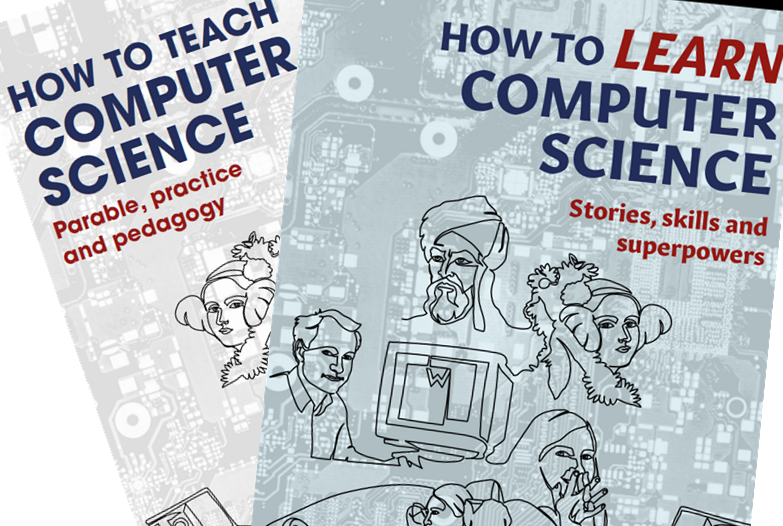
More on that in a moment. My name’s Alan Harrison, and I wrote the books how to teach computer science on how to learn computer science available in online bookstores, more details at the companion website HTTCS dot online. That’s the initials of. How to teach computer science. HTTCS doc online. You know, it’s been quite a week.
I’ve had a lot of feedback on the podcast. Most of it positive. Thank you so much. And I was in a teams meeting with other teachers of GCSE and A-level computer science this week. Run by AQA. Thank you, Steve Kenny for inviting me. And there was a lot of love for the podcast and it seems you appreciate my humor, which is nice.
But I did say there are a load of cheesy computing jokes, which are not going to make it into the parts such as why do computer scientists confuse Halloween and Christmas? Because OCT 31 equals DEC 25.
Like I say, I won’t be doing cheesy jokes like that. But just for Ian Bissix in the AQA meeting, this is for you Ian what sits on your shoulder, shouting pieces of seven pieces of seven. A parroty error.
Which reminds me, what’s a Pirate’s favorite programming language. Ye might think it’d be R but his first love be the C. If you like this content, please subscribe. Tell your friends, buy my books at HTTCS dot online. Leave a review on Amazon, or at the very least buy me a coffee details on the website. Every week, I will transcribe this recording and blog it at HTTCS dot online slash blog.
If you prefer reading, you can always print my blog and read it on the train like it’s the 1990s again. Talking of printing. I was going to put this story in the book, but I’m not sure of its veracity. a listen and tell me what you think. We have to go over to Germany in the 15th century for this story.
1440. Johannes Gutenberg has just invented the printing press. And just five minutes later at 1445, the printing press has invented the first paper jam. And at 1530, despite printing only in black and white. Johannes printing press has demanded a magenta ink refill. Gutenberg’s invention heralded what historians call the printing revolution. Although teachers are waiting for the second printing revolution where they all just work.
swear the teacher workload crisis is caused by 15 hours a week of marking and 20 hours clearing other people’s paper, jams and screaming. Jean! Where the hell is the duplexing unit cover? My advice. Stop printing anything at all. Use OneNote as their digital exercise books. And when mocks come around, use your school’s printing service, often described in that unique way schools have of clinging onto nostalgic terms from a bygone age as the reprographics service. Make sure you greet Mina in reprographics every morning, and don’t forget her at Christmas and she’ll print your stuff first.
This week on the podcast, I have a special guest he’s been a CAS Master teacher for many years. He wrote the excellent Python course for REPLIT. And is very active on X, formerly Twitter when CAS chat comes around every Tuesday.
I’m delighted to welcome a fellow computer science teacher, Andy Colley. How are you, Andy?
I’m very well, thank you. Thanks for having me on. It’s slightly unusual this because I’m pretty much sat up in my spare room and I reckon if I look out of the window on my left, I could probably wave to you because you’re about two streets away from me.
And yet we’re using the magic of the Internet to record this. Maybe next time we’ll get in the same place. So the how the tables have turned because I was on your podcast probably a couple of years ago now. So just Fill us in. What’s your podcast about Andy?
I mean I’ve never been one to be backward about coming forward, but for those of you who don’t know me, my name is Andy Colley. I am a rather fancily titled Director of Computing, which is a posh title for Head of Subject at a school called Laurus Cheadle Hulme in Cheadle Hulme, South Manchester.
And in my spare time when I’m not teaching people, I like to talk about teaching people. And one of the ways I do that is through a podcast called Learning Dust with an unbelievably good better half, podcast wife on there called Dave Leonard, who is a network manager a MAT network lead, IT director and so on.
And he’s fabulous. He was one of the first people to steer my career down the way of using technology. Pedagogy first technology, if you will. Not just using it because it’s a shiny box, but using it because It helps learners improve the way they learn and remember more and be able to do more.
Yeah, he’s an all round good egg, Dave, isn’t he? I keep bumping into him as well at conferences.
I know he’s annoyingly popular, isn’t he? Yeah. But you called that podcast Learning Dust. Just remind me where that phrase came from.
I think the first time I heard it was back at a conference called Rethinking ICT. In about 2010, I want to say, and it was Professor Tom Crick who used the phrase, he said, magic learning dust does not fall out of the bottom of an iPad, just because they’re using technology doesn’t mean that automatically the learning is going to happen. And I’ve remembered it for years and years because the way I’ve taught and developed my career over the last 20 years in education is I was an advanced skills teacher, I was a lead practitioner for teaching and learning, I’m now running a subject.
Throughout all of that it’s about how do you do what you do in the classroom to the best effect so that your kids. Learn as much as possible for that limited amount of time they are with you and then can remember it for the next time you see them.
Absolutely and hence our shared belief in the need to plan really effective lessons, not see if we can use this new shiny thing that’s come out and and is going to, oh, the latest thing that’s going to revolutionize education, let’s throw that into the classroom and see if it does.
You’re dead right and what we were saying just before we started recording was that I think we’re in such a much better place now both as the teaching profession and. Also as computer science teachers in particular about information about pedagogy that works, best practice pedagogy.
Dylan Wiliam speaks a lot of sense. He says, everything works somewhere. But what we do have now is a set Of best bets, if you will. Of things that have been shown to work in a majority of situations that we can default to. I like to call it minimum best practice. So there are certain techniques that you use with questioning, that you use with explanation, that you use with modelling, that are my default techniques.
And from there, I’ve raised the floor. Yeah, if my department are using cold calling and think pair share as their default questioning techniques, if we’re using mini whiteboards as our default check for understanding, if we’re using dual coding and live modeling as our default method of explanation, then that floor standard is a much higher, and there’s much more consistency in terms of It sounds flippant, but the worst it can possibly be, and then, what I say to my department is okay, that’s our minimum. If you’re going to do something different, let’s make it better than what we’ve already got. And we can use that as our benchmark. And like I say, we’ve got so much more information now, I’m looking at the Teach Computing, Big Book of Pedagogy here. And there’s what, a dozen things in there, a dozen concepts. Alan’s reaching for his as we speak. This is live podcast. Yep, here we go. Ta da! There’s page five. There’s a dozen things there.
Yeah absolutely. This is I was going to talk about this. I’m flicking it in front of the microphone. Like that’s helpful when we’re on a podcast, but yeah, it’s I like what you say about a sort of a floor level of performance and then you can build on that.
So I do recommend everyone reads something like the Big Book of Pedagogy. There’s other stuff out there now, like you say, loads of it that we have access to now in the last 10 years, like Sue Sentance’s, computer science, education book. And I wrote a book by the way, I don’t know if you heard about that.
And I do mention it occasionally. Yeah. And William Lau’s and many others. What I tried to gather was some of the best bits of , it’s a bit of a magpie book. Really, I magpied all the best bits of pedagogy from other people’s research, but I did credit everybody.
So yeah, I like what you’re saying about, questioning and whiteboards and there’s sometimes I come across people who say oh we’re in a computing room we’ve got to use the computers all the time and I think good teaching is good teaching you don’t have to be on the computers all the time.
Magic learning dust does not fall out of the bottom of an iPad.
Exactly you know if it’s the best tool for either explaining something to them or checking that they’ve learned what you’ve taught them. Or getting them to practice individually, what you’ve learned, what you’ve taught them, then if the best tool for that is a pencil and paper, then use a damn pencil and paper.
Mini whiteboards are brilliant. I’ve used them for years. And, And, you can ask a question and bear in mind there is what people call a lot of theory to our subject. There’s a lot to know. There’s a lot of declarative knowledge as well as procedural knowledge, if we’re using those terms in the Ofsted Research Review.
You’ve got to check for understanding and that’s a skill that we can use in any classroom with mini whiteboards. One thing I would say is I did start to, I did use occasionally something called Socrative and of course the poll option and just asking questions in Teams if you’re on Teams.
So you can use technology to imitate mini whiteboards. And I like the, this Socrative. com would allow you to ask a question, they would put their answers in, and then you could choose two or three to push back to the students in a poll of best answers. And so you can tweak. The check for understanding with a mini whiteboard with technology in some ways, but it’s still a check for understanding.
Yeah, once I’ve got the mini whiteboards up, I will get some off the students, particularly if we’re learning how to write code fragments and I will put them under the visualizer. And then we’ll debug them together or they will discuss what I like about this particular example or where they’ve used, let’s say, variable assignment in here and so on.
But I’m I’m zooming we’re zooming right in at the moment. If I back off a minute and look at big principles in terms of information about teaching in general, Daniel Willingham said memory is the residue of thought. For me, that’s my Occam’s razor. That is, is. Everything I’m doing in the classroom, getting the kids thinking hard about what I want them to think about.
sometimes that can mean that I have to stop doing something really good to make sure that we’re doing something better. A great headteacher once said to me, if they’re learning, get the hell out of the way. I like it. And I have been as guilty as anyone of having a lovely computing adjacent discussion and if I’ve got a class that’s interested and engaged, I will swerve off what I want them to learn in the lesson and I’ll stay off that for too long.
Oh yeah, my kids knew how to get me off on tangents but yeah.
Yeah talking of tangents. We’re just going to pause the interview with Andy Colley there and have a quick look at next week’s podcast.
But I will just say that one of the things that I personally find really irritating is when People think, oh, how can we get more girls into computer science? Let’s make the projects more girly. And then they have like, , perfume or nail polish or pink or something. And as someone who’s not interested in that, I think many girls will spot that immediately, and they’ll be like, oh, honestly, this is really annoying.
That was a sneak preview of next week’s podcast. You’re not going to want to miss it. That was Anna Wake who with her cousin, Harry. Was talking about. Getting girls into computing and their website mission. encodable, it’s a fab podcast next week. Subscribe now, but first back to Andy Colley.
if I’ve got a class that’s interested and engaged, I will swerve off what I want them to learn in the lesson and I’ll stay off that for too long.
I’m all over that. The Willingham quote. I use that a lot. And it leads onto the ratio blogs from Adam Boxer. Yeah. And Ben Newmark’s Golden Silence. Um, Yes. So it’s, frightening sometimes when, kids are silently working, you think, oh God, I should say something, but the pressure to fill the void, yep. Like I say, I like that quote, get out of the way if they’re learning, and the ratio thing, in case listeners haven’t heard about it, is, what percentage of my pupils are thinking hard about the stuff they should be thinking hard about
We were talking about that semantic waves idea there we’ve introduced the abstract idea of ratio. Let’s zoom into an example now. For example questioning in the classroom. If I say to you, Alan, what is this? The moment I say Alan, everyone else in that classroom stops thinking.
Yes. Yeah, or if I go for hands up, then there are some kids who can quite happily sit there and never put a hand up and never have to think. Whereas if I say, I’m going to ask a question, I want everybody to think about their answer, and I’m going to take several responses. Yeah. Ask the question, pause, then Alan. Now, the number of students that are thinking up to the time I say the name is hopefully everyone.
And then, because I’ve said I’m going to take several responses, I can move it around. And that’s, that’s the sort of The nutshell of cold calling, isn’t it? Yeah, it is. And I was talking about this. I was delivering a course at the STEM Centre in York a few weeks ago and we were talking about questioning.
And I brought up the fact that novice teachers often don’t. really understand the purpose of questioning and they remember their school days of teacher asking a question and kids put the hand up, teacher asked the child who put the hand up and everyone moved on
we have to make explicit for novice teachers what questioning is about and it’s a pedagogical technique that ensures that the students are all thinking about what you want them to think about. In a sense, getting the right answer is really not important. The thinking is what’s important. And you mentioned cold call, which is what it’s called in Teach Like a Champion, of course.
And you also mentioned something that Doug Lemov, Teach Like a Champion bloke, calls wait time as well, which is asking a question and waiting.
All these things are little habits because it’s possible to do all of this stuff really badly and I say that from a position of having done all this stuff really badly. Yeah. Early in my career, I started behind the eight ball because I started in the era of engagement, the era of how many different tasks can you have going on in a classroom? As long as people look busy, that’s fine. Yeah. And from that, I’ve moved to be If I want them to learn something, I’ve got to explicitly teach it to them, and then check effectively have they learned what I’m teaching.
So from the engagement era, then you go through the right it’s the slide design as lesson planning. And you end up, especially working with non specialists, or you’re trying to produce a curriculum that can be picked up and run by other people, temptation is you just put everything you’re going to say on the slide. Absolutely. Which is, yeah, we’ve all sat in those insets, haven’t we? Read out of a PowerPoint, and yeah, look at what some of us do to kids.
It’s funny, some of the teachers CPD historically has been some of the worst teaching that any of us have had. But yeah, . We’re the toughest crowd out there.
Yeah, we’re, yeah, we’re sat there going, my brain’s overloaded, why am I suffering cognitive overload in a teacher CPD session? But yeah, again,
Let’s dig into that then, because that’s the first time we’ve mentioned cognitive overload, isn’t it? And Sweller and his cognitive load theory and being a non computer scientist who learnt to teach this subject. It’s really easy when you are an expert to think that everybody else finds things easy. I’ve seen so many programming courses that go variable assignment, input, output, and now recursion.
Yeah, absolutely.
And there’s this giant pit that you fall into. You’re on your back like a turtle and you can’t get out. And I see that look on the faces of students all the time.
So, yeah, my lesson slides now are a lot more pared back. There’s a lot more diagrams or part diagrams that I then complete in front of the students. The note section is where I keep my explanations and I don’t know how long it, I dunno, it was far too long it took me, but before I started practicing my explanations.
Actually get into an empty classroom and say what you want to say. Are you doing it with brevity? Are you doing it as simply as possible? And then you can start to build in your analogies and your what william Lau brilliantly talked about in terms of semantic waves where you go from concrete to abstract to concrete back to abstract you pack you unpack and so on.
So you as an experienced teacher you pick up on a load of those analogies don’t you? And you’ve got to be super careful about picking those as well because if you pick the wrong one you can build in misconceptions. You know, , you bake in the misunderstandings and You can do just as much damage with a bad analogy as you can enlighten with a good one.
Yeah, someone pointed out to me, the variable analogy is a box, and I’ve used that with novice programmers down in year 7,8,, And the box thing comes with the possibility of a number of misconceptions, the main one being a box can hold many things at once.
So that’s where you check for understanding with your mini whiteboards.
Yeah, as you get more experience you learn that if you have a bit of code on the screen with the variable num1 being assigned I don’t know four times in ten lines You can put that up and you can say right predict on your white boards What will be stored in num1 by the end of this code?
And you’re trying to draw out that misconception that you don’t just add them all together, or you don’t shove them all in the variable. And by doing that with the handover phase, the checking for understanding phase, the sort of we do it together phase, and especially by, oh, brilliant, I’m glad you thought that. Loads of people think that when they come across variables for the first time, and we can really learn from that now. And getting discussion going about why this isn’t the case and questioning like that, you can turn your classroom into a place where it’s okay to make mistakes. Absolutely. Where we’re learning from this, this is a learning process, so we are not afraid to have a go, 30 answers up in the air you can see 30 different answers from 30 different brains and pick out those misconceptions. And as you get more experienced, you get better at setting up those questions and those examples to check for understanding, to draw those out.
For example, when you’re teaching selection and you do if age is greater than 18, output you can vote, and then you do what will happen for an input of 18. Yeah. Because we don’t read the comparison operator properly.
I used to call it the bouncer program because it was you can go into the pub and then someone pointed out that I should really not be encouraging drinking.
So it became the you can vote program. Yeah. And yeah, you can teach, with that one example, you can teach , variable tracing, and dry running a program to see if it will work and testing as well. Yeah, that’s.
That leads us on to that to Sue Sentance’s really quite fantastic PRIMM, doesn’t it, in terms of code comprehension and learning to read before you can write?
Yeah. I put a quote in the book from David Gries, computer science educator, 1974, said, if you’re an apprentice carpenter, you don’t get given a load of tools and an example of a finished cabinet, and then be told go and make one,
so the idea of PRIMM’s been around some time, reading code before you can write it and getting familiar with it. But it’s good to have the research to back it up.
Yeah, I think also, though, being super careful with that cognitive load theory and that Willingham idea of introducing new material in small steps, , again, we can fall into that expert trap of we’re teaching selection, so Yeah, with an if and an else, and then we go to a make task and it requires selection and oh, there’s an iteration in there as well, and then we’ve got lists built into the make task as well.
Who was it who described I think it might have been Sue Sentance again. A single line of code can be so syntactically dense. Yes. There’s so much going on. There’s so many concepts to understand, yes. Let’s go back to selection again. You’ve got the selection statement, you’ve then got a condition, so you’ve gotta understand what a condition can be made of. A comparison operator, it can contain a variable, it can contain two variables, two pieces of data, strings, integers, and then you’ve got indentation, and that’s a single line.
So much going on. You can have a subroutine call and then in Python, you don’t even have to go if. Valid input equals true. You could just go if valid input. Yeah,
hang on. that’s a fun one to discuss when you’re doing selection and conditions and stuff equals true. You don’t need that. Ah, yeah, but I teach it with the equals true.
And then you can take it off and explain why later.
I call it the long way round for a lot of my students. I say, I’m going to teach you the long way around and we’re going to do one thing per line.
Oh, it never stops. This idea that we simplify for the age or the level of the audience that we’re teaching to. It never stops because of course when you get to A level you learn functional programming and when you get to university you learn all sorts of esoteric languages that do parallel processing with abstraction and so on.
So the first thing that you teach children about programs is they are a sequence of steps to solve a problem and then you get to a level and they’re not anymore because a functional program is not that. So we’ve got this idea that we teach, abstractions again of the knowledge at each level and then sometimes we have to unweave the abstractions and teach them what the truth is.
Again, it’s are you baking in misconceptions and it’s really hard because it’s tricky and I guess this is pedagogy and this is what we have been researching
yeah Yeah if we move on from programming a minute. What other pedagogy is there in our subject that, besides programming I’ll give you an example. I teach networking, what’s called a threshold concept of packet switching. Yes.
Just as an aside, someone asked me, do we need to teach packet switching? because it’s no longer in the spec. It’s true that in the OCR spec, you don’t have to describe packet switching, but you can’t possibly understand networking without understanding the threshold concept of packet switching. So I get nervous sometimes when teachers ask me, can I drop this from my classroom? And I go no, it’s a fundamental concept.
So I get it across with post its. Post it packet switching, I call it, and they write one word on each post it and they write who it’s to and the number of that. Post it in the message and I send them around the classroom and so these post its are standing in for the packets and that’s my analogy but I’ve got to make sure I go back up like you mentioned, go back up the semantic wave and explain how this analogy is the same as packet switching and the ways it’s different. For example, it’s not one word in a packet, it’s a number of bytes and so on.
Are there any other pedagogical tricks and techniques that you use for the non programming stuff?
Yeah my overriding thing is before I go into the classroom, I’ve really planned what I want to say and how I want to explain it and then how I want the students to respond to that in the handover phase.
And the majority of the time that will be an explanation, a diagram, checking for understanding with mini whiteboards, think pair share discussion time or cold calling. And again, I’m picking up on those if I expect them to know the answer, I’ll use cold calling. If I need them to discuss something or to have a think and safety in numbers, that would be think pair share and so on. I do almost something similar when we’re talking about CPU architecture, the different parts of the processor.. So we will have some students sat along one side of the room with instructions.
On their mini whiteboards, add this load that, do something else. Yes. And then in the middle of the room, on a table, I will have my CPU. And again, it’s abstraction. So I’m using the program counter the memory address, register the memory data Registered the control unit, the A LU.
So the program counter tells the memory address, register. Which number instruction is next the memory address register then shouts that to memory instruction one That gets brought to the front. Yeah, and if I really want to complicate it, I will have a student counting down as the clock So we’ll have a five second clock speed Five four and it’s got to be the instructions got to arrive at the processor into the memory data register control unit decodes it gives the ALU if it’s Arithmetic and so on and they’ve got five seconds to complete this Yeah, good stuff.
Stuff. And then we go again and we go again. So they’re actually moving the instructions around and if you get a class you can trust, that’s great.
Yeah exactly. So absolutely fab. Yeah, .What else have I been doing? A couple of revision sessions, with 11s on binary search, and again
Play the high low game. We’ll play the high low game, of course we’ll play the high low game, I will read your mind. Six guesses or fewer, 64.
But what I’ll do is Before I introduce binary search In order to do that, you’ve got to master finding a midpoint. And in order to find a midpoint, you’ve got to do integer division, floor division. We will do lots of practice of floor division to get the right answer. Then we will do floor division to find the midpoint. Here’s a list, what’s the midpoint? We’ll practice several of those until I’m convinced they’ve got it.
And then we’ll introduce the idea of binary search, so that We’re introducing in small steps. I’m getting that high success rate. They can all do floor division. They can all find the midpoint now binary search midpoint is our search item higher or lower? Yeah, and then we show them how it works So we it’s just about really thinking carefully about what I’m doing and making sure that I’m pre teaching the skills They need for them to be successful because there’s nothing worse than that Jump from input to recursion when you are absolutely lost
And, and it’s so easy to do. It’s so easy to do. And startling to realize, but some of our lovely students do not do what I do and spend every minute between one lesson and the next thinking about computer science. No, I know. So there is a chance that they may not.
You can’t be remembering the stuff that you want them to remember from one lesson to the next, especially at key stage three.
Talking of remembering stuff from one lesson to the next, how can we help them do that? So yeah, I’m hinting at retrieval practice.
You got a lot of retrieval practice going on, Andy?
Every lesson. Every lesson. Every lesson. With very few exceptions. And again, at Key Stage 4, Smart Revises is the best platform I’ve seen for that. They’re constantly making changes. It’s worth the money. Constantly making changes and updates.
One of the best things they’ve done recently is introduce topic, guided topic filtering. So with my 10s, as I teach a topic, I can add that to the smart revised question set that my 10s see. And then when they do mixed retrieval, just the topics we’ve covered. are built in there, because retrieval should be something you’ve already encountered.
It’s practicing remembering, isn’t it? Because when you’re sat in an exam, that’s all you’re doing. That’s what revision is. It’s tricking your brain into remembering stuff that it really doesn’t want to remember. I know all the words to the Neighbours theme tune. Not doing it now. No idea why, but for some reason my brain, when I first encountered CPU architecture and parts of the processor, it just slid right off.
So revision is just doing and doing until it blooming well sticks, until that synapse pathway is strong enough. At Key Stage 3, actually, I use something called Quizzizz, it’s that absolutely, it’s that sweet spot of engagement and hard thinking. And if you find me on Quizzizz as Mr. A. Colley, you can nick all my Question sets and question banks it also lets me celebrate, oh this class today we got 70 percent as a class.
Let’s aim for 75, and we can give out house points for quality performances, things like that. It’s great.
Absolutely. You touched on something that Willingham said there, which was knowing is remembering in disguise.,
that’s, that links back into cognitive load theory, doesn’t it? Because when, as we keep going back to programming, because we’re computer scientists and it’s what makes our socks roll up and down, isn’t it? But when you see a problem to program now. You’ve got a stored bank of experience of problems like that you’ve seen before, and how you saw them solved, or how you solved them yourself.
So you’re not processing that as new information. So your experience, and the fact that you can retrieve those and remember them, they’re in your long term memory, means they don’t take up. Any of the, is it five blocks? Five things in your working memory. Five new, five new things. You’re not trying to process that as a new thing. So that frees up your working memory to process the new things that are different about the problem. It also means as an expert you can use that experience to focus on the parts of the problem that are important to do that mental abstraction that you need to do. Whereas a New learner can’t do that yet.
They’ve not learned what’s important and what’s not. They give everything equal weight So when you’re saying it’s blooming easy. Of course you need selection there. Of course you need a loop there Because you’ve seen it a thousand times. They haven’t. By practicing retrieval, by remembering experiences or skills we’ve had, you’re removing that cognitive load, you’re removing the opportunity for overload, so they can process the things that are different about that problem.
And it’s all computer science in disguise, isn’t it? It’s pattern recognition. Abstraction. All of that stuff. So, there’s a reason I was talking about best practice and floor levels earlier and that’s because this stuff is proven to make it more effective for our learners to learn new things and without cognitive overload because it’s hard enough as it is
absolutely you said about noticing what’s different and I Listened to a talk from William Lau about Marton’s variation theory, which Really explains all that.
Yeah, you’ve heard of that. Yeah. Yeah, so So, giving examples and non examples or varying one thing at a time. And so the learners notice the thing that’s varied and how that changes the situation.
Even the way you set your questions up in your practice. I’ve reworked my binary conversion practice questions. Yeah. So that a lot of my examples. change just the least significant bit from one example to the next so they can get to spot that then evaluates out as one higher in denary. Yeah,.
Which brings us back to last week with Andrew Virnuls and we were talking about this then about how the principle of the number of bits in a sample, or the number of bits in the bit depth of an image, the number of bits You have on the width of your data bus and so on, are all the same thing.
And it was interesting that Andrew said we had a chat. A few weeks ago about the number of topics there are in computing and how much content there is to cover.
And novice computing teachers will talk about there being 30 topics at Key Stage 3. And Andrew and I could probably think of seven. And I think it’s the understanding of the subject gives us this overarching vision of six or seven strands that everything relates to, whereas novice teachers will see, a unit on Photoshop as separate to a unit on vector graphics and as separate to a unit on data representation of images.
And the hard thing is in your lessons then how to keep the main thing the main thing and introduce that information in small parts when you can see all these really exciting joins between the topics, and then you’re off on a story.
Yeah. I know, I keep, every time I make a joke in class, I say to the kids, I say, there aren’t many computing jokes and the ones there are aren’t very good.
No, that is true. So I’m trying to buck that trend. I’m trying to bring in some new humor to the subject. I think it’s necessary. I think that might be a bigger task than sorting out the pedagogy but. Yeah, it
could well be. Yeah. Because in my experience, I did computer science degree way back in the dark ages the others on my course weren’t particularly funny or entertaining, so I didn’t hang around with the computer scientists.
I hung around with archaeologists and English majors.
There is. At the risk of alienating the entire audience, there’s a there’s a stereotype about computer scientists, isn’t there, which is wildly exaggerated and, but you hear it everywhere you go. But for most stereotypes there’s a grain of truth in there somewhere.
And sometimes the things that make you like computer science and make you good at it are not necessarily the same things that make you good as a classroom teacher.
Yeah, that’s probably true. I’ve had this debate online about, does a degree matter? Does I think subject knowledge is important, hugely important.
Otherwise, we wouldn’t be, doing this. But, yes. Not all computer science graduates make good teachers, I think. So
And not all great teachers, so better make good computer science graduates either. I think it’s . It’s a what did Liam Neeson say? It’s a particular set of skills. . .
Yeah, exactly. On that threat from Andy there. Given that I’ve got a particular set of skills, a new skill being podcasting. I learned from the best. Go and listen to Learning Dust with Andy Colley and Dave Leonard after you’ve finished.
Listening to this podcast. What’s your week like, Andy? What’s it looking like this week? This week in Laurus Cheadle Hulme, you it’s option year, nine options evening, tomorrow night, which is exciting. And tiring both rolled into one because it’s that chance to change some minds or
To come
can anybody take computer science in your school? Yep. Yeah, . I hear about a lot of gatekeeping. A lot of schools are nervous about results, and so they try to steer some pupils away from computer science, which I think is wrong. I would like it to be open to everyone.
I think if you’re gonna come in to the classroom and you’re gonna work hard. Yeah. And you understand as you’re coming in, if your key stage three curriculum has set students up to understand what they’re really getting into. Really getting into. ’cause you’ve gotta love, learn to love the pain a bit at GCSE.
Yeah. You know that’s true. My 10, my tens are my 10. Some of them are really wrestling with Subprograms right now. Yeah, really wrestling and when you said about sequence before I’m thinking yeah Because I’ve just introduced subprograms to them looking at me going I can’t I just do this as three lines of code rather than having to define a subprogram and call it in the main Ascended parameter because we’re doing it a very simple level at the moment.
It’s yes, we’ll make things better later You know, we’re doing we’re taking the pain now they have to be prepared for that and if you’re gonna come in and Work your backside off and get a grade two because you work your backside off and that is a hole in one for you. Then I am as proud of you as I’m as the person who comes in and works the backside off and gets a grade eight or grade nine.
Yeah. Don’t forget, grade two, three can be a positive progress eight score for some students, let’s not forget that.
It’s a big achievement for some students and some of my Best results were low prior attainers, and they thrived in the subject.
Catherine Elliott talks about what we’ve talked about. That’s these sorts of pedagogies of new information in small steps, avoiding cognitive overload wherever you can, of high success rate of code comprehension.
She talks about those as key techniques in creating an inclusive classroom. And these techniques are just great teaching. And if you are doing that and your classroom is a place where great teaching is taking place, that helps everyone.
Yeah, a high tide lifts all boats is how I explain it, which is the old fashioned phrase, but yeah, I remember the days when, you know, my head of department would go tell me all the ways you’re helping these students, and it would be a list of characteristics, and it would be EAL, and PP, and SEND, and so on, and oh, tell me how you’re differentiating your lessons 20 different ways . And, we’re over that now. We talk about inclusive and adaptive teaching, which means, teaching it well and responding to the needs of the pupils.
Know your subject well. Know your subject well. Explain it well, model it, check for understanding well, hand over that hand over lesson stage well. Give students opportunities to practice what you’re trying to teach them and then explore and vary William Lau and the variation theory with your better programmers, right, how many different ways can you make this happen? And have you seen that that competition they have every year of making the worst user interface?
Oh yeah, I love that.
Take inspiration from that. What’s the worst way you can make this program? What’s the most inefficient way you can make a program that does this? And have some fun with it at that creative end. You can’t take a solo on an instrument till you’ve mastered your foundations and you know your scales and then you get creative with it once you can play with the forms and break the rules And that’s the creative end of computing for me.
So yeah it’s about quality teaching. And that comes back to, there’s things like, now is intervention season, isn’t it? It’s how many extra revision sessions are you running for this? How many days of your Easter holiday are you giving up? Actually, and this is a big bug, bear of mine.
Actually, the number one time you get with those kids is in the classroom, in your lessons. You don’t get any chunk of time that’s bigger than that. That’s where the difference is made.
I’ve worked places where the head of department had me rattling through the curriculum to leave loads of time for revision and I knew it felt wrong at the time because I was just flying through the content ticking it off, if you like, so that I had time to revise it, which meant that they weren’t getting it. So they needed more revision time. And it was a self fulfilling prophecy.
So by the time they get to the revision, they’ve got no confidence in it. Yeah. Yeah. That high success rate, that, that small steps, high success rate is what builds learners confidence in your subjects, especially in a hard subject like ours.
Yeah, absolutely. So you’ve got options evening tomorrow ? Sell the
subject tomorrow. I’ve got loads of Key Stage 4 lessons at the moment. I’ve got some fabulous groups of kids who are just smashing it out of the park and really lucky this year.
I did see when I popped in, I loved the idea that you had this open ended, long list of programming problems that they were just jumping onto at the end of lesson, and I thought that was fab.
That comes from something you said a while ago about you never finished. Yeah, so what I’ve done is I’ve taken the Craig and Dave, the TIME and the mission encodable time Programming projects and I’ve adapted them a bit. I’m delivering them through Repl. it at the moment, but we can’t do that anymore Can we? So I’m gonna have to find a different platform And yeah especially my year 10s. They’ve just absolutely gone nuts for it Yeah, in a way that I’ve never had before and they’re just loving it.
They’re smashing through them they’re doing, they’re doing four in lesson and then going home and doing another six.
That’s great. It’s great when you get that.
It’s brilliant, but I’ve got so much marking to do. Not marking, reviewing of code.
Reviewing, yeah, so yeah, I was never a big fan of marking myself and so I tried to do as little as possible and do things like, reviewing stuff online that they’ve done or self marking quizzes and stuff. Like I said back in class at the time, those mini whiteboards again, get it under the visualizer.
That’s feedback right there when they can do something about it.
Feedback, not marking, that’s what we say. I know I said earlier, you’re never finished. And I’m grateful that you mentioned that, that blog. I blogged about it, didn’t I? I banned the words, sir, I’m finished from my classroom because because basically they should never be finished.
They should always have something to do. But time is run out for us we are finished. This is the problem, we talked about brevity of explanations, but when you get me
going. Both of us the same, so we can talk about computing pedagogy all day. And I’m sure we will again, because we can come back and talk about something else in a few weeks.
It’s been great to talk to you. Andy Colley, thank you for coming on the podcast. An absolute pleasure. Thanks for having me, Alan.
And this has been how to teach computer science, the podcast I’m Alan Harrison. If you want to give me feedback or get involved, just go to. HTTCS. Online or check the show notes. Remember, if you liked this content, please subscribe. Tell your friends, buy my books, leave a review of my books on Amazon, or at the very least buy me a coffee details at HTTCS dot online. So don’t miss next week’s episode when we will have the amazing Harry and Anna Wake of mission encodable, that was a fantastic interview and you don’t want to miss it so. I’m heading down to that London at Easter. So I’m just printing some stuff to read on the way.
But I’m printing black and white.
Okay. Okay.
What.
Jean!. Where the hell is the duplexer cover?
In case you’re wondering, R, is a programming language used mostly for data science. Also no printers were harmed in the recording of this week’s episode. Although this one’s going to get it in a minute. It’s been lovely to talk to you. Speak to you next week.

 How to Teach Computer Science
You must be logged in to post a comment.