Last Saturday, 25th February I spoke at “I Love Computing 2023” a FREE Festival of Computing CPD in London, details at bit.ly/lovecomp23.
I was honoured to be among some of the biggest names in Computing education today, including Jane Waite, Sue Sentance, Miles Berry, Paul Curzon, Phil Bagge and Elli Narewska.
My two talks were on the following (after the ad break…) NOW WITH PDF LINKS TO THE CONTENT.
Advertisements
The Computing Ofsted Research Review and preparing for a Deep Dive
Understand what OFSTED are looking for. What are declarative and procedural knowledge anyway? How do I deliver the National Curriculum at KS4 if they don’t all take the subject? Alan served on the working group that created the Ofsted Research Review and has interviewed successful OFSTED Deep Dive recipients. Attend this talk to help prepare for OFSTED and be relaxed about their next visit. UPDATE – PDF available to download below.
Beyond Mnemonics – teaching for mastery through PCK – a GCSE Computer Science booster
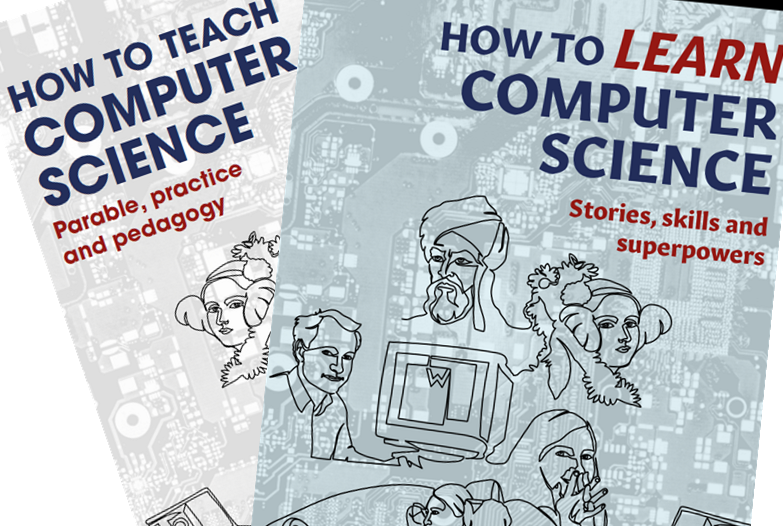
Do you feel you are teaching for “surface learning”? Are you using tricks and schemes such as mnemonics to get them through the exams, and would rather teach for mastery but don’t know how? Alan’s book “How to Teach Computer Science” is all about the hinterland, the background knowledge that illuminates the subject and helps you teach it with confidence, and pedagogical content knowledge (PCK) – the “how to teach” knowledge that helps you succeed. Alan will explain why this “hinterland” is important and what PCK is and how to acquire it, and how to use both for mastery learning. UPDATE: PDF available to download below:
All attendees go into the prize draw for a copy of my book, and there are other, far more desirable prizes available too! At the event I will also reveal a discount code for 30% off either of my books, generously donated by the publisher John Catt Educational (part of Hachette). Update – read my PDFs for the code, available for one more week!
Video recordings of my talks from last year’s online conference are saved here, where I spoke on the “hinterland” and on demystifying computer networks, and if you enjoy those, I hope to see you in Tottenham this Saturday.
If you are grateful for my blog, please buy my books here or buy me a coffee at ko-fi.com/mraharrisoncs, thanks!
Jim Al-Khalili is undoubtedly an accomplished scientist and communicator, and I’ve enjoyed his books and TV appearances. But his article is misguided, and ironically shows a lack of scientific method in his thought process. Most notably he doesn’t seem to have discussed his ideas with anyone who currently works in education.
Advertisements
A science teacher would have quickly confirmed that we do indeed teach the scientific method in schools. I could have told him that we also teach research skills, spotting fake news and judging the trustworthiness of sources from various angles in computing and many other subjects. Indeed, here is part of the national curriculum for computing, at Key Stage 2 (ages 7 to 11):
– use search technologies effectively, appreciate how results are selected and ranked, and be discerning in evaluating digital content – select, use and combine a variety of software (including internet services) on a range of digital devices to design and create a range of programs, systems and content that accomplish given goals, including collecting, analysing, evaluating and presenting data and information
What’s more concerning though, is Al-Khalili’s rejection of “facts” and “knowledge”:
Why spend so much of the school science curriculum loading up children’s brains with facts about the world that they can just look up anyway? Wouldn’t it be more useful teaching them how to find reliable scientific knowledge – which these days inevitably means online rather than in books – and how to assess and critically analyse and absorb that knowledge when needed?
Jim Al-Khalili, ibid
Unfortunately, Jim appears to have succumbed to the “curse of knowlege“, in short, the failure to see a domain as a novice, and understand their needs. Jim forgets that he himself learned a vast amount of knowlege (those pesky “facts”) about science before he was able to find out new facts about the world. His huge and complicated mental schema, built up over decades of study, opened up new discoveries to him that the novice is simply unable to see, as they do not have the decades of learning behind them.
Advertisements
Children are not small adults, when it comes to learning. At school they need to learn as much as possible of the knowledge that has been acquired by humanity before. This store of knowledge will then enable them to think critically about the world, make sense of new experiences and tackle advanced learning. Without this base level of facts they can not integrate new ideas, and learn new skills that require domain-level knowledge. We cannot think critically about a domain we know little about.
There’s a nice clip of Barak Rosenshine explaining the importance of knowledge that did the rounds last year, and you can find it in this post by Greg Ashman. Rosenshine gave the example of expertise in a specific branch of medicine not being a skill that is transferrable to other branches of medicine. As Greg put it:
Rather than possessing general purpose higher-order thinking skills, cardiology professors know a lot about cardiology. When asked to solve endocrinology problems, they stumble.
David Didau goes as far as to say “we cannot teach skills, only knowledge” here. Didau even gives us a clue in this blog just how Al-Khalili came to his fallacious position:
Eventually, we may start to believe the skill which for us has become so natural and straightforward can be taught to others as a complete edifice. […] The idea that skill can be taught without the hard work of teaching all the requisite knowledge is an illusion born from the curse of knowledge.
The curse of knowledge is a terrible thing. How often have you been to a talk, lecture or presentation and the speaker has assumed knowledge you don’t posess? We all do it, I refer to computational thinking as “CT” when talking to computing teachers but have been guilty of failing to explain the abbreviation at times. My own children’s school gave a talk on GCSE options that referred to the modern foreign languages department as “MFL” for 45 minutes before a parent asked what it meant.
Al-Khalili makes the case for a scientifically literate society being better able to make sense of the world, but his boldest claim comes later in the piece, that scientific literacy can make the world kinder:
Adopting the scientific method could help us all become more tolerant and less polarised in our views – to disagree without being disagreeable – particularly online.
Al-Khalili, ibid
Sadly, this is naive because it assumes good faith on the part of online participants and a willingness to seek truth and reject our biases. Cognitive bias is the enemy of critical thinking, even those of us that claim to be critical thinkers are not immune from it, and that’s before we bring in those that are not interested in truth, or not interested in challenging their own biases and conceptions.
And we must understand the sheer power and range of these biases, studies have shown repeatedly that confirmation bias,anchoring bias and the halo effect are extremely powerful, and lets not forget that the filter bubble imposed around us by the algorithms that drive our social media feeds creates the perfect conditions for the false consensus and bandwagon effects. These biases are stronger than we know. Indeed Jaron Lanier likens social media to a “Skinner box”, after the behaviourist who proved that we could be conditioned to act in a certain way through external stimuli. Pinning our hopes on critical thinking is misguided when large swathes of the media we consume is curated deliberately to misguide and feed our biases.
In short, Al-Khalili’s blog is well-meaning but misguided. Educators do indeed teach the scientific model. But our pupils are not researchers. They need knowledge to become experts, and only then can they discover new knowledge. And critical thinking is important, but as a defence against the spreading of “toxic opinions” and “disinformation” it is no match for a trillion-dollar manipulation machine: the giant Skinner box that is the modern internet. Fixing that is a whole other ball game. I recommend you start with this TED talk from Jaron Lanier, but that’s a blog for another day.
Read more about the impacts of Computer Science including algorithmic bias and the power of big tech in my book:




You must be logged in to post a comment.