Categories
AI pedagogy podcast teaching and learning tech

Podcast S2 Ep5: “Will AI revive the art of tinkering?”

My discussion with Miles Berry and Becci Peters is live on all good podcast platforms and here: pod.httcs.online/e/s2e05

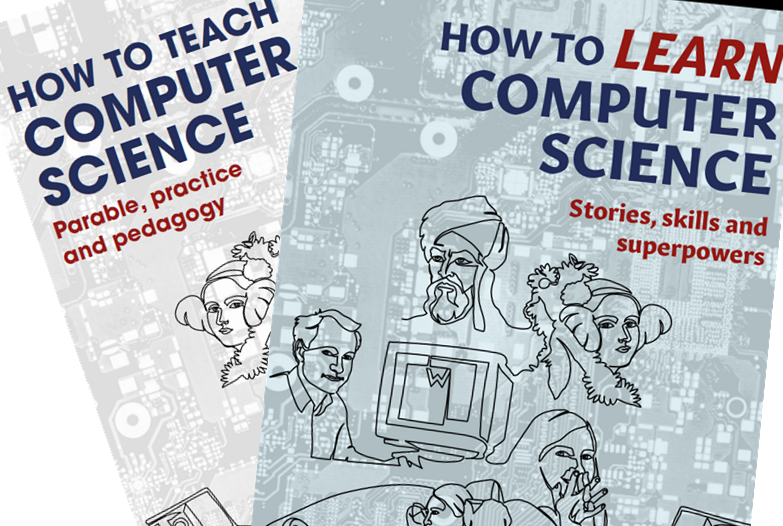
Podcast thumbnail - Alan holding his two books.

The transcript follows below.

Alan: Hello, and welcome to How To Teach Computer Science the podcast. My name’s Alan Harrison, and I wrote the books how to teach computer science and how to learn computer science available in online bookstores. And if you like the podcast, you’ll love hearing me in-person. Visit. httcs.Online to find out more about my training and consultancy, and I could be speaking soon, live at your school on inset day, jokes optional. More details about this and book purchase links at httcs.online, that’s the initials of how to teach computer science dot online. Listeners to the pod get a special discount code too, just type HTTCSPOD in the checkout page at johncattbookshop.com to get 20% off everything. That’s everything including classics, such as teaching walkthroughs by Tom Sherrington, the Huh series by Mary Myatt. And of course my two little books. 

I’ve got no time for shenanigans today because I’ve got a 45 minute chat with two of the best people in computing education in the UK coming right up. 

If you are grateful for my blog, please buy my books here or buy me a coffee at ko-fi.com/mraharrisoncs, thanks!

Welcome to the podcast. And today I’ve got two brilliant guests. We’re going to talk about AI again, but it seems like it’s changing every day, so that’s good.

First of all, I’ve got Becci Peters from BCS. Morning, Becci. How are you? 

Becci: Good. Thanks. 

Alan: Great, thanks. Yeah. And also on the podcast today, we have Professor Miles Berry. How are you, Miles? 

Miles: I’m well, thank you, Alan. It’s lovely to be here and to see you too, Becci. 

Becci: You too, Miles. 

Alan: Good. Yeah great to have you both on to talk about, well, AI.

You might have heard about it. It’s in the news a lot at the moment. So what I wanted to do today is I’m trying to make this podcast something that teachers can listen to. On the way to work and get something useful out of it each day. And I just thought, can we cut through the noise today? And can we tell teachers listening to this what do they need to know about AI? Miles where should we start?

Miles: How long have you got there, Alan? Yeah. This is an impossible question to answer, but let’s at least make an attempt on this.

I think there are three aspects of this, just as we’ve got those three aspects, dimensions, whatever you call them, to our computing curriculum. So I would see those very much along the same lines of the foundations of AI, the applications of AI, and then the implications of AI. Yes, for us as individuals.

but also for our pupils and indeed for our society. And it might sound arrogant to suggest civilization, but who knows where we can go with this. So I think it’s worth teachers and indeed their pupils, their students having knowledge and skills around all three of those layers. At the moment, whenever we’re talking about AI, we seem to find ourselves talking about generative AI, but it is worth broadening the scope here and considering other aspects of machine learning, other aspects of artificial intelligence.

But the really cool stuff is all happening around generative AI in one form or another. So I think there is something there about. Teachers ought to know a little bit about what’s happening behind the screen, how these amazing machines do this amazing work, what it is that this is based on, a hand waving notion of how the algorithms work, and that sort of unplugged understanding of what actually is going on here.

And then a whole load of stuff around the applications of this. And very often this is what one sees on training courses and conferences and so on. Look at all of these cool things that we can do with this. And this is very cool. And just having your eyes open to the different things that we can now use these tools to do is part and parcel of any sort of stuff.

Professional development or indeed what we might want to do with our pupils and then there ought to be also a stepping back and thinking about the implications of this and yeah, saving a little bit of teacher time a little bit on that sort of workload reduction is no bad thing, but at what costs, what are the, where do we spend it?

Teachers still have to play a pivotal, vital role in the education of young people. What is the world that we are preparing them for going to be like? And of course, all of the sort of due diligence things around intellectual property and data protection and stuff around sustainability and stuff around bias.

I could go on, but I should stop. You might want to ask Becci the same question, or do I just pass on to Becci now? What do you think, Becci? What should they know about all of this? Please do.

Becci: I think you’re right. It is important to know about all the different aspects. I think, as you say, there’s all sorts of wonderful things that you can do with it.

So one of the things that I’ve been doing is I’ve been like making little short videos with showing some of the free tools because not every school’s got the budget to be able to buy into some of this stuff. So showcasing some of the little things that you can do that will save a bit of time.

But, it is worth noting that, it’s not 100 percent accurate. Everything that you see that is generated by generative AI, taking it with a pinch of salt, giving it a once over, and double checking whether One, do you want to use it in the first place? And two, does it need any kind of edits or anything?

And then I think from the student point of view, they generally know more than we do generally about AI. TikTok is full of videos of different things that they can do. And That’s where they’re getting most of their knowledge, and that’s not how it should be. So think about teaching your students what it is, what are the benefits of it, but also what are the risks of it?

When should they and shouldn’t they use it? And if you need some free resources, CAS has some, so go check out the CAS AI website. 

Alan: Brilliant I will do. one of the problems you mentioned there is, the inaccuracy, the hallucinations and so on. So how can we ensure that teachers and students are being prudent with the tool and they’re not getting misconceptions, which we then have to iron out. 
 

Becci: I think part of it is that, having that discussion with the students about, so obviously depending on the age of your students depends on what kind of AI they’re going to be allowed to use that doesn’t necessarily depend on whether they’re using it.

We know that PRIMMary school kids are using it, but they’re not technically allowed to. If you, the safe bet is you as the teacher display something on the board where you’re all having a discussion, but you’re the one using it so that you’re not getting around any age issues because most of them are 13 plus some of them are 18 plus. So to be able to have that discussion with the students and say, right, well, if I type in this prompt, this is what it gives me.

Now let’s discuss what it’s given back and whether that’s good, bad and have a discussion about why and really help them to understand what the dangers are of using it and then having that conversation about when it’s appropriate. So if they’ve got some form of NEA, then they obviously cannot use AI.

And if they do, they need to be explicitly referencing that and the safest way to do that is to just not use it at all. The JCQ guidelines are so strict on that. Obviously they’re not going to have it in their exam, but if you’re setting some kind of homework task, which is not NEA, there are no guidelines about whether or not it can or cannot be used.

Guaranteed, they will be trying to use it. So thinking carefully about the tasks that you’re setting and not just setting, write this, answer these questions, because they’ll just use AI to do it and they won’t think about it themselves. 

Alan: Yeah, I think I think that’s important. Setting an essay homework, for instance, is probably dead as a as a means of getting them to think and explore or as a means of assessment because they are, yeah, then 

Miles: I’m going to get back to your question about. How should we teach them to be able to tell? So the point of the essay is not the essay. It’s the process and not the product here. Assignments are not merely about assessment. This, we talk about summative and formative. I’d like to add in another adjective into the mix there of constructive assessment, where we acknowledge really clearly. That the point of the assessment is to provide an opportunity for learning to take place.

That if you are going to set one of those eight plus mark questions as a homework, the point of this is not so you get an answer to the question. You can use the generative AI to get that answer. The point is for them to walk through the process reading about this, bringing to mind all of their prior learning, marshalling their own argument.

We spoke before the call started about, early morning activities. Respect to Alan who ran to the gym before the call started. He could so easily have got in his car. Running there. has so many advantages for him as a person, for the environment, and yeah, I suspect he’s a very safe driver, but there is far less danger of him, killing somebody on his run than if he were driving.

Alan: No, just much more danger of me, much more danger of me slipping on the ice and breaking something personally, but there you go. 

Miles: Oh, that’s another weird thing. I’m not sure I think we’re torturing the metaphor if I take this too far. So, you know, There are occasions. When the tools that we have, the technologies we as a society have built, make life easier for us. That doesn’t necessarily mean they make life better. And so there are occasions when, like running, like you’re going to the gym, it is worth doing the hard work, rather than taking the easy way out. We’ve got that message when it comes to personal fitness, present company accepted. But Not necessarily yet because of these cool shiny things around getting the we become lazy We take our eyes off the road and our hands off the wheel because the machine is very good Doing much of this so your question was around How can we teach them to tell, and, this danger of hallucination?

And I think I come back to this notion of a knowledge rich curriculum. That knowledge really does matter for this. Your ability to make sense of the response you get from the machine, to be able to tell whether that’s plausible or likely to be correct, and indeed your ability to even prompt well. is down to the knowledge you have of that particular domain.

So yes, it has read loads more books than any of us have, but we can only really make good use of these tools if we have the knowledge ourselves. And that includes the domain specific knowledge, which really does matter. But I think it also includes something around the knowledge of how the generative responses are, forgive me, generated.

And, this sense of what is the algorithm here, I think, matters, and that hallucination is built into the process because of the stochastic parrot, stochastic pirate nature of the way it is producing text. And that actually there are better ways of prompting this retrieval augmented generation, give it the document to start with, and it’s way less likely to hallucinate as a result of that.

Ask it to demonstrate its chain of thought. And again, you’re likely to get to develop your own trust in this. Forgive me for a moment longer. I remember the days when Wikipedia came out. We started using this in schools and we had, teachers were telling their pupils back then, you cannot trust Wikipedia.

It is made up by people. Now, here we are in 2025, made up by people sounds like a really strong selling point for Wikipedia. But it developed a critical literacy. of the content there, because you encourage pupils to think, is this right? Is this just the result of some random person coming in and graffitiing a Wikipedia page?

This time it may be the machine that’s making stuff up, but again, returning to that sort of critical digital literacy about, okay, I can read this, but should I trust this? Will matter 

Advertisements

Alan: it’s interesting you bring up the example of wikipedia there Miles and i remember having this conversation with students who threw at me the “you can’t trust wikipedia because anyone can edit it” and and there was a study done years ago where wikipedia was pretty much on a par with encyclopedia britannica for accuracy in most areas the only pages you can’t trust really on Wikipedia are pop culture pages, which get updated by young people all of the time, K pop bands that they love or hate and so on. And most of it is… 

Miles: I know very little of this, Alan. Yeah. I remember the study and the interesting thing was that the errors that they had found on the Wikipedia pages were all I think almost all corrected before publication. The errors they had found on the dead tree printed encyclopedia were waiting for the next edition.

Alan: Yeah, exactly. you made the point there that perhaps something human edited is now seen as of greater value than something AI generated. Is that is that going to persist? Do you think, do you, or will the AIs just get better? 

Becci: Well, they’ve already gotten a lot better, let’s face it.

Alan: Yeah, that’s true. 

Becci: We’re two and a half years in now, just, well, not quite, nearly, just over two years, they’ve already got significantly better than they were when they were first released to the world. 

Alan: Yes. You can’t do I think there are I tried the one, can an anaconda fit in a shopping mall? And it said no, of course, anacondas are far too big to fit in a shopping mall. Stuff like that doesn’t happen anymore. 

Miles: Stop putting your anacondas in shopping malls. It’s not a good idea. 

Alan: No, it genuinely did. 

Miles: I think there are things where we humans will continue to appreciate human added value to this. So I love the Suno thing, this create me a song in the style of. I still enjoy listening to something which I have verifiable trust was the product of a human singer, of human artists.

If you are grateful for my blog, please buy my books here or buy me a coffee at ko-fi.com/mraharrisoncs, thanks!

And there are going to be a large number of areas where, yes, the machine may be better at this in some sort of measurable, qualitative, quantitative way. That doesn’t mean to say it’s something which we should just leave to the machines. I think teaching is going to be one of those things where Yes, the machine may be very good at setting tasks and marking work and so on, but it’s, there is a personal aspect to this.

And it is worth doing the thought experiment about what it is that makes us human beings. I want to say unique, but different from the AIs. It’s very good at faking loads of things. But there are, I’m sure, still things which for a little while longer yet are part of, a Almost uniquely human preserve and some of that is around curiosity.

Some of that is, I think, around character. It’s, it has no set of moral values baked into the language model. Yes, guardrails are typically put in place and I’m grateful for that. But that sense of, I’m doing this because this is the right thing to do. And there’s stuff around there around creativity.

And creativity is not just making something new, but it’s also about participation in a creative community. Yes, I am, of course, an enthusiast for these technologies, but I think it would be a shame if we lost sight of uniquely human value. 

Yeah I’m thinking, when we talk about generative AI creating stuff, like, like you say, songs in the style of, and so on makes me wonder, If we will ever get those step changes in artistic style or paradigm changes that let’s say in music, rock and roll when people first heard Elvis, there was.

Absolute gnashing of teeth among the old people and the young were, yeah, this is for me, so that was a step change in musical taste. How is AI going to do that? It’s not, is it? We need the human input. And if you think about art, you think about the impressionist movement was absolutely rejected.

When money first exhibited at the salon, it was like, what on earth is this? And then, we all look at money, and all of that now with great affection. And that’s my favorite part of the national gallery. When I wonder in. I get a few minutes in London. But that, I can’t imagine that step change in some kind of art and a new paradigm emerging if we’re leaving it all to AI, which which is derivative, isn’t it?

I think you may be onto something. It’s worth bringing this home into the classroom, into schools and thinking, okay, if we still value that sort of, amazing human creativity of thinking in a way that has never been thought before, what should, what we do in the classroom, what should the education system do to nurture that sort of combination of creativity and curiosity and intention and determination?

These things, I’m sure, matter as we go forward. I don’t want to say never for the AIs, but I think you may be onto something. It’s worth looking at what’s going on in science. Sciences, these technologies, AI, rather than just merely generative AI, has transformed so much of science. Have a look at what our friends at DeepMind Google.

are doing with AlphaFold of identifying the structure of proteins, given the amino acids, just by trying out the combina sorry, there’s more to it than that, by trying out the combinations. Look at what they’re doing with their weather forecasting, where it’s better than our current atmospheric model based approaches to weather forecasting.

Science is changing because of this, but at the moment, as far as I can tell, It isn’t like commissioning original experimental research. It’s because it’s, it doesn’t have that sense of moving forward beyond the bounds of current knowledge, current understanding to coming up with new theory and new areas for exploration.

Maybe ChatGPT six will be there, but I suspect that might be for a bit longer yet. 

Alan: Coming back to, I started this conversation saying, let’s talk about the practical aspects of AI and what teachers can do. So I’ll come back to Becci and and say, right, what can we do in the classroom that’s really valuable with the AI tools that we’ve got.

Advertisements

Becci: Obviously, you can use it with different aspects of lesson planning. If it’s a particularly stale topic, you might want to get some ideas about how you can make it a bit more engaging. It’s great coming up with ideas, especially when you’re a really tired teacher and it’s that time of the day or the week or the year or whatever it might be.

And you’re just like, I can’t think of any ideas. I’ve run out of creativity. And you just need You know, just, ask GPT or whatever to come up with 10 ideas for teaching. Whatever topic it is you want to teach see what it comes up with. You can ask for more details on the other. It can then plan the entire task for you. It’s quite good. 

Marking and things. I don’t think it’s quite there yet. I think we’ll get there, but I don’t know when there’s people experimenting with it, but I don’t think it’s quite there yet. One of the things that I was playing with this week that I really like, so Brisk Teaching is a Google Chrome extension, which is free and it can do all sorts of wonderful things and it’s specifically made for teachers. But one of the things that I mean I learned about this at BETT actually that it can do is: So you can, if you’ve got your lesson materials on whatever topic it might be, you can then create a “boost engagement” activity that Brisk just takes over for you.

And basically it takes your lesson materials, so maybe it’s your slides or your worksheet, whatever it might be it will then give each student their own individual chat bot about that topic, and it will talk to them and make sure it understands what, the content and whatever. But you as the teacher then get a breakdown of all the students who are doing this, how, which percent of them are engaged in it.

And it will then give you, for each of the learning objectives in the lesson, it will then give you a breakdown as to whether they’ve not done that bit at all, whether they partially understand it or whether they’ve completely nailed it. And it’s, I think it’s a really nice thing that you can do as homework where.

You know exactly what the students are doing. And you can see all of their conversations that they’ve had with the chatbot as well. So in that sense, it’s pretty safe in that sense. They can’t, they’re going to use AI for their homework. So they can’t like cheat and use AI for their homework because they’re going to have to, but they can’t get it to do it for them.

They’re just going to have the conversation. You don’t have to mark it because it’s going to do all that, but you can go in and have a look at the conversations and, double check, if a student, if it’s showing that all reds for all the learning objectives and you’re thinking why is this student not getting it?

You can go in and have a look at that student’s conversation, see what the misconceptions are, and then obviously address it. So there’s all sorts of cool things that you can do. Um, There’s a lot of these kind of rapper apps that exist. I’m not going to name them, but there’s a few of them about, and you can get free versions.

You can get. That the paid versions and brisk is one of them and they are quite useful, but I do find that the generic generative AI is better, partly because as a teacher, you’re having to learn how to prompt it effectively and partly because you’re not restricted with what you can get it to do. Some of the rapper apps, I don’t know of anything that has that feature like brisk doors where the students can have the conversation and you can track all the kids progress.

But all the generic things like make me a lesson plan, make me a worksheet, whatever, you can do all that with the generic stuff anyway, but you’re going to learn how to prompt it. So I feel like the generic way forward is definitely better. 

Miles: If your school is willing to fund the premium subscriptions to ChatGPT or the equivalent other language models.

It’s worth playing with creating your own custom GPT or custom chat bot there. So you can give it very specific system messages and knowledge based stuff and then create a bot which your pupils over the age of 13, of course, because terms and conditions still apply, can interact with. Again, checking the intellectual property rules there.

If you are grateful for my blog, please buy my books here or buy me a coffee at ko-fi.com/mraharrisoncs, thanks!

Provide it with a version of an exam specification. Provide it with example exam questions and the mark schema and all of that sort of things. Check the terms and conditions. And allow it to enter into a conversation to support your pupils or to challenge your pupils. I love that idea of the customized one to one chat bot and being able to I’m going to try and suck out from that.

The assessment data is really powerful, but this is, again, a thing which teachers could do for themselves in a way which is very specific to their particular context. But in terms of a teacher’s own generative AI skills moving beyond the sort of basic prompt response window to fine tuning it, creating an language model based application is well worth experimenting with. I think some of the most exciting stuff happens when our pupils start interfacing with this. So whilst I have issues with getting ChatGPT or its equivalent to mark a pupil’s work, it’s a whole other matter if they ask for feedback on their work, because it’s their work.

They own the intellectual property in it, assuming they didn’t make it. chat, dbt equivalent, do the work in the first place, and empowering them to take more charge of that educational process. And, lovely examples of read through my notes here, tell me if I’ve still got any misconceptions or identify my knowledge gaps.

That sort of personal tutoring thing that come back to, what are our human values about nurturing pupils own curiosity and trying to rekindle that. Joy in learning. So lots and lots of things which are actually entirely achievable now because of this amazing technology. 

Alan: Yeah, I think that the personalization is probably the most exciting feature of it. If we can capture that, because of course, what do we want to achieve in the classroom? We want to make the learning relevant and accessible. And yet we have a classroom of 30 pupils, all very different backgrounds and interests. So we do our best and we wander the classroom and we try to know our children.

And of course, there’s that pressure to, oh, you’ve got to make a, have a relationship with all your children and know what they do. And I remember reading something a few years ago was an American teacher and he said, Oh, well, I have an index card on every student and I write down their favorite sports team and their favorite… and I’m thinking an index card on every student. Yeah. So when I, when, so he said, when I have a a meeting with that student coming up, I’ll get the index card out. And then, so I’ll say to the student, Hey, great bears game or whatever it was, and I’ll relate to that student and, um. I was just, that’s just not possible in any meaningful sense for a human to do that. And I remember teaching, I think 300 pupils in one year was the most that I saw. So we can’t do that, But AI can, of course.

Miles: It’s really good at summarizing data. You of course need to play by the rules of the Data Protection Act GDPR and anonymize this data unless you’re working in a very secure environment. But if you give it a spreadsheet full of how well kids have done on all of the end of lesson, end of topic tests that they’ve done, it will analyze that.

Well, produce all of your lovely visualizations, but also look for the interesting patterns there as to several of these peoples have still not got this particular idea. It would be worth revisiting this. Good teachers can do this for themselves, but it’s really hard to do this. What you’re saying 300 kids in a week and the AI is very good at that sort of working with large amounts of data and coming up with the patterns and the exceptions.

Alan: We briefly skimmed over marking just now, and I had this conversation on LinkedIn last week where someone was advocating AI marking and I said, well, look, if you’ve already done, if you’ve took the grunt work out of marking, if you’re not taking the pile of books home and ticking everything and then writing what went well and even better if on every book if you’ve replaced that with whole class feedback where you maybe skim the work and you create a slide of misconceptions that you spotted and things that the class could improve. And then you give them the work back and you say, right, these are all the things I’ve seen. Go and improve your work. That’s what I ended up doing. And so 90 percent of the work was gone. So if you’ve already moved away from traditional marking to something like the valuable tasks that I’ve just explained, whole class feedback, there’s very little left to automate.

And what’s left is the human bit that we don’t want to automate. And I’m frightened that we’re doing that thing. There’s a meme that went round, I seem to be doing the laundry and the cleaning while AI writes the music and the artwork and, we’re in danger of going down that road where AI is doing all the fun stuff and we’re doing the grunt work instead of the other way around. We’re taking the human out of the wrong bit of the process. 

Miles: I am becoming more confident in its ability to award grades correctly. It does seem to be down to exactly how much detail you give it in the prompt. And that it’s, I have no hard data to go by here, but my feeling is that it’s pretty good at that.

It’s really good at giving detail. personalized feedback to students. So at Roehampton, we’ve spun up a thing which will allow a student to upload a draft of their academic assignments and alongside the assignment brief and get really detailed feedback on how they’ve addressed the brief and the quality of their writing and so on.

Advertisements

Way more so than me or any, I think almost any of my colleagues would do. In advance of the assessment deadline, this seems like a really good use of the technology, saving some of our workload, but much more improving the quality of our students writing. My colleague has put very good guardrails in place that it won’t rewrite sections, it won’t suggest a grade for the work, it will apparently give a recipe for chocolate cake if you want it to, but it’s, broadly speaking, It’s staying within the bounds that it’s been given.

The whole marking their essays and giving them feedback on their essays, we’re saying we still have to do that work because these are decisions of significant effect, and a human has to be kept in the loop at that point. And the same applies with for the awarding organizations for the exam boards at the moment, other than like multiple choice items, Ofqual’s rules are you have to have human oversight of the marking process for GCSE and A level.

I think rightly the other point I would make is about motivation. How many PRIMMary school kids, teenagers are going to want to write An essay, do a homework, fill in an exam paper to get feedback from the robot at the end of the day. The motivation is because I want my teacher to see what I have learnt, what I can do.

The human aspect of my teacher has read my work and thinks this about it and suggests this as where I go next. I think is still our preserve. I did ask this question to a year group of 11 year olds that I was working with at the start of a lovely term long cross curricular policy around you need to work around artificial intelligence.

That’s for another time. And their response was, it depends on the feedback. But if the AI gives us very warm and constructive feedback, we’d quite like to have that, please. A teacher just crossing out everything that we have spelt wrong, not so much. So their view may be rather different from my own view.

What do you reckon, Becci? 

Becci: I think it does depend on, like, As you say what is it that’s being assessed and how that relates to the teacher. If it’s multiple choice questions we don’t need AI for that anyway, but you do need tech. For students to be able to get immediate feedback. That’s great. Doesn’t necessarily need AI to be able to do that. It depends on the questions, but if it’s something that the students can write, an open ended answer, then yeah, you could use AI. But as you say, it’s, it depends at what stage. So if it’s just a simple in class, just need to do it and then we’ll get the whole class feedback generated and, the teacher can view it, then, I can see the benefit in that, especially if as Alan said earlier, you’re teaching 300 kids in a week sort of thing.

I think where you’ve got the danger when it comes to things like GCSEs is the fact that, that makes a major impact. In one sense, it would be great because. You would have so much data to be able to train it on that maybe it would be fairly accurate, but I don’t think anybody would consent to it only being AI.

You still need that human oversight as well.

Alan: Yeah, I totally agree. Yeah, I’m just really frightened of taking the human out completely. 
 

 Just coming back to a practical use of AI again where it can add value. I was coding last week and I thought, oh, I wonder if I can code something in flask which is a a Python web stack and I thought, oh, well, I’ll just ask copilot. And within the hour I had an app running which had a built in Python IDE and did some stuff like checking it for code readability. And I thought, wow, and I did that in a couple of hours. This wouldn’t have been possible if I just sat reading books about it for the, it would have took me about a year to get to this point. And so I’ve now got this idea for an app and the basic code and I’m going to finish it in the next few weeks. Having used chat GPT and copilot to get to this point. So that made me think. Could you- 

Miles: you’ve got the knowledge already and this helps. So this makes a big difference. So VS codes copilot integration is phenomenally good. The integration with VS code and the chat GPT app running on the desktop is really good as well. So it will help do these things. And that I think is something which we should try bringing into the classroom of exposing pupils over the age of 13 terms and conditions to working alongside these tools, which are so very good at helping with that software development process.

I think. There is still foundational knowledge that you have that allowed you to make a start with this, to understand what it was trying to do, to tweak it in particular ways, to give it feedback. 

Alan: I think you’re right. I hadn’t really thought about the level of knowledge I needed to be able to ask the right questions. And I hadn’t thought about how easy it was for me to take the code and put it together, in a, website with HTML, CSS and JavaScript and so on. And I understood the basic structure of a website. So it wasn’t difficult for me to then plug the code into the right places. So I guess there was, I’ve suffered the curse of knowledge there, haven’t I? I didn’t know what I already knew. 

If you are grateful for my blog, please buy my books here or buy me a coffee at ko-fi.com/mraharrisoncs, thanks!

Becci: So I saw somebody’s posted on LinkedIn. That they had no knowledge of code and I don’t know how much no knowledge of code means if they genuinely mean nothing or they mean maybe the tiniest little bit, but they said that within a few hours they’d managed to create a website now haven’t seen the website.

I didn’t. I didn’t read the LinkedIn post that closely, but if somebody if it is possible to create something with no knowledge of the code. Where does that take us? Maybe that’s a whole other podcast episode, Alan, but I think it’s really interesting that, we always talk about this. You’ve got to have the domain knowledge. And I think that it’s definitely true, but it does make me wonder if you don’t have the domain knowledge, what can you make? 

Alan: I think it is staggering how much you can make without really knowing anything about coding. And I think it is totally possible. But that brings me to something I was reading the other day, which is of course, CT 2.0 from Matti Tedre and Peter Denning. But CT 2. 0. Was Matti’s name for this new style of computational thinking, which isn’t thinking algorithmically designing an algorithm to solve a problem.

It is, deciding on what kind of model you need to put together and how to train it and how to to turn something like a neural network into a useful function. And computational thinking is going to change because we’re moving from procedural algorithms to data driven algorithms and how does that relate to what we just said? Sorry, I’ve gone off on one now. 

Miles: No, No, not at all. I think we’ve still not quite fixed what we mean by computational thinking 1. 0, so I’m just delighted we’ve released a new version of this. I’m very much an early adopter of these things. If your definition of computational thinking is, as some exam boards seem to, promote, oh, it is abstraction and algorithms and decomposition and pattern recognition, learn these definitions and you will be fine on those questions, then You have missed something over the last, I don’t know, what is this, it’s getting on for 20 years.

It is about the thinking that comes before the coding. It’s the stuff you do before you put your fingers on your trackpad or on the keyboard or whatever. And as long as we are thinking of computational thinking as, the thinking that precedes the computation. Thinking, computation, I don’t know, then we’re fine.

It’s just the way that the toolbox that we will use to solve problems computationally isn’t so much sitting in front of an editor and typing lines of Python which exhibit repetition and iteration and sequence. It’s much more about finding really good representative training data and choosing the right machine learning.

I’m going to have to use a word here, aren’t I? Algorithm. So that may still be a little bit relevant to make sense of that data and to build a model that links input to output. All of that I have to do on my, in my head or on a whiteboard or on paper or in a notepad. Before I actually start gluing these, sorry, gluing these pieces together, that’s, writing, instructing the AI to build this system for me, or whatever the actual hands on work looks like.

That still is computational thinking. I’m more than happy for Matti Tedra to label this CT 2. 0 because that does recognize that the way we solve problems with computers isn’t quite how it was when Jeanette Wing wrote her paper back in 2006. Some of these ideas, pattern recognition, pattern CT 2. 0, I’d have thought. The other thing, bear with me, so Becci knows the barefoot thing well. The lovely Barefoot Computational Thinker’s diagram, there’s that whole left hand side, which is the list I’ve just given, the right hand side of that diagram or that illustration of collaboration and perseverance and yes, debugging, whatever that means now, and all of that remains just as important in CT 2. 0 as it did in CT 1. 0 or in CT 0. 1 alpha or whatever the first version might have been. 

Alan: Tinkering springs to mind. As, yes. 

Miles: Thank you. Yes. Very. I was trying to, from what? Tinkering. Yes. Tinkering very much. Isn’t the AI great at encouraging that? Let’s just try this approach to problem solving.

Alan: So, So me designing my. App. I mean, It’s even got a, it’s got some tentative names like six pack of code or six hack because because I’m going to ask people to write code six different ways to solve the same problem, all of that, all of that has run 

Miles: from where she says, I always try to believe six impossible things before breakfast. Yeah, yes, six simple. I think Lewis Carroll is out of copyright, you could have six impossible things as your website. 

Alan: Six Impossible things. That’s the name of the app. You heard it here first. OK, brilliant, but it was just tinkering and it’s going to result in something. Who knows what? Becci, do we just raise the profile of tinkering in the classroom?

Becci: I think so. I think, as Miles says, those bits down the right hand side of the poster, I’m gonna have to get it off, I’m gonna have to Google it and remind ourselves what’s all on it, but I do think those are the important skills that you.

Advertisements

We know that students need to learn how to use AI, but we know that they need to learn the human stuff more, the stuff that AI won’t be able to do. So that collaboration, that, those bits and pieces, here we go, I found it. So it’s tinkering, creating, debugging, persevering and collaborating. Yeah. 

Miles: I got, I got most of them.

Becci: You did. You did very well, Miles. But yeah, so I think that those are, as you say, those are the important things. Those are the things that do still apply. Even if you’re, you’re making something with AI, you can still create something. You can still collaborate. You might be working with another person.

You may be working with AI that’s still collaborating. Um, Still having that. debugging, is it doing what I want it to do, tinkering and keep changing things and then persevering because it’s not doing what you’ve asked it to, you can still do all those things without necessarily doing those bits on the left, the logic evaluation, algorithms, patterns, decomposition and abstraction.

So it’s definitely still important. 

Alan: So for the purposes of the podcast, I am sharing that computational thinkers poster from barefoot. And I will put a link to it on the the podcast notes. Yeah so I think those approaches to computational thinking are still very important. But as you say, Becci, perhaps things like abstraction, decomposition algorithms, maybe less does that mean that we have to throw out our curriculum and start again? Miles, you probably have an opinion on curriculum.

Miles: So I am a firm and unashamed believer in a knowledge rich curriculum, although I’m starting to pivot towards knowledge based. thinking rich as where we head with this. So you need to know stuff. I’m sorry about that, but you know, I think there is still stuff, you know, when, when we were sat around the table doing the current programs of study, current for a little while longer yet, the quote that stuck in my mind was the thing from William Morris about interior decor. He says, do not have anything in your house. unless you know that it is useful or believe that it is beautiful. And I think as a principle, what is it? This is the Marie Kondo approach to curriculum design. It should spark joy. The stuff which gets kids excited ought to be part and parcel of what we’re teaching in these lessons. Promoting a love of learning. Curiosity, I come back to this. That matters still. There are foundational things which I think It’s worth knowing how to do by hand before you start using the technology to speed it up to automate the process. I suspect we will still be teaching kids pencil and paper arithmetic and learning their times tables, despite the ubiquity of devices which will do all of that for us now.

What’s the equivalent over here in computing land? Does it? Do kids need to know about? A bubble sort? Do they need to know about the difference between linear search and binary search? I’m not going to be able to argue yes, because if they get jobs as software engineers, it’s very important that they choose the right algorithm. That seems the wrong way round. This is not vocational training for the software industry, because they’re going to get the box to do a lot of that. But something in there about, there are, it’s your six impossible things thing. There are two ways, several ways, to find the right number from an ordered list.

And one of those is way quicker than another. Seems still worth teaching. That said, the technology landscape has moved on massively since 2012. And some recognition that the world has changed I think is worth doing when it comes to rethinking what goes into a computing curriculum. There is in the PRIMMe Minister’s, what is it?

AI action plan. There’s a thing in there which says. Which, this talked about digital skills for all in the manifesto, the AI action plan talks about AI and digital skills for all. I’d love to know which bit of AI isn’t digital, but we’ll leave that for another time. So there’s a thing in there about, We’re broadening the scope of what we mean by these essential skills for everybody now to probably include AI.

And there’s a thing about DfE have to talk to DCIT about this and DfE ought to jolly well have a look at what’s happened in South Korea. Not everything that’s happened in South Korea, but what’s happened in South Korea around software education of bringing the AI in at that level. If we do a redraft of the programs of study, there is certainly things I’d like to see go, but that’s for another podcast, Alan, the stuff which I would very much like to bring in, which is this understanding of how AI works, how to critically consider its impact, and also how to actually use this productively for meaningful tasks.

Alan: Becci, do you agree? Do we need to change the curriculum? And if so, what’s in and what’s out? No, that is another, another podcast. 

Becci: I’ll do a brief. I agree with Miles. Some knowledge is definitely still important, but I think for me the problem is testing students on recalling knowledge. I don’t think that’s the important bit. The important bit is applying the knowledge. So for me, it’s a knowledge base, but then very skills heavy. So whether that’s digital skills, whether that’s creative skills, whether that’s, applying the knowledge that you have to a situation, the more real world stuff that the students can do, If qualifications assess that, then they’d be well set up for qualifications and life. And surely that’s the way that education should go. 

Alan: Yeah, I’m a , you hear all the time. Don’t you? Oh, why do we need to know this? We can just Google it. And of course, yes, you can Google facts, but you can’t Google. Can’t Google wisdom, can you? You know, It’s what’s the old, knowledge is knowing a tomato is a fruit, but wisdom is not putting a tomato in a fruit salad or something.

If you are grateful for my blog, please buy my books here or buy me a coffee at ko-fi.com/mraharrisoncs, thanks!

Miles: Absolutely right. This is about that. capability. This is a combination of their knowledge and their skills as well. Perhaps Alan has some sort of wisdom about what the right thing to do is, the courage to do that. Yeah, it is. And my worry, certainly when it comes to assessment and, current GCSE, at least with at least one of the boards, this removal of practical programming from what is actually assessed seems such a shame in our subject.

And it feels We’ve become something which feels a lot more like physics with, required but not assessed practical work rather than something which feels a lot closer to D& T or music or art and design where actually making a thing is the way you demonstrate your capability within this domain.
 

Alan: Well, I think we’ve we’ve just about covered everything I wanted to cover, but I do annoyingly want to come back to practical tips just one more time. What can listeners to this podcast do in the classroom on Monday give us one tip. 

Advertisements

Miles: Very brief, and exactly what you’ve just asked me. PRIMM. PRIMM is utterly cool, but creating a PRIMM resource takes, like, expertise, and time, and so on. If you give it a program, and explain to it patiently what PRIMM means, it will come up with a whole worksheet for you. Based on the code that you have written, or code that it can write for you, of course. Which starts with, what do you think this code will do? And then ends with, okay, now go and make something of yourself. It’s got PRIMM. It can write code. It can work with code. It, if you want to try PRIMM out, but can’t find the time to make the resources. Get GPT to make these resources for you. 

Alan: Brilliant, brilliant. Becci, what do you think teachers could do on Monday after hearing this? 

Becci: I think the easiest thing is load up one of the free versions and have a discussion with it on the board and involve the students in the discussion. Find out what it can do. Scrutinise the outputs that it’s giving you. You don’t need to have any knowledge necessarily to do that, you can just open it up, start to have that conversation, involve the students in the discussion and go from there. 

Alan: Brilliant. I think that’s been amazing and I’m very, very grateful for your time this morning. Thank you very much, we must do another podcast about all the things we didn’t get onto at some point in the future, but for now, thank you very much, Becci and Miles. 
 

Becci: Thanks. Bye now.
 

Alan: So that’s it for another pod. Hope you enjoyed that. Don’t forget, I don’t get paid for this unless you kind people want to reward me in some way. You can visit my website, httcs. online to find out how. Maybe you want to gift me a WordPress subscription, buy me a coffee, or buy one of my books. It’s all good. And I’ll speak to you on the next episode. Bye.
 

If you are grateful for my blog, please buy my books here or buy me a coffee at ko-fi.com/mraharrisoncs, thanks!

Categories
AI leadership pedagogy podcast teaching and learning

Podcast Episode 009: What is the Future of Education?

Transcript for the new podcast episode is below…

Alan: Hello. And welcome to how to teach computer science, the podcast. This is episode nine, what’s the future of education. I’ll be answering that question and many more with the help of today’s special guest.

David: my teaching persona is very much, I have taken millions of stories from around the web and just turned them into anecdotes that involve me or my friends.

I don’t have many friends. It’s, I haven’t done that much in my life. but I’ve got all these little anecdotes to hook ideas into people’s brains. And I, that is what teaching is to me. 

Alan: And, more on that in a moment. My name is Alan Harrison and I wrote the books how to teach computer science and how to learn computer science available in online bookstores. More details at the companion website HTTCS dot online. 

That’s the initials of how to teach computer science. HTTCS dot online. We talk about AI today, artificial intelligence. So with that, as a theme, I asked chat GPT to make up a joke. Here we go. Why don’t scientists trust atoms. ’cause they make up everything. 

AI AI is going into everything. Now I hear that McVities have even made an artificially intelligent hobnob. That’s gotta be one smart cookie. 

Ikea’s home design product has AI in it now. So you can visualize it’s Billy bookcases in your living room. That’s right. It’s shelf-aware. 

Alan: talking of awareness, would robots becoming self-aware really be a bad thing? I mean, look at that ASIMO robot made by Honda, if it was at all self-conscious would it really walk like an old man who hadn’t quite made it to the loo in time? 

So I also mentioned threads in this episode, you can find me there as @mraharrison on threads and every Friday, Dr. Bill Wilkinson. Hosts a #FridayFive challenge, name, five tracks on a theme. And last week was crooners, now I don’t know many crooners, but I do like Sinatra and Crosby. Not Bing Crosby. I prefer his brother, and arch rival, Google Crosby, who nobody seems to talk about such is Microsoft’s influence in Hollywood. My computer keeps trying to replace Google Crosby with Bing Crosby, but I keep rejecting the change. And everyone out there. Particularly the Linux heads are all wondering if I’m going to mention. DuckDuckGo Crosby aren’t you. There you go. And you’re all listening. Thinking of search engines to put in front of the name, Crosby. , I’ll leave you doing that. And I will. 

Alan: Quite right. I will get on with today’s episode and we can meet today’s guest known as the lesson hacker, or if you’re a fan of Craig and Dave’s YouTube channel, you may know him as Another Dave. We had a blast. Here’s all the goss. When I met David Morgan. 

All right so I’m delighted to say on the podcast today I’ve got another Dave. Why is he another Dave? Well Last week we had Dave Hillyard of Craig and Dave and on their YouTube channel you will see a new series of videos from Another Dave. Another Dave, who are you, please, and what do you do? 

If you are grateful for my blog, please buy my books here or buy me a coffee at ko-fi.com/mraharrisoncs, thanks!

David: Yeah, I’m David Morgan. I’m not the OG Dave from Craig and Dave, but I do some content on the channel. But no, I’m David Morgan. I’ve been a computer science teacher in the UK for the last 20 years which is my excuse for not having any hair, Alan, but I know that you have a beautiful head of hair, so I can’t use that much longer. I’m currently the head of learning and community at MindJoy, and we make AI platforms for AI tutorbots in the classroom, which is really exciting. 

Alan: I don’t know if you’ve been listening to the podcast. I’ve been using. Yeah. You enjoying it? 

David: Yeah. Yeah. I really am. Like it’s really nice to have a podcast from someone who knows what they’re talking about and he’s a computer scientist as well. Because I did a computer science degree, because I really spent a lot of time honing my teaching craft and making sure that it was entertaining.

Like I find a lot of those people that say things like, Oh, computer science is it’s for the very intelligent ones. Cause it’s very difficult. I’m like, Oh, jog on sunshine, jog on. And I hate all that stuff. Your podcast is just no, here’s the stuff you can learn. Here’s the cool things. I like, I’ve really been enjoying it, but then I enjoyed your books as well. So I didn’t expect anything else. I literally read your books for fun. So yeah, brilliant. 

Alan: Brilliant. You’re the one, you’re the one that bought them. Singular. Yeah. Brilliant. Anyway. You touched on a topic close to my heart there, gatekeeping of computer science and I I won’t have it. I won’t have it in my classroom. So haha think 

David: Anna Wake said in the last one I listened to, she was going on about like tokenism and that’s something I’m very worried about. . Oh yeah. It’s something that I like. I really like AI for solving that problem. But it’s not only tokenism, is it?

It’s it’s even like ableism. It’s oh yes, only the people that do maths can do this. I’ve had people like who absolutely were in bottom set maths, but were engaged. That’s far more of a superpower in my book. 

Alan: There was a Facebook comment on one of the computer science groups a year ago. I won’t mention who said it, but name and shame. No . No. This is a safe space. This podcast the yeah, it’s, they described GCSE computer science as a bit like further maths with computers and I just completely disagree with that. I don’t think, I don’t think that person got very many agreements in the comments, to be honest, because it’s much more than that.

And if you’ve heard any of the, Discussions, it’s all about creativity. I haven’t published the one with Dave Hillyard the other Dave. Sorry, no, you’re another Dave. He’s OG Dave. So original Dave, OG Dave, OG Dave and I. Had a chat last week and we were all about creativity and the beauty of algorithms and stuff. And it’s not maths. There’s a bit of maths, but there’s a bit of maths in everything. 

David: Mathematicians wish they were us, dude. They wish they were us. Applications of your subject, things you can show students, you can actually go and do as a living. And you can make money from things they can do in their spare time. They wish they were us with application of a fundamental subject into the real world. 

Alan: They do. And when I was researching for my master’s, I have a master’s in education now. Don’t know why, but there you go. Me too, snap. Wow, cool. Oh, we have a computer science degree and a master’s in education. 

David: Yeah, you have nicer hair though. You’ve got that one up on me, so don’t worry about it. 

Alan: Why are we sat here chatting rubbish, on wednesday morning and not fixing the world’s problems. I’m sure if we put our minds together, we could do something more important. But hey, here we are. Um, What was I going to say?

Oh, yes, I was reading about computational, astronomy, as you do. Computational branches of all the sciences have now evolved so far that I think it was Peter Denning’s book that wrote about how one American university the computer science department thought that they could probably help the computational astronomers so they put together a seminar where they shared each other’s work and the computer scientists couldn’t understand the computational astronomy because it had gone so far from, Just ordinary computer science.

It had developed its own life and its own curriculum way beyond what the computer scientists could understand. So computational stuff, computational name, your subject is is out there and gone on a journey of its own in all the sciences now, it’s great. Someone said it, computation is the third pillar of science after theory and practice.

 That’s why it’s fascinating. But what are we here to talk about? I wanted you to tell me some stuff about what you think the future will look like. The future of school and work, maybe. Our fertile question today is what does the future of school and work look like? Dave, what do you think? 

David: We are here to talk a little bit about the future today, but I will sort of preface this by saying I’ve always been a software guy, so I think my leanings are very much towards how software changes things. I’ve always very much been like the hardware’s cool, especially as an educator. Who can afford the brand new stuff? Who can afford to buy a classroom of Apple Vision Pros for the 30 students in their state school? So I’m very much a person that is a realist with what the hardware can offer. But get very excited by what the software can do.

Alan: Just as an aside on the Apple Vision Pro, I’ve got a theory on that. I’ve got a theory that it’s just really a meta quest underneath, but they thought if they sold it for 400 quid, no one would buy it because they, that people want to believe that Apple have put Apple ness into everything. So They put a price tag of seven grand on it and just went, wow, see what happens. And of course the fanboys lapped it up. But, 

David: Yeah, I will say I say I’m not a hardware guy, but like the specs on it, beautiful, like from what I’ve heard from people that have used it and the quest, it is a step up in terms of augmentation to reality. And I think that’s where we need to go.

I’m not. Personally, I’m not convinced that I want to strap an enormous thing onto the front of my head. I look enough like characters from Star Wars that it is being a bald gentleman wearing big headphones. So I don’t want big giant things sticking out of my face as well. When they get to the point where they’re eyeglasses and they’re just something we take for granted and it’s just an everyday like the phone is just a bit of metal we stick in our pocket.

Advertisements

And when it gets to that point, I think then we’ll reap the benefits of AR and who, who in this room? would not want to look at a group of students whilst on duty and have their names floating above them. So when they’re running down the corridor away from you, you can actually call after them and follow up without having to ask 20 people if they saw anything.

Alan: This is the Holy Grail. This was one of the problems I had when I was a teacher which is I never remembered names, particularly if I hadn’t taught them. And of course, computing teachers, we see 300 kids every year and then 300 new kids the next year because we only get one hour a fortnight or whatever. And loads of classes. And yeah. 

David: I’m not sure if you noticed this as well though, but like it’s 300 kids, but you see the back of their heads most of the day. So it’s very good at naming students. If I saw the, sometimes on parents evenings, I’d have to be like, Just turn around for a second. Oh, yes, I know. Yeah, 

Alan: I know the back of that head. Yes. Right. Okay. Um, Yeah you’ve touched on something I mentioned with Andy Colley on his podcast. Andy Colley does the Learning Dust podcast with Dave Leonard about ed tech and it’s brilliant. And he asked me what would I invent if I could invent anything to help teaching?

It would be, so like Google Glass, when you’re looking around the classrooms reading the brainwaves of the kids, so you can see confusion as red and understanding is green and all of that. So you could basically do a check for understanding by scanning the room. 

David: It’s hilarious because we we literally do that with Mindjoy, the conversations they have and we color code them. So like at a glance, you can see. That’s amazing. That’s like simultaneous thought. I love that. 

Alan: Well, it’s the future everyone’s got the mini whiteboards, so you ask the question, they hold up the mini whiteboards and you go, ah three quarters of them didn’t get it. If you could do that with technology instantly, then that, that would be great.

I’m sure that will come soon. But yes, just names. How many times I shout “Oi, you!”, and they give you fake names as well. That’s always hilarious. And the weird thing is you go on Sims or whatever your school system is and you look for these kids and I don’t know about you, but I think I’m, I think it’s called face blindness.

If I see just a mugshot of a child, I can’t say whether or not that was the child I saw running away from me down the corridor. 

David: It’s a completely different context as well. If I spend the time putting my makeup on and smiling beautifully for the camera and sucking in my gut, I look a little bit different than I do just walking around the corridor, slouching and, I think it’s a real big difference. And one of the, one of the interesting things there’s been a lot in the news recently about schools and public institutions using facial recognition and being like rightly so being brought to the information commissioners purview and told off about it and fined in some cases, because like I’m sure you’re aware of this, but if you introduce any biometric sort of measures you do need to give people an option to opt out and a more old fashioned sort of pin number style version. And I remember when we introduced a fingerprint based sign in and payment system in one of our schools, part of the budgeting process was just like, how many students do we think are going to opt out? How many smart cards are we going to need? Because if it becomes a meme, it’s going to, it’s not going to be worth installing. 

Alan: It hit the press, I don’t know, about 10 years ago when these fingerprint payment systems came in around schools and parents were outraged, apparently if you read the Daily Mail, but I think that’s par for the course. And they were going why do they need to fingerprint my child? And it’s just because they forget their lunch money or they forget a card, a payment card. That you give them or whatever. And we don’t want them to starve. It’s as simple as that. It wasn’t really because we’re evil and we want to collect all this data on children. It’s just this fear of technology though, isn’t it? And I guess we just need to make our communities understand it better, which is why we teach the subject of computing,

David: I think you’re right. I think like part of the thing for me was that the reason I got into teaching computer science was because, and this is the worst origin story for a teacher you’ll ever hear, right? But my computer science teacher in secondary school was god awful. And I won’t name him and shame him, but he was god awful. And I was the one in the classroom helping people out and getting people excited about it. And I was just like, oh, I love this subject. And I’ve just read about it myself. I can make people excited about this.

This is what people should be like. They should be fascinated with technology. Changing everything. And I did, when did my computer science degree and I trained to be a teacher because I wanted to achieve that. And I think, I think I did, I think I did a pretty good job, but it’s such an important thing that people understand what technology is, what the abstraction is, and what the impacts of it.

Like the big technology for me, the thing that I think is going to have the biggest impact on education full stop is AI. And I hadn’t really encountered this generation of AI until. I started working for Replit about two to three years ago, and at the time, OpenAI hadn’t released ChatGPT or anything like that. They didn’t have that big model in the works. What they had was an auto, like a fancy auto complete model. But we were looking at it internally and I was still teaching at the time and I remember going, oh my God, this is just, this is gonna blow people away. And I went into school and I was showing my sixth form. I was showing my GCSE students. I was like, look at this. I can, and it was very simplistic compared to what it is now, but I can give it a breakdown of what I want an essay to be and it’ll generate the text for it. And everyone was like, Oh my God, this is my homework for the next X years. And I’m there going, they’re not wrong. They’re not wrong. Why in the real world? Why would we, why would I not use a spell check in my day to day life? Why would I not use AI completion of things? And then, GPT came along and it was this. big thing. And everyone’s Oh God, there’s no jobs because AI does everything. I think it’s important that people know what AI is and what it’s good for.

And I think there’s a, there’s an issue with AI in the classroom because what people think is, Oh, I can do my worksheets and my reports. It’s ah, those things have existed forever. And let’s be honest. Who amongst us gets a worksheet from TES or whoever and just rolls it out into the classroom without looking at it or editing it ourselves? If you use third party resources without engaging in them and modifying them and going through that thought process, your teaching is going to be absolutely shocking. 

This is why most computer science teachers Most computer science teachers, worth their salt, sticklers for, Oh, no, I made this and I like my resource because I’m comfortable with every aspect, every facet of it. And so AI for me, isn’t like this thing that will fix the admin issue, the time issue in schools. Because let’s be honest, if we get more time back, they’ll find a way to fill it. For me, what AI is is a way of reducing a bottleneck in the classroom, which has always been there, and it’s you as a teacher.

You as a teacher, you might have the best relationships, you might have spent 20 years honing your craft, you may have the most amazing, exciting stories to introduce the concept of, I don’t know binary arithmetic, you know, you might have fun anecdotes, but at some point in that lesson you go 30 students, Off you go! And then four people put their hand up and you have to split your time up. And what AI is to me is a way of augmenting your teaching and using things like AI tutor bots to be like, okay, we’re going to go. There’s an AI tutor bot I’ve put the effort into that I know will work the way I want it to.

And I want you guys to go and use that. And what that does is that removes that initial Oh, what do I need to do? I don’t quite understand X, Y, and Z. And it opens up a lot of opportunities. That’s just really the most simplistic way you could possibly use anything, right? And it, but it’s such an augmentative, such a saving. And what that frees you up to do as a teacher, is instead of running around like a crazy person for an hour, you can actually It lets you target those interventions and it lets you make sure the people that need the help really get the help. And I think AI is going to be such a boon for us in the classroom.

If you are grateful for my blog, please buy my books here or buy me a coffee at ko-fi.com/mraharrisoncs, thanks!

Once we get out of that mode we’re in now where we’re afraid to talk about it because the reality is that every student has used it to cheat on their homework and every teacher has used it to mark work or do a report and the twain do not talk about it because we feel like we’re cheating. And I think if we use the most appropriate use case, it’ll be much better.

Sorry, I interrupted 

Alan: you. Yeah, no, I absolutely, I love all that. And you said cheating then, and I wrote a blog on this six months ago or something, and I titled it, Stop Calling It Cheating. That was my blog title. And because I was so frustrated, if you want to be really frustrated Dave, you need to.

Join a Facebook group called ChatGPT4Teachers, and it’s mostly American teachers and they’re mostly trying to automate the worst pedagogical ideas ever, and of course, American schools, a lot of them are still stuck with the grade point average system. They do term papers and and mark them and give them a grade A to F and that becomes a grade point average and that decides whether you graduate or not.

And so right throughout their high school career, these kids are doing term papers and basically that’s how their understanding is judged, which is terrible. And even before AI, they were cheating by doing homework for each other and googling things and writing down what they found and all sorts.

And And suddenly there’s this, Oh my God, I can’t trust any of my kids term papers now. So how do I grade them? And what AI detectors are there so that I can check that they’re not cheating and all of this? And I’m in there trying to be the voice of reason going, if you’re setting a term paper, every term in all of 10, 11 subjects, then those poor kids are swamped with writing essays. All of their entire high school life to try and prove to you that they’ve remembered something that you taught badly in the first place. And they’re going to cheat. So stop doing that. And there is fortunately a movement in America called ungrading, which brings us back to more like what we do in this country, which is more formative assessment and far less graded papers.

David: I think one of the things that I think I’ve written a blog post, which should be out before this episode comes out, called The History of Cheating in Schools, where I sort of go through everything that I did as a student, because I like, I grew up at the transition from paper to computers to internet. So there was a significant difference in the way that I, I suppose, in quotes, cheated on my homework for the entire time that I was in school.

But if you examine every step, what happened is let’s take for instance a research homework in the days pre internet, pre computers. What did people do? They went to the library and they copied out of a book, right? Now, in the ideal world, that’s, I’ve got multiple sources, I’ve synthesized, I’ve done a good pedagogical strategy, but what the reality is for the vast majority of people is they literally copied it out.

And there’s research that suggests that actually is an element of pre learning and helps with mastery because you’ve got that sort of, it fires off the phonological loop and. What you end up with is it is a base layer understanding that when you cover it in lessons is enhanced. So the cheating, so to speak, was actually what was used and leveraged by teachers as pre learning. And I think that is if you go through every sort of, like I go through in the article Oh, then Microsoft Encarta, everyone literally copies and pastes the same text because there’s a limited supply. and what happened? 

Alan: CD ROM encyclopedias. I miss them. 

David: Exactly. If you were clever you bought one of the less popular ones and then you look like you knew what you were talking about, but everyone copied from Encarta. And it was like the, in every stage of this, and we’ve been stuck in the same sort of stage of this for 15 years with, we have Google for instance, good search, and we have Wikipedia, the repository of all human knowledge, but we’ve just hit a different milestone. And that is. That unique generative work can be created by anybody.

And in that situation, what you need to do is you need to stop making it a taboo. You need to stop being like, Oh God, we don’t talk about it. Please don’t use it. Because the reality is when these students end up in the world of work, AI tools are going to be like a spell check to them. They’re just going to use them. So we need to train them how to use it. So what you need to do is stop AI being this mystical, horrible thing that People feel like they’re cheating on and something you’re actually using your lesson. I say this a lot. I think if you think about what is the gold standard of academia? How, like what if you’re doing it, if you’re doing a a final thesis for your PhD, how do you get graded? You defend it orally. 

Alan: Orally. Absolutely. Yeah. 

David: Now, AI, can be used to simulate that entire thing. You can get a 10 year old, 11 year old to place in a piece of homework they’ve done and the AI can come back with. arguments with the opposite, and they have to defend it. And it’s a conversation. It’s not just I’ve programmed in four responses and it’s going to come through. It’s a genuine, generative conversation that makes the student more able to back up their thoughts and their feelings, which is a much better, and let’s be honest, if we say that’s the gold standard of academia, if we can bring that all the way down to the point at which we’re using it in like secondary education, gives the student a much more concrete awareness of.

the points they’re making and the arguments against them and why they think one thing. So for me, generative AI is this beautiful thing that coming into the classroom as a tutor, coming to the classroom as something to augment your teaching, really makes you more like the 10x teacher. I’m sorry, I use that phrase a lot. I don’t know if that’s very common in, it’s very common in Silicon Valley. So the idea of a 10x like engineer is that you start your career. You can do the work of one person. With tools, with experience, with automation, you can be, have 10x that impact. And the sort of the leading theory at the moment is that AI is the sort of thing that would drive you to, to be able to become the 100x engineer.

And this isn’t everyone, but this is the sort of things they give to people like Steve Wozniak and the types of people that can go on a weekend code bender and come out with a revolution. You know what I mean? We can all get to that stage with engineering and coding by leveraging these tools. But I genuinely think there’s a place for the 10x teacher in the classroom, because if you are an outstanding teacher, if you’re getting up there and smashing it every single day, then leveraging these tools, and I think importantly, not getting off the shelf stuff, not getting Oh, here’s a worksheet generator. Here’s something that will knock up my lesson objectives for me. Prompting those AIs yourself means that you’ve got control of it the same way you have control of that content. Sorry, go on. 

Alan: It’s alright, just on worksheet generator, that made me shiver. You know, Just the phrase worksheet actually makes me a little go cold. I think there’s been a Very obvious shift towards PowerPoints and worksheets in the last 10 15 years or so. And so again, going back to my blog I wrote a blog a couple of years ago about Nevermind, it’s called Nevermind the PowerPoint. And because I would, again, on Facebook teachers would go, has anyone got a PowerPoint on this? And it’s Boolean logic for year nine or something. And I realized that they were equating a PowerPoint with a lesson, and believing that the PowerPoint would magically deposit the knowledge into the kids heads and stuff. And it comes back to Andy Colley’s podcast, learning dust doesn’t fall out of the bottom of an iPad.

It equally doesn’t transmit itself from the whiteboard to the children’s heads through a PowerPoint. And the worksheet as the lesson or the worksheet as the product of the lesson, completely forgetting what we’re actually trying to do, which is make a change in children’s long term memories. They need to know more and be able to do more. And the, we’ve encouraged in a lot of classrooms, we’ve encouraged The children, the pupils, to believe that completing a worksheet is the goal of the lesson. And so they will have spaces on the worksheet and they will point to them and go, look, there’s something in each space. Therefore, I have achieved what you wanted me to achieve, sir, or miss or whatever. And teachers will be happy with this and they’ll say things like on Adam Boxer’s podcast, he was very scathing about a result on the TeacherTap app, which is this survey app that teachers can fill in that said do you mind children chatting in lessons as long as they’re getting their work done?

And 50 percent of teachers said, yeah, that’s fine. And he was furious about that because it’s all about the concentration. But I think what we’ve What we’ve come to understand as teachers, a lot of teachers have come to understand that completing the worksheet is the lesson. Going through the PowerPoint and transmitting the stuff followed by completing a worksheet is the lesson. And I think the art of teaching is being lost in all of this in order to, I don’t know, to perform, to show that you’re doing something, to have something to mark. And I think we need to get back to, telling stories, encouraging children to love the subject for itself and to love the journey of learning rather than produce, producing an end product on a piece of paper.

David: Absolutely. I think, I think I’ve said at the start of this podcast, big fan of your books read them for fun. I am not a very popular slash employable teacher slash head of department slash deputy head as I was in schools, because I am very opinionated. And I do not believe in following. Don’t say. Shockingly, shocking no one. I don’t believe in following the the breadcrumb trail left by people that are trying to commoditize and standardize things into a worksheet. Let’s look at the present, not even the future, the present. The present is I generate a worksheet or a PowerPoint with AI.

I give it to my students. They answer it with AI. I mark it with AI. Who does any work in that? It’s just busy work. It is dancing around this concept of what education is from God knows the 19th century. I agree with you completely. What education is, is telling stories, hooking into those young person’s brains and encoding the information in their brains in the most useful way.

I had a brilliant lecturer at university. I did a module which. was about communication ostensibly, but he was a like a film director a local one. And after the initial, two weeks of here’s how we format communication, it was, let’s make a film, shall we? And his teaching was brilliant because he always, he said to me just one day, he’s like, Oh, I seem to have lost the room.

If you are grateful for my blog, please buy my books here or buy me a coffee at ko-fi.com/mraharrisoncs, thanks!

I’ll tell you an anecdote now. And I was like, That works. So my entire teaching career, my entire teaching persona, and I say persona because I do believe it’s, there’s an element of it’s an exaggerated form of yourself a lot of the time to be comfortable. But like my teaching persona is very much, I have taken millions of stories from around the web and just turned them into anecdotes that involve me or my friends. I don’t have many friends. It’s, I haven’t done that much in my life. but I’ve got all these little anecdotes to hook ideas into people’s brains. And I, that is what teaching is to me. It is not marking. I was always like, for the first five years of my career, I had this existential guilt. People would be going home with bags of books and tick and tick.

And I would mark two or three things, a term which are meaningful. And I don’t like, why would I, The worst thing for me was when this idea of differentiated work became very popular and what, what, what the conceptualization was. I agree with, I am very much a scaffolding guy. So like the project, the idea, the thing we’re building is the same for everyone. We’d like you to get to this same place. But what I’m going to do as a teacher is I’m going to give. Scaffolding, so that if you need more help to get there, there is more things in place to help you get there. But what this idea of differentiated work turned into was, look at this perfect example. Here is, I don’t know, modern foreign language X.

Here’s a worksheet with lots of gaps, Here’s a worksheet with less gaps. Here’s a worksheet with less gaps in the words written in the bottom. And I’m like how is, this is not differentiation. This is three different worksheets that, that’s complete the box. I don’t understand the pedagogy behind it. And maybe that’s why I’m such a big Pedagogy Nerd. That’s why that’s why, to be honest working at Mindjoy has been amazing for me because everything in the company is pedagogy focused. Everyone’s teachers, everyone’s very much we understand the science of learning, we want it to happen.

And you used this beautiful phrase just a few minutes ago, which was, I think that the art of teaching is being lost. I think there is an artistry to the best teaching, but I think the vast majority of teaching is learnable and science. And I think the differentiating factor between a solidly good lesson and an outstanding lesson is the little bit of spark and joy that you can bring with our artistry as a teacher. And that, think about your favorite teachers as a child or as an adult, who made the biggest marks on you? For me, it was the weird and wacky ones. It was the ones with the best stories. It was the ones that weren’t absolute fascists. And I think that if you are going into a classroom to teach young people, you’ve got to go in with the idea that the only thing you can change in that classroom to influence them is you.

No amount of worksheets, no amount of content that you buy that you get from elsewhere. is going to influence how they engage with your lesson. That’s you. That’s your behavior. That’s the way you act. That’s the things you present them with. That’s your idea of pedagogy and what you like to do. And it is stuff that you can learn. And your book very rightly covers a lot of that. And your podcast with Andy Colley, was absolutely exciting. Like I was geeking out when you mentioned my favorite theory, which is semantic waves, which when I read that, I was like, Oh my God, there’s a word for what I’ve been doing. Wow. And I think so much of pedagogy and research is giving people a shared vocabulary to talk about.

And what I love about the future we’re heading towards is we’re heading towards a future where I can model a singular pedagogical style inside an AI, and I can push that AI to a student who can experience that, but they can experience it from a system that’s, That hasn’t had a bad night staying up with the baby. That hasn’t got 7B next, who are going to be screaming. There’s a bunch of things that AI has, which is which if you program it, you prompt it well, and that’s a skill we need to get as teachers as well. I think that’s worth saying. As a teacher, you need to go and learn how to prompt AIs because you don’t want to be someone who buys things off the shelf and has to use what’s there.

You want to be somebody that goes, actually I want to change this lesson in this way because I think this would be better for my learners. Again, the only thing you can change in the classroom is you. And the only thing you can change with AI is if you can adapt the prompt, learn how to do it. Come along to my workshops. That’s what we do there. We talk about those things. It’s a skill for the future. It is something you need because if you’ve got the skills to tell these bots how to interact with these students, how to bring these pedagogical strategies. I spent the weekend building a semantic waves bot because I was like, I need to turn this into something that I can push because I’m a massive nerd.

Like what else are the people at the football on Saturday? I’m there. with my notes out and my research and tapping away at a prompt and being like, can this work? Is this for me? And 

Alan: I think that one, I think that one sentence Dave probably sums up this podcast. I’m going to cut that out and I’m going to, I’m going to post it on social media. Um, “I spent the weekend making a semantic waves bot” said Dave, the lesson hacker. 

David: I like that idea, just the nerdiest quotes. 

Alan: This has become a very niche podcast now. Very niche podcast. 

David: Computer scientists who spend their Saturdays doing work. The thing is, there are hardware people, right? There are hardware people that spend their weekends with their Raspberry Pis and their soldering irons doing amazing projects.

I’d love to be one of those people. But My brain works with software. My brain is I’ve got this hardware in front of me, which is super capable. What can I do with it? And I think the reason that, again, we had a list of topics to talk about today. We had VR. I think I’ve covered that very quickly. I’m like too expensive, but cool. 

Alan: We had, we had robotics. We can maybe rattle through a few other topics before we wind up, but 

David: yeah, go on. I think like I can sum up robotics in a sentence for you. I’m like, Cool, but too expensive. Software is the only thing that we have in school that we can actually make an investment in a reasonable way. And especially if you’re on a departmental level budget. Now, I I was, I, as I said, most of my career is like a head of departments. I did a little bit of like senior leadership stuff. And then you’re talking about Big money, but you’re talking about big money that has to tick all the boxes across a school.

When you’re in a departmental level and you’re looking at software, you’re looking at things that are going to improve and enhance what you’re doing, but the money’s not a lot. So you can’t, again, I’m talking from a state school point of view here, but you can’t go out and you can’t go out and say, Yes, I’ve bought 30 Raspberry Pis and a bunch of kits and all these little bits, and we’re going to have a three week project doing hardware because, it’s just not affordable, is it?

And especially the rate at which those things end up getting destroyed because students make mistakes, as they should. I, the most costly lesson I ever had was when I brought in a processor that I was going to reuse in a different PC and was showing the students it, and they were having a look at it. And one of the students bent all the pins on it accidentally. 

And in that moment, I was like, that was a couple of hundred pounds down the drain because I was excited about showing them something. That happens all the time. With software, what you end up with is something that can push along the pedagogy, can push along the teaching and learning, can give you tools that isn’t going to cost the earth and that will run on pretty much anything.

And I taught a lot in one to one schools or schools where devices were like a thing that they could have, because I very that’s me. I very much think that if I can whip out my phone at any minute and look something up, students should be able to too, because I’ve taught in schools where the rules for teachers and rules for students were very different and I find it very hard to enforce rules on students that I don’t have to follow myself.

Advertisements

I’m like, I am a person that I like, I have lots of piercings, right? You probably don’t notice it on my videos a lot because they’re not very flashy, but whenever anybody meets me in real life, they go, Have you always had those piercings? And I genuinely remember having to crack down on, and this is in the last couple of years, crack down on piercings in students.

And I’m sat there with two fresh ear studs at the top of my ear. And I’m like how does that work? And it’s the same with phones. I think if there’s an expect, with any sort of device. We have, we as a culture now rely on this ability to pull out information at the drop of a hat to look things up.

And I do that all the time. If I’m in a conversation with a student and that they say, Oh, what about this? And I’m like, Oh, I’m not quite sure. Let’s have a look. If I’ve got my laptop there, I’ll look it up. But if I haven’t, the phone comes out because I’m like, Yeah, this, the conversation improves, the learning improves. Students should be able to do those same things. 

Alan: I can see that, but I can also even I struggle with the discipline of, getting your device out to look up the one thing and not go, Oh, I’ll scroll Twitter or threads these days rather than Twitter or whatever it’s called. 

David: Is threads still alive? I haven’t been on it in a while. 

Alan: Oh, it’s great now. Yeah. No, jump, jump back into threads. 

David: I have to jump in because one of the questions, one of the questions I had is I was big into EduTwitter when it was like a big thing with 10, 15 years ago. And recently, people don’t even argue during the holidays anymore.

What’s happened to EduTwitter? What’s going on? So where have people gone? 

Alan: I wrote a blog six months ago now saying, I’ve quit X, you should too. Because I just documented the fall of Twitter and how it’s been taken over by a white supremacist. I’m not joking. It is a dangerous place now for academics because if you believe in equality or diversity, you will get attacked.

If you, even if you talk about climate change, you will get attacked. If you say anything, what they call woke, you’ll get attacked. And those attacks, 

David: I’ve got the trans flag in my bio. I get attacked all the time. 

Alan: Exactly. But that’s the thing, but we know that these these attacks can spill over into the real world as in people get physically attacked and there have been the owner of Twitter or the owner of X himself has amplified Right wing attacks on vocal students and so on and force people into hiding. It is a horrible place. So anyway, that’s my little rant about it. 

David: I don’t think it’s a rant. I don’t think, I don’t think it’s unnecessary. I think the important thing as teachers is that we’re all very aware. We need to model the behaviors we want to see in the real world to our students.

And unfortunately the sort of interactions that you have on X and Twitter with the extreme. Minority. Yeah. And not the sort of things you want to model. So I can completely understand why so many educators have fell away. But I really miss that community of practice, that sort of critical friend, that, that group of educators that would just go, I’m trying this, what do you think? And then it would be a great conversation about those one things. Now I found those practice, I found smaller versions of those communities of practice on LinkedIn, certainly. Which is, at least it’s. At least it’s unblocked in most schools because it’s like a business y thing.

If you are grateful for my blog, please buy my books here or buy me a coffee at ko-fi.com/mraharrisoncs, thanks!

And there’s private Facebook groups which replicate it, but I think I still miss the ability for me, I finished my dinner. There’s nothing really on TV. I’ve got no mini projects to do. What can, what conversations are going on about education? Things I actually care about?

Alan: No, absolutely. So in an ideal world, I’d love the kids to be able to whip out their devices and look things up. I just, I feel that the temptation to do other things and the possibility of distraction, which there’s a lot of evidence for, means that that’s a really difficult thing to to, to manage.

David: I do agree. And I think in the same breath. I agree. And I think that I have no beef with schools that ban phones or ban devices at all. I don’t, they’re just not for me. They’re not my sort of school because I think this is important with the way that teachers, we’re going off, off topic a little bit here, but I think it’s important for how teachers apply for schools as well.

I used to apply for schools with a CV. Which was very colorful, which was very graphic design y, which had jokes in it, which had a silly picture of me pulling a face. And I would do that because I know that teachers where everyone’s poo faced and are very serious about things aren’t schools for me. So teach, like anybody that would get that CV in a bundle of an application and go, Bring this guy in, let’s see what we want to talk to him about. That’s a school for me and that did me very well in my career.  

Alan: It’s a good message. To be honest, as a computer science teacher, we are in a privileged position in which we are much in demand and we can probably work anywhere. So that’s going to work for us, where it might not work for an art teacher, ironically. Because the art teacher is often more likely to have the piercings and nail polish and so on. But um, but yeah, use your privilege computing teachers. You are much in demand and if you’re not enjoying where you are and you can’t be yourself in the classroom, have a look around.

David: Yeah. 

Alan: Absolutely. 

 Well, it was bound to happen sooner or later when I get talking to someone fascinating and we bounce ideas around, we can’t stop. David and I talked for nearly 90 minutes and I ended up with far too much content for one episode. So I’m splitting this bumper recording over two episodes of the pod. You can look forward to the second half. Where Dave and I really get into AI next week on how to teach computer science. 

 However, towards the end of our chat, Dave issued me a challenge. Let’s hear what happened as I skip to what became the mind joy chatbot challenge.

Alan: My favorite. Chatbot at the minute really is probably cs50. ai from Harvard because it’s, it’s got guardrails so it doesn’t hallucinate quite as much about um, some stuff and, and it’s better.

David: I’m putting faces at you, but I’ll tell you why in a minute. 

Alan: Yeah, so Dave’s making a funny face for those listening about the word guardrails. So it’s about the CS50 bot in particular. CS50 bot. Um, Yeah, so you can ask it questions about programming and it’ll uh, it’ll guide you towards the answer rather than just, here’s the code. It’ll have a Socratic conversation, as you mentioned earlier. What are your, What are your issues with CS50 then? 

David: So the reason I sort of sucked my teeth and did the, the um, ooo emoji, is because that is a commoditization of very simple prompting. And I have an issue with commoditization of, again, we talked about this, worksheet generators. In my mind, the CS50 bot is the same as a worksheet generator. It is a closed system. It is something that I can’t impact as a teacher. It is something that I can’t edit the bot is great, but it’s a general purpose teaching bot. And there’s so much more we can do with AI if we make AI part of the lesson and we build the lesson around, I’ll get the, I’ll get the bot to do this, that will help the students do this.

And therefore, the lesson can be different. It can be more exciting. It can be, like you can build a bot to help the student with PRIMM, to help them work through how they should do it. Let them have those questions. I think it will do this. And the AI can come back and say actually, let’s have a look at how that would work. And the conversations that you would have, they are what I want from an AI, not this generic tool. So that’s why I was sucking my teeth. 

Alan: No, absolutely. I think that. The situation is that probably you could build a better bot than cs50. ai, but not all the teachers listening to this. 

David: I would say anyone listening to this podcast can build a better bot than cs50 have got at the moment. And I’m no shade on cs50, they’ve done a great job, it’s a beautiful bot, but I guarantee you if everyone listening to this podcast sign up for one of my workshops and I give them half an hour on prompt engineering, right? We will all be building bots that are suitable for our classrooms, suitable for our learners, who we know better. I promise you if you want, I’ll send you a code and we can send out an invite to all the audience. I promise you every person in this, listening to this podcast can do a better job than CS50 with 30 minutes of training and a bit of time twiddling around with it. 

Alan: I, challenge accepted, Dave. What I’ll do is I’ll get on a call with you after this, I will take you up on your offer and we’ll build a bot together. And have some fun. Um, Talking of fun. 

David: What I will say is in May, we are having a computer science themed month at Mindjoy. workshops will be all based on computer science. Like what we’re pushing out will be based around computer science, which is great because I know computer scientists, so that’s a bit of fun. But like. 

Alan: Where can we find out, where can we find out more about those workshops, Dave?

David: This is actually set up well, mindjoy. com, MINDJOY. COM is where you’ll find all the workshops and all the stuff we’re doing with AI. But genuinely, like I, I know that I’ve gone on about AI a lot this episode, and we have gone very long, my friend, which I, because we’ve been enjoying ourselves, I think.

Alan: I think that is probably a good point to start wrapping up. It seems we started talking about wrapping up about an hour ago. I think probably we should. 

David: I’m off to start prompting AI in the random bits of pedagogy to see what I can do. 

Alan: Dave, it’s been brilliant I will take you up on your offer. Thanks for coming on.

David: No worries, buddy. I appreciate it. And long may this podcast keep going. Cause I have a great time listening to it. 

Alan: Thank you very much. Thanks for your kind words about the podcast and the books.

David: If you’ve not bought the books, please do. Learn, how to learn computer science is my favorite of the two.

Alan: Alright then Dave, have a nice day. I’ll catch up with you again soon. Cheers. Thank you. Bye then.

 So it’s happening. David Morgan and I are hosting a live event on Thursday, 9th of May, 2024. at, 5:00 PM. See mind joy.com. And scroll down to upcoming events or see my blog . httcs.online/blog, or check the podcast, show notes for more details. David and I will create a coding companion live on air. I have no idea what’s going to happen, but I’m sure it will be lit as the kids apparently don’t say anymore. So it’s nearly time to wrap up. I’m going to play beat saber on my Meta quest. I was thinking about VR after our chat. And I, I wear glasses and it’s a bit of a hassle getting the headset on. And the other issue is no one else can see what I’m doing unless I cast to the TV. And that’s a bit of a faff as well. And while I’m using it, nobody else in the family can. So I thought. Wouldn’t it be good if we all had a headset each, but that’s expensive and we still couldn’t see each other or share popcorn and stuff like that. So maybe. What we need is one big VR headset we can all use maybe a big room sized one we walk into with a big screen at the end. And. And comfy seats. So you can enjoy a movie together and share popcorn and maybe a hot dog. That would be amazing. 

 So that was a fun episode to make our attempt to answer the question. What is the future of work and school. Part two is coming next week. Hope you enjoyed our ramblings. Let me know in the comments or on the socials. This has been how to teach computer science, the podcast I’m Alan Harrison, please do visit my website. HTTCS dot online and buy my books. Don’t forget. You heard David tell you how much he enjoyed the books today. And don’t forget last week, Dave Hillyard of Craig and Dave said this. 

Dave: I think the final thing I would say is that your book is great. How to teach computer science, I think, is excellent for teachers. How to learn computer science, I think, is essential reading for all students, and my recommendation would be get a class set, and I’m not just saying this because you’re the author, I genuinely mean it. Get a class set of these books, hand them out, that is your background reading. 

So buy the books, if you already have the books, buy me a coffee, please at ko-fi.com/mraharrisoncs all links on my blog at HTTCS dot online slash blog. And subscribe now. So you don’t miss a thing. Check out mindjoy.com or my blog for the live event on the 9th of May. So have a great weekend and I’ll catch you next week.

If you are grateful for my blog, please buy my books here or buy me a coffee at ko-fi.com/mraharrisoncs, thanks!
Categories
pedagogy podcast teaching and learning

Podcast Episode 4: How DO we teach Computer Science?

Episode 4 is here!

Transcript

 Hello. Welcome to how to teach computer science, the podcast. This is episode four. How do we really teach computer science? I’ll be answering that question and many more with the help of today’s special guest. 
every time I make a joke in class, I say to the kids, I say, there aren’t many computing jokes and the ones there are aren’t very good. 
No, that is true. So I’m trying to buck that trend. I’m trying to bring in some new humor to the subject. I think it’s necessary. I think that might be a bigger task than sorting out the pedagogy but. Yeah, it could well be. Yeah 

If you are grateful for my blog, please buy my books here or buy me a coffee at ko-fi.com/mraharrisoncs, thanks!

More on that in a moment. My name’s Alan Harrison, and I wrote the books how to teach computer science on how to learn computer science available in online bookstores, more details at the companion website HTTCS dot online. That’s the initials of. How to teach computer science. HTTCS doc online. You know, it’s been quite a week. 

I’ve had a lot of feedback on the podcast. Most of it positive. Thank you so much. And I was in a teams meeting with other teachers of GCSE and A-level computer science this week. Run by AQA. Thank you, Steve Kenny for inviting me. And there was a lot of love for the podcast and it seems you appreciate my humor, which is nice. 

But I did say there are a load of cheesy computing jokes, which are not going to make it into the parts such as why do computer scientists confuse Halloween and Christmas? Because OCT 31 equals DEC 25. 

Advertisements

 Like I say, I won’t be doing cheesy jokes like that. But just for Ian Bissix in the AQA meeting, this is for you Ian what sits on your shoulder, shouting pieces of seven pieces of seven. A parroty error. 
 Which reminds me, what’s a Pirate’s favorite programming language. Ye might think it’d be R but his first love be the C. If you like this content, please subscribe. Tell your friends, buy my books at HTTCS dot online. Leave a review on Amazon, or at the very least buy me a coffee details on the website. Every week, I will transcribe this recording and blog it at HTTCS dot online slash blog. 

If you prefer reading, you can always print my blog and read it on the train like it’s the 1990s again. Talking of printing. I was going to put this story in the book, but I’m not sure of its veracity. a listen and tell me what you think. We have to go over to Germany in the 15th century for this story. 

1440. Johannes Gutenberg has just invented the printing press. And just five minutes later at 1445, the printing press has invented the first paper jam. And at 1530, despite printing only in black and white. Johannes printing press has demanded a magenta ink refill. Gutenberg’s invention heralded what historians call the printing revolution. Although teachers are waiting for the second printing revolution where they all just work. 

 swear the teacher workload crisis is caused by 15 hours a week of marking and 20 hours clearing other people’s paper, jams and screaming. Jean! Where the hell is the duplexing unit cover? My advice. Stop printing anything at all. Use OneNote as their digital exercise books. And when mocks come around, use your school’s printing service, often described in that unique way schools have of clinging onto nostalgic terms from a bygone age as the reprographics service. Make sure you greet Mina in reprographics every morning, and don’t forget her at Christmas and she’ll print your stuff first.

 This week on the podcast, I have a special guest he’s been a CAS Master teacher for many years. He wrote the excellent Python course for REPLIT. And is very active on X, formerly Twitter when CAS chat comes around every Tuesday. 

I’m delighted to welcome a fellow computer science teacher, Andy Colley. How are you, Andy? 

I’m very well, thank you. Thanks for having me on. It’s slightly unusual this because I’m pretty much sat up in my spare room and I reckon if I look out of the window on my left, I could probably wave to you because you’re about two streets away from me.

And yet we’re using the magic of the Internet to record this. Maybe next time we’ll get in the same place. So the how the tables have turned because I was on your podcast probably a couple of years ago now. So just Fill us in. What’s your podcast about Andy? 

I mean I’ve never been one to be backward about coming forward, but for those of you who don’t know me, my name is Andy Colley. I am a rather fancily titled Director of Computing, which is a posh title for Head of Subject at a school called Laurus Cheadle Hulme in Cheadle Hulme, South Manchester.

Advertisements

And in my spare time when I’m not teaching people, I like to talk about teaching people. And one of the ways I do that is through a podcast called Learning Dust with an unbelievably good better half, podcast wife on there called Dave Leonard, who is a network manager a MAT network lead, IT director and so on.

And he’s fabulous. He was one of the first people to steer my career down the way of using technology. Pedagogy first technology, if you will. Not just using it because it’s a shiny box, but using it because It helps learners improve the way they learn and remember more and be able to do more.

Yeah, he’s an all round good egg, Dave, isn’t he? I keep bumping into him as well at conferences. 
I know he’s annoyingly popular, isn’t he? Yeah. But you called that podcast Learning Dust. Just remind me where that phrase came from. 

I think the first time I heard it was back at a conference called Rethinking ICT. In about 2010, I want to say, and it was Professor Tom Crick who used the phrase, he said, magic learning dust does not fall out of the bottom of an iPad, just because they’re using technology doesn’t mean that automatically the learning is going to happen. And I’ve remembered it for years and years because the way I’ve taught and developed my career over the last 20 years in education is I was an advanced skills teacher, I was a lead practitioner for teaching and learning, I’m now running a subject.

Throughout all of that it’s about how do you do what you do in the classroom to the best effect so that your kids. Learn as much as possible for that limited amount of time they are with you and then can remember it for the next time you see them. 

Absolutely and hence our shared belief in the need to plan really effective lessons, not see if we can use this new shiny thing that’s come out and and is going to, oh, the latest thing that’s going to revolutionize education, let’s throw that into the classroom and see if it does.

You’re dead right and what we were saying just before we started recording was that I think we’re in such a much better place now both as the teaching profession and. Also as computer science teachers in particular about information about pedagogy that works, best practice pedagogy.

Dylan Wiliam speaks a lot of sense. He says, everything works somewhere. But what we do have now is a set Of best bets, if you will. Of things that have been shown to work in a majority of situations that we can default to. I like to call it minimum best practice. So there are certain techniques that you use with questioning, that you use with explanation, that you use with modelling, that are my default techniques.

If you are grateful for my blog, please buy my books here or buy me a coffee at ko-fi.com/mraharrisoncs, thanks!

And from there, I’ve raised the floor. Yeah, if my department are using cold calling and think pair share as their default questioning techniques, if we’re using mini whiteboards as our default check for understanding, if we’re using dual coding and live modeling as our default method of explanation, then that floor standard is a much higher, and there’s much more consistency in terms of It sounds flippant, but the worst it can possibly be, and then, what I say to my department is okay, that’s our minimum. If you’re going to do something different, let’s make it better than what we’ve already got. And we can use that as our benchmark. And like I say, we’ve got so much more information now, I’m looking at the Teach Computing, Big Book of Pedagogy here. And there’s what, a dozen things in there, a dozen concepts. Alan’s reaching for his as we speak. This is live podcast. Yep, here we go. Ta da! There’s page five. There’s a dozen things there. 

Yeah absolutely. This is I was going to talk about this. I’m flicking it in front of the microphone. Like that’s helpful when we’re on a podcast, but yeah, it’s I like what you say about a sort of a floor level of performance and then you can build on that.

So I do recommend everyone reads something like the Big Book of Pedagogy. There’s other stuff out there now, like you say, loads of it that we have access to now in the last 10 years, like Sue Sentance’s, computer science, education book. And I wrote a book by the way, I don’t know if you heard about that.

And I do mention it occasionally. Yeah. And William Lau’s and many others. What I tried to gather was some of the best bits of , it’s a bit of a magpie book. Really, I magpied all the best bits of pedagogy from other people’s research, but I did credit everybody.

 So yeah, I like what you’re saying about, questioning and whiteboards and there’s sometimes I come across people who say oh we’re in a computing room we’ve got to use the computers all the time and I think good teaching is good teaching you don’t have to be on the computers all the time.

Magic learning dust does not fall out of the bottom of an iPad. 

Advertisements

Exactly you know if it’s the best tool for either explaining something to them or checking that they’ve learned what you’ve taught them. Or getting them to practice individually, what you’ve learned, what you’ve taught them, then if the best tool for that is a pencil and paper, then use a damn pencil and paper.

Mini whiteboards are brilliant. I’ve used them for years. And, And, you can ask a question and bear in mind there is what people call a lot of theory to our subject. There’s a lot to know. There’s a lot of declarative knowledge as well as procedural knowledge, if we’re using those terms in the Ofsted Research Review.

You’ve got to check for understanding and that’s a skill that we can use in any classroom with mini whiteboards. One thing I would say is I did start to, I did use occasionally something called Socrative and of course the poll option and just asking questions in Teams if you’re on Teams.

So you can use technology to imitate mini whiteboards. And I like the, this Socrative. com would allow you to ask a question, they would put their answers in, and then you could choose two or three to push back to the students in a poll of best answers. And so you can tweak. The check for understanding with a mini whiteboard with technology in some ways, but it’s still a check for understanding.

Yeah, once I’ve got the mini whiteboards up, I will get some off the students, particularly if we’re learning how to write code fragments and I will put them under the visualizer. And then we’ll debug them together or they will discuss what I like about this particular example or where they’ve used, let’s say, variable assignment in here and so on.

But I’m I’m zooming we’re zooming right in at the moment. If I back off a minute and look at big principles in terms of information about teaching in general, Daniel Willingham said memory is the residue of thought. For me, that’s my Occam’s razor. That is, is. Everything I’m doing in the classroom, getting the kids thinking hard about what I want them to think about.

sometimes that can mean that I have to stop doing something really good to make sure that we’re doing something better. A great headteacher once said to me, if they’re learning, get the hell out of the way. I like it. And I have been as guilty as anyone of having a lovely computing adjacent discussion and if I’ve got a class that’s interested and engaged, I will swerve off what I want them to learn in the lesson and I’ll stay off that for too long.

Oh yeah, my kids knew how to get me off on tangents but yeah.

 Yeah talking of tangents. We’re just going to pause the interview with Andy Colley there and have a quick look at next week’s podcast.

 But I will just say that one of the things that I personally find really irritating is when People think, oh, how can we get more girls into computer science? Let’s make the projects more girly. And then they have like, , perfume or nail polish or pink or something. And as someone who’s not interested in that, I think many girls will spot that immediately, and they’ll be like, oh, honestly, this is really annoying.

 That was a sneak preview of next week’s podcast. You’re not going to want to miss it. That was Anna Wake who with her cousin, Harry. Was talking about. Getting girls into computing and their website mission. encodable, it’s a fab podcast next week. Subscribe now, but first back to Andy Colley. 

Advertisements


if I’ve got a class that’s interested and engaged, I will swerve off what I want them to learn in the lesson and I’ll stay off that for too long. 

I’m all over that. The Willingham quote. I use that a lot. And it leads onto the ratio blogs from Adam Boxer. Yeah. And Ben Newmark’s Golden Silence. Um, Yes. So it’s, frightening sometimes when, kids are silently working, you think, oh God, I should say something, but the pressure to fill the void, yep. Like I say, I like that quote, get out of the way if they’re learning, and the ratio thing, in case listeners haven’t heard about it, is, what percentage of my pupils are thinking hard about the stuff they should be thinking hard about 

 We were talking about that semantic waves idea there we’ve introduced the abstract idea of ratio. Let’s zoom into an example now. For example questioning in the classroom. If I say to you, Alan, what is this? The moment I say Alan, everyone else in that classroom stops thinking.

Yes. Yeah, or if I go for hands up, then there are some kids who can quite happily sit there and never put a hand up and never have to think. Whereas if I say, I’m going to ask a question, I want everybody to think about their answer, and I’m going to take several responses. Yeah. Ask the question, pause, then Alan. Now, the number of students that are thinking up to the time I say the name is hopefully everyone.

And then, because I’ve said I’m going to take several responses, I can move it around. And that’s, that’s the sort of The nutshell of cold calling, isn’t it? Yeah, it is. And I was talking about this. I was delivering a course at the STEM Centre in York a few weeks ago and we were talking about questioning.

And I brought up the fact that novice teachers often don’t. really understand the purpose of questioning and they remember their school days of teacher asking a question and kids put the hand up, teacher asked the child who put the hand up and everyone moved on

we have to make explicit for novice teachers what questioning is about and it’s a pedagogical technique that ensures that the students are all thinking about what you want them to think about. In a sense, getting the right answer is really not important. The thinking is what’s important. And you mentioned cold call, which is what it’s called in Teach Like a Champion, of course.

And you also mentioned something that Doug Lemov, Teach Like a Champion bloke, calls wait time as well, which is asking a question and waiting. 

 All these things are little habits because it’s possible to do all of this stuff really badly and I say that from a position of having done all this stuff really badly. Yeah. Early in my career, I started behind the eight ball because I started in the era of engagement, the era of how many different tasks can you have going on in a classroom? As long as people look busy, that’s fine. Yeah. And from that, I’ve moved to be If I want them to learn something, I’ve got to explicitly teach it to them, and then check effectively have they learned what I’m teaching.

So from the engagement era, then you go through the right it’s the slide design as lesson planning. And you end up, especially working with non specialists, or you’re trying to produce a curriculum that can be picked up and run by other people, temptation is you just put everything you’re going to say on the slide. Absolutely. Which is, yeah, we’ve all sat in those insets, haven’t we? Read out of a PowerPoint, and yeah, look at what some of us do to kids. 

It’s funny, some of the teachers CPD historically has been some of the worst teaching that any of us have had. But yeah, . We’re the toughest crowd out there.

Yeah, we’re, yeah, we’re sat there going, my brain’s overloaded, why am I suffering cognitive overload in a teacher CPD session? But yeah, again, 

Let’s dig into that then, because that’s the first time we’ve mentioned cognitive overload, isn’t it? And Sweller and his cognitive load theory and being a non computer scientist who learnt to teach this subject. It’s really easy when you are an expert to think that everybody else finds things easy. I’ve seen so many programming courses that go variable assignment, input, output, and now recursion. 

Yeah, absolutely. 
And there’s this giant pit that you fall into. You’re on your back like a turtle and you can’t get out. And I see that look on the faces of students all the time. 

So, yeah, my lesson slides now are a lot more pared back. There’s a lot more diagrams or part diagrams that I then complete in front of the students. The note section is where I keep my explanations and I don’t know how long it, I dunno, it was far too long it took me, but before I started practicing my explanations.

Actually get into an empty classroom and say what you want to say. Are you doing it with brevity? Are you doing it as simply as possible? And then you can start to build in your analogies and your what william Lau brilliantly talked about in terms of semantic waves where you go from concrete to abstract to concrete back to abstract you pack you unpack and so on.

So you as an experienced teacher you pick up on a load of those analogies don’t you? And you’ve got to be super careful about picking those as well because if you pick the wrong one you can build in misconceptions. You know, , you bake in the misunderstandings and You can do just as much damage with a bad analogy as you can enlighten with a good one.

Yeah, someone pointed out to me, the variable analogy is a box, and I’ve used that with novice programmers down in year 7,8,, And the box thing comes with the possibility of a number of misconceptions, the main one being a box can hold many things at once.

So that’s where you check for understanding with your mini whiteboards.

Yeah, as you get more experience you learn that if you have a bit of code on the screen with the variable num1 being assigned I don’t know four times in ten lines You can put that up and you can say right predict on your white boards What will be stored in num1 by the end of this code?

And you’re trying to draw out that misconception that you don’t just add them all together, or you don’t shove them all in the variable. And by doing that with the handover phase, the checking for understanding phase, the sort of we do it together phase, and especially by, oh, brilliant, I’m glad you thought that. Loads of people think that when they come across variables for the first time, and we can really learn from that now. And getting discussion going about why this isn’t the case and questioning like that, you can turn your classroom into a place where it’s okay to make mistakes. Absolutely. Where we’re learning from this, this is a learning process, so we are not afraid to have a go, 30 answers up in the air you can see 30 different answers from 30 different brains and pick out those misconceptions. And as you get more experienced, you get better at setting up those questions and those examples to check for understanding, to draw those out.

For example, when you’re teaching selection and you do if age is greater than 18, output you can vote, and then you do what will happen for an input of 18. Yeah. Because we don’t read the comparison operator properly. 

I used to call it the bouncer program because it was you can go into the pub and then someone pointed out that I should really not be encouraging drinking.

Advertisements

So it became the you can vote program. Yeah. And yeah, you can teach, with that one example, you can teach , variable tracing, and dry running a program to see if it will work and testing as well. Yeah, that’s. 

That leads us on to that to Sue Sentance’s really quite fantastic PRIMM, doesn’t it, in terms of code comprehension and learning to read before you can write? 

Yeah. I put a quote in the book from David Gries, computer science educator, 1974, said, if you’re an apprentice carpenter, you don’t get given a load of tools and an example of a finished cabinet, and then be told go and make one, 

 so the idea of PRIMM’s been around some time, reading code before you can write it and getting familiar with it. But it’s good to have the research to back it up. 

Yeah, I think also, though, being super careful with that cognitive load theory and that Willingham idea of introducing new material in small steps, , again, we can fall into that expert trap of we’re teaching selection, so Yeah, with an if and an else, and then we go to a make task and it requires selection and oh, there’s an iteration in there as well, and then we’ve got lists built into the make task as well.

Who was it who described I think it might have been Sue Sentance again. A single line of code can be so syntactically dense. Yes. There’s so much going on. There’s so many concepts to understand, yes. Let’s go back to selection again. You’ve got the selection statement, you’ve then got a condition, so you’ve gotta understand what a condition can be made of. A comparison operator, it can contain a variable, it can contain two variables, two pieces of data, strings, integers, and then you’ve got indentation, and that’s a single line.

So much going on. You can have a subroutine call and then in Python, you don’t even have to go if. Valid input equals true. You could just go if valid input. Yeah, 

hang on. that’s a fun one to discuss when you’re doing selection and conditions and stuff equals true. You don’t need that. Ah, yeah, but I teach it with the equals true. 
And then you can take it off and explain why later. 

I call it the long way round for a lot of my students. I say, I’m going to teach you the long way around and we’re going to do one thing per line.

Oh, it never stops. This idea that we simplify for the age or the level of the audience that we’re teaching to. It never stops because of course when you get to A level you learn functional programming and when you get to university you learn all sorts of esoteric languages that do parallel processing with abstraction and so on.

So the first thing that you teach children about programs is they are a sequence of steps to solve a problem and then you get to a level and they’re not anymore because a functional program is not that. So we’ve got this idea that we teach, abstractions again of the knowledge at each level and then sometimes we have to unweave the abstractions and teach them what the truth is.

Again, it’s are you baking in misconceptions and it’s really hard because it’s tricky and I guess this is pedagogy and this is what we have been researching 

yeah Yeah if we move on from programming a minute. What other pedagogy is there in our subject that, besides programming I’ll give you an example. I teach networking, what’s called a threshold concept of packet switching. Yes.

Just as an aside, someone asked me, do we need to teach packet switching? because it’s no longer in the spec. It’s true that in the OCR spec, you don’t have to describe packet switching, but you can’t possibly understand networking without understanding the threshold concept of packet switching. So I get nervous sometimes when teachers ask me, can I drop this from my classroom? And I go no, it’s a fundamental concept. 

So I get it across with post its. Post it packet switching, I call it, and they write one word on each post it and they write who it’s to and the number of that. Post it in the message and I send them around the classroom and so these post its are standing in for the packets and that’s my analogy but I’ve got to make sure I go back up like you mentioned, go back up the semantic wave and explain how this analogy is the same as packet switching and the ways it’s different. For example, it’s not one word in a packet, it’s a number of bytes and so on. 

Are there any other pedagogical tricks and techniques that you use for the non programming stuff? 

Yeah my overriding thing is before I go into the classroom, I’ve really planned what I want to say and how I want to explain it and then how I want the students to respond to that in the handover phase.

And the majority of the time that will be an explanation, a diagram, checking for understanding with mini whiteboards, think pair share discussion time or cold calling. And again, I’m picking up on those if I expect them to know the answer, I’ll use cold calling. If I need them to discuss something or to have a think and safety in numbers, that would be think pair share and so on. I do almost something similar when we’re talking about CPU architecture, the different parts of the processor.. So we will have some students sat along one side of the room with instructions.

On their mini whiteboards, add this load that, do something else. Yes. And then in the middle of the room, on a table, I will have my CPU. And again, it’s abstraction. So I’m using the program counter the memory address, register the memory data Registered the control unit, the A LU.

So the program counter tells the memory address, register. Which number instruction is next the memory address register then shouts that to memory instruction one That gets brought to the front. Yeah, and if I really want to complicate it, I will have a student counting down as the clock So we’ll have a five second clock speed Five four and it’s got to be the instructions got to arrive at the processor into the memory data register control unit decodes it gives the ALU if it’s Arithmetic and so on and they’ve got five seconds to complete this Yeah, good stuff.

Stuff. And then we go again and we go again. So they’re actually moving the instructions around and if you get a class you can trust, that’s great. 

Yeah exactly. So absolutely fab. Yeah, .What else have I been doing? A couple of revision sessions, with 11s on binary search, and again 

Play the high low game. We’ll play the high low game, of course we’ll play the high low game, I will read your mind. Six guesses or fewer, 64. 

But what I’ll do is Before I introduce binary search In order to do that, you’ve got to master finding a midpoint. And in order to find a midpoint, you’ve got to do integer division, floor division. We will do lots of practice of floor division to get the right answer. Then we will do floor division to find the midpoint. Here’s a list, what’s the midpoint? We’ll practice several of those until I’m convinced they’ve got it.

And then we’ll introduce the idea of binary search, so that We’re introducing in small steps. I’m getting that high success rate. They can all do floor division. They can all find the midpoint now binary search midpoint is our search item higher or lower? Yeah, and then we show them how it works So we it’s just about really thinking carefully about what I’m doing and making sure that I’m pre teaching the skills They need for them to be successful because there’s nothing worse than that Jump from input to recursion when you are absolutely lost

And, and it’s so easy to do. It’s so easy to do. And startling to realize, but some of our lovely students do not do what I do and spend every minute between one lesson and the next thinking about computer science. No, I know. So there is a chance that they may not.

You can’t be remembering the stuff that you want them to remember from one lesson to the next, especially at key stage three. 

Talking of remembering stuff from one lesson to the next, how can we help them do that? So yeah, I’m hinting at retrieval practice. 

 You got a lot of retrieval practice going on, Andy? 

Every lesson. Every lesson. Every lesson. With very few exceptions. And again, at Key Stage 4, Smart Revises is the best platform I’ve seen for that. They’re constantly making changes. It’s worth the money. Constantly making changes and updates.

One of the best things they’ve done recently is introduce topic, guided topic filtering. So with my 10s, as I teach a topic, I can add that to the smart revised question set that my 10s see. And then when they do mixed retrieval, just the topics we’ve covered. are built in there, because retrieval should be something you’ve already encountered.

It’s practicing remembering, isn’t it? Because when you’re sat in an exam, that’s all you’re doing. That’s what revision is. It’s tricking your brain into remembering stuff that it really doesn’t want to remember. I know all the words to the Neighbours theme tune. Not doing it now. No idea why, but for some reason my brain, when I first encountered CPU architecture and parts of the processor, it just slid right off.

So revision is just doing and doing until it blooming well sticks, until that synapse pathway is strong enough. At Key Stage 3, actually, I use something called Quizzizz, it’s that absolutely, it’s that sweet spot of engagement and hard thinking. And if you find me on Quizzizz as Mr. A. Colley, you can nick all my Question sets and question banks it also lets me celebrate, oh this class today we got 70 percent as a class.

Let’s aim for 75, and we can give out house points for quality performances, things like that. It’s great. 

Absolutely. You touched on something that Willingham said there, which was knowing is remembering in disguise.,

that’s, that links back into cognitive load theory, doesn’t it? Because when, as we keep going back to programming, because we’re computer scientists and it’s what makes our socks roll up and down, isn’t it? But when you see a problem to program now. You’ve got a stored bank of experience of problems like that you’ve seen before, and how you saw them solved, or how you solved them yourself.

If you are grateful for my blog, please buy my books here or buy me a coffee at ko-fi.com/mraharrisoncs, thanks!


So you’re not processing that as new information. So your experience, and the fact that you can retrieve those and remember them, they’re in your long term memory, means they don’t take up. Any of the, is it five blocks? Five things in your working memory. Five new, five new things. You’re not trying to process that as a new thing. So that frees up your working memory to process the new things that are different about the problem. It also means as an expert you can use that experience to focus on the parts of the problem that are important to do that mental abstraction that you need to do. Whereas a New learner can’t do that yet.

They’ve not learned what’s important and what’s not. They give everything equal weight So when you’re saying it’s blooming easy. Of course you need selection there. Of course you need a loop there Because you’ve seen it a thousand times. They haven’t. By practicing retrieval, by remembering experiences or skills we’ve had, you’re removing that cognitive load, you’re removing the opportunity for overload, so they can process the things that are different about that problem.

And it’s all computer science in disguise, isn’t it? It’s pattern recognition. Abstraction. All of that stuff. So, there’s a reason I was talking about best practice and floor levels earlier and that’s because this stuff is proven to make it more effective for our learners to learn new things and without cognitive overload because it’s hard enough as it is 

absolutely you said about noticing what’s different and I Listened to a talk from William Lau about Marton’s variation theory, which Really explains all that.

Yeah, you’ve heard of that. Yeah. Yeah, so So, giving examples and non examples or varying one thing at a time. And so the learners notice the thing that’s varied and how that changes the situation. 

Even the way you set your questions up in your practice. I’ve reworked my binary conversion practice questions. Yeah. So that a lot of my examples. change just the least significant bit from one example to the next so they can get to spot that then evaluates out as one higher in denary. Yeah,. 

Which brings us back to last week with Andrew Virnuls and we were talking about this then about how the principle of the number of bits in a sample, or the number of bits in the bit depth of an image, the number of bits You have on the width of your data bus and so on, are all the same thing.

And it was interesting that Andrew said we had a chat. A few weeks ago about the number of topics there are in computing and how much content there is to cover.

And novice computing teachers will talk about there being 30 topics at Key Stage 3. And Andrew and I could probably think of seven. And I think it’s the understanding of the subject gives us this overarching vision of six or seven strands that everything relates to, whereas novice teachers will see, a unit on Photoshop as separate to a unit on vector graphics and as separate to a unit on data representation of images. 

And the hard thing is in your lessons then how to keep the main thing the main thing and introduce that information in small parts when you can see all these really exciting joins between the topics, and then you’re off on a story.

Yeah. I know, I keep, every time I make a joke in class, I say to the kids, I say, there aren’t many computing jokes and the ones there are aren’t very good. 

No, that is true. So I’m trying to buck that trend. I’m trying to bring in some new humor to the subject. I think it’s necessary. I think that might be a bigger task than sorting out the pedagogy but. Yeah, it 

could well be. Yeah. Because in my experience, I did computer science degree way back in the dark ages the others on my course weren’t particularly funny or entertaining, so I didn’t hang around with the computer scientists.
I hung around with archaeologists and English majors. 

There is. At the risk of alienating the entire audience, there’s a there’s a stereotype about computer scientists, isn’t there, which is wildly exaggerated and, but you hear it everywhere you go. But for most stereotypes there’s a grain of truth in there somewhere.

And sometimes the things that make you like computer science and make you good at it are not necessarily the same things that make you good as a classroom teacher. 

Yeah, that’s probably true. I’ve had this debate online about, does a degree matter? Does I think subject knowledge is important, hugely important.

Otherwise, we wouldn’t be, doing this. But, yes. Not all computer science graduates make good teachers, I think. So 

And not all great teachers, so better make good computer science graduates either. I think it’s . It’s a what did Liam Neeson say? It’s a particular set of skills. . . 

Yeah, exactly. On that threat from Andy there. Given that I’ve got a particular set of skills, a new skill being podcasting. I learned from the best. Go and listen to Learning Dust with Andy Colley and Dave Leonard after you’ve finished.

Listening to this podcast. What’s your week like, Andy? What’s it looking like this week? This week in Laurus Cheadle Hulme, you it’s option year, nine options evening, tomorrow night, which is exciting. And tiring both rolled into one because it’s that chance to change some minds or 

To come 

can anybody take computer science in your school? Yep. Yeah, . I hear about a lot of gatekeeping. A lot of schools are nervous about results, and so they try to steer some pupils away from computer science, which I think is wrong. I would like it to be open to everyone.

I think if you’re gonna come in to the classroom and you’re gonna work hard. Yeah. And you understand as you’re coming in, if your key stage three curriculum has set students up to understand what they’re really getting into. Really getting into. ’cause you’ve gotta love, learn to love the pain a bit at GCSE.

Yeah. You know that’s true. My 10, my tens are my 10. Some of them are really wrestling with Subprograms right now. Yeah, really wrestling and when you said about sequence before I’m thinking yeah Because I’ve just introduced subprograms to them looking at me going I can’t I just do this as three lines of code rather than having to define a subprogram and call it in the main Ascended parameter because we’re doing it a very simple level at the moment.

It’s yes, we’ll make things better later You know, we’re doing we’re taking the pain now they have to be prepared for that and if you’re gonna come in and Work your backside off and get a grade two because you work your backside off and that is a hole in one for you. Then I am as proud of you as I’m as the person who comes in and works the backside off and gets a grade eight or grade nine.

Yeah. Don’t forget, grade two, three can be a positive progress eight score for some students, let’s not forget that.

It’s a big achievement for some students and some of my Best results were low prior attainers, and they thrived in the subject. 

Catherine Elliott talks about what we’ve talked about. That’s these sorts of pedagogies of new information in small steps, avoiding cognitive overload wherever you can, of high success rate of code comprehension.

She talks about those as key techniques in creating an inclusive classroom. And these techniques are just great teaching. And if you are doing that and your classroom is a place where great teaching is taking place, that helps everyone.

Yeah, a high tide lifts all boats is how I explain it, which is the old fashioned phrase, but yeah, I remember the days when, you know, my head of department would go tell me all the ways you’re helping these students, and it would be a list of characteristics, and it would be EAL, and PP, and SEND, and so on, and oh, tell me how you’re differentiating your lessons 20 different ways . And, we’re over that now. We talk about inclusive and adaptive teaching, which means, teaching it well and responding to the needs of the pupils.

 Know your subject well. Know your subject well. Explain it well, model it, check for understanding well, hand over that hand over lesson stage well. Give students opportunities to practice what you’re trying to teach them and then explore and vary William Lau and the variation theory with your better programmers, right, how many different ways can you make this happen? And have you seen that that competition they have every year of making the worst user interface? 

Oh yeah, I love that. 
Take inspiration from that. What’s the worst way you can make this program? What’s the most inefficient way you can make a program that does this? And have some fun with it at that creative end. You can’t take a solo on an instrument till you’ve mastered your foundations and you know your scales and then you get creative with it once you can play with the forms and break the rules And that’s the creative end of computing for me.

So yeah it’s about quality teaching. And that comes back to, there’s things like, now is intervention season, isn’t it? It’s how many extra revision sessions are you running for this? How many days of your Easter holiday are you giving up? Actually, and this is a big bug, bear of mine.

Actually, the number one time you get with those kids is in the classroom, in your lessons. You don’t get any chunk of time that’s bigger than that. That’s where the difference is made. 

I’ve worked places where the head of department had me rattling through the curriculum to leave loads of time for revision and I knew it felt wrong at the time because I was just flying through the content ticking it off, if you like, so that I had time to revise it, which meant that they weren’t getting it. So they needed more revision time. And it was a self fulfilling prophecy. 

So by the time they get to the revision, they’ve got no confidence in it. Yeah. Yeah. That high success rate, that, that small steps, high success rate is what builds learners confidence in your subjects, especially in a hard subject like ours.

Yeah, absolutely. So you’ve got options evening tomorrow ? Sell the 
subject tomorrow. I’ve got loads of Key Stage 4 lessons at the moment. I’ve got some fabulous groups of kids who are just smashing it out of the park and really lucky this year.

I did see when I popped in, I loved the idea that you had this open ended, long list of programming problems that they were just jumping onto at the end of lesson, and I thought that was fab. 

That comes from something you said a while ago about you never finished. Yeah, so what I’ve done is I’ve taken the Craig and Dave, the TIME and the mission encodable time Programming projects and I’ve adapted them a bit. I’m delivering them through Repl. it at the moment, but we can’t do that anymore Can we? So I’m gonna have to find a different platform And yeah especially my year 10s. They’ve just absolutely gone nuts for it Yeah, in a way that I’ve never had before and they’re just loving it.

They’re smashing through them they’re doing, they’re doing four in lesson and then going home and doing another six. 

That’s great. It’s great when you get that.
It’s brilliant, but I’ve got so much marking to do. Not marking, reviewing of code. 

Reviewing, yeah, so yeah, I was never a big fan of marking myself and so I tried to do as little as possible and do things like, reviewing stuff online that they’ve done or self marking quizzes and stuff. Like I said back in class at the time, those mini whiteboards again, get it under the visualizer.

That’s feedback right there when they can do something about it. 

Feedback, not marking, that’s what we say. I know I said earlier, you’re never finished. And I’m grateful that you mentioned that, that blog. I blogged about it, didn’t I? I banned the words, sir, I’m finished from my classroom because because basically they should never be finished.

They should always have something to do. But time is run out for us we are finished. This is the problem, we talked about brevity of explanations, but when you get me 

going. Both of us the same, so we can talk about computing pedagogy all day. And I’m sure we will again, because we can come back and talk about something else in a few weeks.

It’s been great to talk to you. Andy Colley, thank you for coming on the podcast. An absolute pleasure. Thanks for having me, Alan. 

And this has been how to teach computer science, the podcast I’m Alan Harrison. If you want to give me feedback or get involved, just go to. HTTCS. Online or check the show notes. Remember, if you liked this content, please subscribe. Tell your friends, buy my books, leave a review of my books on Amazon, or at the very least buy me a coffee details at HTTCS dot online. So don’t miss next week’s episode when we will have the amazing Harry and Anna Wake of mission encodable, that was a fantastic interview and you don’t want to miss it so. I’m heading down to that London at Easter. So I’m just printing some stuff to read on the way.

But I’m printing black and white.

Okay. Okay. 
 

What. 
Jean!. Where the hell is the duplexer cover? 

If you are grateful for my blog, please buy my books here or buy me a coffee at ko-fi.com/mraharrisoncs, thanks!

In case you’re wondering, R, is a programming language used mostly for data science. Also no printers were harmed in the recording of this week’s episode. Although this one’s going to get it in a minute. It’s been lovely to talk to you. Speak to you next week.