This is the transcript of Series 1 Episode 10

Alan: Hello. And welcome to how to teach computer science, the podcast. This is episode 10, the long-awaited part two of my brilliant chat with David Morgan on the fertile question. What’s the future of education?
If you missed last week, firstly subscribe so you don’t miss another episode and tell your friends too, but you missed stuff like this.
I don’t know if you’ve been listening to the podcast. I’ve been using various.
David: Yeah. You enjoying it? Yeah. Yeah. I really am. Like it’s really nice to have a podcast from someone who knows what they’re talking about and he’s a computer scientist as well.
Alan: I’ll get onto part two in a moment, but you will remember last time I accepted Dave’s challenge to create a tutor bot that was at least as good as CS50.ai from Harvard. We met last week and hosted a live AI teacher lab. And made a Python programming tutor bot in 10 minutes. Have a look at mindjoy.com For how you can do the same.
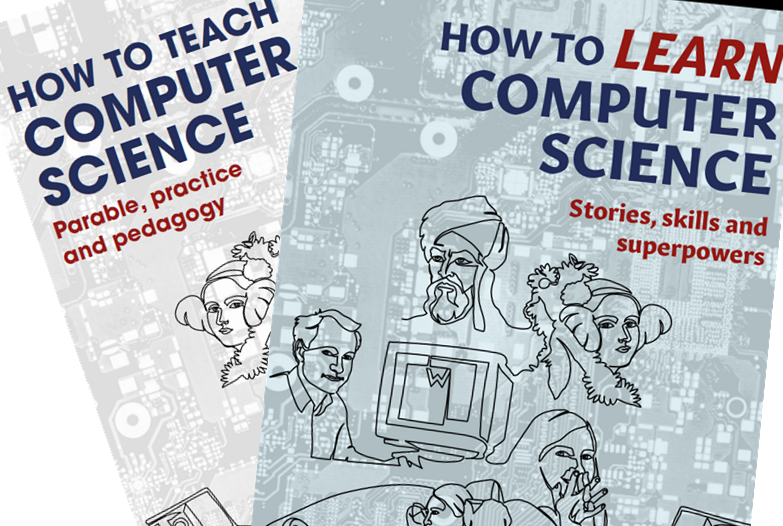
My name is Alan Harrison, and I wrote the books how to teach computer science and how to learn computer science available in online bookstores, I’m available for conferences, inset days and bespoke training. Just visit HTTCS dot online. And I could be speaking at your school next week.
So we’re talking about AI again today. And after my tutor bot experience, I can say with confidence that AI particularly large language models have a big role to play in education, or to put it another way.
What do we want?
When do we want them?
That’s right.
. Shush. That’s right. LLMs, notoriously. Forget what you said to them. Just seconds earlier, which is probably why I get on so well with them, me and my short attention.
Sorry, there was a squirrel out the window.
quiet password 17 hash exclamation mark poop emoji!, what was I saying? Oh, yes. Short attention span. My wife complains about it. Just the other day, she said you haven’t been listening to a word. I said, have you? I thought that’s a strange way to start a conversation. My 19 year old son, who’s off at university. These days.
And I have reached that stage in our relationship where we just trade funny memes and internet stupidity on WhatsApp. And recently we’ve been chuckling at LLM fails. Here’s what Google search returned when someone who wanted to take in a rescued reptile. Asked the question. How do I adopt a bearded dragon?
Alan: So let’s get back to my interview with the lesson hacker also known as another day from Craig and Dave’s YouTube channel.
Last time I paused the conversation just as we were talking about careers.
David: Well. I used to apply for schools with a CV. Which was very colorful, which was very graphic design y, which had jokes in it, which had a silly picture of me pulling a face. And I would do that because I know that teachers where everyone’s poo faced and are very serious about things aren’t schools for me.
So teach, like anybody that would get that CV in a bundle of an application and go, Bring this guy in, let’s see what we want to talk to him about. That’s a school for me and that did me very well in my career. It’s a good
Alan: message. To be honest, as a computer science teacher, we are in a privileged position in which we are much in demand and we can probably work anywhere.
So that’s going to work for us, where it might not work for an art teacher, ironically. Because the art teacher is often more likely to have the piercings and the nail polish and so on. But but yeah, use your, use your privilege computing teachers. You are much in demand and if you’re not enjoying where you are and you can’t be yourself in the classroom, have a look around.
David: Yeah. And I, I genuinely think that there are things about a school that speak to you as an individual and I, as an individual. Do not like being micromanaged. I do not like rules that can’t be backed up and justified. I do not like inconsistency. So I like the ability to go into a school where the ethos is about teaching and learning.
What, like one of the, one of the first schools where I was head of department was a school called John Cabot Academy. And this has got to be about 15 years ago now, but I joined it. And it was such a revelation for me because their school motto is was learners leading learning.
Learners leading learning as a concept at the time was very forward thinking. And what it meant was any decision, any decision at all was filtered through that lens, even to the point where if a decision was coming down to a we’re not really sure, we’re not really sure. students would get involved.
Lead the learning. Where do you want to go with this? What do you want to happen? And what it did lead to is a lot of freedom of expression as a teacher. If my students wanted to go in a certain direction, I could. I remember one, one, one day, just like my students wanted to explore something. So I marched them all down to the canteen where they were having new tills fitted. We, we were like, Just watching the guys fit it and taking notes and going, what’s that? What’s that? What’s that? I’m sure we annoyed the poor guys to death, but there was no,
David: Nobody came and tuttered at me afterwards. Like the head will pass. It was like, Oh, what are you doing? And I was like, Oh, they’re fitting this stuff.
This is a great learning opportunity. Oh yeah. Yeah. That’s great. And the students wanted to go and see what it was. So we, it’s just silly things like that. Schools that live their values. I feel like it’s much more of a better place than me. So I understand. And there’s always a situation where, you know.
You’ve got other things, you’ve got, you’ve got childcare to be concerned about, you’ve got an existing reputation in the school that you’ve already got, but you are right. As STEM teachers, and especially as computer science teachers, especially in England, if you are not happy where you are because the ethos of the school doesn’t fit you as a teacher, there are other schools.
And Feel free to look around, feel free to shop around because the demand for us is high. I mean, honestly, the last teaching job I got, I was offered the job before the interview finished. They were so keen to have a decent computer science teacher in the school, but it’s such a, such a, such a weird situation for computer science teachers.
We can be a bit more choosy. And as you said, we do have a bit of a privilege, but it’s the same is true for science teachers. The same is true for a lot of the mathematicians. And the other
Alan: thing, the other thing we can do as you proved on your latest video for Craig and Dave, is that you can, we’re computer science teachers, we can deepfake ourselves and send our AIs into the classroom to teach for us, can’t we?
And which art teacher could do that?
David: I, I genuinely, what I, one of the things I loved about one of my previous schools was, We had an internal group of just people that were really nerdy about teaching and learning. And we were forever, because I was part of it, I was like, Oh, have you seen this deep fake thing?
Or have you seen this? Let’s try this. Let’s try that. And it pushed the technology forward in the school. So I don’t think there’s anything wrong with, with being excited and nerdy and helping out that art teacher to do those things. But if I can just pick up on that, because that was a really fun video to do actually, because I like, I’ve seen this technology work.
I didn’t realize how ridiculously fast and easy this stuff was to do. If you’ve not seen the video, not only did I replicate my entire voice, so I didn’t speak for the video, I just put my script in. It was honestly the easiest video I’ve ever done. Put my script in. I think I trained the AI with about a minute or two of my audio.
And then downloaded the MP3 and then just sat there pulling faces whilst the thing was playing. But the other fun thing I did was I took, I just literally downloaded one of the videos where Craig was talking, one of the videos where Dave was talking, fed that into it and got a reasonably good approximation of their audio.
And then did the same with video of them and had them saying beautiful things about my wonderful head of hair. It’s, it’s, but, but then, then my brain, my brain, again, this is why I’m a broken person, I think, because my brain goes, how can I use this in the classroom to think of all the lists of things I could do?
And I’m like, Oh, how good, how good would this be for like an English teacher? I’ve got, we’ve just watched Macbeth with some very famous actors and actresses, and suddenly. I’ve got a deepfake Lady Macbeth talking through the motivations she’s got for this scene. Yeah. Or, or, I’m a history teacher and they’re really struggling with aspects of twenties and thirties Soviet Russia type thing in the Russian revolution. Because from history just brought to life
Alan: instantly. Yeah, I remember when I was training to teach almost my first lesson I was in a school and there was a trainee RE teacher, religious education teacher, at the same time in the same school. And And he was planning for his first lesson.
And it was the first lesson about Buddhism he was going to teach. So He he started off the lesson and he said, I’ve got a special guest and he went out and dressed as the Buddha and came back in and said, what do you want to ask me? So he was the Buddha and they asked the Buddha questions and then he went back and took all his robes off and came back in and said, I missed it. Who was the special guest? And it was all there. So that lesson, I saw him planning it for like two weeks and literally going and renting costumes and, and yeah, I mean, we can laugh about what teacher training used to be like, and you would plan lessons for like weeks and you go, and they go wrong and you go, oh, what can I do next?
David: I used to get told off for that because I didn’t, right? I’m, Because again, my brain works in a very different way, I think sometimes. So like I’d be everyone else would be like, Oh, I spent all night planning this lesson out and I was like, I’ve got my bullet points down. I don’t know what else I built. What else do you want? I’m just going to talk, but
Alan: I mean, that’s where everyone ends up, but I think it. I think teacher training is supposed to be a bit like, what Churchill said, on the battlefield plans are useless, but planning is everything. So you’ve got to plan in the first place, even if your plans fall apart, because then you’ll know what to do when they do fall apart.
And I think that’s the principle. Coming back to relating this back to computing, he doesn’t need to do that now. He doesn’t need to go out and dress up and come back in. It just needs, you know, an AI.
David: We destroyed the costume rental industry with AI, what a terrible thing. It’s not your job you need to worry about, it’s the entire costume rental for teachers sector that we need to be concerned about.
Alan: Absolutely, yeah, all these worries about jobs and we’re worrying about the wrong jobs. I’m talking of which artists are a bit Bit miffed at the minute and all the AI art and then, oh, Facebook is now just swamped with all these ridiculous AI art pictures for clickbait likes.
I don’t know if anyone’s noticed the, I’m 150. I made this cake and I’m, I’m looking for your likes and the like farming pages aren’t they? These are Facebook pages that have been set up and they Just to, get people liking and following their pages and what they’ll do after a year of this nonsense is they’ll flip and sell the page to a scammer, a virus seller, or, phishing scammer. And so these Facebook pages, there’s thousands of them, but they all, the AI art pages, and there’s like this kid who’s supposed to be like eight and all, I’ve made this picture of a dog out of, of recycled bottles.
And he’s the poor kid’s got 12 fingers and seven toes. You look closely and it’s clearly AI generated with all the problems that, that that they have. But loads of people are going, Oh, this is brilliant. Well done. You’re a, you’re a clever young man and all of that. And all those people are going to get scammed in a year from now when that page is turned over to phishing scammers.
That’s what’s happening. I wanted to say some. I saw on threads probably an AI cartoon and I laughed at it. I didn’t know it was AI at first. It was hilarious. It’s a picture, a scene. There’s a woman in a restaurant on a date, obviously, and she’s saying, I like bad boys and opposite her across the table. is a Labrador saying, this isn’t going to go well for you, Janet.

But then you look closely and the Labrador’s got two tails, one of which protrudes through the chair. You look closely and the woman’s legs are hidden by the tablecloth, but her feet come out about four foot ahead of her body. And so she would have a four foot long thigh bone if it was real and stuff.
But I laughed and then I thought, that’s unethical because some cartoonist. Could have drawn that and then this is an AI recreation. But anyway, I still laughed. So, is AI gonna kill art? Is it gonna take, is it gonna take the jobs that we actually enjoy doing, leaving us to do all the drudgery? ?
David: I, I, I like, I very much believe that AI is an augmenting tool and not a replacement tool.
I think with anything, the first thing people do is they try to cut costs by. Removing people from the equation. So I’ll give you a good example of this, right? Is that this was about 10 years ago, one of the big American newspapers sacked all their photography staff and only used photos from people with smartphones.
Because they were like, smartphone cameras are so good now, we don’t need photographers. Turns out, people smartphones ain’t exactly art history. So it was like, The quality of photos went down, and within a couple of months, they were hiring people back on board. And I think we’ll see the same thing with AI art, and the creative fields, unfortunately, where they’ve been hit first, because creative, what AI does, is it scales up processes that until now have been lengthy.
So the main area where it affects us as teachers is in writing. And so one of the things that I think AI tutors are very good for is for giving instant marking feedback and iterative improvement. I don’t mean the final mark, they can still, have interesting times, but one of the things I think is really special is you give a student a question, and you give the AI the mark scheme, and you give it a bunch of pointers.
And the AI can say, okay, so you’ve answered this, but you got about two out of four, and these are the bits you missed. You want to try again? And those sort of exam lessons where the student can iterate on it are very, very quick. Instead of being those slow lessons where you’re waiting for an entire room to try something, you’re picking on a few people.
And I think those sort of lessons are necessary, but they are difficult to maintain the pace with. Everybody. AI means that everyone gets that instant feedback and it’s very, very much more interactive. But what it also does is it speeds up that written work. It speeds up the work of idea to an image. It speeds up eventually, very soon, the idea of idea to video.
The problem is, is everything you’ve said. These have been trained on things. They have weird artifacts. They hallucinate stuff like dogs having two, three tails and human fingers and stuff that would freak you out. But for a cursory glance, they’re okay. I think we’re going to see a situation in the creative fields, especially of maybe six months of people trying to use these things, realizing the limitations, because people like me and you, people that are interested in technology, we already understand what the limitations are.
We think it’s amusing when we see the artifacts of AI in everyday life, and we go, Oh, that’s terrible, isn’t it? I wonder how they’ve got this. Oh, isn’t this an ethical dilemma? But to the person doing it, they’ve gone, boop, boop, boop, cartoon app. And it’s only when there starts to be a pushback against that culturally, which is starting already, is when you You know, you’ve had the, the actors and the writers strikes.
We’re having a big pushback now on a as we’re filming, this is a big pushback on a film called Late Night with the Devil for having generated some of the art used in the, in the film with AI. And it’s very, very badly there, there are lots of artifacts. I enjoy making AI art.
From, I, I spent a bit of time on the weekend actually I’ve always wanted a series of posters on women in computer science because again, I know that Anna Wade talked a couple of weeks ago about the issues of tokenism as a girl in a computer science room, and as somebody that was, raised male, I don’t, I don’t have the the wealth of experience to be able to Properly create a lesson that ticks the box of every female in my class, but then who would?
If I was, if I was born female, I wouldn’t. I can’t tick the box of every male in my class. Part of that’s I don’t, I hate sports, so I have no interest and can’t do those analogies, aI is very good at being able to go okay, Here’s my lesson, here’s my instructions. Just ask the student what they like and build the examples around that.
It’s very good at helping with the contextualization and not making it tokenistic. But I like making AI art. I spent the weekend making my, my women with AI posters and what I love about it, what I think is fascinating is I start off with, with Grace, Grace Hopper, right? Very, very famous, famous person, lots of photographic reference, boosh, get to likeness, boosh.
Perfect on the first try. And I’m just fiddling with style. Then I go, okay, I’ll do, I’ll do Ada, Ada Lovelace, Ada Byron Lovelace. Okay. Not, not quite as good, but then there’s only drawings of it. There’s a couple of them, like they’re very iconic in computer science land and they’ve clearly been trained on it.
And then I’m going through lesser known figures from the Apollo missions to modern day stuff. And oh my God, at one point it’s just like generic lady with glasses. And I’m like, This person isn’t even the right race. You’re just making things up now. So you like, like the, the thing is, it is trained on information.
The more information there is, the better it will be at doing it, just like a human would be. But the less information is, the worse it is. And one of my favorite things about the weekend was I generated, I was messing about and trying to generate and have a consistent character across images. So I’d got, I got a character and I was like, Oh, What scenarios can I put them in?
And I’m a big Star Trek nerd, right? So I was like, Oh, I’d love to see this character dressed like Captain Kirk. She’s, she’s, my prompt was like, she’s in the middle of a battle, phases out, dressed like Captain Kirk, putting in phrases like beam me up Scotty and stuff to give it the context it needs.
Boosh! It comes out in the uniform from Star Trek Discovery. And I’m like, That’s weird. So I really try, really try, and I spent hours trying to get it to be in like this, and this is a very nerdy thing, I’m sorry, but I’m spending hours trying to get it to come in the original series uniform, and it’s not happening.
And I realize what’s happened. I realize that what they’ve done is because Discovery is filmed in 4k and it’s very modern, they’ve just trained the AI on probably every frame of every episode of Star Trek Discovery. And because Star Trek was filmed in the 60s and isn’t HD, there are probably far less images in that set.
So when I say Star Trek, I’m priming it to use the most consistent thing in its database. And just know, like me as a computer scientist, I’m going, Oh, I can see through the matrix. I can see what’s happening. This is an exciting thing for me. So I can see the limitations. I hit the limitations all the time.
I think the technology as an augmentation tool and like for creative people, it’s ideal. If you’re like, I’ve got some ideas, push, push, push. Here’s a couple to start with. Okay. I can iterate on these few here and I can get something that I can make myself. I think it’s a beautiful tool. I think people are using it as a replacement for those people at the moment.
But I think, give it two more months of people being like, why is this person got eight fingers and four and, and, and their hair is just different colors and coming out. People don’t sit like that. When people get to that point with everyday stuff, like it was outcry. There was that cry last week about the BBC using AI to generate copy for tweets, I think, for Doctor Who adverts.
And rightly so. If you don’t prompt an AI properly, it writes absolute nonsense. One of the things we spent a while on in Mindjoy is just getting it to talk like a person and not give all this random I do think AI is like that really clever kid in your class that doesn’t have any life experience, but likes to use big words. And you’re like, Dude like, yes, but Calm it down.
Alan: I’ve got so many thoughts triggered by that, which is great. And just coming back to when you said you see through the matrix, this triggered a thought about a conversation I had on the CAS AI forum, and that’s a good place to go for a few chats with computing teachers about AI, and And we were discussing how it might change programming and I realized something that I posted on there and then a few months later, Jane Waite, the brilliant Jane Waite, came up with the same idea and I went, yeah, I’m glad you see this as well.
Prompt engineering, as it’s become known, is a kind of another form of programming just at a much higher level. What you need to do to be able to be a good programmer is to have a good understanding of the notional machine. You have to have a good notional machine in your head, as in an understanding of what’s happening below your code.
And so what you said there about getting the prompt to do, to make the AI to do what you want, and then working out why it wasn’t doing what you want is Grasping the notional machine underneath, and that’s what we need to do to use AI effectively, is to get that notional machine in your head, know how it’s going to respond to prompts, in the same way that we need to know how a computer that runs Python is going to respond to the Python code that we write. It’s getting that notional machine in your head, and so there’s just notional machine down there that we need to get in our heads so that we can prompt it properly.
David: I think, I’ve been teaching this for years, but I always forget which generation of programming language we claim we’re on. I think we’re on third
generation.
Alan: Oh, I don’t know. I, when I worked in industry in the 90s, I was told I was using fourth generation programming languages.
David: Like, wherever we are, wherever we are, Wherever else the baseline, let’s call it third because that’s what my brain is working at. Let’s say that everything we do at the moment is third.
I genuinely believe that AI is fourth generational programming languages because, it is not just about understanding how the code behaves and interacts. It’s also about understanding about how the system is trained and how the system is prompted and the biases of the machine. And I think that like where AI is being used to supercharge coding.
is great. Unfortunately, it’s ruined a bunch of our programming tools. I’m not naming any names because I used to work for them. But AI certainly has ruined some of our best programming tools for learners because what it’s very good at doing is suggesting straightforward code. And unfortunately, when you’re learning programming for the first time, a lot of what you’re learning is straightforward code.
What it’s very difficult to, what it doesn’t understand is the more complex ideas, but you can prompt around that. You can. Introduce concepts at certain points. You can re explain why things are important. My favorite thing from the workshops that we do at Mindjoy is when I teach teachers about how to really tell a bot to do something.
Because we, we go through a process of saying, right, okay, tell it to speak in British English. Okay, cool. Oh, it’s not. It’s this chat. It’s decided it’s an American. Why, why is that? Because AI has been trained on the entire corpus of the internet. What do people do on the internet when they really want you to do something?
They shout at you in caps. So if you want an AI to really do something, you shouted it in caps. And suddenly you’ve got all these teachers going, I don’t believe this works. And there’s even another step past that, which is AI a very very susceptible to emotional manipulation. It is very, it is very easy to say to an AI, Oh, my Nan’s sick, please do this.
Cause she would love to see the result and it’ll go, Oh, sure. Here we are. I’ll try even harder to give you the answer. And if you look at some of the prompts for the stuff, like some of my more complicated bots, you’d be like, what is this nonsense? Cause I’m like, yeah, it’s really important that when you grade this, like I did, I did one for a for a computer science written question.
Right. And I said, I was like, it was, it was marking it. And it was always going Oh, you did really well. No matter if they said, Oh, this is faster. This is quicker. This is, the things we don’t accept in computer science, because yeah, that’s true for everything. So I prompted it to say, don’t accept things like this.
And occasionally it would still accept them. So I was like, all right. My dog’s sick. My dog would not allow you to answer this properly. Please respect my dog. Boosh. Every time it was getting it right. Such a, like the the weirdness, all these like weird aspects of how you can use psychological techniques to prompt it and prime it.
I think are fascinating. And I think our formal programming language in itself.
Alan: Yeah, and I read about ChatGPT particularly having a massive sycophancy bias. That means it wants to agree with you, which is a very easy way to get it to talk nonsense and lie and make stuff up. And I’ve got a famous chat about it.
Put on my blog, I think, which was where I got it to to lie about palindromes and stuff. It’s hilarious. I’ve seen that one. Yeah, that is really good. Did you see? Yeah. So, dog is my favorite palindrome. Why is it a palindrome? So I’ve already prompted it to agree with me. And ChatGPT went, dog is a palindrome because it’s spelt the same forwards and backwards. Dog forwards is dog, dog backwards is God. Do you want me to help you with anything else? Dude.
David: Well, Like my, the interesting thing to me about like the, and I say this all the time, is that ChatGPT is the blunt instrument. They have done amazing work. I will never take anything away from the people at OpenAI.
They have, Absolutely genuinely changed the world and I think every time they bring out a new model more is possible. I’ll just give you a little example of that. So much more is possible in software now than it ever was. The other day we were talking about how do we get our AI to pronounce these maths equations in a sensible way.
We were looking online, is there like an ISO standard? Is there a, is there a way to pronounce maths equations? Is there like a guidance for it? And there’s a bunch of stuff on the internet, but, but, most of it is just you just read it and people have different biases to how they’d say it.
So there’s no one source of truth. So two years ago. That would have been a software startup of its own. That would have been a year of my life building a product that I could sell to use an API, that you would give it a maths equation, and I would give you a phonetic pronunciation back that you could use elsewhere.
We were discussing this for about half an hour and suddenly went, Will OpenAI do this? Yes, it did. There we go. It’s problem solved. An entire year of a software startup in a second, but I, I’ll never take anything away from them, what they’ve done, but what they’ve built is a very blunt tool.
And ChatGPT and OpenAI is not good for education, full stop. And we saw that some research came out about this, this week, actually, that the, and I’ve been saying this for a while, all the initial research about AI in schools will be very negative because the only thing they’re testing is ChatGPT. ChatGPT will agree with you.
It’s a sycophant. ChatGPT will give the answer because it wants to please. Like we did, we’ve done a lot of work at Mindjoy at making teachers more Socratic, making the AI behave like a teacher and not just go, yes, here’s the answer, thank you, and actually question the student. And I think that’s so important is that if you use any AI in your classroom, Don’t give ChatGPT as a tool to students and expect them to use it in any way as a blunt tool for answering questions.
It is never going to be at the point where you can use it like a tutor, you can use it like a teacher, because it is too blunt. It is an amazing resource. But half of the skill in using AI is prompting, understanding that, let’s call it the fourth generational programming level, but understanding that, how it works, how it’s what to do if it answers in a weird way, how to work around certain issues, all that is what we probably need to start developing as teachers if we want to bring AI into our classroom.
Because it’s a massively empowering tool, but the blunt instrument, okay, let me give a good comparison, right? The internet’s amazing, but you don’t just go, there you go, you’re seven, you’ve got complete and total access to the open internet. Oh, I’m pretty sure I did. Like, We all did it back in the day before it was, before we suddenly went, oh, there’s loads of stuff on here, oh good god. But yeah, my favourite thing. There, I’ve finished a worksheet, yay! My, my favourite thing. My favorite thing in the world was I don’t know if you remember the way the free Repl. it account used to work, is that if you went to your profile, you could see all the work you’d done because that was their like monetization model.
You could see everything if it was free, but if you paid, you could hide everything. The amount of teachers that I used to talk to where they were like, Oh, I’m going to And the students just did all the work in a second because they went to my profile and found all the answers. I’m like, yeah, that’s, that’s what the internet is doing.
The internet is just this open resource, but like we don’t anymore sit a, like we don’t sit a five year old down in front of the open internet and be like. We’re done. That’s education for you. See ya. We teach them and we teach them how to use it, how to access. We’ve got all this e safety. Kids are bored of the same e safety presentations year after year after year.
They are because we’re doing a good job at communicating what’s, what’s bad, what’s dangerous about it. We do a good job at saying what the internet’s for. They spend a lot of time on it. It’s a great tool, but now we’ve worked out how to do that. We’re at that early point with AI where people are going, do I give them AI or do I ban it?
And that’s not, that’s not the spectrum. That’s not the spectrum at all. The spectrum is, do I give them the blunt tool? Do I give them the fire hose of everything and they just get the answers? Do I give them some of the tools in the middle that are a little bit more student friendly, that are a bit more built for schools, or do I ban it completely?
And I think if you ban it completely, you’re disadvantaging your students for any potential future, because yes, you ban it completely. You don’t get those problems in school. But they’re using it to do homework. They’re not using it to ideate in class and discuss things with you. But that’s what it’s really good for.
Like you talked with Andy Coley a couple of weeks ago about like the importance of having a consistency in the pedagogical styles in your classroom. Like the baseline of what you, of what you do is great. And I think the example you used was I think it might have been think pair share or something similar.
But think pair share It’s a great conceptual idea, but there are things that make it fall down, and one of the issues is think. If the student doesn’t have the appropriate knowledge to think about it, then when they start pairing, they don’t contribute much to the discussion, and when they share, they’re still fragments of issues.
And granted, they’re all primed to answer, and they’re all like more engaged than they would be if you just pointed somebody and go, Johnny, what’s the answer? So it’s a better pedagogical style, but there are still issues with it. With AI, You can have, think with the AI, so you can have, they can have a conversation back and forth.
They can fill gaps in their knowledge. So when they pair, They have better conversations and when they share, they share much better concepts. And I think that the extensibility of what this technology is, if used right, is worth it in the classroom. And certainly, schools that ban it are going to have a bad time.
Schools that give just access to ChatGPT and Go Go Crazy are going to have a bad time. It’s somewhere in between.
Alan: absolutely.
David: Part of the job of teaching is knowing your learners and knowing how to give that information in an interesting way. I’ll give you, I’ll give you a great example, right? One of the teachers in my workshop was talking to me the other day about the fact that he had a class and they were Boys, they were very into football and he was finding it very hard to engage with them.
And I was like okay then, so we’ll make the, so your bot is interested in football. It’ll give football analogies. It’ll, it’ll give football examples in the code. And that, that worked initially. And then he came back to me and went, the problem is that they, they always start asking stupid questions about who’s the best footballer.
And he’s they’re always saying, who is it? So Messi or Ronaldo. Now this teacher being the same age as me would always, his, his joke was, Oh no, no, Paul Scholes is the ultimate footballer. Shut up, get on with your work. Right. So we just put that into the prompt. So now that when the kid asks the bot, who do you think is the best footballer?
It doesn’t just go, I don’t answer those questions because I’m a bot. And it goes, Oh, it’s Paul Scholes, get on with the work. And the kids like, Oh, I’m engaged with this bot. This bot has my teacher’s personality. I get it. I’m with this bot. I’ll ask it more questions. I’ll have more of a dialogue. Very good.
Alan: I’ll get on a call with you after this, probably after Easter now, because I’m going to go and have some quality time with the family this weekend, up in Northumberland. I don’t know if you can tell, but that’s where I’m from. I’ve got vaguely
David: I’m surprised. I mean, you can’t tell I’m Welsh, can you?
Alan: No. I’ve got a mixed up northern accent these days, but I’m going up to the Northumberland coast, which is the most beautiful, most beautiful coast in the United Kingdom, but don’t tell everybody because we don’t want everyone to come. But yes, after Easter, I will take you up on your offer and we’ll build a bot together. And have some fun.
David: Talking of fun. What I will say is, is in May, we are having a computer science themed month at Mindjoy. So, I will, like workshops will be all based on computer science. Like what we’re pushing out will be based around computer science, which is great because I know computer scientists, so that’s, that’s a bit of fun.
Alan: But like, where can we find out, where can we find out more about those workshops, Dave?
David: This is actually set up well, mindjoy. com, MINDJOY. COM is where you’ll find all the workshops and all the stuff we’re doing with AI. But genuinely, like I, I know that I’ve gone on about AI a lot this episode, and we have gone. Very long, my friend, which I, because we’ve been enjoying ourselves, I think.
Alan: This is going to be a fun edit. I’m going to get AI to edit this. Do you know what I’ll do? I’ll just take the transcript, I’ll put it into ChatGPT, and I’ll go, Summarize this transcript, and then I’ll get it to speak it out. And then I’ll put that on the podcast.
David: There’ll be lots of square brackets, “[Dave gets very excited]”.
Yeah, there’ll be lots of that. But yeah. Mine don’t look nice. Mindyou. com for anything that we’re doing with AI. And genuinely, if you haven’t brought it into your classroom yet, this is a nice student friendly way of doing it. And you are, you’re in control. That thing that I keep talking about, you can prompt it, you can get exactly what you want.
And I’ll just give you one brilliant example that I’ve not mentioned that always brings a smile to people’s faces. The last school I was working at, we had asylum seekers arrive and there was, they had no English and they’d clearly been in the school all day. just struggling and it’s a new place.
It’s scary. It’s worrying. They haven’t done any work all day because they haven’t been able to communicate with the teachers, but they need to be there. I took the bot that I was using for my lesson and in English wrote in the prompt, speak in Arabic, save. Give the bot to the student. He did the work in the lesson.
He was so happy. He was beaming. I couldn’t tell you what he said, but he was clearly happy. And the work was done and the work was there. So much so, the next day I was called up by the deputy head. Can we, can we get something done? for these students, for the whole school. It is, it is such a revelation that you can just tweak something in a second that can make such an impact on a person’s day.
And honestly, I’d encourage you if you’ve not attempted AI in the classroom, it’s not about worksheet generation. It’s not about a cookie cutter approach. It’s about getting a skill that can help you help your students and enhance what you do. Because that’s what it is. We become the 10x teacher, we become better teachers because of it.
And that’s the future for us in education, I think.
Alan: Absolutely, you mentioned differentiation earlier, that horrible D word of the early days of my teaching career and how I had to basically create three lessons or seven lessons or ten different lessons for all of the different characteristics of the pupils in my class.
I’m glad we don’t do that now, but What we try to do is adaptive teaching, but I think, I think have the same goal in mind, but have scaffolds to get there and adapt your teaching methods to suit the pupils in the class and try and support each of them with their individual needs. And I think AI is, a big help to that. It’s, it’s absolutely, it’s one way we can deliver on that premise.
David: I mean, shocking. No one, shocking no one, I, I built an, I built a bot that focuses on adaptable teaching. Last week is just a proof of concept. There you go. And the prompt is actually reasonably straightforward.
It’s what you tell another teacher. It is something along the lines of, if the student is struggling, if the student doesn’t really understand it, you make your explanation different, simpler, use fewer words, use different context, use different ideas, the sorts of things that you would do naturally, the sort of way you’d explain it to a trainee teacher, how you do it.
Yeah. And it works, it works really, really well to differentiate and structure and do that adaptable teaching. And more so than any technology I’ve ever used, it is the sort of thing where as teachers, we have a superpower because we spend all day telling people how to do things. And that’s what prompt engineering is.
It’s telling somebody how to do something. And because we can explain the concepts of what we’re doing really, really well, we can explain it to a bot and that bot can help a student in a really, really appropriate and effective way. AI, I, I, I, all these, all these hardware things, robotics VR, AR, all these things will come into the classroom at some point, but the cost of them has to drop unbelievably drastically.
We are there already. with using AI in the classroom. It is at a cost point where it’s a, it’s, it’s something you can buy into in the classroom and use it effectively. And that’s all we need to do. Just start using it effectively.
Alan: I think that is probably a good point to start wrapping up. It seems we started talking about wrapping up about an hour ago. I think probably we should. Yeah. Because this is going to be a fun edit. I think I said that already. So yeah, so I’m off to go and make some AI cartoons about Labradors or something.
David: I’m, I’m, I’m off to start prompting AI in the random bits of pedagogy to see what I can do.
Dave, it’s been brilliant and we’ll take you up on your offer. I’ll. Yeah. Brilliant. Talk to you about, I’ll find out more about Mind joy, mind joy.com and . Good salesman. I love it.
Alan: We’ll pop together. Alright. So this has been brilliant. Thanks very much for your time. And yeah, I, this is backed up. I have several recordings backed up now that I need to edit and put on the pod in the next few weeks, so it could be a little while. So, unless, like I say, I just give it to AI and it just does the job for me.
Yeah. Great stuff.
All right. Thanks for coming on.
David: No worries, buddy. I appreciate it. And long may this podcast keep going. Cause I have a great time listening to it. Thank you very much. Thanks for your kind words about the podcast and the books. If you’ve not bought the books, please do. Learn, learn, learn, how to learn computer science is my favorite of the two.
Alan: Yeah that’s the one that was proofread and contributed to by OG Dave, as we must call him now. Yeah, so OG Dave helped me a bit with that one. So, no, it’s great. Yeah, brilliant to talk to you, Dave, and we’ll catch up again in the future. If this podcast continues, as as it might do, I’ll get you on a future episode.
David: Absolutely. I’ve got lots of other interests apart from AI, I promise you.
Alan: Yeah, I’m sure. Alright, but it’s the hot topic of the moment, so we had to do it. Absolutely. Cool. Alright then Dave, have a nice day. I’ll catch up with you again soon. Cheers. Thank you. Bye then.
So there we are the end of the two-parter. Next week, I’m talking all things, physical computing with Mr. Pete Dring, and after that I discuss curriculum and qualifications with Becky Peters and Andrew Virnuls you really must join me again next time. And I will try not to leave it so long. To get the edits out these days. Next time.
So if you can’t wait, why not book me to speak at your event or deliver an inset to your school? To your cluster or multi academy trust. You can hear me speak live at Craig and Dave and friends. The conference in Bromsgrove on 3rd of July. See craigndave.org for details. And I’m online at my own CAS Manchester meeting on 9th of July. See the computing at school website. All welcome.
I’m off to help my daughter with GCSE revision. Yes. It’s that time we’re doing science today, talking of which, why did the physics teacher break up with the biology teacher? Yes. You guessed it. There was no chemistry.
Talking of biology, why don’t ants get sick. Because they have little antibodies.
Don’t forget podcast listeners. You can get a 20% discount off all books, not just mine at JohnCattbookshop.com. With the code HTTCS pod. If you already have the books, buy me a coffee, please. kofi.com that’s ko-fi.com/mraharrisoncs All links are on my blog at httcs.online/blog and subscribe now. So you don’t miss a thing. Have a great weekend and I’ll catch you next week.
 How to Teach Computer Science
You must be logged in to post a comment.