This is a blog I wrote for the NCCE where I work as the Secondary Computing Leadership Specialist PDL. It will appear on the NCCE blog here shortly.
If they remember nothing else, I’m sure my former pupils will recall my rallying cry for the Computer Science GCSE when their options choices came around: “we need good computer scientists like you on the side of the humans when the robot apocalypse comes!” I would declare, only half-joking. It worked, too, in my five years as HoD at an inner-city school I saw option numbers climb to record levels. I even achieved a 30% female cohort, through a range of efforts from ensuring representation in displays and resources, making the learning relevant, and a relentless “whisper campaign” of praise and encouragement: countering girls’ tendency to underestimate their ability and feel they don’t “belong” in computer science (see here). (Thrillingly, all the girls in that cohort achieved GCSE grade 6 or above, so the moral is: if you want good results, encourage more girls!) I also picked up a confused and disjointed curriculum, and set about re-engineering it, replacing my schemes of work, over a couple of years, with the Teach Computing Curriculum (TCC). I was able to trust the research-informed progression framework that underpins the TCC and cite this in my curriculum documentation – the ubiquitous Intent, Implementation and Impact docs we all wrote for the new Ofsted regime!
Today the TCC contains nearly 300 lessons in over 40 units for KS3 and 4, so there really is a TCC unit for every need, and there are now “Secondary question banks” for assessment, available as Google Forms and Microsoft Forms which you can just duplicate and use as your own, editing as necessary. I’m a big fan of good quality Multiple Choice Quizzes (MCQs), as they can take a lot of strain out of retrieval practice, and formative and summative assessment. Combined with some longer – but less frequent – written assessment you can get a good handle on progress without too much traditional marking. There are thousands more questions available for free at diagnosticquestions.com/quantum, and I’m also a seasoned user of SmartRevise from Craig’n’Dave, which offers longer-form exam-style questions with self- and AI-marking features.
Teaching A-level, I found Isaac Computer Science came in really handy. What I needed was a “MOOC” or online source of accurate, exam-board-specific content I could just point the students at for self-study and revision. Now expanded to cover GCSE content, IsaacComputerScience.org does just that. It also contains many hundreds of practice questions which can be organised into “gameboards”. I would create a gameboard every week on the topic we were studying, and use the results to re-teach the bits on which they performed worst. I’ve no doubt this cycle of self-marking quizzes and re-teaching (along with other deliberate practice techniques, I’m a big fan of Adam Boxer’s concept of “ratio”) helped me to record GCSE and A-level results in recent years. For A-level students, Isaac comes with regular “student booster” events aligned to the content, while Isaac Teacher events have now been merged into the regular Teach Computing course catalogue here.
I completed the Computer Science Accelerator (now called the Subject Knowledge Certificate) a few years back, then the Teach Secondary Computing certificate, and I strongly recommend doing both of these if you are a subject leader, courses are free and subsidised for all state schools and really affordable for private institutions, find out more here. So impressed was I with the NCCE courses, I completed Professional Development Leader training and joined a computing hub as a PDL, and here I am today as your national specialist in Secondary Leadership! The hubs are amazing, I recommend you get in touch with a local hub and find out what they can do for you, including advice, needs analysis, bespoke support and the loan of equipment.
I’ve spoken a lot about pedagogy, it fascinates me, and I really enjoyed the Big Book of Computing Pedagogy, and the follow-up Big Book of Computing Content published by the Raspberry Pi foundation, and these are must-reads for Computing subject leads. Maybe you could organise some CPD for your team around one of the articles? If you’re pressed for time, there are Pedagogy Quick Reads on the NCCE website here, which all helped me switch to PRIMM programming and improve my explanations with Semantic Waves with excellent results.
Finally, all of the above topics will be on the agenda The Big Computing Leadership Conference, on December 14th 2023 at Oxford Brookes University. Myself and Primary Computing Leadership Specialist, Phil Wickins, are joined by a star-studded cast of speakers and exhibitors. It’s your one-stop shop for all things a computing leader might need. You will also get trained in the Computing Quality Framework for free on the day, enabling you to go back and take immediate action to develop your department.
For more information about the specialist hub and how to get in touch see our website here, while the agenda for the Big Conference and how to book are here. See you on 14th December, but only if you want to be on the side of humans in the coming robot apocalypse!
You’ve probably heard this week that the CEO of X, formerly known as Twitter, has said he will charge all X users “a small monthly payment”, he claims is needed to combat “vast armies of bots”. This business-model-killing ploy may never come to pass, remember “block is going to be deleted as a feature“? But this latest desperate attempt to shore up a failing company (Musk himself has admitted Twitter has lost around 50% of its ad revenue since he took over, which itself was over 90% of the company’s revenue), might just be the nail in its coffin. Here’s why I hope it is. And even if it’s not, here’s why you should leave and build your following somewhere else (possibly Meta’s Threads?) for your own safety and wellbeing, and before X collapses completely.
The issues
Through our presence on the platform, we are supporting the company and thus tacitly, the values it represents, and those of its owner. Musk has repeatedly shown himself to be an alt-right Trump and Putin supporter, even attending the World Cup Final with Trump’s son-in-law Jared Kushner and the Superbowl with the right-wing media-owning Murdoch family. Musk has allowed literal Nazis back onto Twitter including Andrew Anglin, editor of white-supremacist website The Daily Stormer. Anglin had been banned from Twitter back in 2017 after calling for death to “enemies of the white race” at the rally where an anti-Nazi protestor was murdered by a self-confessed neo-Nazi. Meanwhile, Musk was quick to ban five left-wing journalists including respected Washington Post reporter Drew Harwell, for daring to draw attention to his frequent private jet travels.
Earlier this month, Musk boosted the hashtag #BanTheADL, a campaign against the internationally respected charity fighting antisemitism, the Anti-Defamation League. In a series of tweets such as this one, Musk amplified attacks on not just the ADL but on the American Civil Liberties Union (ACLU) and the Southern Poverty Law Center (SPLC), organisations that exist to fight discrimination and inequality. He has threatened a defamation lawsuit against the ADL and bizarrely blamed them for X’s fall in advertising revenue. Recently Musk has given a platform to America’s chief insurrection supporter and election-denier, alt-right darling Tucker Carlson, after Carlson was fired by Fox for lying about the 2020 election (and being chosen as the fall guy). Carlson and others’ constant lying about the 2020 result contributed to the January 6th 2021 violent attack on the Capitol which resulted in seven deaths, and Carlson continues to lie, in his X-hosted content, about the terrible events of January 6th.
Musk has also gone after the LGBTQ+ community, posting without evidence that the horrific hammer attack on the husband of then-House speaker Nancy Pelosi might have been a “gay lovers’ quarrel”, and in this single tweet both mocked trans people and boosted anti-scientific medical disinformation:
He has spoken repeatedly about the “woke mind virus“, a common trope in the alt-right community that suggests that “being woke” is a socially contagious disease, rather than just, as Kathy Burke suggested, “not being racist, not being homophobic and just calling out bad things”.
In April 2023 Twitter removed a section of T&Cs that specifically protected trans people from “targeted misgendering or deadnaming”, leaving it as the only major platform without specific transphobic abuse protections. And Musk’s release of former Twitter safety chief Yoel Roth’s internal communications, in a document dump Musk named “The Twitter Files”, followed up with deliberate targeted misinformation, has caused Roth to take his family into hiding with police protection, after a barrage of death threats and accusations of “grooming” from homophobic and antisemitic followers of Musk.
Roth was sacked along with almost the entire safety team. Musk has in total fired around 80% of Twitter’s workforce, most of them just before Christmas 2022. The layoffs disproportionately impacted women, Black employees, and employees aged 50 and older. Hard working people with families to feed were given little notice and the legal minimum severance pay (and some not even that). Musk also ordered people working at home to return to the office, a move which discriminates against disabled employees and those with caring responsibilities, not to mention adding an environmental cost. Indeed, Musk tweeted baseless criticism of one particular disabled employee with muscular dystrophy in a tweet exchange that makes for painful reading.
And let’s not forget the rise in misogynistic content, with Musk welcoming back to the platform misogynists-in-chief Donald Trump and Andrew Tate. Musk recently joined Tate and the roster of right-wing outlet GB News in rallying to the defence of Russell Brand who stands accused of multiple counts of rape and sexual assault, although Brand denies the allegations. Violent rhetoric against women has escalated since Musk took over Twitter, with misogynistic accounts rising 69%.
All social media platforms have a duty of care to their users. We must feel reasonably safe interacting on the platform, including from scams, inappropriate content, threats of violence and hate speech. Twitter has sacked almost everyone responsible for this service, causing a rise in all problematic content. And Musk’s decision to change “blue tick” verification to a paid service available to everyone has removed a key safety feature: the ability to detect impersonation, and this change has caused a spike in phishing scams on the platform.
Some changes appear deliberate, perhaps to increase engagement at the cost of safety, and some accidental amid rapidly changing priorities. December 2022 saw the removal of the safety feature known as #ThereIsHelp, which promotes suicide prevention hotlines. We saw above how the T&Cs now no longer protect trans people, and we know about the blue tick fiasco. But a recent BBC investigation goes further and depicts a company “on fire” and “no longer able to protect users from trolling, state-co-ordinated disinformation and child sexual exploitation.”
Academics are leaving the platform, unable to talk meaningfully about the climate crisis, politics, race or gender without inviting a litany of abuse. And recent changes to the privacy policy might actually make you unsafe in the real world, as the company plans to collect “biometric and employment data”, yet is known to release sensitive personal data to authoritarian regimes.
This blog cannot begin to capture the many, many problematic actions taken by the X CEO before and after his purchase of Twitter, but Vanity Fair made an attempt to document Musk’s problematic behaviour back in April 2022. Musk is possibly the worst person to trust with our personal details, online safety and everyday thoughts, and his chaotic “management” of the social media platform makes us all unsafe every day.
The implications
When I use social media (SM) in a personal capacity, that’s my own decision and barely affects anyone else. However we sometimes operate SM accounts on behalf of organisations, and as such we are aligning that organisation, to some extent, with the values of the SM platform. We are driving traffic to the platform, and hence doing two things:
Adding value to the platform: as users we are the product and our views are being re-sold to advertisers and thus we make money for the company to spend on further problematic activity.
Driving users to the platform: a platform where we know they are now unsafe, in the absence of a working safety team and the presence of a vast army of white supremacists, transphobes and misogynists, which is unethical.
I don’t want any part in supporting this man’s alt-right agenda, and I don’t wish to be responsible for exposing users to the risk of hateful abuse. So for that reason, X, I’m out.
I’m on Threads, Mastodon and LinkedIn, but mostly active on Threads. I’m well aware that all platforms have their ethical questions, and Threads being a Meta (formerly Facebook) product might raise an eyebrow. I get that, but at least Meta has a working moderation team and is not openly aligning itself to enemy tyrants, attacking people with protected characteristics and deliberately amplifying hate. I hope you will join me on Threads, it’s nice over there. See you soon.
UPDATE: my talk was warmly received, thanks to everyone who came to my stand later to talk to me, it was a fantastic day.
The content (actually a 12-inch remix version of my talk*) can now be found below. Also in the attached is a discount code for 30% off my books this summer at John Catt bookshop – read the embedded PDF below to find it!
*for the younger generation, a 12-inch vinyl single was an extended recording of the track, often up to 3 times longer than the 7-inch single.
I am delighted to be speaking and exhibiting at the LGfL “Let’s Celebrate II” conference in London on Friday 30th June 2023. I’ll be giving a talk on Powerful Knowledge in Computing, and I’ll also have a stand in the exhibition area where you can buy my books and lovely new merchandise:
For more information about the conference and how to book, click the LGFL banner image below:
I’ll be speaking on the topic below. Hope to see you there!
A Knowledge-Rich Computing Curriculum (that also pleases Ofsted!) – Alan Harrison alan@httcs.online
What is powerful knowledge in Computing? What are declarative and procedural knowledge anyway? How do I squeeze computing into my packed Primary curriculum? What must I deliver at KS4 for those that don’t take Computer Science GCSE? Alan wrote the book “How to Teach Computer Science” and is passionate about powerful knowledge in the important academic discipline of computing. Alan also served on the working group that created the Ofsted Research Review and has interviewed successful Deep Dive recipients. Attend this talk to be enthused by powerful Computing knowledge and also get some actionable tips to be relaxed about OFSTED’s next visit.
The furore about this year’s OCR GCSE Computer Science Paper 2 (J277/02) brings into stark relief the gulf between where we are as a subject, and where we need to be, in terms of capability. It’s a time for reflection, not for panic. The responsibility for thoughtful reflection falls on the computing subject leaders.
Subject Leaders (SLs) are the engine-room of the school. Sometimes called curriculum leaders or heads of department, as such these engine-rooms should be given largely unlimited fuel (training, resources and support) and clear guidance (achievable goals and strategic direction) to ensure their success. Often this is lacking, and computing SLs regularly report feeling under-supported: that their subject is poorly understood and under-resourced. Exam results should drive a discussion between the SL and strategic/senior leadership team (SLT) and it’s right that this should ask non-threatening questions of the SL about their department’s capability: do they have the resources, training and support to achieve the best outcomes possible for their students?
Unfortunately, these conversations are not always positive, causing SLs to fear for their careers instead of being able to work together with SLT on the advancement of their subject outcomes. This has never been so clear as in the panic over Thursday’s paper. I hope in this blog to bring some clarity to the situation. I have left out names, and avoided criticising individuals. But to be clear before we start, I think some teachers have gone too far in their response to what was a tough but fair paper, and I give alternative views and a series of actionable recommendations below.
The harsh reality is that the complaints about the paper that inundated Facebook from Thursday evening onwards say more about our ability as a teaching body to prepare our learners for a robust assessment, than they do about the quality or fairness of the exam itself. My unpopular opinion is that the exam was tough but largely fair. Nothing was assessed that wasn’t in the specification, and it seems many teachers have been over-reliant on the practice paper and past papers on OCR’s website and secure “Interchange” area, perhaps leaning on these to guide their curriculum rather too much, instead of trying to cover the whole specification. [Edit: this paragraph previously used the phrase “been caught out teaching to the test” and I have removed and rewritten to be clearer and sound less judgemental].
An over-reliance on questions from the previous specification (J276) would not have helped. That specification was designed to run with a practical programming project worth 20% therefore paper 2 looked somewhat different, without the in-depth scenario-based “Section B”. Each programming question on J276 was fairly short and self-contained, so didn’t demand a great deal of computational thinking. Add to this the COVID-adjustments to boundaries last year, against the first run of J277, and some schools may have gained false confidence in their performance.
Let’s look at some of the specific complaints from the social feeds, and I’ll try to refute them with evidence from the exam board as necessary. I’ve taken comments from the J277 and older OCR Comp Sci group (which I call the J276 group below).
What was said on the socials…
I can’t agree with these comments:
“Bring back teacher assessed grades” and “I strongly believe teacher assessed grades should be implemented after this tragedy” – please, just no. Read this.
“I’m going to email my kids tomorrow to let them know we all feel the same about the paper” and “Please encourage pupils and their parents to write/complain to OCR and other bodies such as OFQUAL etc. Do everything you can!” Please don’t. This will increase anxiety and be counter-productive, and possibly bring your school or the exam board into disrepute, so I’d advise against this.
“People creating these papers need to show their face and take responsibility. The paper today seriously undermines teachers across the nation of this difficult subject, and can’t imagine what pupils are going through right now. If we don’t make noise, students in the future will continue experience days like this.” OCR have a feedback form, an appeals process and a helpful subject advisor, I strongly urge you to use the appropriate channels and take guidance from your exams officer or SLT before taking any other action.
“most of us are 1 person subjects and the consequences from this are we have to explain ourselves to SLT and it makes us question our own ability. Almost feels like they want this subject to fail.” The correct response from SLT to any 1-person departments struggling to get good results in this subject would be to support you with CPD or recruitment. I’m aware this is difficult in the current climate, but all subject leaders have a responsibility to communicate upwards effectively about their department’s strengths and weaknesses. It goes with the territory, although I’ve been there and I know how hard it is. I give lots of actionable advice below.
“loopy loop question driving me loopy let alone my poor EAL students!” – I thought the wording of 3b was about as clear as it could be, while still asking an important question that reveals whether the candidate understands the two types of loops in the context of a sorting algorithm. I talk more about this below. As for EAL, some students are allowed translation dictionaries under specific rules, but it is an English exam board GCSE.
“It certainly wasn’t written by a teacher, as good teachers know how to relay computing concepts to students with a range of abilities.” – I think there were a lot of AO1 marks in Section A that are “easy” if the content has been taught well, retrieved often and revised well. Differences between HLL/LLL, arithmetic operators, define syntax and logic errors, spot the truth tables, describe features of an IDE to name a few. There is enough there to be accessible by those with mock/predicted grades of 1,2,3,4.
The accessibility of the paper is questioned several times on the Facebook groups. I think it’s worth exploring this some more in the context of the 3b insertion sort question. I put the question into Word and it came out as “Grade 6.7” so roughly UK Year 8 reading level. I think any attempts to dumb down this question would fail, because ironically the first sentence is an important preamble, conveying content rather than asking a question. The extra words are intended to help, not hinder understanding.
The answer “because the inner loop moves the unsorted number leftwards in the array and only stops when the number to its left is smaller than it, which is a condition not a count.” could only be gleaned from this question worded as it is, or similarly to it.
Advertisements
Amusingly I posted the question into ChatGPT followed by the prompt “Please help me reword this exam question to be easier to understand” and the result was as follows:
Why is it necessary for the inner loop in an insertion sort algorithm to be condition-controlled rather than count-controlled?
Note that we’ve lost the preamble, so this version could well be harder for some to answer than the original! We’ve lost the word “loop” after both “condition-controlled” and “count-controlled”, but does this make it easier or harder to understand? Ironically, Word now rates this “Grade 12.9” or Year 13/14 reading level due to the average word-length and sentence-length increase. I think we do examiners a disservice when we jump to conclusions about readability: question writing is not an intuitive skill.
The Logic Gate question was not as heavily scaffolded as last year’s question. But it was fair. Students need to understand that a boolean value often represents a fact about the world, such as whether it is day or night. It is reasonable to expect them to work out the logic circuit for an alarm system. I always teach logic circuits with real-world examples, because it says in the specification, “Understanding of how to create, complete or edit logic diagrams and truth tables for given scenarios”, and there was even a scenario question on Practice Set 2 Paper 2: “A cinema uses the following criteria to decide if a customer is allowed to see a film that has a 15 rating…”
Indeed, one of the most popular commercial resource bundles for our subject, that from Paul Long includes an exercise that is almost identical to last Thursday’s exam question, and the helpful advice “You could be presented with a real-world scenario and asked to create a logic circuit for that scenario”:
Valid criticisms
I do consider these valid complaints about the paper:
Page 13 uses “alarm has been activated” when it should say “system has been armed” to match the variable name above “SystemArmed”, and to better describe the condition of being armed. Activation should only refer to the triggering of a sensor, otherwise the candidates will be confused. So the sentence below the bulleted variable list should begin “The alarm will only sound when the system has been armed…”
There is an error in the identifier of the array on page 17, this should have said arrayEvents[1, 1] not events[1, 1]
Printing the array on a right-hand page, with the algorithm writing space on its reverse caused unnecessary back-and-forth. Papers are usually designed to avoid this but not in this case.
The complaints about “Do Until” in question 1d are misguided. Both switch/case and do-until are in the specification, and switch/case was even on the 2022 paper. The Examiners’ Report (available on Interchange since last September) says this: “Candidates appeared to struggle with this question. In particular the use of switch/case was not well understood. This may be because some high-level languages such as Python have not traditionally supported this.” It’s important to teach the whole specification, and remember this is not a Python exam.
Practical programming with Python, C#, Javascript or whatever language(s) you choose is vitally important, but you must cover all of the concepts in the spec. As the examiners’ report says, Python 3.10 supports switch/case with the new match and case keywords explained here, and you can Fork my REPL here replit.com/@mraharrison/match-case. If you are still using IDLE, Thonny or another local install, you’ll need to get this upgraded to Python 3.10 to use it, or you could jump online to the excellent replit.com instead. For do-until you could show them the Do Until Loop statements in Visual Basic Macros inside Excel like this, or maybe the JavaScript do-while construct, which you can try out here.
So the subject leaders need to know the specification inside out, read the examiners comments, attend OCR training and generally be experts in what the qualification is testing. As well as this, all teachers of the subject must have clear guidance on what to teach, be supported with quality materials, and most importantly, be provided with quality CPD so they can improve their subject knowledge. I’ve written before about the need for computing teachers to upskill themselves, so they can teach the subject better. In my June 2021 blog post, I said this:
Once you know it yourself, and feel confident you know it, you can explain the material in ways others understand. Rather than asking for slides and worksheets, I recommend teaching yourself the content. Then study others explaining it well.
Don’t add fuel to the fire. You have a duty of care to remain calm, supportive and professional. Help your students by not exaggerating the issue and don’t encourage them to complain.
Don’t assume we are all of the same opinion. As a subject body, opinions are at best divided on the quality and fairness of J277/02 2023. We are not universally outraged, perhaps step out of the “Facebook filter bubble” and see other opinions. I have made the case above that it is hard but fair, and many others share my opinion.
Thoughtfully consider how you feel about both papers (and remember there was no great panic over paper 1) and give your feedback to OCR via the feedback form.
Discuss with your exams officer what happened, and get a meeting with your SLT link this summer to start conversations about closing any gaps in you delivery, what help do you need?
Request copies of completed scripts in August, with permission from the students, of the top, middle and bottom of your cohort. Read these alongside the examiners report, that comes out in early September. Use this to identify gaps in your delivery that may need closing with CPD, resources or curriculum changes.
Use the NCCE and CAS and the free resources available online to upskill yourself and other teachers in the department. For example “switch/case” and “do/until” are explained in this Craig’n’Dave video. Book you and your department onto some subject-specific CPD, and buy books you can use to upskill (and yes I wrote one that is well-regarded, see the home page).
Think broader than KS4, are results this year likely to be poor because of insufficient curriculum time at KS3, or non-specialist provision? Write those things on your subject improvement plan. We cannot be expected to deliver strong results with one hand tied behind our backs.
Complete the Computing Quality Framework questionnaire which identifies the needs of your department. Use this to justify to SLT any support or changes you need: computingqualityframework.org
Read the Ofsted Research Review of computing identify any gaps, and put these on your plan as well. Be honest and professional. (Oh and remember as computing teachers we are like hen’s teeth right now, if your current SLT don’t support you, you have options!
To SLT
Computer Science is an EBacc subject and highly prized by employers and colleges. Ofsted’s recent report (above) makes it clear that they are expecting you to offer the GCSE (and also deliver alternative computing teaching at KS4 for those that don’t take it), and also that a minimum of 1 hour per week at KS3 delivered by a specialist is expected. Please resource your computing department accordingly and be guided by the subject leader in what they need to succeed.
To students
To students reading this: remember you sat two papers, this was a tough paper but your scores will be aggregated, then standardised and grade boundaries will be set that reflect the difficulty of the papers. You have likely done better than you think. Put it behind you and do the best you can when exams resume on Monday. You’ve got this.
If you are grateful for my blog, please buy my books here or buy me a coffee at ko-fi.com/mraharrisoncs, thanks!
There are two words I hate to hear in the classroom. So much that I banned them. I banned the phrase, “I’m finished”. Here’s the proof, a poster in my most recent classroom:
Why did I ban “I’m finished?” Surely you want pupils to finish their work in lesson time, and if they finish early, what’s the harm if they find something less stressful to do? Like going online to play Chess with their mates, as one Tweeter told us her pupils do (or did, until the IT technicians blocked Chess.com, forcing them to “go on YouTube” apparently.)
Allowing “free time” at the end of a lesson encourages poor performance. Many pupils will rush the work to get it “done” in plenty of time to play games or watch videos. In my early career I often responded positively to the plea “Sir, if we get finished early can we go on coolmathgames ?” But I learned that dangling that carrot of “free time” just ensured poor concentration: a tendency to fill boxes on worksheets with the bare minimum, and importantly, ensured a poor ratio (proportion of pupil-minutes thinking hard about the topic, instead of other things).
Worse, though, than the direct effect of encouraging a poor work ethic, is the meta-message sent by the “rewarding” of completion with something “more fun”. This communicates to the pupils that the learning is not valuable, that it cannot be enjoyable in and of itself, and getting “finished” is more important than doing the work well: giving your entire congitive faculties to the learning itself for the duration of the lesson. Better to show you value the learning by foregrounding it, praising effort: let them know that in your classroom, hard work pays off. Ditch the focus on “busywork”: completion of worksheets as a proxy for learning, and ensure there is plenty of productive struggle in your classroom: pupils thinking hard about what you want them to learn, sticking with a tricky task with resilience, learning the value of persistence, and being rewarded with success. Learning is it’s own reward in my classroom.
…the purpose of study should be to improve our capacity to properly pay attention to something by subsuming ourselves to it and making the point the humble, genuine work towards it.
Simone Weil quoted in the blog “Try” by Ben Newmark
My lessons are full of thinking hard about the topic of computing, from start to finish. Don’t get me wrong, my lessons are not boring, each is rich and varied (practical programming, physical computing, Quizzes, puzzles, past paper questions, debates…) but not one minute of the 60 is given over to non-computing time. Why would I deprive them of enjoyable learning about our wonderful subject? Why would I suggest that playing games is somehow more desirable than building logic circuits or learning to code?
If you are grateful for my blog, please buy my books here or buy me a coffee at ko-fi.com/mraharrisoncs, thanks!
Within 10 seconds the whispers start. “What are we doing?”, “What page are we on?” “Are we copying down from the board”. “I can’t be bothered, want to play noughts and crosses?”
“Right, stop and listen, I’ve just told you about the impact of Robotics on employment, you need to list three industries and explain how they have changed because of robotics. All clear? Good.”
“Sir, do we use the textbooks?”
“No, just from memory and the stimulus on the board (indicates some pictures of robots in factories, agriculture etc.”
“Can we use the internet for research?”
“No, just the stimulus and your memory of what I just told you.”
“Can you tell us again, Sir?”
Sigh. “OK robots are used extensively in car manufacturing……”
This was me about five years ago, before I discovered Teach Like a Champion, and other sources of material about deliberate practice, defined here as…
‘Deliberate practice […] is a highly structured activity, the explicit goal of which is to improve performance. Specific tasks are invented to overcome weaknesses, and performance is carefully monitored to provide cues for ways to improve it further’
Teaching a class is an unnatural activity, and novice teachers are often unaware of the highly-specialised skill needed to do it effectively. When I started I was supremely unaware of the importance of routines, cues and systems. I held a misconception that all failures to follow instruction were down to poor student choices: in effect I blamed the students for my lessons falling apart. I failed to recognise the importance of my practice in ensuring the correct choices were easier than the poor ones.
Specifically, in the lesson above, I had failed to do several things:
Ensure everyone is paying attention to the instructions (and throughout the explanation, keep looking and be seen looking and correct any inattention in the least invasive way possible)
Clearly articulate the means of participation, that they are to write in their books, using the stimulus on the board only, no internet.
Check for understanding of the task, perhaps by asking a student to report back what the task is, ensuring the class’s attention is on the conversation between me and the student speaking.
Signal the start of the task and remain looking, using non-directed correction and moving towards directed e.g. “That’s most of you working now, just 3 more to start… OK 1 left now, please get started… OK Robert can you get started please…. Great stuff, you have 5 minutes working in silence.”
Walk the room, checking for misconceptions and misunderstandings as they work.
I do all of the above now, and my transitions are far more effective, the students make more progress and the lessons are calmer and more purposeful.
How did this come about, my improved effectiveness as a teacher? CPD and self-study of deliberate practice techniques. I read blogs and books, and eventually stumbled onto Teach Like a Champion (TLAC) almost by accident, but by 2020 my school had started to promote the book among other sources for teachers to self-study, and by 2021 had incorporated parts of it into our usual staff CPD. Once a fortnight the training would be called “Deliberate Practice CPD” and we would discuss a TLAC technique and take it back to our departments. This training was positively received by most staff who recognised that “sweating the small stuff” usually paid off in the form of more productive lessons. The bulleted list above is from “Brighten Lines”, a TLAC technique described here in full by Lee Donaghy. It’s fair to say that this technique alone improved my practice so much that it was worth the cover price of the book on its own.
Advertisements
If you’re reading this thinking “all of that’s obvious, though, I do all of that anyway”, then you are suffering the “curse of knowledge”, which I talked about here, and described as the failure to see a domain as a novice does, and to thus understand their needs. There is a parallel here with driving: we can probably all learn to drive without an instructor, just by repeatedly practicing. We would probably crash a lot, but eventually we would get there. Likewise, teachers have traditionally discovered what works in various unstructured and accidental ways, but many experienced teachers forget how hard teaching was in their early days. A good professional development curriculum is therefore a good thing, and books, blogs and videos can be part of that.
Critics of TLAC I’ve read online recently have made some interesting assertions, some of which I want to address now…
SLANT IS OPPRESSIVE, EVEN FASCIST
The recent Twitter conversation around SLANT and the discussion between Tom Rogers and Phil Beadle was fascinating. Much has been said about this by more articulate people than me, and I don’t want to re-ignite the arguments. But what struck me most was this response from TLAC author Doug Lemov, clarifying what he actually believes, regarding the best way to direct students’ attention where it is needed. He explains that he re-named the technique formerly known as SLANT to “Habits of Attention”, and the acronym to STAR:
Sit up to look interested and stay engaged.
Track the speaker to show other people their ideas matter.
Appreciate your classmates’ ideas by nodding, smiling, and so on when they speak.
Rephrase the words of the person who spoke before you so they know you were listening.
What seemed to me, to be missing from the debate around SLANT was that “Track the speaker” meant track whoever is speaking, including the student contributing to the class discussion. Note also the following two bullet points which clarify the rather strange “Nod” direction in the previous version: the point of SLANT/STAR was always to encourage listeners, both teacher and student, to appreciate and value everyone’s contribution in the classroom. This is a far cry from the recent mischaracterisations of SLANT as a form of oppressive teacher control.
While we’re on SLANT, I note that “S” for “Sit up” does not say “Sit bolt upright” as Phil Beadle claims in the interview above, nor is that implied anywhere in TLAC or in any CPD I have attended. I simply get “eyes on me” and deal with any students turning away as non-invasively as possible, but I’ve seen no evidence to support schools that use TLAC insisting on “bolt upright” posture. Indeed, here is Doug Lemov clarifying just that in his recent blog:
An additional challenge can be that managing attention behaviors can prove successful enough that it can lead to a spread in managing behaviors less clearly tied to attention: hands folded on the desk; back flat against the chair, and so forth. To be clear, these behaviors are not something I’ve discussed in Teach Like a Champion (my emphasis), but I have certainly seen classrooms where they are reinforced in a counterproductive way and sometimes in the belief that this book endorses them. Reminding students who are at risk of becoming distracted—or who are sending unsupportive messages to peers—to Track or SLANT can be useful; telling students to keep their feet flat on the floor or interrupting them when they are productively engaged in a discussion to tell them to fold their hands on the desk is not. What if they want to take notes?
Lemov could hardly have made it more clear that “bolt upright” is not suggested by any of the TLAC techniques.
“Habits of Attention” (the technique formerly known as SLANT/STAR), “Brightening Lines” and the other 47 techniques are a goldmine of ideas for improving classroom practice, and if implemented thoughtfully can help transform a classroom from a disorganised place of unrest and confusion to a thoughtful community of learning.
“Habits of Attention” signal that our words (of both teacher and student) are important because they convey our ideas, and everyone’s ideas are worthy of our attention.
“Brighten Lines” ensures that everyone understands what is expected of them, reduces confusion and increases the opportunities for learning and making good progress.
TLAC is “all or nothing”, you’re not doing TLAC if you do SLANT without the N, for example.
This is an odd criticism. TLAC is described on the publisher’s website thus: “Teach Like a Champion provides educators with a set of techniques, a shared vocabulary, and a framework for practice”. Nowhere does the author suggest that it’s “all or nothing”. In that same Lemov blog mentioned above, he says this:
In this acronym [STAR] you can see I’ve added details about purpose. Nodding is included in the “appreciate” step to emphasize the importance of appreciating your classmates. That said, you might replace the “Appreciate” A with an A called “Active listening” (to help you focus and show that you value your classmates). “Sit up” includes a purpose as well, so you look interested and engaged. You’ll also notice that I’ve brought in an idea from the Habits of Discussion technique, “rephrasing,” but you could drop it if you wanted, perhaps replacing it with something else. Again, I am describing options here because the behaviors described in any acronym (and the expectations) should be carefully thought through at the school or classroom level. My version of STAR may be helpful, but the adaptations you make to it will make it even better.
So from the author’s pen: TLAC is a helpful guide to what works elsewhere, to be implemented and adapted by thoughtful, experienced practitioners and novices with expert guidance in their own settings. The “TLAC is all or nothing” criticism is just a “No True Scotsman” fallacy.
TRACK THE SPEAKER AND COLD CALLING ARE CHALLENGING FOR VULNERABLE STUDENTS
I have taught a great number of vulnerable students in my time. Oliver (not his real name) was in my form a few years ago. Oliver was autistic and found eye-contact hard, so I didn’t insist on it, just that he wasn’t paying attention to anything else such as a book or computer. He also found answering in class challenging, and responding well to cold-calling near-impossible, so I worked with him on how to make a reasonable adjustment. I would go up to him discreetly during a task and say “if I ask a question about this topic in 2 minutes can you get an answer ready?” If he was willing then I would ask and he would answer, and over time his confidence grew. Oliver’s gratitude-filled, handmade good luck card to me when I left that school remains one of the best gifts I’ve ever received.
Daniel has ADHD and shouts out or makes other involuntary noises. I am understanding about this, so if I ask a “hands-up” question and he shouts out without putting his hand up, or I cold-call someone else and he answers, or simply interrupts someone else with an outburst, I’ll accept this in good grace, and the class naturally understands that I’m making a reasonable adjustment for Daniel. I use TLAC to maximise learning, but crucially, I’m not a monster!
GOOD TEACHERS ALREADY DO EVERYTHING IN TLAC
Great! I’m glad for you, but if this is your position then please recognise you got here through a long and painful journey of learning what works and what doesn’t. You will have taken a few steps back at times, and eventually arrived at a practice that works well for you. Not everyone is there yet, so I welcome the opportunity that TLAC presents to novice and improving teachers: the chance to try techniques that many others have had great success with, well-explained with helped videos and lots of valuable background including the research that is behind it.
A related claim that pops up often, including recently on Twitter, is that TLAC is claiming “credit for inventing pedagogy”. This is also a strawman, as Lemov points out that TLAC is a collection of good practice, not brand new ideas. Here’s Lemov in his own words again…
How do you answer staff who claim TLaC is just common sense? “I know how to pass out books!” is a quote I have heard.
The comment doesn’t bother me. Honestly, if it is “common sense” to a lot of teachers that the ideas in the book are effective and can help you make your classroom work, then I am happy. If I have merely collected a lot of things that teachers know work and if teachers have a place to go where they can find lots those solutions, well I’m really happy with that. If you know some of the ideas already, great. Other people may not. There may be others that can help you. Or studying what you already do a bit of could help you be even sharper. I guess for some people “useful” is faint praise. They want to be brilliant or innovative or original. In the end I am more interested in what’s effective than what’s new or “innovative” or makes me look like I thought all this stuff up. I didn’t. that’s what makes it valuable.
COLD-CALLING IS JUST “NO HANDS UP QUESTIONING”, WHY THE AWKWARD NAME?
Perhaps you do the techniques but hate the acronyms and “jargon-y” names for the techniques? Teaching practice is a domain of specialist knowledge just like the domains we teach (Computing in my case, or maths, or history). We usually call it pedagogy, but whatever you call it: learning to teach, discussing what works and what doesn’t work; communicating this knowledge to others is difficult without shared names for things.
Advertisements
“Cold-calling” is a memorable, 3-syllable name for a specific technique described in TLAC. At it’s heart is asking a question and then choosing students to respond by name, rather than asking for raised hands and asking someone who has their hand up. (The reason is ratio, read more here, but I don’t have time to discuss that today.)
TLAC techniques all have short, memorable names such that practitioners can discuss techniques easily and build CPD around them, and everyone knows what is being discussed, and can look in the book or online for further information by searching the term. If you don’t like the term, use another one. If you must (as one critic recently said on Twitter) you can call it “asking kids who haven’t got their hand up” if that is more palatable to you. But I leave as an exercise for the reader, which phrase is clearer, easier to communicate, and more memorable.
Complex concepts in every domain of knowledge must be named. Jargon is just another word for technical terminology, and teaching is already rife with jargon, which is not inherently a bad thing, it speeds up conversations between experts. Here are some teaching jargon phrases off the top of my head: working memory, restorative justice, fixed-term exclusion, MFL, DBS, walking-talking mock, SpLD, Safeguarding, inquiry learning, time-out pass, reduced timetable, think-pair-share…
If you don’t like the terms, don’t use them, but don’t expect others to immediately know what you mean if you’re using an imprecise phrase instead of a well-established “jargon” phrase.
Finally, on the name of the book… I myself wrote a book recently, on teaching computing, you may have heard of it, I called it “How to Teach Computer Science“. It wasn’t always going to be called that, working titles were “Computer Science Teaching Handbook” and “Computer Science Teaching: The Fine Manual” (because I wanted to tell people to RTFM). I settled on HTTCS after a conversation with my copy-editor, who liked the idea of a “How To..” title. Is it a bit arrogant? Definitely, but I would like to sell a few copies, so a snappy, positive title is a good idea. One of the oddest criticisms of TLAC I hear is the “title is arrogant” or similar, and “Lemov just has a product to sell”. Yes, it’s designed to sell. As an author I’d like to get paid for my work, I’m sure Lemov feels the same. If you disagree with TLAC, why not broaden the debate with a book of your own, rather than arguing against the author’s right to get paid for his work?
TLAC helped me become a better teacher. It wasn’t the only way this could have happened, but I’m glad TLAC exists because without it I might not have made as much progress quite as quickly. The techniques help me achieve and maintain a warm, purposeful atmosphere and maximise attention and thought on that which is important: the learning. But as Lemov didn’t quite say (but probably would): you do you.
If you are grateful for my blog, please buy my books here or buy me a coffee at ko-fi.com/mraharrisoncs, thanks!
120 years ago, a stage illusionist decided to take a famous scientist down a peg or two, and in the process became arguably the first white-hat hacker. This story is taken from my books How to Teach Computer Science (for computing teachers) and How to Learn Computer Science (for computing students) available here.
Royal Institution Lecture Theatre, London, June 1903
An expectant audience watches the physicist John Ambrose Fleming tinkering with arcane apparatus. They are waiting for a demonstration of long-range wireless messaging developed by Fleming’s employer, Guglielmo Marconi (now recognised as the inventor of radio). Marconi is 300 miles away, preparing to send a signal to London from a clifftop station in Poldhu, Cornwall. Yet, a few minutes before the official demonstration begins, the apparatus starts tapping out a message. And it’s clearly not from Marconi.
RATS RATS RATS RATS…
…types the Morse code printer, set up to decode the messages arriving from Cornwall. And then, even worse, the printer begins to tap out a rude rhyme about Marconi:
THERE WAS A YOUNG FELLOW OF ITALY, WHO DIDDLED THE PUBLIC QUITE PRETTILY…
The magician Nevil Maskelyne has hacked the demonstration; he has been hired as a spy by the Eastern Telegraph Company, a wired telegraph provider that fears the Marconi Company will push it out of business. “I can tune my instruments so that no other instrument that is not similarly tuned can tap my messages”, Marconi had boasted just a few months earlier, and Maskelyne’s job today is to disprove that claim.
Eastern had no trouble recruiting Maskelyne for the hack. The magician had previously used Morse code in “mind-reading” magic tricks to communicate with a stooge. After experimenting with wireless technology, Maskelyne had hoped to make further use of it, but he was frustrated by Marconi’s broad patents.
Advertisements
Marconi doesn’t respond to the hack, but a furious Fleming writes a letter to The Times, asking for assistance in finding the culprit. Maskelyne happily identifies himself, saying his prank was for the good of the public, since it revealed holes in the “secure” transmission. Maskelyne has arguably become the first “white hat” hacker in history.
HTTCS and htLEARNcs
My two books are available from the publisher John Catt Ed and from Amazon, see here for the links. Each chapter covers a typical GCSE Computer Science topic with stories (like the above), pedagogy, research and teaching and learning ideas. I am humbled to have worked on the LEARN book with Craig’n’Dave who wrote this lovely tribute in the foreword:
We are delighted to have helped with this fascinating book because Alan shares our passion for computer science and striving for the very best from our students. This shines brightly through an easily digestible exploration of the history of the subject and some of its trailblazers. Each chapter concisely describing the background to a topic you will be studying and how things came to be. In addition, the book provides thought provoking questions for you to consider, or even to challenge your teacher! It signposts excellent resources and the very best advice to help you achieve highly in the subject.
From the Foreword to htLEARNcs, written by Craig Sargent and Dave Hillyard, aka Craig’n’Dave.
Speak to me about bulk discounts for trusts, classes and more! Or just show your appreciation for this blog, it’s all good…
If you are grateful for my blog, please buy my books here or buy me a coffee at ko-fi.com/mraharrisoncs, thanks!
Social media is literally making us sick. It’s happening on a grand scale, both macro- and micro-effects are huge, and we don’t know how these effects will play out. But unless we act now, one possibility is the breakdown of societies, states and countries. Maybe you’re aware of some of the micro-effects such as lowered self-esteem through social comparison: comparing yourself to others. Or perhaps you’ve heard our attention spans are shortening due to something something I forget now…
But what if I told you: this is deliberate? More accurately, these effects are well-known attributes of the system, not so much bugs as features. It would be a stretch to say that social media companies want us to feel bad, but there’s no doubt they know their algorithms are doing it and see it as a necessary evil. It’s all about engagement.
It’s a cliché now that as a social media user “you are the product”, but only because it’s true. In order to reach as many people as possible, Facebook famously carried the message “It’s free, and always will be” on its landing page. (They meant fee-free, because it can cost you your sanity, more on that later). So Facebook started carrying ads. (If you’re still using Facebook, I just have one question: how? My mum used to love the platform as she saw updates of the kids regularly, now she tells me she never sees my family-sharing posts, just cosmetic adverts and “Reels” of skateboard accidents).
Where advertisers could previously only choose a channel (this magazine, that radio show, this TV programme break) and hope their target market was tuned in, now they can literally target individuals based on what the platform knows about them. This is gold dust to advertisers: being able to… “Show this video ad to everyone who lives within 50 miles of Birmingham, who have just returned from a foreign trip, have a child aged 11-18 and have shopped online before”. This “custom audience” of very specific groups of people keeps the marketing costs down while achieving a good return.
Let’s pause a moment to consider what advertising is. The uncomfortable truth is that all advertising is behaviour modification through psychological manipulation. We like to think our minds are our own private domains, and our thoughts are our own. But who hasn’t driven past a bus shelter ad for ice-cream on a hot day and immediately wanted one? After-shave ads show confident, well-groomed men getting romantic with typically-good-looking perfectly-made-up female models, and we want a part of that lifestyle. (I bought Davidoff but I still can’t surf, should I sue?). Ads create a desire in us to buy the product, and they are not squeamish about the emotional triggers they use to get the job done. We are all being operant-conditioned every day. What we once thought of as advertising is now Skinnerian behaviour modification on an industrial scale.
Skinner is regarded as the father of Operant Conditioning, but his work was based on Thorndike’s (1898) law of effect. According to this principle, behavior that is followed by pleasant consequences is likely to be repeated, and behavior followed by unpleasant consequences is less likely to be repeated. – Simply Psychology
The original “Skinner Box” used to research operant conditioning in mice.
But targeted ads are no good if nobody is watching. That’s where the problematic algorithms come in. Revenue comes from people seeing the ads. For that, people need to be on the platform. This means increasing both the number of people online, and the number of hours they spend online. These metrics are called “engagement”.
Engagement
In order to ensure maximum exposure of their customers’ ads, social media platforms have developed sophisticated attention-demanding techniques based on Skinnerian theories that keep users online for longer and longer, learning what you like and dislike, giving you little dopamine hits of what you like, and showing you less of what you dislike. Rewarding you with joyful animations for “streaks” (continuous days on the platform). Showing you “likes” and “views” on your own content, helping you understand what your followers like to see, and encouraging you to share more popular content. Here’s Sean Parker, the first President of Facebook admitting that the algorithm literally hacks the mind…
We need to sort of give you a little dopamine hit every once in a while, because someone liked or commented on a photo or a post or whatever… . It’s a social-validation feedback loop … exactly the kind of thing that a hacker like myself would come up with, because you’re exploiting a vulnerability in human psychology.
Sean Parker, quoted in Jaron Lanier. Ten Arguments For Deleting Your Social Media Accounts Right Now (p. 8). Random House.
But the issue is not just that the platforms have hacked your mind to keep you engaged. At the same time the platform is building up a picture of you and what you are interested in: data which they sell to advertisers to target their ads to you. The Skinner box includes advertisers, algorithms and users all working in symbiosis, ostensibly to sell more product, but at what cost? The rest of that Sean Parker quote reveals that they knew, Zuck knew, right from the start, that there were consequences for individuals and society arising from their engagement model
…you’re exploiting a vulnerability in human psychology… . The inventors, creators— it’s me, it’s Mark [Zuckerberg], it’s Kevin Systrom on Instagram, it’s all of these people— understood this consciously. And we did it anyway … it literally changes your relationship with society, with each other… . It probably interferes with productivity in weird ways. God only knows what it’s doing to our children’s brains.
In that they use emotions to change behaviour, social media is basically a civilian “PsyOp“, the term the US military use for manipulating foreign actors to make choices favourable to US interests. In this case, the motive is profit, not military or political dominance.
Advertisements
Of course Facebook started on the web in 2006 when people had dumb phones. What made the Skinner-box, algorithmic modification of our brains to sell stuff really viable was the rise of Smartphones. Apple launched the iPhone in 2007, HTC the Android-powered Dream in 2008 and by 2015, two-thirds of US adults had a smartphone. With the internet now in our pockets, we can get our dopamine hits any time we want, and so, the Skinner box now extends outside our homes to enclose us wherever we are.
Base emotions win
Remember that big business has no driver more powerful than profit, and therefore does not care which emotions they invoke in order to manipulate you into doing their bidding. Negative or positive: all’s fair in social advertising. So why does big tech want us to feel bad? It turns out that they simply make money more quickly that way.
Negative emotions such as fear and anger well up more easily and dwell in us longer than positive ones. It takes longer to build trust than to lose trust. Fight-or-flight responses occur in seconds, while it can take hours to relax.
Jaron Lanier. Ten Arguments For Deleting Your Social Media Accounts Right Now (p. 18). Random House.
We don’t so much buy more product directly as a result of being made to feel bad, but we engage more, react more, share more. If someone shares a holiday picture we might “Like” it. If someone posts “we should close the boarders (sic) to these illegals NOW” we may respond in anger, others may jump in and suddenly we’re in a 20-way conversation interspersed with ads. Engagement thrives on conflict, with the end result that adverts reach more people, and crucially more fertile people (who share our interests and are therefore equally good targets of the ads we see). And the people we engage with, well their data is hoovered up too, and the valuable “map” of who likes (and hates) what just grows and grows, and with it the value proposition for the paying customers (advertisers).
Feature, not bug
Negative emotions are collateral damage, not the primary goal of the corporations but definitely a design feature:
There is no evil genius seated in a cubicle in a social media company performing calculations and deciding that making people feel bad is more “engaging” and therefore more profitable than making them feel good. Or at least, I’ve never met or heard of such a person. The prime directive to be engaging reinforces itself, and no one even notices that negative emotions are being amplified more than positive ones. Engagement is not meant to serve any particular purpose other than its own enhancement, and yet the result is an unnatural global amplification of the “easy” emotions, which happen to be the negative ones.
Jaron Lanier. Ten Arguments For Deleting Your Social Media Accounts Right Now (p. 18). Random House.
Note that the accumulation of all this negative emotion in individuals, is having a collective effect on society. Lanier talks of global amplification of negative emotions. We’re all being made sadder, more anxious and more stressed by social media.
So what to do? The title of Lanier’s book speaks for itself, but not everyone has the privilege of deleting all their social media accounts, many of us (including me) rely on them for revenue – I’ve got books to sell, and most businesses can’t afford not to advertise socially – but delete if you can, or at least educate yourself and those around you of the dangers.
Use the platforms sparingly, set time limits, delete the apps from your phone and use social media on computers only, which tend not to go around with you all day. Manage use by children, whose brains are perfect vessels for operant conditioning (we’ve all read Brave New World, well here we are )
Online Safety Education
Teachers reading this, please shift your focus away from the “walled garden” outlook on eSafety common throughout the 2000s and into 2010s: where the user of technology (the child) was regarded erroneously as a benign and unwitting recipient of hostile attention. Instead we must recognise that as users, the children we teach are invested, even willing participants in the manipulation machine, they engage in, share, propagate harm simultaneously with being harmed. That’s why the UK Department for Education document “Keeping Children Safe in Education” (KCSIE) includes conduct as one of the 4 C’s of online safety risks (the others being content, contact and commerce). Recognising that a child’s own conduct can itself be risky is vitally important in keeping them safe.
Advertisements
The document “Education for a Connected World” (EFACW) created by the UK Council for Internet Safety (UKCIS) suggests a curriculum for online safety appropriate for the modern world, and includes these learning objectives:
I can recognise when and analyse why online content has been designed to influence people’s thoughts, beliefs or restrict their autonomy (e.g. fake / misleading reviews, fake news or propaganda).
I can explain how and why anyone could be targeted for sophisticated information or disinformation intended to influence their beliefs, actions and choices (e.g. gas-lighting, information operations, political agendas).
I can describe some of the pressures that people can feel when they are using social media (e.g. peer pressure, a desire for peer approval, comparing themselves or their lives to others, ‘FOMO’)
I can recognise features of persuasive design and how they are used to keep users engaged.
For a ready-made, fully-resourced curriculum aligned with EFACW, see the Project Evolve website here, created by the South-West Grid for Learning in collaboration with the UK Safer Internet Centre. It’s all free to use.
In conclusion, we need a step-change in the way we understand how technology is understood, away from some passive tool that we are masters of, to a more nuanced understanding of how we are part of a larger system of emotional manipulation. We can be passive or active in our engagement with this model. Being active and making informed choices we can prevent some of the greater harms, and those with influence may make mass-market technology less harmful in the future.
Read more about the origins of the internet, ethical issues of technology and more, when you buy my easy to read book (under £15) for teachers of Computer Science, or the even easier-to-read student version, here on my home page. And…
If you are grateful for my blog, please buy my books here or buy me a coffee at ko-fi.com/mraharrisoncs, thanks!
We’ve all been there. After form time and tough, back to back Year 9 lessons where your patience was stretched to the limit, you manage a bathroom break, grab a cup of tea, open Outlook and – boom – 36 emails have arrived since you checked just two-and-a-half hours ago…
“Can you check your classroom, Darius has lost his planner again. Also don’t give him a uniform detention for his trainers as he has outgrown his shoes and Mum is buying new ones at the weekend, thanks”
“A reminder about next week’s parents evening, as per my previous email, don’t forget to order a sandwich and tell staff about the new uniform policy, pupil progress data, options available in Y10 and remind behaviour standards – these are non-negotiables.”
“There is a new vacancy for a High Level Teaching Assistant…”
“Celebrating sports success: Year 9 boys football team beat Saint Bart’s 3-1 in the semi last night, if you see Tyrone congratulate him on his hat-trick!”
“Jodi’s PE kit is missing, and it’s got her new Nikes in, mother is frantic, please look in your departments, cheers”
“Has anyone seen Rylan, he walked out of Geography twenty minutes ago to go to the toilet but hasn’t returned?”
“PLEASE READ! Jude has a new reasonable adjustment, please see the SEND spreadsheet asap”
“READ ONLY IF YOU TEACH Y10: Don’t seat Pasha and Ruby together they’ve had a fallout”
“You have been placed on cover for period 5: 8C Drama in DS1”
“Can someone do my duty second half of lunch, Lara’s been sick at school and I need to pick her up asap sorry”
“Reminder: as stated in today’s briefing email, send all Y7s to the Sports Hall period 4 today for their photos”
“Your cover has been cancelled period 5: 8C Drama in DS1”
“IMPORTANT: Has anyone seen Libby’s Rubik’s Cube, it’s her fidget device and helps her concentrate, she thinks she left it in Science yesterday”
“Hi Alan, this is an action from the Heads of Faculty meeting, Ann-Marie says ‘Can everyone update their Curriculum Intent, Impact and Implementation documents asap, we might be getting an Ofsted soon as there is a lot of website traffic – this is urgent and non-negotiable so please do it before close of play tomorrow.’ – so, Alan, as you’re the expert for Computing can you get this updated before lunchtime tomorrow so I can check before the deadline please?”
“Dear Alan, thanks for your interest in the <middle leader role>, your application was welcome but we won’t be selecting you for interview. “
“Last chance to send me your world book day pics! The more unusual setting in which you’re reading a book the better: up a tree, in the bath (keep it clean folks!), anything goes. Email pics to me by the end of the day thanks.”
“Hi Alan I see you gave Rylan a 4 on his behaviour report, can you elaborate on that because he says he’s never had a C1 from you? Was it homework not behaviour?”
“URGENT: Can all staff show this slide to their class this afternoon about next week’s charity bake sale, thanks”
“Hello all. As you know, everyone needs to contribute to the school’s Enrichment programme, so can you reply before the end of the week with the enrichment activity you want to run? There are some suggestions on the staff drive in the Enrichment folder.”
“As a literacy champion, can you please attend a meeting this Thursday at lunchtime, RSVP asap please so I can get this sorted, also I’ll need your Tier 3 vocabulary asap thanks!”
“URGENT: You have not done your mandatory training on FGM, the deadline was last Friday. This has now been escalated to your Line Manager. Please do this today”
“Exam access arrangements: I have updated these after recent assessments, see this spreadsheet for details”
“If anyone in school owns a red Audi MK55 IJK please move it, you’re blocking a resident, thanks.”
“I’ll be popping round today with the ‘This is what an Ally looks like’ rainbow picture frame for our PRIDE day presentation, so please pose for a pic to show our pupils you are an LGBTQ ally, thanks!”
“Re: URGENT: that slide about the bake sale is only for Key Stage 3 please, sorry for the confusion. KS4 are not invited to the bake sale as they are focusing on exams so don’t show to them, thanks”
“Hello Sir, can you send me some past papers please?”
“Geography field trip: updated pupil list – these pupils will be on the trip on Friday…”
“FW: from <exams officer> Here is the draft timetable for the summer exams from AQA let me know any potential issues.”
“Ramadan Mubarak to all our Muslim staff and students!”
“Sorry to email everyone again but Libby’s really upset about her Rubik’s cube, please check everywhere, thanks!”
“Jodi’s PE kit turned up, thanks everyone for looking. Florence had taken it home by mistake again!”
“Re: URGENT mandatory training email. Sorry this was sent to some of you in error, please ignore if you believe you have done the FGM training, with my apologies.”
“It’s me again, Lara’s Dad is picking her up, thanks to everyone who offered to cover my duty but I’m OK now, and you’re all stars mwah!”
“Hello Mr Harrison, this is the parent of Aisha in your Y11 class, she says she got a detention for missed homework but she says she did it, can I have a call today asap as she is very upset.”
“Sorry I didn’t send this earlier but Rylan turned up just after I sent that email, I’ve spoken to him about internal truanting. Thanks to all that went out looking for him in their frees, sorry for the wild goose chase!”
“You have been placed on cover for period 5: 9D Maths in M4”.
It’s good to talk (or email, or chat…)
There’s no denying that many of the above messages are important. Most are desirable in some way: who doesn’t want to hear about the school’s successes, or have a chance to curry favour with the pupils by taking a hilarious “extreme reading” picture? Some are extremely important (but perhaps not the ones that say they are important). Some are definitely urgent, but again perhaps not those marked as such. Some are time-bounded, having an importance that is fleeting, so reading them even 30 minutes too late renders them completely without value (sorry Rylan) and therefore a waste of the recipients’ time.
And we should not underestimate the wasted time. A single email sent to all staff in a big school could cost 2 man-hours altogether just to read and discard it. Consider how much staff time is lost dealing with the list above, every day, 195 days per year?
The problem with email in schools is that it is often the only communication channel everyone uses, it’s quick and easy to use, and therefore it gets used for everything. Untamed, email use spirals out of control and the truly important messages get drowned out by the “lost kit” and “bake sale” emails. The signal is drowned out by the noise. We need to tackle the flood of emails above, but how?
Too often, organisations impose a top-down approach to email noise, blaming the medium and the messengers, rather than recognising a systems problem. All of the above emails have some intrinsic value, but email treats them all the same, presenting them to the recipients in chronological order, the “importance” flag largely unused and the senders employing ALL CAPS exhortations to encourage you to read theirs first. The receiver has little chance of knowing which ones are really important to them, so they have no choice but to read them all, or risk being out of the loop. In a toxic organisation, the latter can be a real issue, “I sent you this last week, didn’t you read it?” is a conversation nobody needs.
We need to start asking where emails are coming from, if we are really to tackle the issue at source. And we need to start using other channels of communication where appropriate. Only then will we solve the systems problem of email overload.
Workflows
Each email above should be considered as a process within a bigger process, the workflow that gives rise to the need for communication. For example, “lost bag” emails belong to a lost-property workflow, which might originate with a child or parent reporting a lost item. If you implement a robust lost property process wherein staff are encouraged to take found items promptly to the lost property officer, maybe assign a student ambassador to look in the likely places if really necessary, but ask staff never to chase lost property by email again and firmly deal with transgressors, explaining the cost to everyone of “all staff” emails.
Some workflows should use the school’s software designed specially for the task. Your school’s MIS (SIMS, Arbor, Bromcom etc.) is designed for collecting and presenting pupil data. If your behaviour workflow includes any emails, e.g. “Hi there, you’ve given pupil A a score of 4 for behaviour, can you explain why, was it classroom behaviour or lack of homework or something else?” then your data collection sheet wasn’t fit for purpose: either split that “4” into two or more values, one that means homework and one that means classroom behaviour, or better still, use the MIS’s points system to allow staff to record behaviour and merit points throughout the year and get rid of behaviour data drops altogether!
Microsoft 365 and Google Suite both provide productivity tools such as chat (instant messaging), internal websites, shared documents and the ability to collaborate on documents. All of these can be considered communication channels that have advantages over email. Train your staff to be confident with these tools and explain how they might be used to improve communications (and reduce email).
Take a sample of emails (like the list above) and categorise them into workflows, then redesign the workflows to remove as much use of email as possible. I share some ideas how to do this on my Sway here.
Advertisements
On “Schedule Send” and timed bans…
I’m not a fan of the idea we should prevent staff from sending emails outside of work hours. Many parents and carers choose to front-load their days and work from 5am, or work in the evening after their children have gone to bed, so an email ban “out of hours” takes this agency away from adults who really should be trusted with their own time management. We should instead consider the reasons why staff don’t like receiving emails out of hours. Often the email is a source of stress because it requires urgent action that was not planned in. If that’s the case, the issue is with the workflow that generated that urgent action, and I urge you to re-assess your processes and prevent such unexpected workload spikes.
And take the advice in my Sway above on right audience, right channel and right content, and your communications will disturb fewer people and feel less threatening. Embed a culture of “I send when convenient to me, you reply when convenient to you” and model it as leaders, and the “dread” of email will subside.
Finally, it’s vital that staff know how to turn off notifications and use Do Not Disturb on their devices, so they are not pinging out of hours. Do this anyway on all school devices, except for the Oncall channel, your staff will thank you!
Internal communications are the lifeblood of an organisation but can also stifle it’s effectiveness, submerging people in information overload and causing anxiety and overwork. With systems thinking: dealing with workflows to move communications to the right channel or getting rid of them altogether, you can give your staff more agency over their jobs and reduce distractions so they can be more effective. And you might just improve morale and teamwork in the process.
If you are grateful for my blog, please buy my books here or buy me a coffee at ko-fi.com/mraharrisoncs, thanks!
Teaching is hard. But not for the obvious reasons, those that are well-known to novices and non-teachers like long hours, excessive planning and marking, dealing with behaviour that detract from its many joys such as seeing young people grow, develop, experience “lightbulb moments” of realisation.
Teaching’s hard because we always have a nagging feeling there is something more important we should be doing, and usually there is, but we can’t get to it because of all the planning, marking and behaviour management. We know there is higher-value work, and work that would be more enjoyable or fulfilling such as really thinking deeply about curriculum or planning a bespoke lesson based on serious analysis of some assessed work. Making those positive calls home you always promised you would do, or properly watching some training videos that improve your pedagogy, observing other teachers or being coached and putting into practice everything you learned.
But we rarely get time for any of this. As teachers we are constantly living a fiction: that we will eventually get time for the good stuff. Every single week, we fool ourselves that “next week will be less busy”…
Academia is basically just repeating “next semester should be a little less busy” for the rest of your life.
Sadly this nagging feeling of rummaging around in the weeds and finding occasional sparkly gems, but wishing you could rise above it all and live in the sunlight is what eventually causes burnout: unmanageable stress, anxiety or other mental health issues, and then good people leave the profession.
Studies show that autonomy is important in job satisfaction:
Teachers’ perceived influence over their professional development goal setting is the area most associated with higher job satisfaction and a greater intention to stay in teaching. The average teacher reports a lower level of autonomy compared to similar professionals.
Last year the UK’s social research app TeacherTapp reported that only 1 in 3 Primary teachers reported having enough autonomy. And the TES reported in 2020, pre-pandemic, that teachers rank second-lowest (just above healthcare professionals) out of 11 professions for autonomy.
Which is a round-about way of saying: I understand why a colleague left this note on my laptop last September, why I am not bitter about it, and why it made me reflect so deeply on my own autonomy.
I had been covering a lesson in his classroom, and realised I was on playground duty immediately afterwards, so I collected in the pencils, tidied up as best I could in 30 seconds and ran out to do my duty. Just 25 minutes later I returned to gather my things to find this accusing note. Of course I was cross at first: I’d not stopped all day at this point, lost a “free” to a difficult cover and not yet had my lunch, and I thought it was a bit unnecessary: could he not be a bit more understanding? Nobody really wants to cover lessons but we know it’s part of the job and we do our best to look after our colleagues’ classrooms, but nobody’s perfect (don’t get me started on the mess my Computing classroom has been left in previously).
But then I remembered the importance of autonomy, and how lacking in it most teachers are. I remembered this scene about autonomy from “You’ve Got Mail” (which is worth watching just for the banging Cranberries track “Dreams” playing as Joe enters the coffee shop…)
The whole purpose of places like Starbucks is for people with no decision-making ability whatsoever to make six decisions just to buy one cup of coffee. Short, tall, light, dark, caf, decaf, low-fat, non-fat, etc. So people who don’t know what the hell they’re doing or who on earth they are can, for only $2.95, get not just a cup of coffee but an absolutely defining sense of self: Tall. Decaf. Cappuccino.
Nora Ephron’s script for “You’ve Got Mail”, Starbucks scene, Tom Hanks’ character Joe Fox speaking.
My pencil-counting colleague was “doing a Starbucks”. In a job severely lacking in autonomy, one thing he can control (most days) is the equipment in his classroom. He can count out the pencils and count them back in. I’m sure there are many other aspects of his job he has control over, but just maybe, returning to find a box of pencils with a gap where an HB should be was the last straw that day. I forgave him but the incident sparked reflection.
Possibly the pencil-missing-post-it cover lesson acted as my toothpick instructions moment. Douglas Adams’ marine biologist character “Wonko the Sane” retired to a house in California he called “Outside the Asylum” upon reading instructions on a pack of toothpicks…
‘It seemed to me,’ said Wonko the Sane, ‘that any civilization that had so far lost its head as to need to include a set of detailed instructions for use in a package of toothpicks, was no longer a civilization in which I could live and stay sane.’
It’s certainly true that I handed my notice in four weeks later. What my post-it-author colleague felt that day I’ll never know, I simply dropped off a couple of similar pencils on his vacant desk at the end of the day and we never spoke about it. (Sure, I wrote and deleted several emails, but never sent them, which I was glad about soon after).
So if you’re in a position of power in school, and you wish to improve well-being, maybe stop doing “surface-level” things like cake in the staffroom or yoga sessions (and do not make any “well-being” sessions mandatory). Deliver on autonomy, which in turn means cutting things out of the calendar to make room for middle-leaders to do high-value stuff. Stop mandating lesson structures and slide layouts (but do share good practice around this that others can learn from). Ask your staff what they think, they are all graduate professionals after all, let them bring themselves into the job.
And just maybe, with more autonomy, teachers won’t feel the need to write passive-aggressive notes to colleagues, or feel the need to leave, and go live Outside the Asylum. 😎
If you like this blog, my books are available at the home page here. Or…
If you are grateful for my blog, please buy my books here or buy me a coffee at ko-fi.com/mraharrisoncs, thanks!






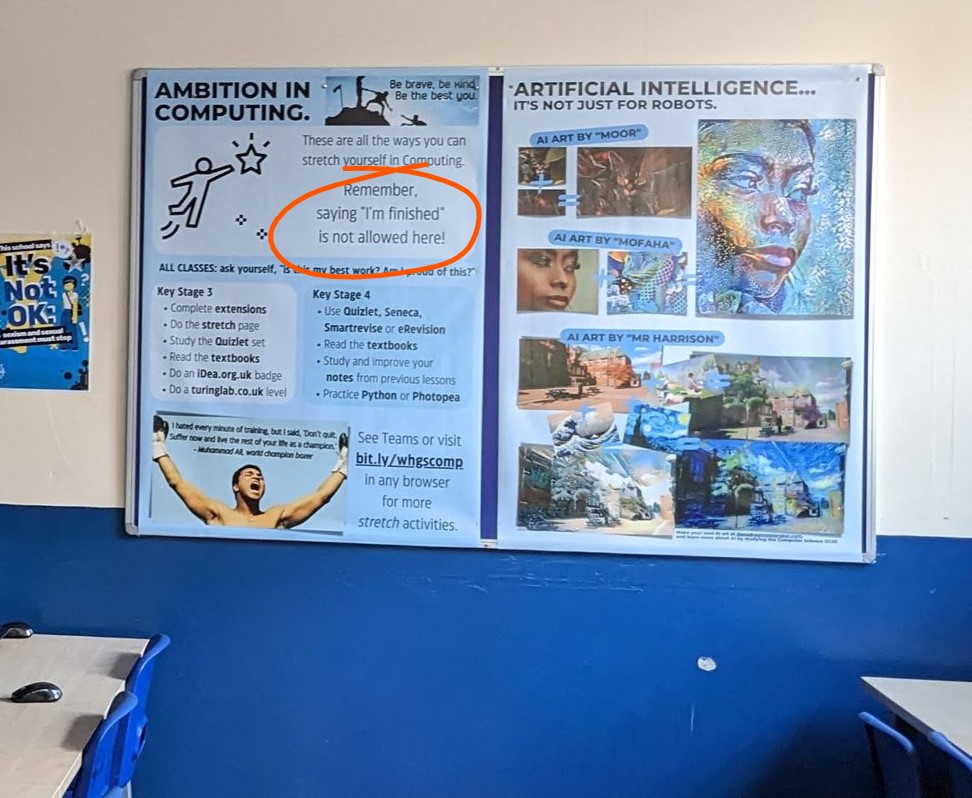
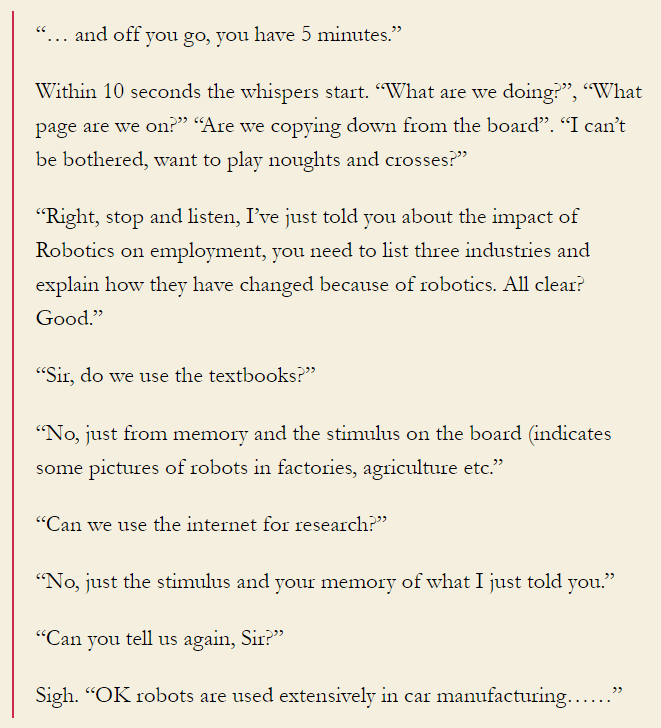
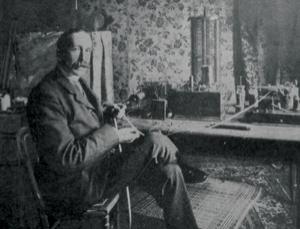

 )
)

 How to Teach Computer Science
You must be logged in to post a comment.