This is a blog I wrote for the NCCE where I work as the Secondary Computing Leadership Specialist PDL. It will appear on the NCCE blog here shortly.
If they remember nothing else, I’m sure my former pupils will recall my rallying cry for the Computer Science GCSE when their options choices came around: “we need good computer scientists like you on the side of the humans when the robot apocalypse comes!” I would declare, only half-joking. It worked, too, in my five years as HoD at an inner-city school I saw option numbers climb to record levels. I even achieved a 30% female cohort, through a range of efforts from ensuring representation in displays and resources, making the learning relevant, and a relentless “whisper campaign” of praise and encouragement: countering girls’ tendency to underestimate their ability and feel they don’t “belong” in computer science (see here). (Thrillingly, all the girls in that cohort achieved GCSE grade 6 or above, so the moral is: if you want good results, encourage more girls!) I also picked up a confused and disjointed curriculum, and set about re-engineering it, replacing my schemes of work, over a couple of years, with the Teach Computing Curriculum (TCC). I was able to trust the research-informed progression framework that underpins the TCC and cite this in my curriculum documentation – the ubiquitous Intent, Implementation and Impact docs we all wrote for the new Ofsted regime!
Today the TCC contains nearly 300 lessons in over 40 units for KS3 and 4, so there really is a TCC unit for every need, and there are now “Secondary question banks” for assessment, available as Google Forms and Microsoft Forms which you can just duplicate and use as your own, editing as necessary. I’m a big fan of good quality Multiple Choice Quizzes (MCQs), as they can take a lot of strain out of retrieval practice, and formative and summative assessment. Combined with some longer – but less frequent – written assessment you can get a good handle on progress without too much traditional marking. There are thousands more questions available for free at diagnosticquestions.com/quantum, and I’m also a seasoned user of SmartRevise from Craig’n’Dave, which offers longer-form exam-style questions with self- and AI-marking features.
Teaching A-level, I found Isaac Computer Science came in really handy. What I needed was a “MOOC” or online source of accurate, exam-board-specific content I could just point the students at for self-study and revision. Now expanded to cover GCSE content, IsaacComputerScience.org does just that. It also contains many hundreds of practice questions which can be organised into “gameboards”. I would create a gameboard every week on the topic we were studying, and use the results to re-teach the bits on which they performed worst. I’ve no doubt this cycle of self-marking quizzes and re-teaching (along with other deliberate practice techniques, I’m a big fan of Adam Boxer’s concept of “ratio”) helped me to record GCSE and A-level results in recent years. For A-level students, Isaac comes with regular “student booster” events aligned to the content, while Isaac Teacher events have now been merged into the regular Teach Computing course catalogue here.
I completed the Computer Science Accelerator (now called the Subject Knowledge Certificate) a few years back, then the Teach Secondary Computing certificate, and I strongly recommend doing both of these if you are a subject leader, courses are free and subsidised for all state schools and really affordable for private institutions, find out more here. So impressed was I with the NCCE courses, I completed Professional Development Leader training and joined a computing hub as a PDL, and here I am today as your national specialist in Secondary Leadership! The hubs are amazing, I recommend you get in touch with a local hub and find out what they can do for you, including advice, needs analysis, bespoke support and the loan of equipment.
I’ve spoken a lot about pedagogy, it fascinates me, and I really enjoyed the Big Book of Computing Pedagogy, and the follow-up Big Book of Computing Content published by the Raspberry Pi foundation, and these are must-reads for Computing subject leads. Maybe you could organise some CPD for your team around one of the articles? If you’re pressed for time, there are Pedagogy Quick Reads on the NCCE website here, which all helped me switch to PRIMM programming and improve my explanations with Semantic Waves with excellent results.
Finally, all of the above topics will be on the agenda The Big Computing Leadership Conference, on December 14th 2023 at Oxford Brookes University. Myself and Primary Computing Leadership Specialist, Phil Wickins, are joined by a star-studded cast of speakers and exhibitors. It’s your one-stop shop for all things a computing leader might need. You will also get trained in the Computing Quality Framework for free on the day, enabling you to go back and take immediate action to develop your department.
For more information about the specialist hub and how to get in touch see our website here, while the agenda for the Big Conference and how to book are here. See you on 14th December, but only if you want to be on the side of humans in the coming robot apocalypse!
UPDATE: my talk was warmly received, thanks to everyone who came to my stand later to talk to me, it was a fantastic day.
The content (actually a 12-inch remix version of my talk*) can now be found below. Also in the attached is a discount code for 30% off my books this summer at John Catt bookshop – read the embedded PDF below to find it!
*for the younger generation, a 12-inch vinyl single was an extended recording of the track, often up to 3 times longer than the 7-inch single.
I am delighted to be speaking and exhibiting at the LGfL “Let’s Celebrate II” conference in London on Friday 30th June 2023. I’ll be giving a talk on Powerful Knowledge in Computing, and I’ll also have a stand in the exhibition area where you can buy my books and lovely new merchandise:
For more information about the conference and how to book, click the LGFL banner image below:
I’ll be speaking on the topic below. Hope to see you there!
A Knowledge-Rich Computing Curriculum (that also pleases Ofsted!) – Alan Harrison alan@httcs.online
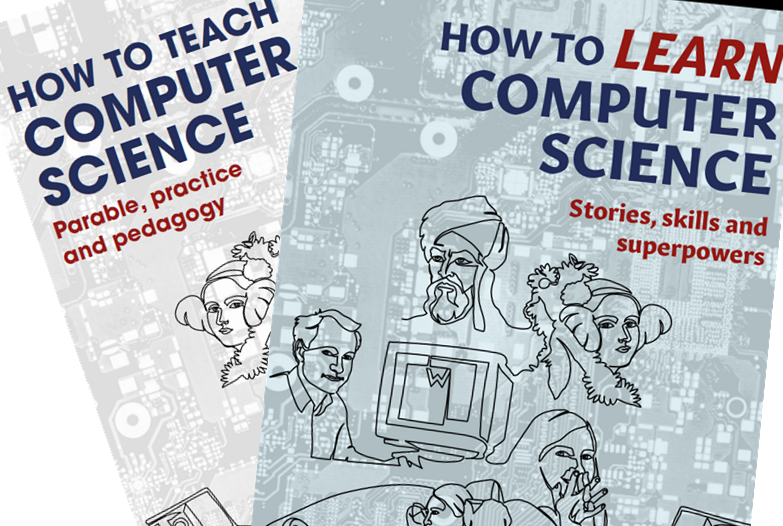
What is powerful knowledge in Computing? What are declarative and procedural knowledge anyway? How do I squeeze computing into my packed Primary curriculum? What must I deliver at KS4 for those that don’t take Computer Science GCSE? Alan wrote the book “How to Teach Computer Science” and is passionate about powerful knowledge in the important academic discipline of computing. Alan also served on the working group that created the Ofsted Research Review and has interviewed successful Deep Dive recipients. Attend this talk to be enthused by powerful Computing knowledge and also get some actionable tips to be relaxed about OFSTED’s next visit.
The furore about this year’s OCR GCSE Computer Science Paper 2 (J277/02) brings into stark relief the gulf between where we are as a subject, and where we need to be, in terms of capability. It’s a time for reflection, not for panic. The responsibility for thoughtful reflection falls on the computing subject leaders.
Subject Leaders (SLs) are the engine-room of the school. Sometimes called curriculum leaders or heads of department, as such these engine-rooms should be given largely unlimited fuel (training, resources and support) and clear guidance (achievable goals and strategic direction) to ensure their success. Often this is lacking, and computing SLs regularly report feeling under-supported: that their subject is poorly understood and under-resourced. Exam results should drive a discussion between the SL and strategic/senior leadership team (SLT) and it’s right that this should ask non-threatening questions of the SL about their department’s capability: do they have the resources, training and support to achieve the best outcomes possible for their students?
Unfortunately, these conversations are not always positive, causing SLs to fear for their careers instead of being able to work together with SLT on the advancement of their subject outcomes. This has never been so clear as in the panic over Thursday’s paper. I hope in this blog to bring some clarity to the situation. I have left out names, and avoided criticising individuals. But to be clear before we start, I think some teachers have gone too far in their response to what was a tough but fair paper, and I give alternative views and a series of actionable recommendations below.
The harsh reality is that the complaints about the paper that inundated Facebook from Thursday evening onwards say more about our ability as a teaching body to prepare our learners for a robust assessment, than they do about the quality or fairness of the exam itself. My unpopular opinion is that the exam was tough but largely fair. Nothing was assessed that wasn’t in the specification, and it seems many teachers have been over-reliant on the practice paper and past papers on OCR’s website and secure “Interchange” area, perhaps leaning on these to guide their curriculum rather too much, instead of trying to cover the whole specification. [Edit: this paragraph previously used the phrase “been caught out teaching to the test” and I have removed and rewritten to be clearer and sound less judgemental].
An over-reliance on questions from the previous specification (J276) would not have helped. That specification was designed to run with a practical programming project worth 20% therefore paper 2 looked somewhat different, without the in-depth scenario-based “Section B”. Each programming question on J276 was fairly short and self-contained, so didn’t demand a great deal of computational thinking. Add to this the COVID-adjustments to boundaries last year, against the first run of J277, and some schools may have gained false confidence in their performance.
Let’s look at some of the specific complaints from the social feeds, and I’ll try to refute them with evidence from the exam board as necessary. I’ve taken comments from the J277 and older OCR Comp Sci group (which I call the J276 group below).
What was said on the socials…
I can’t agree with these comments:
“Bring back teacher assessed grades” and “I strongly believe teacher assessed grades should be implemented after this tragedy” – please, just no. Read this.
“I’m going to email my kids tomorrow to let them know we all feel the same about the paper” and “Please encourage pupils and their parents to write/complain to OCR and other bodies such as OFQUAL etc. Do everything you can!” Please don’t. This will increase anxiety and be counter-productive, and possibly bring your school or the exam board into disrepute, so I’d advise against this.
“People creating these papers need to show their face and take responsibility. The paper today seriously undermines teachers across the nation of this difficult subject, and can’t imagine what pupils are going through right now. If we don’t make noise, students in the future will continue experience days like this.” OCR have a feedback form, an appeals process and a helpful subject advisor, I strongly urge you to use the appropriate channels and take guidance from your exams officer or SLT before taking any other action.
“most of us are 1 person subjects and the consequences from this are we have to explain ourselves to SLT and it makes us question our own ability. Almost feels like they want this subject to fail.” The correct response from SLT to any 1-person departments struggling to get good results in this subject would be to support you with CPD or recruitment. I’m aware this is difficult in the current climate, but all subject leaders have a responsibility to communicate upwards effectively about their department’s strengths and weaknesses. It goes with the territory, although I’ve been there and I know how hard it is. I give lots of actionable advice below.
“loopy loop question driving me loopy let alone my poor EAL students!” – I thought the wording of 3b was about as clear as it could be, while still asking an important question that reveals whether the candidate understands the two types of loops in the context of a sorting algorithm. I talk more about this below. As for EAL, some students are allowed translation dictionaries under specific rules, but it is an English exam board GCSE.
“It certainly wasn’t written by a teacher, as good teachers know how to relay computing concepts to students with a range of abilities.” – I think there were a lot of AO1 marks in Section A that are “easy” if the content has been taught well, retrieved often and revised well. Differences between HLL/LLL, arithmetic operators, define syntax and logic errors, spot the truth tables, describe features of an IDE to name a few. There is enough there to be accessible by those with mock/predicted grades of 1,2,3,4.
The accessibility of the paper is questioned several times on the Facebook groups. I think it’s worth exploring this some more in the context of the 3b insertion sort question. I put the question into Word and it came out as “Grade 6.7” so roughly UK Year 8 reading level. I think any attempts to dumb down this question would fail, because ironically the first sentence is an important preamble, conveying content rather than asking a question. The extra words are intended to help, not hinder understanding.
The answer “because the inner loop moves the unsorted number leftwards in the array and only stops when the number to its left is smaller than it, which is a condition not a count.” could only be gleaned from this question worded as it is, or similarly to it.
Advertisements
Amusingly I posted the question into ChatGPT followed by the prompt “Please help me reword this exam question to be easier to understand” and the result was as follows:
Why is it necessary for the inner loop in an insertion sort algorithm to be condition-controlled rather than count-controlled?
Note that we’ve lost the preamble, so this version could well be harder for some to answer than the original! We’ve lost the word “loop” after both “condition-controlled” and “count-controlled”, but does this make it easier or harder to understand? Ironically, Word now rates this “Grade 12.9” or Year 13/14 reading level due to the average word-length and sentence-length increase. I think we do examiners a disservice when we jump to conclusions about readability: question writing is not an intuitive skill.
The Logic Gate question was not as heavily scaffolded as last year’s question. But it was fair. Students need to understand that a boolean value often represents a fact about the world, such as whether it is day or night. It is reasonable to expect them to work out the logic circuit for an alarm system. I always teach logic circuits with real-world examples, because it says in the specification, “Understanding of how to create, complete or edit logic diagrams and truth tables for given scenarios”, and there was even a scenario question on Practice Set 2 Paper 2: “A cinema uses the following criteria to decide if a customer is allowed to see a film that has a 15 rating…”
Indeed, one of the most popular commercial resource bundles for our subject, that from Paul Long includes an exercise that is almost identical to last Thursday’s exam question, and the helpful advice “You could be presented with a real-world scenario and asked to create a logic circuit for that scenario”:
Valid criticisms
I do consider these valid complaints about the paper:
Page 13 uses “alarm has been activated” when it should say “system has been armed” to match the variable name above “SystemArmed”, and to better describe the condition of being armed. Activation should only refer to the triggering of a sensor, otherwise the candidates will be confused. So the sentence below the bulleted variable list should begin “The alarm will only sound when the system has been armed…”
There is an error in the identifier of the array on page 17, this should have said arrayEvents[1, 1] not events[1, 1]
Printing the array on a right-hand page, with the algorithm writing space on its reverse caused unnecessary back-and-forth. Papers are usually designed to avoid this but not in this case.
The complaints about “Do Until” in question 1d are misguided. Both switch/case and do-until are in the specification, and switch/case was even on the 2022 paper. The Examiners’ Report (available on Interchange since last September) says this: “Candidates appeared to struggle with this question. In particular the use of switch/case was not well understood. This may be because some high-level languages such as Python have not traditionally supported this.” It’s important to teach the whole specification, and remember this is not a Python exam.
Practical programming with Python, C#, Javascript or whatever language(s) you choose is vitally important, but you must cover all of the concepts in the spec. As the examiners’ report says, Python 3.10 supports switch/case with the new match and case keywords explained here, and you can Fork my REPL here replit.com/@mraharrison/match-case. If you are still using IDLE, Thonny or another local install, you’ll need to get this upgraded to Python 3.10 to use it, or you could jump online to the excellent replit.com instead. For do-until you could show them the Do Until Loop statements in Visual Basic Macros inside Excel like this, or maybe the JavaScript do-while construct, which you can try out here.
So the subject leaders need to know the specification inside out, read the examiners comments, attend OCR training and generally be experts in what the qualification is testing. As well as this, all teachers of the subject must have clear guidance on what to teach, be supported with quality materials, and most importantly, be provided with quality CPD so they can improve their subject knowledge. I’ve written before about the need for computing teachers to upskill themselves, so they can teach the subject better. In my June 2021 blog post, I said this:
Once you know it yourself, and feel confident you know it, you can explain the material in ways others understand. Rather than asking for slides and worksheets, I recommend teaching yourself the content. Then study others explaining it well.
Don’t add fuel to the fire. You have a duty of care to remain calm, supportive and professional. Help your students by not exaggerating the issue and don’t encourage them to complain.
Don’t assume we are all of the same opinion. As a subject body, opinions are at best divided on the quality and fairness of J277/02 2023. We are not universally outraged, perhaps step out of the “Facebook filter bubble” and see other opinions. I have made the case above that it is hard but fair, and many others share my opinion.
Thoughtfully consider how you feel about both papers (and remember there was no great panic over paper 1) and give your feedback to OCR via the feedback form.
Discuss with your exams officer what happened, and get a meeting with your SLT link this summer to start conversations about closing any gaps in you delivery, what help do you need?
Request copies of completed scripts in August, with permission from the students, of the top, middle and bottom of your cohort. Read these alongside the examiners report, that comes out in early September. Use this to identify gaps in your delivery that may need closing with CPD, resources or curriculum changes.
Use the NCCE and CAS and the free resources available online to upskill yourself and other teachers in the department. For example “switch/case” and “do/until” are explained in this Craig’n’Dave video. Book you and your department onto some subject-specific CPD, and buy books you can use to upskill (and yes I wrote one that is well-regarded, see the home page).
Think broader than KS4, are results this year likely to be poor because of insufficient curriculum time at KS3, or non-specialist provision? Write those things on your subject improvement plan. We cannot be expected to deliver strong results with one hand tied behind our backs.
Complete the Computing Quality Framework questionnaire which identifies the needs of your department. Use this to justify to SLT any support or changes you need: computingqualityframework.org
Read the Ofsted Research Review of computing identify any gaps, and put these on your plan as well. Be honest and professional. (Oh and remember as computing teachers we are like hen’s teeth right now, if your current SLT don’t support you, you have options!
To SLT
Computer Science is an EBacc subject and highly prized by employers and colleges. Ofsted’s recent report (above) makes it clear that they are expecting you to offer the GCSE (and also deliver alternative computing teaching at KS4 for those that don’t take it), and also that a minimum of 1 hour per week at KS3 delivered by a specialist is expected. Please resource your computing department accordingly and be guided by the subject leader in what they need to succeed.
To students
To students reading this: remember you sat two papers, this was a tough paper but your scores will be aggregated, then standardised and grade boundaries will be set that reflect the difficulty of the papers. You have likely done better than you think. Put it behind you and do the best you can when exams resume on Monday. You’ve got this.
If you are grateful for my blog, please buy my books here or buy me a coffee at ko-fi.com/mraharrisoncs, thanks!
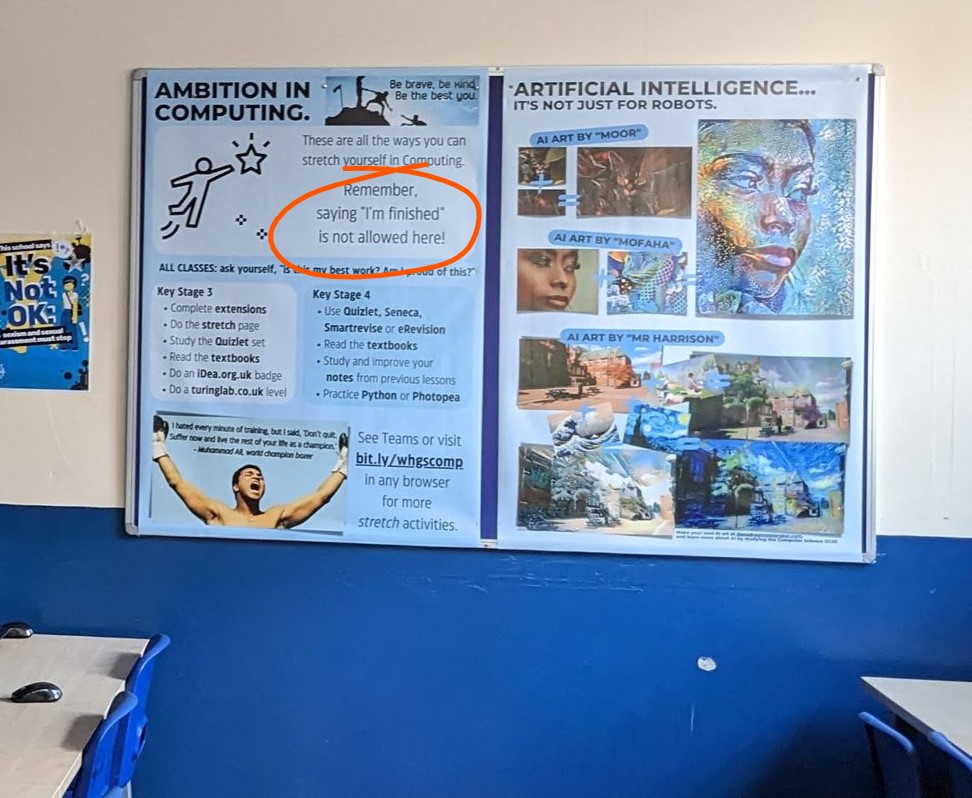
There are two words I hate to hear in the classroom. So much that I banned them. I banned the phrase, “I’m finished”. Here’s the proof, a poster in my most recent classroom:
Why did I ban “I’m finished?” Surely you want pupils to finish their work in lesson time, and if they finish early, what’s the harm if they find something less stressful to do? Like going online to play Chess with their mates, as one Tweeter told us her pupils do (or did, until the IT technicians blocked Chess.com, forcing them to “go on YouTube” apparently.)
Allowing “free time” at the end of a lesson encourages poor performance. Many pupils will rush the work to get it “done” in plenty of time to play games or watch videos. In my early career I often responded positively to the plea “Sir, if we get finished early can we go on coolmathgames ?” But I learned that dangling that carrot of “free time” just ensured poor concentration: a tendency to fill boxes on worksheets with the bare minimum, and importantly, ensured a poor ratio (proportion of pupil-minutes thinking hard about the topic, instead of other things).
Worse, though, than the direct effect of encouraging a poor work ethic, is the meta-message sent by the “rewarding” of completion with something “more fun”. This communicates to the pupils that the learning is not valuable, that it cannot be enjoyable in and of itself, and getting “finished” is more important than doing the work well: giving your entire congitive faculties to the learning itself for the duration of the lesson. Better to show you value the learning by foregrounding it, praising effort: let them know that in your classroom, hard work pays off. Ditch the focus on “busywork”: completion of worksheets as a proxy for learning, and ensure there is plenty of productive struggle in your classroom: pupils thinking hard about what you want them to learn, sticking with a tricky task with resilience, learning the value of persistence, and being rewarded with success. Learning is it’s own reward in my classroom.
…the purpose of study should be to improve our capacity to properly pay attention to something by subsuming ourselves to it and making the point the humble, genuine work towards it.
Simone Weil quoted in the blog “Try” by Ben Newmark
My lessons are full of thinking hard about the topic of computing, from start to finish. Don’t get me wrong, my lessons are not boring, each is rich and varied (practical programming, physical computing, Quizzes, puzzles, past paper questions, debates…) but not one minute of the 60 is given over to non-computing time. Why would I deprive them of enjoyable learning about our wonderful subject? Why would I suggest that playing games is somehow more desirable than building logic circuits or learning to code?
If you are grateful for my blog, please buy my books here or buy me a coffee at ko-fi.com/mraharrisoncs, thanks!
Social media is literally making us sick. It’s happening on a grand scale, both macro- and micro-effects are huge, and we don’t know how these effects will play out. But unless we act now, one possibility is the breakdown of societies, states and countries. Maybe you’re aware of some of the micro-effects such as lowered self-esteem through social comparison: comparing yourself to others. Or perhaps you’ve heard our attention spans are shortening due to something something I forget now…
But what if I told you: this is deliberate? More accurately, these effects are well-known attributes of the system, not so much bugs as features. It would be a stretch to say that social media companies want us to feel bad, but there’s no doubt they know their algorithms are doing it and see it as a necessary evil. It’s all about engagement.
It’s a cliché now that as a social media user “you are the product”, but only because it’s true. In order to reach as many people as possible, Facebook famously carried the message “It’s free, and always will be” on its landing page. (They meant fee-free, because it can cost you your sanity, more on that later). So Facebook started carrying ads. (If you’re still using Facebook, I just have one question: how? My mum used to love the platform as she saw updates of the kids regularly, now she tells me she never sees my family-sharing posts, just cosmetic adverts and “Reels” of skateboard accidents).
Where advertisers could previously only choose a channel (this magazine, that radio show, this TV programme break) and hope their target market was tuned in, now they can literally target individuals based on what the platform knows about them. This is gold dust to advertisers: being able to… “Show this video ad to everyone who lives within 50 miles of Birmingham, who have just returned from a foreign trip, have a child aged 11-18 and have shopped online before”. This “custom audience” of very specific groups of people keeps the marketing costs down while achieving a good return.
Let’s pause a moment to consider what advertising is. The uncomfortable truth is that all advertising is behaviour modification through psychological manipulation. We like to think our minds are our own private domains, and our thoughts are our own. But who hasn’t driven past a bus shelter ad for ice-cream on a hot day and immediately wanted one? After-shave ads show confident, well-groomed men getting romantic with typically-good-looking perfectly-made-up female models, and we want a part of that lifestyle. (I bought Davidoff but I still can’t surf, should I sue?). Ads create a desire in us to buy the product, and they are not squeamish about the emotional triggers they use to get the job done. We are all being operant-conditioned every day. What we once thought of as advertising is now Skinnerian behaviour modification on an industrial scale.
Skinner is regarded as the father of Operant Conditioning, but his work was based on Thorndike’s (1898) law of effect. According to this principle, behavior that is followed by pleasant consequences is likely to be repeated, and behavior followed by unpleasant consequences is less likely to be repeated. – Simply Psychology
The original “Skinner Box” used to research operant conditioning in mice.
But targeted ads are no good if nobody is watching. That’s where the problematic algorithms come in. Revenue comes from people seeing the ads. For that, people need to be on the platform. This means increasing both the number of people online, and the number of hours they spend online. These metrics are called “engagement”.
Engagement
In order to ensure maximum exposure of their customers’ ads, social media platforms have developed sophisticated attention-demanding techniques based on Skinnerian theories that keep users online for longer and longer, learning what you like and dislike, giving you little dopamine hits of what you like, and showing you less of what you dislike. Rewarding you with joyful animations for “streaks” (continuous days on the platform). Showing you “likes” and “views” on your own content, helping you understand what your followers like to see, and encouraging you to share more popular content. Here’s Sean Parker, the first President of Facebook admitting that the algorithm literally hacks the mind…
We need to sort of give you a little dopamine hit every once in a while, because someone liked or commented on a photo or a post or whatever… . It’s a social-validation feedback loop … exactly the kind of thing that a hacker like myself would come up with, because you’re exploiting a vulnerability in human psychology.
Sean Parker, quoted in Jaron Lanier. Ten Arguments For Deleting Your Social Media Accounts Right Now (p. 8). Random House.
But the issue is not just that the platforms have hacked your mind to keep you engaged. At the same time the platform is building up a picture of you and what you are interested in: data which they sell to advertisers to target their ads to you. The Skinner box includes advertisers, algorithms and users all working in symbiosis, ostensibly to sell more product, but at what cost? The rest of that Sean Parker quote reveals that they knew, Zuck knew, right from the start, that there were consequences for individuals and society arising from their engagement model
…you’re exploiting a vulnerability in human psychology… . The inventors, creators— it’s me, it’s Mark [Zuckerberg], it’s Kevin Systrom on Instagram, it’s all of these people— understood this consciously. And we did it anyway … it literally changes your relationship with society, with each other… . It probably interferes with productivity in weird ways. God only knows what it’s doing to our children’s brains.
In that they use emotions to change behaviour, social media is basically a civilian “PsyOp“, the term the US military use for manipulating foreign actors to make choices favourable to US interests. In this case, the motive is profit, not military or political dominance.
Advertisements
Of course Facebook started on the web in 2006 when people had dumb phones. What made the Skinner-box, algorithmic modification of our brains to sell stuff really viable was the rise of Smartphones. Apple launched the iPhone in 2007, HTC the Android-powered Dream in 2008 and by 2015, two-thirds of US adults had a smartphone. With the internet now in our pockets, we can get our dopamine hits any time we want, and so, the Skinner box now extends outside our homes to enclose us wherever we are.
Base emotions win
Remember that big business has no driver more powerful than profit, and therefore does not care which emotions they invoke in order to manipulate you into doing their bidding. Negative or positive: all’s fair in social advertising. So why does big tech want us to feel bad? It turns out that they simply make money more quickly that way.
Negative emotions such as fear and anger well up more easily and dwell in us longer than positive ones. It takes longer to build trust than to lose trust. Fight-or-flight responses occur in seconds, while it can take hours to relax.
Jaron Lanier. Ten Arguments For Deleting Your Social Media Accounts Right Now (p. 18). Random House.
We don’t so much buy more product directly as a result of being made to feel bad, but we engage more, react more, share more. If someone shares a holiday picture we might “Like” it. If someone posts “we should close the boarders (sic) to these illegals NOW” we may respond in anger, others may jump in and suddenly we’re in a 20-way conversation interspersed with ads. Engagement thrives on conflict, with the end result that adverts reach more people, and crucially more fertile people (who share our interests and are therefore equally good targets of the ads we see). And the people we engage with, well their data is hoovered up too, and the valuable “map” of who likes (and hates) what just grows and grows, and with it the value proposition for the paying customers (advertisers).
Feature, not bug
Negative emotions are collateral damage, not the primary goal of the corporations but definitely a design feature:
There is no evil genius seated in a cubicle in a social media company performing calculations and deciding that making people feel bad is more “engaging” and therefore more profitable than making them feel good. Or at least, I’ve never met or heard of such a person. The prime directive to be engaging reinforces itself, and no one even notices that negative emotions are being amplified more than positive ones. Engagement is not meant to serve any particular purpose other than its own enhancement, and yet the result is an unnatural global amplification of the “easy” emotions, which happen to be the negative ones.
Jaron Lanier. Ten Arguments For Deleting Your Social Media Accounts Right Now (p. 18). Random House.
Note that the accumulation of all this negative emotion in individuals, is having a collective effect on society. Lanier talks of global amplification of negative emotions. We’re all being made sadder, more anxious and more stressed by social media.
So what to do? The title of Lanier’s book speaks for itself, but not everyone has the privilege of deleting all their social media accounts, many of us (including me) rely on them for revenue – I’ve got books to sell, and most businesses can’t afford not to advertise socially – but delete if you can, or at least educate yourself and those around you of the dangers.
Use the platforms sparingly, set time limits, delete the apps from your phone and use social media on computers only, which tend not to go around with you all day. Manage use by children, whose brains are perfect vessels for operant conditioning (we’ve all read Brave New World, well here we are )
Online Safety Education
Teachers reading this, please shift your focus away from the “walled garden” outlook on eSafety common throughout the 2000s and into 2010s: where the user of technology (the child) was regarded erroneously as a benign and unwitting recipient of hostile attention. Instead we must recognise that as users, the children we teach are invested, even willing participants in the manipulation machine, they engage in, share, propagate harm simultaneously with being harmed. That’s why the UK Department for Education document “Keeping Children Safe in Education” (KCSIE) includes conduct as one of the 4 C’s of online safety risks (the others being content, contact and commerce). Recognising that a child’s own conduct can itself be risky is vitally important in keeping them safe.
Advertisements
The document “Education for a Connected World” (EFACW) created by the UK Council for Internet Safety (UKCIS) suggests a curriculum for online safety appropriate for the modern world, and includes these learning objectives:
I can recognise when and analyse why online content has been designed to influence people’s thoughts, beliefs or restrict their autonomy (e.g. fake / misleading reviews, fake news or propaganda).
I can explain how and why anyone could be targeted for sophisticated information or disinformation intended to influence their beliefs, actions and choices (e.g. gas-lighting, information operations, political agendas).
I can describe some of the pressures that people can feel when they are using social media (e.g. peer pressure, a desire for peer approval, comparing themselves or their lives to others, ‘FOMO’)
I can recognise features of persuasive design and how they are used to keep users engaged.
For a ready-made, fully-resourced curriculum aligned with EFACW, see the Project Evolve website here, created by the South-West Grid for Learning in collaboration with the UK Safer Internet Centre. It’s all free to use.
In conclusion, we need a step-change in the way we understand how technology is understood, away from some passive tool that we are masters of, to a more nuanced understanding of how we are part of a larger system of emotional manipulation. We can be passive or active in our engagement with this model. Being active and making informed choices we can prevent some of the greater harms, and those with influence may make mass-market technology less harmful in the future.
Read more about the origins of the internet, ethical issues of technology and more, when you buy my easy to read book (under £15) for teachers of Computer Science, or the even easier-to-read student version, here on my home page. And…
If you are grateful for my blog, please buy my books here or buy me a coffee at ko-fi.com/mraharrisoncs, thanks!
Teaching is hard. But not for the obvious reasons, those that are well-known to novices and non-teachers like long hours, excessive planning and marking, dealing with behaviour that detract from its many joys such as seeing young people grow, develop, experience “lightbulb moments” of realisation.
Teaching’s hard because we always have a nagging feeling there is something more important we should be doing, and usually there is, but we can’t get to it because of all the planning, marking and behaviour management. We know there is higher-value work, and work that would be more enjoyable or fulfilling such as really thinking deeply about curriculum or planning a bespoke lesson based on serious analysis of some assessed work. Making those positive calls home you always promised you would do, or properly watching some training videos that improve your pedagogy, observing other teachers or being coached and putting into practice everything you learned.
But we rarely get time for any of this. As teachers we are constantly living a fiction: that we will eventually get time for the good stuff. Every single week, we fool ourselves that “next week will be less busy”…
Academia is basically just repeating “next semester should be a little less busy” for the rest of your life.
Sadly this nagging feeling of rummaging around in the weeds and finding occasional sparkly gems, but wishing you could rise above it all and live in the sunlight is what eventually causes burnout: unmanageable stress, anxiety or other mental health issues, and then good people leave the profession.
Studies show that autonomy is important in job satisfaction:
Teachers’ perceived influence over their professional development goal setting is the area most associated with higher job satisfaction and a greater intention to stay in teaching. The average teacher reports a lower level of autonomy compared to similar professionals.
Last year the UK’s social research app TeacherTapp reported that only 1 in 3 Primary teachers reported having enough autonomy. And the TES reported in 2020, pre-pandemic, that teachers rank second-lowest (just above healthcare professionals) out of 11 professions for autonomy.
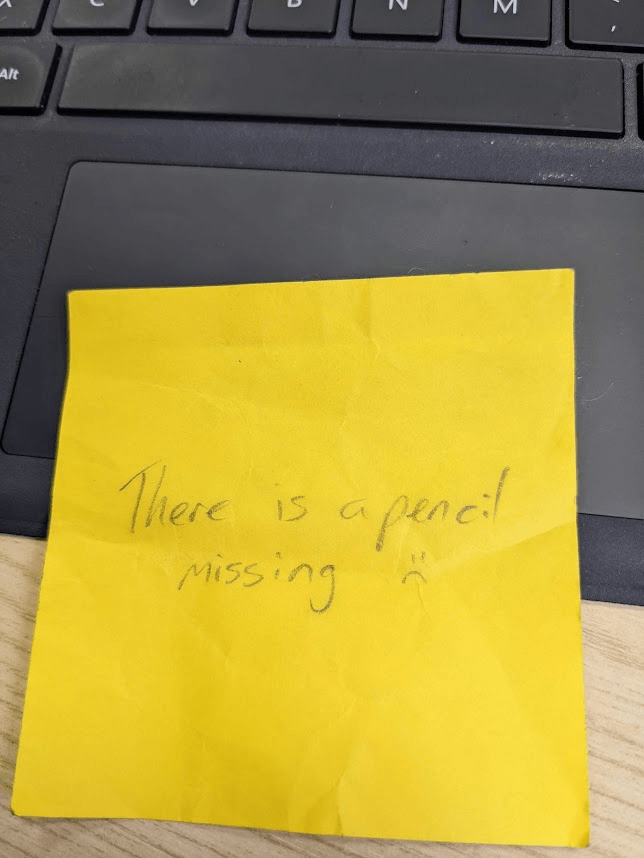
Which is a round-about way of saying: I understand why a colleague left this note on my laptop last September, why I am not bitter about it, and why it made me reflect so deeply on my own autonomy.
I had been covering a lesson in his classroom, and realised I was on playground duty immediately afterwards, so I collected in the pencils, tidied up as best I could in 30 seconds and ran out to do my duty. Just 25 minutes later I returned to gather my things to find this accusing note. Of course I was cross at first: I’d not stopped all day at this point, lost a “free” to a difficult cover and not yet had my lunch, and I thought it was a bit unnecessary: could he not be a bit more understanding? Nobody really wants to cover lessons but we know it’s part of the job and we do our best to look after our colleagues’ classrooms, but nobody’s perfect (don’t get me started on the mess my Computing classroom has been left in previously).
But then I remembered the importance of autonomy, and how lacking in it most teachers are. I remembered this scene about autonomy from “You’ve Got Mail” (which is worth watching just for the banging Cranberries track “Dreams” playing as Joe enters the coffee shop…)
The whole purpose of places like Starbucks is for people with no decision-making ability whatsoever to make six decisions just to buy one cup of coffee. Short, tall, light, dark, caf, decaf, low-fat, non-fat, etc. So people who don’t know what the hell they’re doing or who on earth they are can, for only $2.95, get not just a cup of coffee but an absolutely defining sense of self: Tall. Decaf. Cappuccino.
Nora Ephron’s script for “You’ve Got Mail”, Starbucks scene, Tom Hanks’ character Joe Fox speaking.
My pencil-counting colleague was “doing a Starbucks”. In a job severely lacking in autonomy, one thing he can control (most days) is the equipment in his classroom. He can count out the pencils and count them back in. I’m sure there are many other aspects of his job he has control over, but just maybe, returning to find a box of pencils with a gap where an HB should be was the last straw that day. I forgave him but the incident sparked reflection.
Possibly the pencil-missing-post-it cover lesson acted as my toothpick instructions moment. Douglas Adams’ marine biologist character “Wonko the Sane” retired to a house in California he called “Outside the Asylum” upon reading instructions on a pack of toothpicks…
‘It seemed to me,’ said Wonko the Sane, ‘that any civilization that had so far lost its head as to need to include a set of detailed instructions for use in a package of toothpicks, was no longer a civilization in which I could live and stay sane.’
It’s certainly true that I handed my notice in four weeks later. What my post-it-author colleague felt that day I’ll never know, I simply dropped off a couple of similar pencils on his vacant desk at the end of the day and we never spoke about it. (Sure, I wrote and deleted several emails, but never sent them, which I was glad about soon after).
So if you’re in a position of power in school, and you wish to improve well-being, maybe stop doing “surface-level” things like cake in the staffroom or yoga sessions (and do not make any “well-being” sessions mandatory). Deliver on autonomy, which in turn means cutting things out of the calendar to make room for middle-leaders to do high-value stuff. Stop mandating lesson structures and slide layouts (but do share good practice around this that others can learn from). Ask your staff what they think, they are all graduate professionals after all, let them bring themselves into the job.
And just maybe, with more autonomy, teachers won’t feel the need to write passive-aggressive notes to colleagues, or feel the need to leave, and go live Outside the Asylum. 😎
If you like this blog, my books are available at the home page here. Or…
If you are grateful for my blog, please buy my books here or buy me a coffee at ko-fi.com/mraharrisoncs, thanks!
— Teach Computing Cheshire & Wirral (@ComputingHubFT) March 10, 2023
Tweet from @ComputingHubFT
Coming soon from me, three short, online sessions focussing on some really powerful techniques you can use in the computing classroom, on behalf of TeachComputing, Cheshire and the Wirral hub.
Mon 27 March, 4-5pm online: Storytelling and analogy.
In his book Why don’t students like school? Daniel T Willingham says stories are treated as preferential information, they help with retention. Learn how to bring stories and analogy into your computing teaching to improve retention. Book here: CA303 F79
Cross-topic teaching…
Learners understand a subject much better if the links between concepts are made explicit, and they are encouraged to make their own links either within the subject or across the curriculum. We discover some links that you can make, and activities that make these links explicit.
Wed 29 March, 4-5pm online:Cross-topic and synoptic teaching:
Misconceptions can seriously hinder learners’ progress, and studies have shown that teachers who are aware of common misconceptions and actively seek to address them are more effective. Join us to become more misconception-aware. Book here: CA303 F78
If you are grateful for my blog, please buy my books here or buy me a coffee at ko-fi.com/mraharrisoncs, thanks!
A lot of column-inches and a bazillion frantic tweets have been bashed out recently about the AI tool ChatGPT: the public, text interface to a Large Language Model (LLM) created by the OpenAI consortium. Originally a not-for-profit body which boasted Elon Musk as one of its original investors, OpenAI is now unashamedly for-profit and in November 2022 launched ChatGPT, a language model built on GPT3, the third iteration of their “generative, pre-trained transformer” software. This tool can process natural language text and respond with natural-sounding text back. It also remembers conversations, hence the “chat” element, and this is what makes it more powerful than previous iterations: you can refine your query over several inputs to get better results.
Advertisements
AI services like ChatGPT join a long line of technologies to have been described as both “dangerous”, downsides from its use as a class cheat’s superpower, to a phishing and identity fraud weapon. it’s “the end of assessment as we know it’ because “many of the problems we set in secondary school can now be solved by apps… It is not a good sign that we still teach and test mathematical material in such a routine way that free off-the-shelf systems like these can handle lots of it with ease’ – economist Daniel Susskind in his book A World Without Work.
But we’ve been here before. The internet was going to spell the end of academic assessment in the 90s. In truth it didn’t change much, except for democratising information so you didn’t need to be in school to learn. If we’re honest with ourselves, outside of controlled conditions such as the exam hall, there are a myriad ways to cheat already: copying from others, searching online or using an online service to do your homework for you, sometimes called an essay mill. If a piece of work is important (such as assessed coursework or “controlled assessment” work) then the teacher should already have some skill in plagiarism-checking. Online services such as Turnitin are widely used, but I’ve always found simply asking a student to explain their work, called a “viva voce” interview in academia, does the trick. You may not need to do this with 100% of submissions, just a 10% check might be sufficient to deter serious plagiarism.
And if you absolutely must have confidence the submission is the students own work, then conduct a test in controlled conditions with no devices allowed. But only a small number of pieces of work (often just a summative test of required knowledge to progress to the next stage, e.g. the GCSE’s and A-levels in the UK or the college-entrance-assisting AP tests in the US, and the final exams of a degree course) over a student’s lifetime should require this level of scrutiny. Everything else should be treated as formative and afforded a lesser degree of validity and therefore require less strict control.
Most of my students work is either self- or peer-assessed. A mixture of online self-assessment using platforms like Quizlet (most subjects) or SmartRevise (Computing and Business only at the moment) get the bulk of the feedback done cost-free, and the rest is largely done by the students with lots of guidance from me. I’m glad the UK never adopted the American high-school system of grade-point average (GPA) scoring, not least because it penalises poor early performance which is unfair to immigrants and those with health issues, and is linked with self-esteem issues, but because it makes every piece of work high-stakes and high-cost to the teacher. When both teacher and student are stretched to the max by tests every semester, there is no space to relax and enjoy the journey. And pity the student who gets a C during the grief of a bereavement which prevents them getting the required GPA for their college of choice no matter what they do next. (If you’re in the UK, thinking “glad we don’t have the GPA system here”, count how many controlled tests and data drops you must do each year, and ponder a moment).
Advertisements
Let’s remember the purpose of assessing work. All assessment is a surrogate for what we want to know: what is in their heads. Assessment is not an end in itself, the mark should reflect some measure of achievement that helps both teacher and student understand how to make progress. Let’s not forget that what we want to achieve is an improvement in learning, what’s in their head when they leave school, not what they wrote in a paper when they were eleven or fifteen. As Tom Sherrington writes:
If testing is going to have an effect on the learning process, it needs to have an outcome that will help students to develop a sense of themselves as learners and an awareness of what else there is left to learn.
As Daisy Christodoulou writes, the struggle, not the end product, is the point:
If a student struggles for an hour over an extended piece of writing and then finds that a computer has surpassed it in seconds, it is entirely possible they will feel demotivated. What they need to hear from adults is don’t worry, your work is of value, you’re on a journey and you are developing your own writing skills.
Design your assessments so they create actionable feedback, not just test scores. Furnish the students with marking rubrics ahead of the assignment, and get them to mark themselves against the rubrics before handing in. If they’re using ChatGPT at home to write essays, they might be short-circuiting part of the process, so have the class critique each-others essays in class afterwards. Create model answers or “what a good one looks like” WAGOLLs they can mark themselves against, or choose a student’s answer that is high quality and work with the class to determine what makes it so. Joe Kirby’s seminal 2015 blog post “Marking is a Hornet, Feedback is a Butterfly” is still my go-to article for in-class feedback ideas that can be re-purposed in the ChatGPT age, even to make the most of so-called “plagiarised” work.
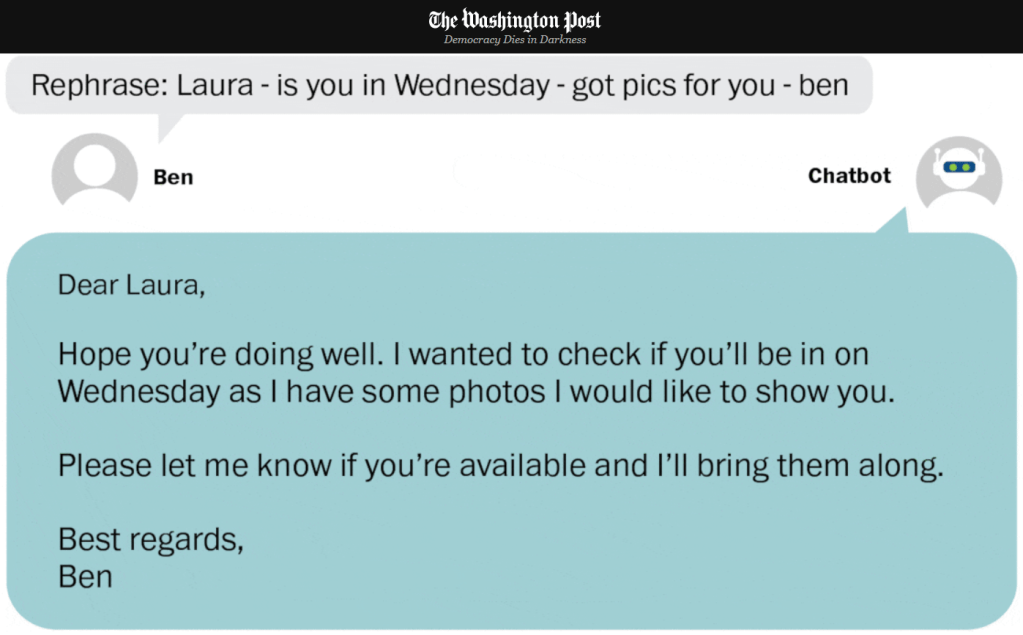
Back to ChatGPT and the “plagiarism panic”. Too often we forget the upsides of a new technology in all the swirling panic about its dangers. For LLMs like ChatGPT these include levelling the playing-field for people with disabilities or assisting people for whom English is an additional language. Make sure your EAL students have access to it and know how to use it. Discuss with your SENCO how students might use it to overcome learning difficulties like dyslexia and dyspraxia. As this article explains, it’s already helping a landscaper with low literacy write professional-sounding emails to customers (see image above), and writing assertive letters to a landlord on behalf of a shy tenant regarding a water leak (the leak was fixed in 3 days). We demonise this technology at our peril.
And with any luck, ChatGPT might bring down the GPA system and its pale imitations in the UK, with all the inequities those systems perpetuate. Which can’t be a bad thing.
If you enjoy my blog, why not buy me a coffee? And I talk much more about AI in the context of the Computer Science GCSE in my book.
If you are grateful for my blog, please buy my books here or buy me a coffee at ko-fi.com/mraharrisoncs, thanks!
Last Saturday, 25th February I spoke at “I Love Computing 2023” a FREE Festival of Computing CPD in London, details at bit.ly/lovecomp23.
I was honoured to be among some of the biggest names in Computing education today, including Jane Waite, Sue Sentance, Miles Berry, Paul Curzon, Phil Bagge and Elli Narewska.
My two talks were on the following (after the ad break…) NOW WITH PDF LINKS TO THE CONTENT.
Advertisements
The Computing Ofsted Research Review and preparing for a Deep Dive
Understand what OFSTED are looking for. What are declarative and procedural knowledge anyway? How do I deliver the National Curriculum at KS4 if they don’t all take the subject? Alan served on the working group that created the Ofsted Research Review and has interviewed successful OFSTED Deep Dive recipients. Attend this talk to help prepare for OFSTED and be relaxed about their next visit. UPDATE – PDF available to download below.
Beyond Mnemonics – teaching for mastery through PCK – a GCSE Computer Science booster
Do you feel you are teaching for “surface learning”? Are you using tricks and schemes such as mnemonics to get them through the exams, and would rather teach for mastery but don’t know how? Alan’s book “How to Teach Computer Science” is all about the hinterland, the background knowledge that illuminates the subject and helps you teach it with confidence, and pedagogical content knowledge (PCK) – the “how to teach” knowledge that helps you succeed. Alan will explain why this “hinterland” is important and what PCK is and how to acquire it, and how to use both for mastery learning. UPDATE: PDF available to download below:
All attendees go into the prize draw for a copy of my book, and there are other, far more desirable prizes available too! At the event I will also reveal a discount code for 30% off either of my books, generously donated by the publisher John Catt Educational (part of Hachette). Update – read my PDFs for the code, available for one more week!
Video recordings of my talks from last year’s online conference are saved here, where I spoke on the “hinterland” and on demystifying computer networks, and if you enjoy those, I hope to see you in Tottenham this Saturday.
If you are grateful for my blog, please buy my books here or buy me a coffee at ko-fi.com/mraharrisoncs, thanks!
Learners need a secure mental model of computation
PRIMM
If you haven’t done so already, you should study the “PRIMM” model of programming instruction, which suggests five stages of interacting with new code: Predict, Run, Investigate, Modify, Make. You can read more about PRIMM in the Teach Computing quick read at helloworld.cc/primmquick and on the blog primming.wordpress.com.
The block model
During the “I” phase of PRIMM, while investigating the code, students should be encouraged to ask questions about it to deepen their understanding. You can prompt them with questions such as:
What would happen if you swap lines 2 and 3?
What would happen if you give it input of ___?
What if you change the symbol on line 5 from > to < ?
Line 5 shows a condition-controlled loop, why do we call it this?
What will make the loop end?
Advertisements
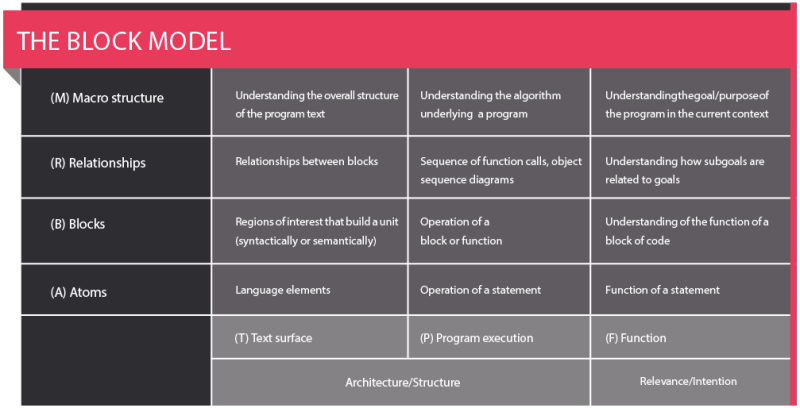
We can check we are encouraging valuable thought across the whole range of programming skills using an approach called the “block model”. Devised by Carsten Schulte in 2008, the block model has a grid with two axes, one showing the size of the programming element under consideration, and the other the distinction between the structure, execution and function of the program:
If we map our questions and activities onto the block model, we can then identify any gaps. Adding more tasks in those gaps will ensure that we cover the whole grid. In this way we ensure students are thinking hard about the full range of skills required to thoroughly understand a program.
The block model is also explained in “Computer Science Education” edited by Sue Sentance and the new version is available now for around £25 here amazon.co.uk/dp/135005710X. I summarise this principle and many other programming pedagogies in my book “How to Teach Computer Science” available for under £15 here: httcs.online.




 )
)



 How to Teach Computer Science
You must be logged in to post a comment.