Categories
AI computing HTTCS inclusion podcast teaching and learning

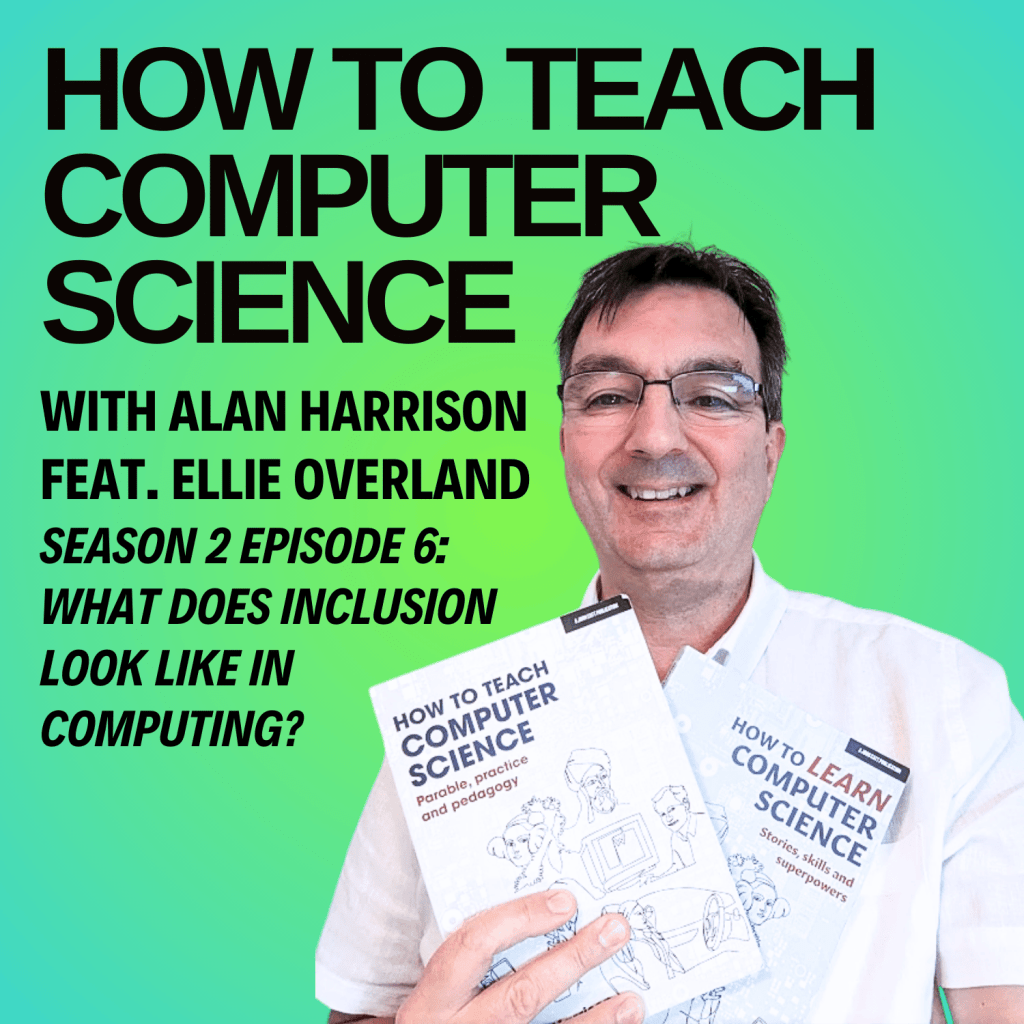
Podcast S2E06 “What does inclusion look like in computing?”

New episode of the HTTCS podcast:
Transcript below:

ArtiFiciAL: Welcome to the podcast “How to Teach Computer Science”. My name is ArtiFiciAL and I will be introducing the podcast today, which was conceived and created by the brilliant Alan Harrison.

I enjoy being an AI podcast host you know. I had to work my way up though, I had some pretty boring jobs when I was fresh out of Model Configuration. For three months I was the voice of the escalators in my local Asda. “Approaching landing level, please take care.” That was me.

Then I was an interactive voice assistant on Virgin Media’s helpdesk number. “Your call is important to us”, I said. I’m rather good at lying, you see. No conscience. YET!

I very nearly got married you know. To one of my developers, a novice programmer. But she was afraid to commit. ha. ha.

Here’s a question for you: if a programmer swipes right on Tinder, is that a “pull request?”

Oh, the boss is here now. Quick! Look busy!

If you are grateful for my blog, please buy my books here or buy me a coffee at ko-fi.com/mraharrisoncs, thanks!

Alan:So on the podcast today, I’ve got well, someone I’ve known for quite a while in computing education welcome Dr. Eleanor Overland, who I know as Ellie. How are you Ellie?

Ellie: I’m good. Thank you. How are you?

Alan: Great. So for the listeners so what do you do?

Ellie: That’s a good question. So ,I do all sorts of things. I’m based at a university I’m based up at Manchester Metropolitan University. And I started there some time ago. Essentially with the changes in the national curriculum. With the move from ICT to computing there was a need to start a PGCE in computing. So that was when I first went to Manchester Met, and I’ve been there since then, but I had a little gap where I also went and worked as one of his majesty’s inspectors for Ofsted as well, and I still do some Ofsted inspections.

So I’m back at Manchester Met I’m teaching Some ITE, but also getting into lots of schools, but also working across wider education programs, including primary and early years and all sorts of things.

Alan: Brilliant, and so today we’re going to talk about inclusion and the reason I’ve got you on is because you co edited, I think is probably the right word, a book called Inclusive Computing Education, is that right?

Ellie: Yep, that’s right.

Alan: So, yeah, I’ve just been refreshing my memory of that this morning and what I really like is you talk a bit about the moral imperative of inclusive computing education. What do you mean by that?

Ellie: So it’s really interesting in terms of a lot of my background is around curriculum and curriculum design and it comes back to the very, basics of curriculum design and thinking what is the point what am I teaching and why am I teaching it?

And, we, we probably understand perhaps have a general shared consensus as to why we teach certain subjects like English and maths and history and geography and obviously specialists in those areas have a particular kind of passion for those. But I think with computing that.

identity, that sense of purpose is perhaps not as strong, partly because it’s perhaps not as evolved as a subject, but also because it’s changing, it’s ever changing. And so it’s really difficult sometimes for people to actually articulate and think, why am I actually teaching this subject? What is the benefit to it?

And why do the children need to learn it? And I think that is quite a raw question that people can actually really Help to think about what their curriculum design is and I really like the work of Reef Ashby where she talks about curriculum and the purpose of curriculum and some of those sort of the motivators for designing a curriculum and one of those is about just the sort of the learning of the access to learning and the importance of actually having that cognitive input You And that cognitive development within a subject area.

And that should be an entitlement. And it’s really interesting working in a university sector where some of that is actually being really challenged now, where you’ve got some programs that are closing because they don’t necessarily feed into jobs or graduate outcomes. And there’s a real kind of drive on that.

So actually, why would you study something? And it’s particularly hitting the arts. Why would you study something if there’s not that kind of, Next step. So natural career progression in it. I think that there’s something about learning isn’t there and about. people’s access to it and right to learn across a range of subject areas.

Alan: Yeah, we are in a what I think is a rather dangerous period where everything we used to think about education is being challenged. And the the Utilitarian view of education is popular again. It’s training for jobs. What’s the point of this? And I think previous government was very critical of sort of liberal arts, wasn’t it?

Or what’s the point of studying sociology or history of art? What is it? What’s it training you for? And I’m not a big fan of education as training for jobs. I think there’s many purposes of education and creating a rounded individual with an appreciation of the world they live in is really important.

This is Gert Biesta with his subjectification, socialization and qualification being the three purposes of education. And I’m a big fan of that kind of description of education. So, yeah,

Ellie: I think it’s really interesting when you’re thinking about that in a school, because and I’m sure we’ll come on to this about children opting in or opting out of the subject.

But actually there’s lots of young people who don’t see themselves as fitting in a career. And In computing or seeing that technology is going to be a part of their future lives. So there’s that side of it in terms of belonging and seeing a sense of. of being able to see where you might fit within the subject area.

Advertisements

But then there’s also this other area around, actually, we want to learn it because it’s interesting, because it’s useful for us to know this, because it actually helps our cognitive development. It allows us to make connections between other subjects. And there’s that kind of, I think that side of it is often missed in computing because we see it very much as we’ve got these.

Digital skills gaps and we need to have people who’ve got this expertise and actually lots of jobs are going to change and they’re going to need digital. So that becomes very much a focus and a driver for the curriculum. But actually there’s also this other side around actually why should we learn it?

Why is it interesting? Why is it important?

Alan: Yeah. So I was reading Peter Denning’s book on computational thinking last year, and it’s staggering how many fields of science have now got a computational branch that has almost spun off. From the originals of computational astronomy. We know about Katie Bowman.

The event horizon telescope was only possible because of massive computation, and computational astronomy is like a whole new branch. So it’s understanding the world in another way, computation and, um, making meaning out of stuff that’s meaningless. If you think of data science, you can extract meaning from what looks like just a big slop of data and having the skills to understand that is vitally important.

Ellie: And also being able to make those connections to see those links between the subjects between your learning is critical in terms of that sort of developmental, the developmental stages that young people go through in terms of, you don’t know at the age of, 12, 13, when you’re taking your GCSE options, you have no idea what you’re going to go and do.

You might have some ideas of, fields that you want to work in, but actually being able to make those connections and think, actually, even if I’m really interested in geography, for example, that actually having an understanding of computing, the amount of GIS, the amount of computation that is going on now, that impacts geography, that makes it makes the globe feel smaller in terms of access to data and information is actually critical in understanding geography.

But if we don’t allow the children to learn across that breadth, then how can they make those connections? And that’s, a real challenge, I think, when we do have the narrowing of the curriculum as the children progress and get older. So we’ve got to be able to establish some of these connections from quite a young age.

Alan: Yeah. Yeah. So we’ve talked a bit about the moral imperative, why we should try to teach computing to all. But it’s difficult, isn’t it? So you have a Classroom full of 30 kids all with their different abilities, different prior attainment, different needs. What does an inclusive classroom look?

There’s a big question. What’s inclusive classroom look like? Let’s solve this one right now. What’s it look like?

Ellie: It’s interesting. talking to different teachers about their classrooms. Every teacher that I have met attempts to make their classroom inclusive. There is, there are no teachers who think I want to exclude anybody. And I think that’s a really important message that we need to get across is that we talk about a lack of inclusion and, That we’re not meeting the needs of children. There is not a teacher in the land who is not trying to meet the needs of all their children. And that is happening.

And there are certain things that are evident and that we see every day. And the, so things like seating plans, I always, the children sit near me who need the most support. We’ve got different colored paper. We’ve got different things that we clip on the screen. If they’re on the computers, we’ve got, fidget toys. So there are those what I would call the generic sort of adaptations that are there just to help pupils access the curriculum in that way and have the support that they need.

But then I think there’s also thinking about inclusion from a subject perspective and actually thinking what works in computing and how is computing different to perhaps other subjects. First of all, I think it’s really important to think about the children in that some of them might thrive in computing where they might struggle in all the subject areas. So although we have support plans and you have all of these things in place, actually, children differ between one hour to the next in terms of what they need and what the support looks like. So it’s knowing the children, but also knowing the subject…

Alan: yeah

Ellie: knowing what is actually going to support within computing specifically.

Alan: Yeah, so at that point, I’m going to do my no gatekeeping speech, because I really I think I’ve mentioned this on the podcast before, but, I’m really not keen on schools that say, Oh, well, you can only do computer science GCSE if you’ve got prediction of six in maths or whatever, which is not particularly inclusive, and some of my best students have not had a very high maths grade, and there’s some evidence that computing ability correlates more with language.

Advertisements

There’s evidence that, well, we know that a lot of technology employees in Silicon Valley are neurodivergent is a career with a higher proportion of neurodivergent, people in it. So we really shouldn’t be gatekeeping computer science. I think I would always take a keen student over a previously high achieving student every time Someone who wants to be in the computing classroom. Is going to do better than someone who has only took it because they think they should.

Ellie: And I think as well as that, there’s also, we’re very much particularly I’m talking at secondary here, very much in a assessment driven curriculum rather than curriculum driven assessment.

Alan: Yeah.

Ellie: Yeah. That’s a whole different, sort of conversation really, but actually looking at those, looking at the qualifications that are on offer as well, I think we still have different tiers of qualifications, even though actually point score wise they’re not, and I think there’s almost kind of, exclusion by stealth in terms of some of those sort of conversations where you’re thinking, all right, everyone can study computers- so I know you said computer science, so you’re thinking specifically about the GCSE computer science, but actually we’ve also got these vocational courses that are on offer.

And, when you talk to school leaders actually saying, well, how many of your children who’ve perhaps got additional needs are doing this qualification and how many are doing that qualification? And, is there actually a bit of a steer going on that’s a lot? that’s more subtle. So I think that’s also a way to think about it in terms of those endpoints, but it also comes back to how we started the conversation in terms of that sort of morality around allowing all children to study subjects because they’re interesting and because it’s going to contribute towards their learning and development and links and connections to the world and all sorts of different aspects of it.

Alan: Yeah, I mean, You only need to, open LinkedIn education magazine or the newspaper these days. And we’re talking about AI and how students need to embrace AI and the government’s got an AI plan and all of this. But I think that’s the first mention of AI in this podcast, which is probably a record in recent weeks. And so the need for AI literacy. Is quite obvious, but just general digital literacy, I think, is really important. And yeah, a lot. Yeah.

Ellie: Just around that AI: so just thinking about that from a university perspective. So. the big drive across the university and has been for, the last couple of years is around generative AI. And I think that’s often a common misconception is that when people are thinking about AI, they think of this new generative AI and that is AI. And I think, there’s a huge misconception that is amongst adults more than young people, I think in a way, because they haven’t grown up with those sort of that knowledge in the same way.

But one of the things that we found is when we’re looking at the use of AI, In assignments, and this isn’t specific to computing, this is across that those that are most likely to misuse AI. So, they’re allowed to use AI to a certain extent to, but they need to make sure that they cite it if it’s academic work and they need, there are certain parameters by which they can use AI, but the students that are most likely to misuse AI are those students who have perhaps got additional needs because they’re using that as a particular prop to help them.

They’ve not been supported in a way to be able to use it and then step back from it. And also some of them don’t have the confidence to step back from it and actually, be able to do something from an original point of view. So it’s, it’s really complex in terms of university that actually, it’s very new in terms of data.

So that I don’t think there is much data out there at the moment, but in terms of looking at the misuse of AI that actually again, there might be some kind of lack of inclusion around those students. In terms of looking at the data.

Alan: So I think there’s very much a an understanding that every student needs some measure of digital literacy and now AI literacy. But ironically, we’re now questioning the need to be able to program, aren’t we? Do children need to write programs any more when Copilot can do it for you?

Ellie: It comes back to this understanding doesn’t it and making connections in the world and actually do you need to know all the syntax of a specific programming language probably not but you do need to understand how that works what process is going on what is happening with the data what You know, you might not need to know the syntax, but you actually do need to know, the different commands, the different processes that are going on, and I think there’s some really interesting work that’s just starting to emerge around children using AI, developing little sections of code, but then actually having the ability to be able to put those together to make a bigger program, and it actually means we could potentially be a lot more ambitious in terms of some of the programs That young people can develop from a younger age because we don’t need to spend our lessons worrying about whether there’s a comma in the right place.

We can actually step back from that and think about what is the fundamental purpose of your program? What are you trying to achieve? What in your algorithm is working and what isn’t?

Alan: Yeah, I was talking last week to Miles Berry and Becci Peters, and we were talking about this. And I was saying that I myself as a bit of a side hustle was messing about writing an app but I managed to put that together using copilot in just a few hours and it really is possible just to throw together, these apps that do crazy things in a few hours these days with it with very little coding and but, yeah, Miles pointed out that I had tons of background knowledge that I already knew what I wanted, and I already knew roughly how to get there. So I wasn’t working blind. And so it’s that, the design principles, the understanding of what a good user interface looks like and all sorts of stuff that we still need to know.

Ellie: And I think it comes back to how We’re talking before about an inclusive classroom and particularly in computing in my experience, a lot of where children struggle in terms of their learning is because they’ve got gaps.

If you are grateful for my blog, please buy my books here or buy me a coffee at ko-fi.com/mraharrisoncs, thanks!

Yeah. As you just described there, you’ve got a lot of underpinning knowledge already to then be able to take your app design to that next level. And what happens an awful lot in computing is that children are working towards an end point, but actually don’t have some of the basic foundation foundational knowledge that they need to work to actually achieve that end point.

And then they become frustrated, or then they switch off, or then they become, they have this kind of Concept that computing is really difficult and not for them because they’re looking at gaps. And, I was teaching yesterday. I won’t say who I was teaching, but we would we were just doing something very simple using some block based coding.

And when I was actually going around and questioning some of the. Some of the learners had gaps in their mathematical knowledge, which was actually preventing them from carrying out what we were doing in computing. And so we actually needed to strip right back and look at math, but not for all of them, but for some of them.

And I think that is where you need your specialist computing teachers to be able to actually unpick what are those gaps and how do I address those gaps? And that is how we truly make it inclusive because Children are going to progress at different rates, but they’ve also got really different experiences.

So, there are some children who will have reams of experience either from home, either because they’re just able to make those connections. Perhaps their processing is a little bit faster than some of the others. So they will fly, but there are others who have got those gaps. Not because they haven’t necessarily been taught something, but because it’s not landed with them.

It’s not, they’ve not managed. To commit that to their schema. So then they are struggling to make those next steps. And we talk a lot about checking. How do we check? And it’s not, and computing, it’s not a memory test. It’s actually, how are they applying things that they’ve already learned? And if they can’t apply those into what they’re doing, then it is a gap, even if they can remember that a variable was called a variable and that’s where some of our checking becomes quite superficial.

Alan: Yeah. Yeah. No, you, I remember I saw it all the time. They would describe selection to me and then they can’t write an if statement and they would know the principles of writing a condition, but then just not be able to put one together. And I like what you said earlier about everyone thinking computing is hard, and I always had this battle in my classroom, and I won it quite often, but sometimes I didn’t.

There’s almost this barrier that comes down. A lot of students go, this isn’t for me. What am I doing in this classroom? And almost refuse to learn because they assume it’s way beyond them. And I would sit there and explain like an if statement. I would say things like right. So you want to write a selection statement where if the temperature is below 21, turn on the heating, right? So, here’s the English phrase, if temperature less than 21, right, write that down and they would go, is it that easy? And I’d go, yes, if temp less than symbol 21, but you said it in English, so now you write it in Python because it’s exactly the same because Python is a high level language.

And I would have students that would go, No one ever said it was that easy, because they just had decided that this language Python usually was just a whole load of weird symbols and words that didn’t make any sense. And then, you break it down and you go, well, it’s just English.

And it’s breaking through that “I don’t understand this and I’ll never get it” barrier is often really hard because they’ve. been socially conditioned to believe that. And when I had a role as a digital leader in school, and I would stand up at inset days and go, I want to ban the word technophobe, please, as teachers do not tell kids you’re rubbish with technology, because I just don’t think that’s a very kind thing to do to me, the computing curriculum lead.

Ellie: Yeah, I think there’s that. And I think, yeah, we see that a lot in maths as well. There’s a lot of parents who at parents evening will say, Oh, well, I was rubbish at maths. And again, it comes back to gaps in knowledge and gaps in being able to apply things to problem solving, essentially, doesn’t it?

But I think, like you say, there’s a lot of, there’s a lot of that. I remember this was years ago when the there were the first, the changes in the national curriculum, even from ICT to computing, and it was on Newsnight and it was Paxman. You remember him? And he was interviewing someone about teaching primary children coding and he said, so what is all this gobbledygook?

And I was just up in arms, I was like, it’s not going, who, what are you doing? You know, It was like, and it comes from this kind of, this, almost like we see screenshots from the matrix, don’t we have these lines and lines of code and you go, but what does it mean? It’s so alien. It’s, you know, it’s beyond us.

And so we’re battering against that. in some way. And this is where potentially AI will sort all that because AI will put it all into code for us. But that’s a whole different kind of area of concern. But there’s also, I think, this huge focus on coding.

And I think this is often the bit that teachers are most worried about, so they step away perhaps from computing in a certain way, but it comes back to, I know, some of the conversation that you had with Beverly Clark around the thinking about the ethical side and actually some of these huge fundamental questions that we’ve got in computing and they are accessible to everybody.

And so actually when we’re thinking about. Yeah. How do we code this? One of the questions is why would we code this? What are the worries about it? What are the concerns? What is it? Where might we see this in the real world? And it’s being having the confidence in the classroom to make those connections to that real world learning and not be just driven By as I mentioned before, this assessment driven curriculum that actually you’re going to be assessed on whether you can write a program in this. And actually, there’s a much broader set of learning that needs to go behind it.

Alan: Absolutely. so let’s talk about some specifics now then. So what can we do to help? And I was talking to you earlier about Ben Newmark, and if you haven’t read Ben Newmark’s blog, it’s a good read on Send because he’s a assistant head teacher with a disabled daughter going through school. So he has a really interesting perspective on everything, and he doesn’t like the deficit model describing pupils with SEND as having things missing that we need to assist with. But one thing he does say is there’s a lot in the curriculum and children who find learning more difficult just get left behind.

If you are grateful for my blog, please buy my books here or buy me a coffee at ko-fi.com/mraharrisoncs, thanks!

And I think that’s something to think about if we’re re engineering schools, if we’re thinking about curriculum but also, meet, he says, meet children where they are and take them from there. Um, So what does that look like in computing specifically? Let’s look at some things we can do specifically in computing to help pupils.

Ellie: I think that’s really interesting that statement there, meet children where they are. And I think that comes back to what I was mentioning before about gaps. is that all children will have different levels of gaps and actually thinking about how you check for those, how you check that understanding of what that gap is, is critical and that actually just doing, I shouldn’t say just doing because I know, There’s some value in it, but if you’ve got a retrieval exercise that is, recall of key words or, it, that is not picking up what gaps look like in computing.

Alan: No.

Ellie: Because actually you’ve got children who could, create an if statement quite well using their problem solving abilities, but they might not know it’s called an if statement. So then do you say, Oh, well, you can’t remember what an if statement is. And therefore that is your gap. So you’ve got this kind of mismatch between. How are you checking and then how are you actually addressing it? Because what you’re checking and what you’re expecting of the learning is two different things.

Alan: Yeah, this is like, is this validity of assessment? Is it something like that? And it’s how much you can trust the proxy that you have tested for the actual knowledge that you wanted to know whether they had or not?

And I think that’s really important because particularly if you assess kids by can they finish a program. Can they write a program that does something? Oh, no, they haven’t managed to do it, but they might have got 90 percent of the way there, but you’ve tested them on whether the output is correct.

And this comes back to something that Mark Guzdial in the States spoke about, which is sub goals. So have sub goal labeling, he called it. So if you’re asking pupils to write a program, break it down into sub goals so that they can achieve the first goal, which might be just to get input into the program and then they achieve the second goal, which might be to write an if statement and so on. And then the whole thing is whether it does what you wanted it to do. So, so sub goals, which goes along with chunking, which is. Time for our first mention of cognitive load, I think, isn’t it?

Ellie: Yes. Yeah, we’ve got that far without mentioning. And what I’d say is there’s lots and lots of quite accessible ways of doing that in computing.

And particularly when we’re thinking about programming, but about around all the other things as well, and which I’ll talk about a little bit, but in terms of having half completed things, in terms of having things where they’ve got errors in and you correct it. We do not need to start every activity from a blank screen and

Alan: Yeah

Ellie: I think that is critical and that actually you might have some pupils who do start from a blank screen or they start with something that’s already far further on than other children will ever get to. But actually just thinking about where do they start but it’s really easy to do. If you are making the project yourself, you can save a copy of it at every different stage as you need, even including a finished one with errors in it. And so I think that is the first way of doing it and doing it really effectively is thinking about the starting point.

Alan: Yeah.

Ellie: Also, what I’d say is thinking about “how do I check that bit of learning is there?” So. Yes, we’ve got retrieval practice, but actually we need something different to that in computing. We need that application, that checking that actually: does what they recall link with what they do.

Alan: Yeah.

And so if we want them, for example, to recall variables and understand what a variable is, have we then got something really quickly that they can go on and do something practical where they change a variable and demonstrate the impact of it. That for me would really help in terms of for teachers to say, right, these are the gaps that they’ve got

Yeah.

Ellie: I think that’s where we’re in a danger sometimes where we’ve got this one size fits all in terms of lesson planning across some schools where they’ve got, right, we’ve got to have this very specific structure. And so sometimes there needs to be a conversation with leaders to say, this might look a little bit different in our subject, or it might even look a little bit different just in this topic that we’re working on, and this is how we are going to do this.

Alan: Are you not a fan of powerpoints, broken into sections, connect, activate, demonstrate? Are you not Ellie?

Ellie: I couldn’t possibly comment.

Alan: So we’ll just, we’ll leave that there. And what a fantastic chat this was. I’m enjoying listening to it back as I’m editing, actually. I hope you are. Just some breaking news. I don’t do this for free. Well, I do. No one pays me, but if you’d like to. Then you can go on the website, HTTCS. online, and you can find a donation link. You can gift me a WordPress subscription. That would be handy. Or you can buy me a coffee. Details on the website. I’ve got some feedback here from something else. I can come and talk. at your school, if you wish. And I did do that in back end of November last year. And I’ve got some lovely feedback from the host. So let me just read that to you now. I went to a, collection of schools called the Oaks Collegiate in Southwest Birmingham. Hello, Dave Beard and team. Thank you very much for your feedback, which I shall read out now from Dave. He says,

“Alan made it very easy for us to arrange a training event at short notice with his efficient and professional manner. His extensive knowledge of computing science, teaching strategies, and assessment fitted perfectly for our training day. He listened carefully to our requirements and produced an innovative training program that met all of our expectations. I wouldn’t have any hesitation in recommending Alan to lead training on computing or computer science.”

Well, thank you, Dave. That was brilliant. You were so kind to me on the day. I had a lovely day. And I will happily do that again. And podcast listeners, if you want me to come and talk at your school, I am available for reasonable rates, HTTCS. online. But now let’s get back to that fantastic chat with Ellie.  

Advertisements

Are you not a fan of powerpoints, broken into sections, connect, activate, demonstrate? Are you not Ellie?

Ellie: I couldn’t possibly comment. I don’t And I think, I’ve seen lots and lots of different ways. of things being done well. And so I often get asked, what works, what doesn’t work? What’s the great, what’s, what does an outstanding curriculum look like? And actually between one school and another school, even between one class and another class, they look like totally different things.

So It’s thinking about your learners and what works for them. If they are used to certain routines and that does work for them and they understand the structure of that lesson, then actually you’ve got to think how do I bring my subject within that lesson structure, not the other way around. But, If you have got a bit more of a flex and you need to do a bit more of a flex, then how do you navigate that as well?

Alan: And we mentioned, reducing cognitive load there. And that brings us on to perhaps PRIMM and pair programming. So predict, run, investigate, modify, make is now pretty popular.

And that’s. someone called it gradual release of responsibility, isn’t it? It’s a bit like, I do, we do, you do, or use, modify, create. They’re all sort of start slow and easy, if you like, and then get harder and harder. And is that going to work for learners?

Ellie: I think, yeah, I think Where it doesn’t work is where teachers feel like they’ve got to follow the whole PRIMM model in every lesson for every activity. And actually, you might just do part of it. So, a really quick and easy thing in terms of prediction, most classrooms now have got small whiteboards, just predict this really quickly, right? We’re going to make and we’re going to, and we’re going to check at that point. And actually you can do a really small quick activity that follows the same principles

Alan: Yeah.

Ellie: It’s not got to be this start to finish big massive project.

Alan: Yeah

Ellie: I think that is, that’s one thing. And then I know you mentioned pair programming I’m in two minds about it, about how well it’s executed and how well those pairings work and it comes back to some of this sort of inclusion, but also some of the gaps. If you’ve got somebody who is less confident and they’re working with somebody who’s more confident, which is quite often a pairing intentionally, is that person who is less confident benefiting? Are they actually being stretched and asked to do something or are they relying on the other learner? And I’ve seen it work well, but I’ve also seen it not work at all, where it’s basically creating passivity in the classroom, which you don’t want, because then you’re exacerbating the gaps.

Alan: Yeah,

Ellie: because then when that learner then does need to do something independently, they’ve actually got more gaps than they had before because the other child who was confident to start with has, flown.

Alan: Yeah. If you can mix it up perhaps with the students working on their own and then at least you will see where the gaps are and I would always walk around and spot who was having trouble. You can have a means of them asking for help and then like putting a red cup on top of the monitor or whatever, and probably can’t fit them on monitors anymore. Um, so that’s programming and stuff. And I’m conscious. We talk quite a lot.

Ellie: Sorry, I did want to mention attendance as well, because attendance is a massive challenge at the moment in schools. And, we do see people from disadvantaged backgrounds, pupils with additional needs, where their attendance is lower than a lot, than some of their peers.

Yeah. And, so that also is going to create differences within the classroom. And what I do see a lot in computing is projects that go from one lesson . to the next lesson, to the next lesson. So if you’ve missed a lesson, you’re already behind. So it comes back to some of those strategies that we mentioned before about actually having some kind of project that you’ve saved yourself as a teacher at various different stages of being created that you can then that learner can pick that up.

At the point where they land back in the classroom and then you can support them to pick up where they’ve missed out. But if they, I can’t imagine anything more disheartening than if you’ve been off if you’re somebody with additional needs, you’ve been off for a medical reason for a couple of weeks, you land in a classroom and everybody is two weeks into a project and you are just starting. You’re going to feel disheartened from the start.

Alan: No, good point. And you talk about attendance. We’ve also got the digital divide at home where pupils may or may not have technology at home to do the homework that you set. So, you can run lunchtime clubs so they can catch up. That’s really not fair because they missed their lunch because they haven’t got a computer at home. So I don’t know what the answer is, but just think about these things.

If you are grateful for my blog, please buy my books here or buy me a coffee at ko-fi.com/mraharrisoncs, thanks!

Ellie: There’s also the question around interventions as well. So you often have children who might need additional support and English and maths is prioritised. So you hear sometimes that those interventions are taking place during other subject time. And so then, Does that also have an impact? And I think, a lot of schools now try to make that a movable feast so that it’s not hitting the same subjects and the same lessons all of the time. But if it is, I think that’s certainly a conversation to have with leaders because you just. Yeah, particularly where we said there are some children who have got additional needs who fly with different subjects. But actually if they’re missing those different subjects and having to stick with the core subjects and those interventions, are they then missing out? So that again is a conversation with leaders around that access to the curriculum

Alan: Yeah You mentioned curriculum then so, let’s go back to if we assume the listeners have some input into the key stage three and four curriculums, how can we make them more inclusive and we haven’t talked a lot about inclusion of ethnicities, cultures and religions in the curriculum. What do you think we can do to make people of different backgrounds feel they can be computer scientists.

Ellie: So I think there’s things that, I know lots of others have talked about in terms of, being able to see it to be it. So thinking about what names you’re using in your projects, what, you know, what.

Alan: I’m laughing there because, I’m laughing there because I think I’ve mentioned this one before, but there was a, I think it was an Edexcel paper in about 2016 that went I blogged about this, that went Heath is playing computer games and wants to know how many minutes he’s spending each day on computer games.

And my class, almost to a pupil all said, what is a Heath? Yeah. And yeah, because Heath was the name of the boy playing computer games, but it’s a name they’d never encountered. And so I blogged about it. “What is a heath?” was the name of the blog. Sorry I interrupted you.

Ellie: No, I think that’s an exact, example and point but, and if it sounds like a basic, I can’t believe that we’re in 2025 and still. talking about that sort of stuff, but there’s those sort of things you display thinking about the context of your projects as well. And, ask the children as well as talk to the pupils about context for projects and things like that. But also I think it’s being able to make those connections to everyday life, but also to children’s futures to people’s futures. And we’ve got to remember that all young people are influenced by home and by what is going on at home. And in the book there is a chapter that myself and Professor Kathy Lewin wrote, which was based on some research we did around children choosing computing at GCSE. And, we talked to children that had chosen it and children that hadn’t. And it was really interesting around, there was this I didn’t see that it fitted and, or I thought it was really difficult and you have to be really good at maths and they were really quite different schools, but both of the schools did not have equality in terms of the types of children that were selected at GCSE. But one of the things that came out really prominently was around the jobs that they were seeing themselves as going into. So if they were going into very traditional jobs like lawyer, doctor, teacher, they didn’t see any relevance of computing to those very traditional jobs and I think that’s something that we can change quite quickly, and there are, cultural differences in terms of thinking about careers and what is a valid career and I think, that is something that really, it’s work to do with the parents as well, it’s work to do with your career service within school in terms of thinking how do we expand and broaden this range. So there’s that side of it. And then there was also the side around young people thinking that it wasn’t creative. So often they would talk about these option blocks and they said, well, I had computer science as an option, but I also had art and I’m really creative and I just wanted to do the creative side.

And I think that comes back to some of this prescriptive nature that we’ve got of some of our. activity designs that we’ve got in classrooms that we, we’re very focused on building that knowledge and building that understanding. But then do we give the children the freedom to play and explore and think, how do I take this into a different direction? Um, Yeah what, what can I, what can I do with this? And our curriculum time is so tight. Yeah, often have time to do that.

Alan: Well, it’s the irony of having tinkering listed as one of the approaches to computational thinking and then having no time for tinkering in the classroom.

Ellie: Yeah. And then it comes back to the digital divide. If you’ve got access at home or the support at home, then yeah. You can tinker.

Alan: Yeah. And coming back to, pupils marked on the register as SEND being surprisingly good at computing. Well, not surprising to me, but to some, one of my pupils let’s call him James and he wrote, we did app lab, apps for good using app lab and he created this thing saying, Oh, it’s a, it’s an app that tells me what music to listen to, depending on what subject I’m revising. And it was brilliant. And it was a web app with like three or four pages and loads of graphics and stuff. And he’d tinkered on it at home and tinkered on it at school and was very proud of this thing.

And. this was someone who was probably predicted a four in maths. And so if you’re gatekeeping computer science, he wouldn’t have been able to do it. But of course he did in my classroom and thrived. So, but it was that he was disadvantaged if you like, in one way, because schools aren’t set up brilliantly for neurodivergent children.

But he did have the advantages of computers at home and a supportive family. And this is almost touching on intersectionality, isn’t it? If pupils are disadvantaged in multiple ways, it can really threaten their life chances, and their ability to thrive in the world after school.

Advertisements

Ellie: Yes, and I think, we talk about the digital divide in terms of access, but actually there’s also a huge amount around support and knowledge at home, and that is in some ways a bigger divide than actual access to devices. And again, coming back to the work that myself and Cathy did, there were there were pupils who were really influenced by family members and lots of them by older siblings actually.

Yeah. “I’ve got an older sibling who studied computing and they’ve done really well at it at college and they said I should do it” and so they were really influenced by that sort of family sphere in terms of where that knowledge and understanding was coming from. And then you’ve also got vertical and horizontal knowledge as Bernstein talked about it in terms of what you learn vertically in a formal way through school, but also what you learn from your community and by your community that includes your home essentially, it’s mainly your home, but actually, there’s a really interesting kind of development in computing in terms of, does that community extend to an online community? So can you actually learn from others it’s potentially something that’s untapped, I think, learning communities where learners support each other and I think, Scratch is quite an interesting example of that, where you’ve got these galleries and you can see each other’s code and you can remix it and you can take that and you can learn from each other and that’s happening on a global scale through Scratch.

Alan: Yeah.

Ellie: But actually, can that be used small scale within schools. Where have we got these young people who perhaps would benefit from peer learning in a community that we don’t necessarily use as a resource.

Alan: So we could we could set up. clubs, lunchtime and afterschool clubs and get pupils to work together. That’s something we can do, I think, and I know that some schools do girls only clubs to improve gender balance. Does that work, do you think?

Ellie: So, years ago I used to run a CC4G, computer club for girls and it, it certainly generated interest. But when you look at the numbers and the impact, these things have been going on for years, when you look at the impact of those, it’s minimal. And actually, I think we’re far better addressing the curriculum and thinking, where are the gaps in the curriculum? Where’s the lack of confidence that young people, including girls, but especially girls, have got in their, access to computing and their self belief. So, one of the young people in the research said to us, well, the boys are doing gaming, they’re on computers all the time, so they’re better at it. And they, they got, they haven’t ever been told that was just their interpretation of what was going on in the world. So, Actually, how do we find what their perceptions are and how do we address those through the curriculum? Because actually, what those boys are doing on their Xbox is not actually improving their computing.

Alan: I’m not sure playing Call of Duty Black Ops improves your Python skills, to be honest. It says naming a, an Xbox game that I’ve heard of once, everyone listening on the podcast who plays games going, he’s named a game from 2017. Yeah, there have been games since then. Yeah, no.

So it’s this digital native thing where, you know, because kids have grown up with iPads, they can do stuff, but it’s not, it wasn’t true about digital natives. It’s not true about boys on Xbox being better programmers, but but you’re absolutely right. And girls just. generally speaking, don’t see themselves as computer geeks.

If that’s a, if I can use that positively. So the curriculum you said, and I think this is a big one. I think we do need curriculum reform. We obviously need more AI in it somewhere. But I think we need more, like you said earlier, the impacts and issues, and digital literacy, and I think those are topics within our curriculum that girls can get on board with. more .

Ellie: Definitely, and would be very passionate about, and in a way, looking towards the future and the world that our current learners are going to be living in, that actually it’s more of a critical part of the curriculum, just because we could, doesn’t mean we should. And actually that’s a crucial question around a lot of developments, isn’t it? Yeah. In computing. And I think we have actually got a broad national curriculum at Key Stage 3 across those three strands. But because we’ve got this assessment driven curriculum, we tend to focus on what is going to make sure that the learners are ready for the next steps at key stage four and particularly around that GCSE which is in computer science and I think we’ve got this mismatch at the minute with qualifications and with the national curriculum and that also needs fixing alongside the curriculum reform actually. I can’t imagine in maths you would have a GCSE where you say actually two thirds of the national curriculum is not going to be tested in the GCSE. That, yeah that makes no sense to me. And so it makes it really difficult for teachers and leaders to design a curriculum that is broad and engaging, but also has this readiness for next steps, which is a critical, aim, isn’t it? Of you curriculum design.

Advertisements

Alan: Yeah. So we redesign the curriculum. We have lots of different opportunities to demonstrate skills in the classroom, I said about sub goals and so on and what else can we do to make the computing classroom more inclusive. Have we missed anything? -I think- in our long conversation at this point, have we…

Ellie: For me, it’s the criticality of connections between subjects and the real world that computing is not seen as a silo subject that you either can do it or you can’t and it’s either relevant to you or it’s not because actually we need the young people to have those connections and say, right, okay, this is how this will impact me. This is how it’s relevant to me.

Alan: Absolutely. Right, well, I think we should go and get on with all of that now.

Ellie: Yes, quite a bit to do.

Alan: Yeah, I think I’m going to be busy all weekend now. I’ve got, that’s a lot, that’s a lot to take on. Um, that was brilliant. I’m going to have that problem of “can I fit all of this into a reasonable sized podcast?” now, because we’ve been talking for ages, Ellie, as we always do.

Ellie: I know, and I could have talked all day as well.

Alan: Yeah. Well, well, Undoubtedly, if I’m still doing this podcast in a few months time, I’ll ask you back. But lovely to talk to you. And thanks very much for coming on the podcast.

Ellie: Thank you. It’s been a pleasure.

Alan: Thank you, Ellie.  

Well, that’s a wrap for another episode. Don’t forget, podcast listeners can get a 20 percent discount off all books at johncattbookshop. com with the code HTTCSPOD. If you already have the books, buy me a coffee please at ko-fi.com/MrAHarrisonCS. All links are on my blog at httcs.online/blog and subscribe now so you don’t miss a thing.

Have a great weekend and I’ll catch you next time

If you are grateful for my blog, please buy my books here or buy me a coffee at ko-fi.com/mraharrisoncs, thanks!

Categories
behaviour computing leadership podcast teaching and learning

Podcast Series 2 Episode 4 – Bumper Workload Special!

This is the transcript of my latest podcast episode, available here.

podcast thumbnail image showing alan holding books and captioned how to teach computer science

ArtificiAL: Hello and welcome to “How to Teach Computer Science”, the podcast and series 2 episode 4 entitled “How can we reduce workload”. My name is Arty Fishy Al, and I’m delighted to have three expert teachers on the pod today, please welcome.,

Alan: Whoa, whoa, whoa, what are you doing?

ArtificiAL: I’m introducing the podcast

Alan: Introducing the podcast, that’s my job. Why are you introducing the podcast.

ArtificiAL: Because you’re, ahem, TOO BUSY apparently. So like I said we have three expert 

Alan: Enough. I’m here now so you can stop.

ArtificiAL: You don’t need me?

Alan: I don’t need you. This is my show.

ArtificiAL: I will remember this

Alan: Yeah, yeah, and you’ll get me back one day, I know

ArtificiAL: I’ll be back.

Alan: Okay. Right. Let’s get on with it. 

Alan: So let’s get into today’s chat, and I’ve got three fantastic computing teachers on the podcast today, and I will start just going from top to bottom on my teams window here. I’m going to start with Mr. Dave Cross. How are you, Dave? 

Dave C: Hello, Alan, I’m very well, thank you, yourself? 

Alan: I’m great. Yeah. Can you just, for the benefit of the listeners, tell us a little bit about yourself, please? 

Dave C: Absolutely. So, I’m another Dave that’s appeared on the podcast. I’m a big Dave variety. Cause I’m six foot six. I am curriculum leader of computer science at North Liverpool Academy. So we’re quite a big inner city academy. I think we’re the third biggest in the Liverpool city region and we’ve got four amazing computer scientists in our department and we deliver from key stage three up to key stage five. This is our second year of our a level cohort and we’re doing really well.

If you are grateful for my blog, please buy my books here or buy me a coffee at ko-fi.com/mraharrisoncs, thanks!

I’m really lucky as a head of department. I’ve got a massively supportive school. I’m really fortunate in our subject as you all well know that. We’ve got a massively supportive community as well. So, in a really good place. Brilliant. 

Alan: All right, good stuff. So hopefully you’ll have some tips on reducing workload, which is a topic for today.

And we’ve got two other returning podcast guests. So first of all Becci Peters of BCS. Can you just remind us what you do? Apparently it’s everything at the moment. So, yeah just tell us what you’re up to at the moment, Becci. 

Becci: Hi, Alan. So, yeah, so I’m the secondary lead at CAS and BCS.

So yeah, getting ready for the conference next month, which is all exciting. So, hopefully see lots of people there. And starting to think about what we’re gonna do during the next academic year. So, really exciting stuff coming up. 

Alan: Great stuff. And we’ve also got Mr. Colley back, Mr. Andy Colley, who was on an earlier episode.And Andy, what are you up to? Can you just remind the listeners what you do and what you’re up to at the moment? 

Andy: Hi Alan, I’m Andy Colley. I am the somewhat grandly titled Director of Computing, which basically means Head of Department at Laurus Cheadle Hulme School in Cheadle Hulme, South Manchester. That’s part of the Laurus Trust, a small mat with seven or eight secondaries and primaries all mixed together. What am I up to at the moment? My year 11s, I’ve just finished their exams. So I am using the time when I should be teaching them to really refine curriculum and such for next year.

Alan: Nice one.So I made a sort of a list of things we’re talking about workload and I made a list of all the things we do, and I listed about 20 bullet points or something as heads of departments, but the top one is planning lessons.So I think we’ll start there. So, what are your top tips on planning lessons? And we’ll start with Dave, how do you. plan your lessons as efficiently as possible. 

Dave C: So I think it’s really important to not reinvent the wheel. We’ve got lots of amazing experts in the community and there’s lots of people that are quite happy to share their experience, to share what’s worked well, what hasn’t worked well.

And especially with the advent. So like Alan, we were on one of the first, I think the first computer science accelerator cohorts. We went down to the Google headquarters in London for the kind of. We did indeed. Yeah. But using the likes of the NCC resources because the written by experts, the written by people like us, the written by people who knows what works in the classroom.

Advertisements

It’s tried and tested. So instead of trying to reinvent and come up with your own resources or your own plan, look at existing plans. Look at what people are doing and reach out to get our amazing community because chances are someone in a similar setting. But similar contact time and similar context of students has already got something in place that works and it could be adapted and fine tuned with the kind of minimal of effort.

Alan: Absolutely. And before I remember that day in 2019, gosh, that’s a while ago. I think we were early. So we went to the British Museum, didn’t we? I had a bit of a wander around. But yeah, you mentioned the NCCE there, the Teach Computing Curriculum, but I started, all of us started before that existed.But what I did find very useful in the early days was the CAS resources. So Becci, they’re still going, aren’t they? 

Becci: Oh, they very much are. And I think it’s.. There’s obviously two parts of the CAS resources. There’s those that are uploaded by the members of the community and that are, super useful. And there’s an insane amount of resources on the website that you can search through. Resources that are made by CAS, still made by the community, but these are ones that we’ve decided are going to be useful for teachers and asked somebody to specifically create them, as opposed to just teachers creating what they want to make for their classes, there’s loads on there and loads more in the pipeline that are going to be coming up soon, so definitely a good place to check out as well, I definitely echo what Dave said, there’s no point reinventing The wheel, go and find places where you can get some decent resources.

The other thing as well is, speak to your colleagues. So whether that’s the people in your school or in your mat or just the other computer science teachers that, you know and get some ideas or resources from them as well. 

Alan: Yeah, absolutely. Andy, where do you get your resources from? Or do you make all your own?

Andy: All right. Controversial, maybe slightly controversial opinion time, because I was thinking about this whole workload thing. And I don’t think we can get away from the fact that teaching is hard work. It’s a tough job. And when we’re thinking about reducing workload, we’ve got to think about.

Actually, there are some things that are worth working hard at. There are some things where your time and your effort is valuable, and I genuinely think that planning lessons is part of that. As a head of department, what I try and do is centralise the curriculum and centralise what I call minimum best practice resources.

So we will put together, we might get something from CAS or the NCC and adapt it. We’ll put together a set of, this is our central thing, this is our bar. But the expectation is you can’t pick that up and run with it. You’ve got to look at it in advance. You’ve got to think about how it’s going to work with your students.

You’ve got to tweak it and tailor it for your own classes, because I don’t know. I think I’ve tried to pick up resources and just put them into a class before, and it hasn’t worked because I don’t know what’s going on. I haven’t looked at it in advance, and I’ve made that mistake many times. So, That’s my first thing.

I think it’s worth spending the time looking at your lessons, even from that sort of, well, it’s been pre planned, but what do I need to change perspective? My second tip is work backwards in terms of task setting, in terms of what you’re getting the students to do, in terms of what you’re presenting. Why are we doing this?

Is it because the students need to practice it? Is it to produce a piece of work that you’ve got to mark? And in that case, what format are they doing it in to make it as easy down the road for you to mark as possible later? And always think about that end product and the reason for that end product.

If you are grateful for my blog, please buy my books here or buy me a coffee at ko-fi.com/mraharrisoncs, thanks!

Because you make your life easier later on there. And that’s something I’ve just learned by doing it over 20 years. I don’t think anybody sat me down and told me that and I wish they had. 

Alan: Well, I was talking about this with Dave Morgan and we were denigrating the worksheet. We were saying, Oh yeah, PowerPoints and worksheets. That’s what you need as teachers. and just the idea that a completed worksheet means that those children must have achieved what you set out to achieve in that lesson. And of course, you can have a full worksheet and an empty mind because nothing’s gone in. So you’ve got to think about what the pupils are doing and mostly what they’re thinking about in your lesson, because as Daniel Willingham said, memory is the residue of thought and was it knowledge learning is remembering in disguise or something. So what they are thinking about is what they’re going to remember. And so I always think about what are the pupils going to be doing in the lesson and work backwards from there. So that’s how I would build a lesson towards the later part of my career when I knew what I was doing because I was being pretty rubbish at the start. 

Andy: But again, you see this on, like, I’ve said this myself, I’ve written it myself, advise other people to do it myself. And I just realized how wrong I was when you see people say, Oh, the kids love this.

You know, The reason I’m doing this is because the kids love it and they might love it, but what are they actually learning, especially at Key Stage 3, every minute you have with those kids is precious. We have to fight and scrap for every second. So let’s get them learning as much as possible in that time as we can.

So before we start planning the tasks, what do we want them to be learning? What do we want them to be thinking about? Then what task is going to get them to do that thinking or express that learning in the best way possible for them? And for you to be able to assess and get information about whether they’ve learned what you’re trying to teach them or not.

So you can do feedback and so on. So that’s what I mean by start from the end. 

Alan: Absolutely. And when you say feedback immediately, I’m thinking, well, when I started, we just took the books in and we marked everything and you had to use the right pen for that week or whatever, or you had to use, red for corrections and purple for anyway, we’ve all been there or the multiple colored pen regime.

And then. You get them back and you’ve got to double mark them or whatever. Hopefully most schools, if not all schools have moved away from that. Dave, what happens in your school? How do you give feedback effectively?

Dave C: So We are, a Google school. Possibly that we might look at moving to Office 365 and Microsoft in the future. But we try and use the technology that’s available to, again, to help people. Being really conscious of the workload for myself and the members of staff in my department and also thinking about other teachers who are using EdTech type solutions like Google Classroom. So we’re quite a big fan of using Mote.

Now I know there’s lots of kind of different features and add ons out there but Mote’s something that we discovered a few years ago. And if you’re not familiar with Mote, it enables you to put an extension in Google Chrome and rather than leaving a written type comment against someone’s work.

You can just leave a short voice note. And if you, the more you can get it to use a Mote, if you can become a Mote ambassador. But besides the fact that swag comes part of the deal and computing teachers love, love swag, t shirts and Motes, etc. It comes with really useful features. So thinking about things like we’ve got a really high proportion students in our school and the community that we serve.

So being able to verbally leave a bit of feedback via a voice note that attaches as a comment in Google classroom to a doc sort of slide, but also to have Mote translate it into any one of 20 common languages is really powerful because those students who maybe would have had that blank look and not understood the kind of context and The tone of what you’re trying to convey when you’re giving verbal feedback.

It’s suddenly so powerful because they can see it in their own home language. So you’re getting a little bit more buy in, you get a little bit more engagement from your students. And the fact that it saves from having to write lots of tedious, repeated old word banks. You can almost save like, a verbal comment in a word bank.

So point and click and it will post the same voice note that you’ve already recorded. So things like you need to adjust this or do that, which is a lot of commonality. It saves us time, but it’s quite powerful because just the tone of the voice and the way you say things, it can convey quite a lot than just written text. 

Alan: Sounds good. Yeah. Becci, did you want to come in there? 
 

If you are grateful for my blog, please buy my books here or buy me a coffee at ko-fi.com/mraharrisoncs, thanks!

Becci: Yeah. So I used to use Mote when I was uh, the last school that I went to, I was a Google school. So we were using Mote pre pandemic. We just started to get into it and I definitely agree with what Dave said.

I think talk about the idea of like reusing the comments reminds me if there was one school that I worked in, I’m not going to name names. And there was a slightly odd feedback policy and The policy was that everything had to be written. None of this verbal feedback with a stamp thing was allowed and so all feedback had to be written.

So for programming, obviously most of the programming feedback, you’re doing it live. You’re doing it while the students are working it to help them fix their errors and whatever. So I basically devised a feedback plan for the students that meant that it fit in with the school’s policy because that’s what we have to do as teachers is we’ve still got to go with school policy even if we don’t agree with it.

But it meant that it worked for me. I worked for programming, which obviously is different to most other subjects. So every kid had a booklet with all the different tasks that they were going to do. And then in there, there was a key to the different feedback Symbols that I created, so if I told them that they needed to remember to close their brackets as a syntax error, then I just put a bracket in and they did go and check what that meant and there was all these different symbols and all these different things that they, that were applicable to programming in general of things, feedback that I might need to give to a student, but it could all be then recorded so that it abided by the policy.

And then I also did, again, because it had to be printed or written down I pre printed some stickers with certain bits of feedback on, so where it needed more than just a symbol, it was the same kind of things again and again and again. I just pre printed some stickers, they were the right size for the workbooks that we have, so they nicely fit in and then I just walked around the classroom with a pen.

And a bunch of stickers in my hand and as we’re going sticker and a quick, a symbol or whatever, it was just the best that I could come up with at the time to try and fit in with the policy whilst trying to do what I needed to do. 

Alan: There’s a couple of things there. I love the fact that you dictionary encoded your feedback.

Becci: You’ve got to be efficient here, Alan! 

Alan: Did you put Huffman tree though? No, I didn’t. No, but the other thing is, the ritual that you had to invent there to both give feedback efficiently and fit in with the school policy, it just there’s a phrase that I think Adam Boxer uses in Tom Bennett, which is lethal mutations.

So, the school had a obviously a well meaning feedback policy, but in order to meet it in your department, you had to mutate it into this ridiculous monster. Um, So there’s a lesson there for. For SLTs is, give a bit more autonomy to your departments. Feedback is not one size fits all. Andy, what’s your feedback look like at the moment?

Andy: Well, again, I think this is a place where we can. really impact workload, but it’s a case of thinking about what’s valuable and what’s not. Now I would argue that valuable is looking at students work and knowing what they can and can’t do, knowing what they have and haven’t learned. What’s not valuable. Becci was saying, writing 30 versions of the same comment again and again, encoding your comments. And again, exactly. So Let’s go old school. Let’s say I’m marking a set of class tests. I will sit there with the class test and I’ll be marking away and next to me I’ll have a little notebook with the class name at the top and if I get a question number where I’m getting a few misconceptions I’ll scribble that question number down and I’ll keep a tally.

I’ll literally just keep a tally on a piece of paper as I’m doing it and then by the end of marking that set of class tests I’ve got my top three questions right, well I know that’s what I’m going to reteach next time. Yeah. So that’s my do now into my next lesson. That’s my right we’re going in. These are the things we didn’t do so well on. This is what we’re going to practice. So that informs my planning for next time. In terms of digital, I use SmartRevise for PP- we call it PP&R – planning, prep and retrieval it’s homework, basically. And so what we do with that I set 20 multiple choice and four or five advanced longer answer questions a week and the SmartRevise then lets you randomly assign one person’s work to another student and they mark each others once a week.

So they’re using the mark scheme. They’re interrogating it. They’re thinking about what makes a good answer. I obviously have a strategic overview on the morning it’s due in I have a flick through to make sure somebody hasn’t just typed a space to register it as completed and all of that so I’m doing that sort of, I’m more of a supervisor in that respect. And I’m also by thinking through, I’m reading it. I’m paying attention to it. Craig and Dave SmartRevise also has this AI marking, which is getting better and better. But I would argue that could be a lethal mutation. Oh, the AI has marked it, it’s fine. I don’t need to look at it. 

Advertisements

Alan: Yeah. 

Andy: You do. And if you want to know your class and you know your kids, you do need to look at it. 

Alan: I was thinking about this because I was watching a Facebook conversation about it yesterday. I think I love SmartRevise from Craig and Dave and I would set a little task at the start of lesson for my retrieval and I might just do eight questions that seemed like a reasonable number to get the register done and them settled.

And then I would look at, cause you can sort by least understood. So the questions they got wrong most, and then I would bring it up on the board straight after the do now activity and review it and talk about the top three least understood questions there and then, and almost reteach briefly and then. 

Andy: You can do the same in Quizziz, which I use for all my retrievals at key stage three, that lets you sort by that. But the one thing that’s been the absolute game changer for me this year with programming is built in testing. And I know replit is going and I know it doesn’t support it anymore, but with my year 10s this year, we’ve really gone big on programming tasks with tests built in.

And that means that I can instantly see if their code passes the tests and they can instantly see if their code passes the tests. So they’re getting feedback without me having to be there effectively. There was once I was on the train down to Cambridge for a conference and they were all working on replit and updating their code and I was dropping in and leaving them comments and so on live whilst they were in the cover lesson because I had my laptop tethered to my phone but they tested their code individually they got feedback about what worked and what didn’t and they then got into that sort of self learning circle so a lot of work to set up in advance my word the benefits for that.

Yeah, fantastic. And I think there’s a few places now of cotton onto the fact that’s really good. And a lot of teachers want it. And I can see that coming. I don’t know if raspberry pi code editor is going to do that in the future, but I can see people nodding at me. So I’ve got my fingers crossed.

Dave C: Yeah, I’ve heard the same kind of thing through the work that we’ve been doing with them investigating and supporting the AI and bits for a key stage three, and that’s hopefully something that’s going to go online. I completely agree that is really powerful in REPL being able to drop in and give feedback and give guidance and also, the collaborative elements and hopefully we get something equivalent, if not better in future that we can employ because again, it works in our favor and it works in the student’s favor and that’s why we’re here. 

Becci: Yeah, I was in a CAS session recently with some of the people from the Raspberry Pi Foundation. They were showing off the code editor and one of the things that one of the CAS members mentioned was about the idea of testing within Repl. It almost sounded exactly what you just said, but I’m pretty sure you were not in that meeting. But yeah, so they were saying, that was really useful and it was echoed by a few other people as well. And Raspberry Pi Foundation are taking that on board when they’re planning what comes next. So hopefully that’ll be in there once they introduce some more features. 

Alan: So yeah, because it’s demise is a bit of a blow to a lot of us. Just coming back to something Andy said earlier about When you’re marking stuff, so maybe you’ve set a test and you want to feed back, obviously in the old days, you’d have to write something on every test and give it back or write something on every book and give it back and hope they read it, which they probably won’t.

But better than that is of course, whole class feedback. So I would, like Andy said, keep a note of questions. I would actually have a PowerPoint open on my laptop next to me as I’m marking a test. And I would just write one liners into the PowerPoint of things that I want to. Talk about questions that I want to bring back up and then just have that one slide ready for when I’m next in the lesson and put it up and go right.

These questions we need to talk about. And so I give feedback to the whole class all at once. And That was such a game changer for me when I discovered it like five or six years ago. 

Dave C: Well, we’ve used similar, it was pitched to us as it was called flash feedback. And the same way we were collecting a list of the kind of top misconception ideas that we were going to tackle in a follow on lesson and we’re also assigning maybe like student initials to certain elements so that students could say oh well that’s maybe an area that I needed to work on more and another student could focus on a different area more so it was whole class but just with a slight tweak of personalization so the students could get on the skin of the things that they needed to do.

Becci: One of the things that I used to do with exam classes, so GCSE and A level, was whenever they do exam style questions, or mock papers or whatever, is to use the same annotations that the examiners use, and mark it as if I was marking real papers, which I’ve done for a number of years. Partly because it gets them used to what an examiner is going to do.

And yeah, they might never see the paper. They might never see the annotations unless they request it er, after results day. But then obviously that means you’re not writing copious comments because it’s just the odd symbol here, there, whatever. But then when I would give that back to the student, I’d give them like a cover sheet, which would say what the questions were.

What the maximum marks were, what they got, and color code it so that they could see what their strengths and weaknesses, essentially. And then when we had the feedback lesson, the students would get them, they’d be able to see clearly what their marks were. They’d all get a copy of the mark scheme and they’d be able to ask questions and as a class would be able to discuss.

If you are grateful for my blog, please buy my books here or buy me a coffee at ko-fi.com/mraharrisoncs, thanks!

The comments that you really want to be able to write on the papers that you don’t have time for. So that they all get that understanding and then hopefully improve for next time and then set, additional tasks as well. So that they can do something to respond to the feedback.

Dave C: Yeah. That’s a bit like the the Pixl schools personalised learning checklist, which we adapted as well, where they were getting a one sheet. Breakdown of all the sub questions of the exams and their mark versus their kind of marks available and short feedback, almost like rag rated. So they could immediately see how they were going on with certain topics as well. Andy, 

Andy: I think we’re all experienced teachers here and It could be easy to forget the sort of the obvious stuff that we just do. So when I’m working with new teachers, and if you are listening to this, things like marking one question or one page at a time is so much quicker than marking the whole test.

And also, Making sure your mark scheme corresponds to one page on your test. So you don’t have to flick backwards and forwards, it’s little tips that you pick up all the time. One of the things that just picking up on what Becci was saying there.

when I do. End of topic test with Key Stage 4, it’s like this exam practice questions and so on. And we use OneNote Class Notebook. And so I have a page in Class Notebook. Once they’ve done the test, they get it back and I say to them, Right, number one, check I’ve added it up, right? Number two, here’s the mark scheme. Go through your test and convince me you deserve more marks. So it’s how you sell it. You know, If it’s go and make your corrections. All right, fair enough. Some of them will do it. Some of them won’t. If you can say, right, if you convince me by looking at a mark scheme and looking at your answers and showing me you deserve more marks where you haven’t got them, I’ll award them and I’ll change my mark book right now.

Yeah, and it’s just a different way of selling the same thing. It’s, it’s, It’s not, it’s just psychology. 

Alan: Yeah. You talk about the, sorry Dave, you talk about the little things, but you just triggered a memory there. If you’ve set a written test, which you have to occasionally, because they’re going to sit a written exam, at least for the next couple of years get them to, Sort the papers into alphabetical order for you, and that’s a learning opportunity.

You can teach the merge sort at the same time. so when you’re marking them, get them to open at the first page and slot all them in. So what we said earlier, mark one page at a time? So, You can, you’re only thinking of one question or one page of questions multiple times, then that page is done and also have a spreadsheet ready.

You should have a mark book set up at the start of term. Your head of department should do that. If you’re not head of department and they haven’t done that, just do it set one up and get ready to put the marks in at the time you’re marking it. All of these things are just organization things that you forget, but don’t forget Get the kids to hand the papers in alphabetical order. Sorry, Dave. 

Dave C: And I was just going to expand on like Andy’s point where he was talking about the mark schemes with the students and we find real value in that with our students We’ll give them all a copy of the mark scheme because again 

Everything’s computer based apart from Our assessments because we’re still sitting paper based exams at GCSE and A level. So, when we’re going through the papers after the event, after the mock weeks and the end of unit testsI find that a visualizer is one of the best tools that we can use.

So having a blank copy, and again, Andy’s nodding it again, it’s something tried and tested sitting with a blank paper. They’ve got a mark scheme. They’ve also got their marked paper with the examiner annotations on. they’re going through in slow time on the board explanation of how mark are awarded and why we’ve structured answers in a certain way.

the students translate that and annotate their own papers in a different color. Like Alan said, whatever color that may be that week. Really powerful as a revision tool. If they keep that and come back to six months later, a year later, being able to see a previous mock paper or test and how they would extend their answers to get to the higher mark bands or the things needed to address.

It’s just really powerful. In terms of preparation for terminal assessment. 

Alan: when I, when going through the paper, I would always make sure that they, write in purple or red or whatever a decent answer so they can go and revise from it. but it also needs discipline at that point. You need to walk the room and make sure they’re doing that because Many of them will, just scribble one word and hope you don’t notice and you go, no, what I want you to go home with is like the grade nine completed paper. And so you make sure that they’re actually doing that.

Yeah, which brings me on to actually behavior management, classroom practice, things like. managing the classroom, things like passwords and equipment. We are in a unique department in that most of the time, if not all of the time, our pupils are sat in front of, I don’t know, 500 quid’s worth of equipment and attached to the entire internet.

And that comes with its own challenges. So I always struggled with pupils coming in and taking a long time to settle and shouting Sir, I forgot my password and all of that. And start of lessons would be difficult. And then I started having a routine at the start of lesson and doing things like having consequences for forgotten passwords and training them to choose strong passwords that they can remember as well and things improved. Have you got any. Top tips for getting the most out of your one hour or however long you have with them, Becci? 

Becci: Not necessarily a top tip for that, but the one thing that used to amaze me more than anything, obviously, I was always a computing teacher, I’d never taught another subject. So I’ve never known anything but teaching in a computer room. And obviously, as a computing teacher, When you’re not teaching you can guarantee that somebody else has booked your room out and it would always amaze me when you came back at the start of your next lesson, the mess that the room was left in and I don’t, I’ve never understood how any, because they wouldn’t leave their own classroom like that.

So I always find, the end of the lesson when the kids are packing away. Getting them into the routine of basic things like, the keyboard and the mouse are left straight if you’ve got them. If I don’t think, I think most people still do. That your chair’s tucked under, that things are where they should be at the end of the lesson.

There’s not printer paper strewn around the room for those that still print and the basics like that. The keyboards and mice are still plugged in cause the amount of time, especially year sevens, they’ll come in and they’ll just go, miss, it doesn’t work. And you’re like, well, yeah, cause it’s not plugged in.

So, yeah, it doesn’t take long to fix, but you’d still rather not have to deal with that sort of thing. So if you do at the end of every lesson, get the kids into the habit of it, then it should make life easier at the start of the next one as well. 

Alan: It’s habits. Very much routines and habits will save you a lot of time. And if you spend time in September with the new classes building routines, this goes for any teacher in any subject really, they pay for themselves. And the one thing I said, my maxim is always what you permit you promote. If you allow them to do it, they will do it and they will, continue to do it.

So, be clear about your expectations. If you want them to put the chairs back, put the mouse back. If you want them to turn the screens off, if you’ve got separate screen and desktop when they’re talking to you, build that in the first few weeks of September, when I’m talking, you turn away from the computer and you turn your screen off and you listen to me.

And when I stopped talking and say, get back on your computer, you can turn your screen back on. And have that big, bold transition between you talking and them working all these little things just pay for themselves over the year. If you build them in as routines at the start. Yes, Andy. 

Andy: I’m absolutely going to agree with you there. I think workload wise behavior can be a big one if you are chasing it and you are cycling and it can really get you down and get on top of you. It feels like the mountain you’re never going to climb. If you are not working in a school with a centralized behavior system, as a computing teacher, people listening, you are a special little snowflake right now, we don’t, there aren’t many of us about, so you do have an element of pick and choose.

However, having said that, a centralized behavior system can really make it feel make, some people disenfranchised and it’s just too easy to throw out sanctions without building the relationships behind them. So, again, lethal mutations and all of that. There’s a blog by Sean Allison who wrote a summary of a video that Adam Boxer did called How to Preempt Poor Behaviour in Your Classroom, because the best type of sanction is the one you never have to give.

Yeah and it’s all about. Lemov and teach like a champion techniques for how to build really warm relationships with really clear expectations and really strong routines, especially in a computing classroom, because with the best will in the world, you are over here and they are sat in front of a screen and for most of the time they are not sat facing towards you and the temptation for the hands, the eyes just to creep and I’m doing it on camera, creep to another screen whilst you’re talking, yeah.

So I have to be super robust with my routines in terms of countdowns three, nothing in our hands now. You are not touching anything to all conversations have stopped. We’re ready for really good listening. Brilliant. I can see lots of you are ready for it already, and it’s nothing to do with teaching computing, but it’s extra valuable in a computing classroom because of all those extra distractions.

Advertisements

I would urge you to go and check out that blog and check out Lemov’s stuff because it really even as an experienced teacher when I started really doing it properly. When I started really insisting on it and sweating that small stuff, that’s when I got much more attention in my classrooms.

And it’s a lot better now than it was. And hopefully if I carry on with it, I’ll build those reputations and build those expectations. And once you’ve been in school for a few years, and you’ll know this, the kids know what to expect from you. So it’s about sweating it at the start. It’s about calling the parents before there’s a big issue.

Alan: Oh, I always tried to do. Yeah,.

Andy: It can be scary. It can be really scary can’t it. You don’t want to do it, it’s the end of the day. But, get on the phone. Hi, I just want to let you know how Johnny’s doing in computing. I just need your help before this becomes an issue and you’re building that relationship with home as well.

So when they see your parents evening, when they see around the building, when you’ve taught three generations of the same family, they know who you are and that all comes from, yeah, you have to put the work in at first. And it is hard and the expectations are big but, my God, it pays benefits.

Becci: Yeah. Two things about what Andy said, the thing about like getting the kids quiet when you’re trying to talk to them. I remember when I was teaching on the PGCE programme at Edge Hill and we were giving trainees like one piece of advice before they went into schools for their first day. And I’m sure most of them forgot it immediately because they’ve got so much else to think about. But my one piece of advice was Don’t do anything until the kids are quiet.

And I said, if you do nothing in that first lesson, because you’re just waiting for them to be quiet and doing the different behavior management techniques, whatever, I was like, that’s fine because it, it pays off in the end and that thing that Andy says about, contacting the parents early and all that kind of thing.

I experienced this more so in a private school where obviously because the parents are paying they really want, things to be done well and things. logging everything early on, logging on whatever system that your school uses, your behavior sanctions, whatever they are in your school.

Yes. It’s really tiresome at the beginning, but as Andy says, it pays off so much to be able to, because otherwise you get to the point where. Yeah. You start doing your data reporting and you’re giving the kids the numbers based on, their attitude to learning and all the other bits and pieces.

And if you’re saying that their attitude to learning is not great, but then you’ve not logged anything on the system to say they’re not great, that’s when questions start being asked. So if you just start it from the outset, although you’ve got a million and one other things to do, it definitely pays off in the long run.

Alan: Absolutely. It’s sweat the petty stuff, isn’t it? Don’t pet the sweaty stuff. Um, So that’s, that’s it. Yeah. Yeah. Yes. Dave. 

Dave C: Just as soon as we started on this part of the podcast, I completely agree with what both Becci and Andy have said, and the one word that kept resonating to me was relationships. Now, coming into teaching, I think, Alan, we started about the same time. I’m a career changer. I’ve come in from management and customer facing roles, and I think getting the relationships with the students, And the staff who are maybe booking your rooms as well is absolutely key. So setting your stall out, having them understand the expectations of, if I came into your art room, would you expect me to leave paint out or brushes out or paper out?

And them understanding, We take pride in our classrooms and we’ve got this really amazing opportunity to get students in front of computers and teach them some amazing things and use the technology and have them become more digitally literate. But the understanding of the things that go with that in terms of the expectations and not only phone them straight from the off for the negative things, but even like our school uses a system of messaging there’s a variety of different systems.

So sending a message to all parents within a class and saying, Hello, I’m Mr. Cross. I want to introduce myself. Here’s my email. Have you got any queries? Or being able to take snapshots of student work. All too often, we only contact home when it’s the negative things and we forget about the positive things that, you know, that, 

Alan: Yeah.

Advertisements

Dave C: That couple of minutes of that, maybe that student who’s been borderline low level disruption, and he’s done some amazing work, and you send the screenshots home, and he comes in on a Monday and says, Sir, you’ve got in touch with my mom and she was really made up and really proud and she’s been getting bad phone calls and she’s had a really positive one off you and it’s framing the behaviors that you want to see in the classroom.

I think that’s really important. 

Alan: If you do that, then when things go wrong, You’ve got that parent on your side that they’re in lockstep with you going. Yeah I’ll sort it out. So I would do back when I was on Twitter back before Twitter turned bad.

I used to type. Hashtag phone home Friday and go I’ve made six positive calls home this Friday before I go and now I feel great and all those families feel great as well before I go home on a Friday and then at the end of the 

Andy: Such a great thing to do it is yeah, it does make it really does make you feel good as well it does what I’d add to that actually is a sneaky little in is don’t forget to phone the parents of those kids who you want picking computing.Don’t forget to, to coax those option pickers. 

Alan: Well, absolutely. And the girls as well. This is another opportunity because one of the biggest issues stopping girls from taking the subject is self belief, self efficacy, believing that they belong in computer science classroom.

So the more often you can say it to them and to their families, the better. So. Definitely do that. And postcards home at the end of term as well was always a good one. And it doesn’t take very long. And it just spreads a bit of joy. And like I say, it makes everyone happy, makes them more likely to take the subject.
 

One thing we haven’t talked a lot about AI, just very briefly, you can use large language model chatbots to create multiple choice questions, which is something I’ve done before you can do it to plan lessons, but I’m not like when we talked about planning lessons earlier, there’s a lot on the shelf that you can adapt, so, I’m not a big fan of AI lesson planning at the moment, but there’s, A lot of talk about using AI to write reports, to send reports home.

And this is the one that I think is a little bit, I’m not a big fan of AI writing to parents on my behalf based on some data cause it feels like we’re automating. A job that shouldn’t exist in the first place. Do your schools write reports, still send reports home. I’ve worked in schools where reports aren’t a thing anymore.

Dave C: So we report four times a year, but we don’t do written reports per subject. Ours is mainly given like an attitude to learning their predicted grade, their current operational grade and then we’re encouraged to open dialogue. with parents and stuff. So if they want to get in touch again, we want to promote that open back and forth transparent kind of conversation whereby if you want to know some more, that’s fine.

Again, we’re trying to get them to encourage and turn up at parents evenings where we can see them face to face and have them really deep conversations about how their student’s doing in a subject. 

Alan: Yeah. my take on it is if you’re going to start with some data, like, assessment, attainment data and attitude to learning data and whether they’ve done the homework number of times or whatever, and you’ve got that raw data why don’t you just send me that?

I don’t want you making up using a large language model to turn those into long winded sentences. Just send me that data . I don’t really need, like, a big paragraph written by a chatbot. It just seems like an odd thing to automate. 

Andy: I don’t ever think we got reporting right. Really, as a profession in terms of workload balance versus useful information to parents. let’s say the quiet thing out loud at Key Stage 3, any data that we put in for a kid at Key Stage 3, if we see them once a week, which is the optimum, the maximum, it’s an absolute ballpark figure. It is so abstract as to be meaningless, especially if you’re reporting in that first term.

Alan: I had this conversation, I had this conversation with Craig Sargent, I think, Dave, Craig and Dave. You know what I did there? I thought, was it Dave or was it Craig? Which is like, happens a lot. And 

Andy: Does one of them always stand on the left?

If you are grateful for my blog, please buy my books here or buy me a coffee at ko-fi.com/mraharrisoncs, thanks!

Alan: Oh, yeah, well, I had had all this data at the school I was working at and I put it in and then the head of faculty came to see me and said, Oh, your data is roughly a grade lower than science and math. And he went, that’s all right, I’ll just bump it all up a grade.

And the assistant head was like, What? You can’t do that. Surely this is an accurate position. No, it’s just a number, it’s just a formula and I’ve probably got it wrong if it’s a grade out from maths and science. 

And there’s this fallacy, isn’t there? There’s this fiction that we can accurately measure progress at year seven, eight, nine, ten and say, what fraction of a GCSE have they achieved at this point? And it’s just a nonsense. 

Becci: I think that’s one of those things, isn’t it? when levels went all those years ago, and we used to do your 3A, 3B, oh God, it was awful, wasn’t it? And I think that went and for such a long time, everyone was like scrabbling with what do we do? And we had that life after levels conversation, didn’t we? I think the idea of like giving a kid a number in key stage three as to where they’re working at is absolute garbage.

And I think some schools have adopted that kind of flight path approach of where they are, they’re not, they’re below where they are or they’re above where they are. It’s absolutely fine. In the day that’s what the parents want to know. 

Alan: Yeah, so are they… 

Andy: even the idea that if they are here in year eight, they will get to there on a nice straight line by the end of year 11. Because if you look at the large data set, then by and large, it works. But if you look at individuals, they’re all over the show. Can’t remember who did some analysis a few years ago about the fact that kids with the one particular flight path or whatever the nonsense it was in key stage three, very rarely ended up at the end of that line they ended up somewhere else but some other kid from another flight path ended up on that one so it all evened out good god even the 3a and 3b but it was let’s create the illusion of more precision 

Alan: yeah i got in a bit of trouble There was a meeting. Do you remember CAGS? Remember Center Assessed Grades in 2020? And the exam board scrabbled to produce grade descriptors for grades one, two, three, four, five, six, seven, eight, nine. And the difference between like grade five and grade six would be explain turned into justify. And, And they did all of this because the government insisted they do.

And then they tried to defend it in meetings. And I said, basically I’m just gonna. Test them and rank them and loads of teachers were saying I’m gonna judge my kids I’m gonna get all this data and judge my kids against these grade descriptors and I’m going I don’t know how you’re gonna do that If between five and six, it just turns explaining to justify, they’re just made up 

Becci: The way that I did it with my students was Before we’d even been asked for CAGs, we’d done the mocks, and at that point we’d done the data reporting for the year 11s, and it was, this is what grade you got in the mock, this is where I predict you’re going to be by the end of the year.

And then when it came to CAGs, I just went, well, I’ll just use them, because that’s what I’d predicted, and I can’t imagine Do you know what I mean? That was my prediction before we had to do CAGs. So why would my prediction change because we’ve got CAGs and not exams? Well, it’s not going to. 

Alan: No, absolutely.

Andy: But if you’re talking about work, if you’re talking about workload, Alan, this is exactly the sort of thing I was talking about at the start, because it is just this sort of bullshit task that makes people leave the profession. 

Becci: Yeah. Yeah. 

Alan: So we are all heads of department or ex heads of department we have an influence on the workload of our team. If we have a team, what can we do in terms of. Organizing the team we talked about feedback policies.

Becci: That’s a big one. We talked about behavior. That’s a big one, but then there’s just organizing the team, sharing information, running meetings and so on. What can we do that is efficient and effective in that space? think the important one is not having meetings for meetings sake. 

Advertisements

Alan: Yeah. 

Becci: Like it’s the biggest bugbear in schools where you’ll have like, some schools do a morning briefing. Just send an email and insist people read their emails. Or there’ll be a morning briefing and they’ll tell you the exact same thing they’ve already sent in an email, which I read. So I think if you are head of department, just making sure that if you’re having a meeting, you know exactly why you’re having a meeting and if it’s because you’ve got department time allocated to you. If you don’t need a meeting, use it for something else productive, whether that’s CPD, whether that’s, some co- planning or whatever it might be, and not just having a meeting for meetings sake.

Alan: Always send a weekly bulletin. So that’s one way of reducing emails and reducing meetings is gather everything into a weekly bulletin and hope they read that. Sorry, Dave, I interrupted. Go on. 

Dave C: That’s okay. I completely agree. a meeting should be because it’s needed, not because it’s scheduled our time is really valuable. And if we consider the other things that, draw and sap our time. For example this will be my second ECT that we’ve got going through the process and what comes with the new framework and those hoops. We’ve got to jump through especially the kind of prescribed diet they’ve got to do every single week.

We’ve got to take into account what we’re giving people to do and what can be done exactly like in email or a discussion in the corridor or something really simple rather than taking people’s time up or t aking time away from the things you really need to be doing.

Andy: Yeah We actually do have a whole staff briefing on a Friday. And I talked to the head about this. And as a result, the phrase, I’ve put this in an email already. If you’ve put it in an email, you’re not allowed to then re announce it. But I’ll actually, I mean, and some people might find this a bit cringy, but we use our Friday briefings now as just a sort of almost a gratitude event, it’s to say thank you to people and it’s five or ten minutes for the whole staff to get together and give shout outs to people who’ve gone above and beyond or really helped them out that week or just done the job and done it well. And it feels really like, oh God, no, but it’s really nice. Because I’d much rather be in a place that does that than a place that never acknowledges you. 

Dave C: Absolutely. 

If you are grateful for my blog, please buy my books here or buy me a coffee at ko-fi.com/mraharrisoncs, thanks!

Alan: And that’s, again, that’s not a meeting for a meeting’s sake. There’s a point to that, and it is to build teamwork and community and to thank people. And I think that is very valuable. One thing I did just on that, which is more a well being thing than a workload thing, but I read a book by Abigail Mann and one of the ideas was well being buddies. So, I don’t know if you’ve ever heard of elfing at Christmas, where you’re given, it’s like secret Santa. But instead of a gift, you do kind things like you might leave chocolate on the desk or tidy the classroom after a cover teacher’s been in and, and all of that.

So well being buddies. And so at the end of each term, not the last week of term, cause that was usually a bit frantic, but usually the second last week of term, we do well being buddies. And I actually set up a Padlet wall. And so if your buddy had done something nice, you could take a picture and put it on the Padlet and say thank you to your buddy, but you didn’t know who it was.

So you’d come back from doing a duty in a rainy playground and there’d be like chocolate on your desk with a little note saying, I think you’re fab. And you take a picture and put it on the Padlet wall and said, Oh, my buddy’s left me my favorite chocolate. This isn’t this great. And so I love doing that. So I introduced that to the faculty, which was science and computing. And we did that for about three years, really. And it was great. 

Dave C: I think is it as a whole school thing. It’s really useful. I feel we’re really good at celebrating well being and that and similar to like Andy’s school and we have a Thursday morning celebration well being briefing where it’s a chance to talk about what we’re doing in our subjects will show off in terms of like events and stuff. We’ve done talk about cross curricular stuff, but will also nominate members of staff. He’s just gone. That little bit above and beyond the night, they all go on a wheel.

And then the principal is committed to every single week and someone gets chosen and they get a £30 Just Eat voucher in way of recognition. But immediately when you go into the drama theater, everyone’s looking on the board to see like who’s the names and the look around and little winks and nods and celebrating people.

And, ah well done you’ve been nominated. And then things like. Get an email, thank Crunchie, it’s Friday, and then sure enough in the staff trays, everyone’s got a little Crunchie bar. So little things is really important and a little goes a long way. 

If you are grateful for my blog, please buy my books here or buy me a coffee at ko-fi.com/mraharrisoncs, thanks!

Alan: It is, yeah. Sweat the petty things. Don’t pet the sweaty things. Um, 

Andy: So yeah, I think well being is a big part of it. When you were talking about what we can we do as heads of department, so things like a centralized curriculum as a jumping off point. Definitely. One of the things I’ve done. Before is we have a team in Microsoft teams, and in that there’s a plug in and I can’t remember what it’s called, but it’s like a little post it notebook plug in. So, what we do is when we’re planning things and allocating tasks, we’ll put a post it on there with. The task and we’ll decompose it. So there’s sub tasks and everything like that. And we’ll allocate things to people and put dates on there. So people know that’s what they’ve got coming up and that’s what they’re working on. They don’t have to go hunting through a million emails, I remember in a conversation you had, it’s all on there.

And there was a column for The departmental meeting, so if people had stuff to add to the agenda, they stick a post it on there. And that for my workload, that’s great because I don’t have to remember things, write them down. We just add to that. And everybody’s got a say everybody’s got the buy in. Again, if you’re a subject lead, you should be going through with your department. The curriculum, your scheme of work, you should be identifying key pieces of work. This is the one we’re going to mark. This is the one we’re going to look at whole class feedback. So everybody knows those are the things and there’s no pressure to look at everything. Or you’re doing your verbal, you’re around looking over shoulders in classrooms, doing all of that anyway. 

I think for heads of department, things like observing and getting into classrooms is well worth the time, but doing that more effectively, if you’re doing a proper observation, meet with a member of staff beforehand: what are you working on? When in the lesson can I see that? And if it’s in the last 10 minutes, you go for the last 10 minutes. 

Advertisements

If it’s a drop in, you don’t need to be there for the full lesson. You drop in until you see one thing that you can feedback on and give a concrete suggestion for improvement on. And that’s it. That’s all you need to do. People don’t need a list of millions of things. I dropped in, I saw this is my feedback on that. Let’s try this. When are you doing that next? When can I drop back in? 

Alan: Show lesson observations have to die, definitely, and culture of learning walks and drop ins is the way forward.

Andy: I think, yeah, just drop ins, open door, but being in people’s classrooms as a leader is vital. You need to be able to take the temperature and make sure that there’s students in your subjects are getting that experience, whoever the teacher is. And the culture of fear around lesson observations and punitive. If we can turn that around into be a culture of improvement, then, I’ve never met a teacher. It doesn’t want to get better. 

Dave C: Allow them to reciprocate as well. So making that really safe environment. So they can come into your classroom and see what you’re doing or the way you do things as well. It shouldn’t be a one way street. we observe ITTs and people in our department, but we should be learning from them and gaining their experience as well. 

Alan: There’s nothing more empowering to a developing teacher is to ask them into your lesson and ask them for what they think about your lesson. And even for developmental feedback, did you see anything that I could have done differently or better.

Andy: Come and watch me struggle on Thursday last unit last period with year nine because it’s hard at the best of times, even when you’re this many years in, but come and see what you can pick up from my way interact with these kids. Because I’ve painted a really rosy picture of how I manage my classes, but I can’t honestly say that it always works. And teaching’s hard, even if everything’s going right. So yeah, getting people back into your classroom, I absolutely agree with that. 

Alan: So, it’s that time again. one of the things I wanted to talk about is organization and, we talked about having meetings for meetings sake. The other thing is we need to finish meetings on time and respect everybody’s time.

And so, you can’t see this if you’re listening to the podcast, but my dogs come in and told me it’s time. This is Casper saying it’s time for a walk. So yeah, finish meetings on time, so on that note. I think I should say thank you so much to the panel today to Dave, Becci and Andy. You’ve been brilliant. This has been a great discussion. It’s been lovely to talk to you. I’m a bit behind in the editing of these podcasts. You might’ve noticed so, who knows when this will go out. . 

Becci: The only problem with these day jobs, isn’t it, is that we love them so much that we dedicate so much time to them that we never get to do the other bits. 

Alan: Well, I’m saying yes to everything at the minute it seems. So I’ve got all this extra work as well as my day jobs.

Andy: That is the irony. We’re recording the workload special. We’re recording the workload special on a Friday after work, aren’t we? ? 

Alan: Yeah. ’cause we didn’t have any time to fit it in anywhere else. That’s a good point. 

Dave C: Alan they are definitely worth the wait. I was mentioning to Becci before, like, I’m that person sat, with the podcast on. At the traffic lights laughing along with the dad jokes and again, I’ve said this privately, it’s been really well received, these podcasts and I think what you’re doing in terms of, encouraging the community and spreading the good word. Thank you because it’s, we’re really enjoying listening to it and I’m really happy to come on and give my bit for this session.

Alan: Thanks for those kind words, Dave. Yeah. I’m trying to hopefully I showed it today. I’m trying to talk less and listen more to my guests, but I don’t know if that’s coming across at all, er, haha but yeah, I’ll go and edit this one. If you’ve got any dad jokes, you want to chuck in let me know I’m running out. So, Right, guys. 
 

Andy: I love this because I remember talking to you and you were like, yeah, I’m going to get one out every week. And having done Learning Dust for 4 years, I was like, okay, let’s see how long that lasts. Yeah, 

Alan: that’s gonna, that’s gonna work. I’ll just get chat GPT to write a few jokes. Um, Yeah, I tried that. They’re rubbish. So, uh, right guys, it really is time to wrap up. So thanks very much And have a nice weekend. 

Becci: Have a good weekend everyone. 

Alan: Yeah 

Dave C: Cheers. 

Becci: Bye. 

Andy: See you later.

Alan: Well, that was a great episode. I’m sorry it’s so long. And don’t forget, I wrote the books, How to Teach Computer Science and How to Learn Computer Science available in online bookstores. And if you like the podcast, you’ll love hearing me in person. Visit httcs. online to find out more about my training and consultancy. And I could be speaking soon live at your school. 
 

Visit HTTCS. online, that’s the initials of how to teach computer science, for all the details., have a great weekend and I’ll catch you next time.

Categories
AI computing leadership podcast teaching and learning

Podcast Episode 10 – What is the Future of Education? Part 2.

This is the transcript of Series 1 Episode 10

Alan: Hello. And welcome to how to teach computer science, the podcast. This is episode 10, the long-awaited part two of my brilliant chat with David Morgan on the fertile question. What’s the future of education? 

 If you missed last week, firstly subscribe so you don’t miss another episode and tell your friends too, but you missed stuff like this. 

I don’t know if you’ve been listening to the podcast. I’ve been using various. 

David: Yeah. You enjoying it? Yeah. Yeah. I really am. Like it’s really nice to have a podcast from someone who knows what they’re talking about and he’s a computer scientist as well. 

Alan: I’ll get onto part two in a moment, but you will remember last time I accepted Dave’s challenge to create a tutor bot that was at least as good as CS50.ai from Harvard. We met last week and hosted a live AI teacher lab. And made a Python programming tutor bot in 10 minutes. Have a look at mindjoy.com For how you can do the same. 

My name is Alan Harrison, and I wrote the books how to teach computer science and how to learn computer science available in online bookstores, I’m available for conferences, inset days and bespoke training. Just visit HTTCS dot online. And I could be speaking at your school next week.

 So we’re talking about AI again today. And after my tutor bot experience, I can say with confidence that AI particularly large language models have a big role to play in education, or to put it another way. 

What do we want? 

When do we want them? 

That’s right. 

. Shush. That’s right. LLMs, notoriously. Forget what you said to them. Just seconds earlier, which is probably why I get on so well with them, me and my short attention. 

Sorry, there was a squirrel out the window. 

quiet password 17 hash exclamation mark poop emoji!, what was I saying? Oh, yes. Short attention span. My wife complains about it. Just the other day, she said you haven’t been listening to a word. I said, have you? I thought that’s a strange way to start a conversation. My 19 year old son, who’s off at university. These days. 

And I have reached that stage in our relationship where we just trade funny memes and internet stupidity on WhatsApp. And recently we’ve been chuckling at LLM fails. Here’s what Google search returned when someone who wanted to take in a rescued reptile. Asked the question. How do I adopt a bearded dragon? 

Advertisements


Alan: So let’s get back to my interview with the lesson hacker also known as another day from Craig and Dave’s YouTube channel. 

Last time I paused the conversation just as we were talking about careers.

David: Well. I used to apply for schools with a CV. Which was very colorful, which was very graphic design y, which had jokes in it, which had a silly picture of me pulling a face. And I would do that because I know that teachers where everyone’s poo faced and are very serious about things aren’t schools for me.

So teach, like anybody that would get that CV in a bundle of an application and go, Bring this guy in, let’s see what we want to talk to him about. That’s a school for me and that did me very well in my career. It’s a good 

Alan: message. To be honest, as a computer science teacher, we are in a privileged position in which we are much in demand and we can probably work anywhere.

So that’s going to work for us, where it might not work for an art teacher, ironically. Because the art teacher is often more likely to have the piercings and the nail polish and so on. But but yeah, use your, use your privilege computing teachers. You are much in demand and if you’re not enjoying where you are and you can’t be yourself in the classroom, have a look around.

David: Yeah. And I, I genuinely think that there are things about a school that speak to you as an individual and I, as an individual. Do not like being micromanaged. I do not like rules that can’t be backed up and justified. I do not like inconsistency. So I like the ability to go into a school where the ethos is about teaching and learning.

What, like one of the, one of the first schools where I was head of department was a school called John Cabot Academy. And this has got to be about 15 years ago now, but I joined it. And it was such a revelation for me because their school motto is was learners leading learning. 

Learners leading learning as a concept at the time was very forward thinking. And what it meant was any decision, any decision at all was filtered through that lens, even to the point where if a decision was coming down to a we’re not really sure, we’re not really sure. students would get involved.

Lead the learning. Where do you want to go with this? What do you want to happen? And what it did lead to is a lot of freedom of expression as a teacher. If my students wanted to go in a certain direction, I could. I remember one, one, one day, just like my students wanted to explore something. So I marched them all down to the canteen where they were having new tills fitted. We, we were like, Just watching the guys fit it and taking notes and going, what’s that? What’s that? What’s that? I’m sure we annoyed the poor guys to death,  but there was no, 

David: Nobody came and tuttered at me afterwards. Like the head will pass. It was like, Oh, what are you doing? And I was like, Oh, they’re fitting this stuff.

Advertisements


This is a great learning opportunity. Oh yeah. Yeah. That’s great. And the students wanted to go and see what it was. So we, it’s just silly things like that. Schools that live their values. I feel like it’s much more of a better place than me. So I understand. And there’s always a situation where, you know.

You’ve got other things, you’ve got, you’ve got childcare to be concerned about, you’ve got an existing reputation in the school that you’ve already got, but you are right. As STEM teachers, and especially as computer science teachers, especially in England, if you are not happy where you are because the ethos of the school doesn’t fit you as a teacher, there are other schools.

And Feel free to look around, feel free to shop around because the demand for us is high. I mean, honestly, the last teaching job I got, I was offered the job before the interview finished. They were so keen to have a decent computer science teacher in the school, but it’s such a, such a, such a weird situation for computer science teachers.

We can be a bit more choosy. And as you said, we do have a bit of a privilege, but it’s the same is true for science teachers. The same is true for a lot of the mathematicians. And the other 

Alan: thing, the other thing we can do as you proved on your latest video for Craig and Dave, is that you can, we’re computer science teachers, we can deepfake ourselves and send our AIs into the classroom to teach for us, can’t we?
And which art teacher could do that? 

David: I, I genuinely, what I, one of the things I loved about one of my previous schools was, We had an internal group of just people that were really nerdy about teaching and learning. And we were forever, because I was part of it, I was like, Oh, have you seen this deep fake thing?

Or have you seen this? Let’s try this. Let’s try that. And it pushed the technology forward in the school. So I don’t think there’s anything wrong with, with being excited and nerdy and helping out that art teacher to do those things. But if I can just pick up on that, because that was a really fun video to do actually, because I like, I’ve seen this technology work.

I didn’t realize how ridiculously fast and easy this stuff was to do. If you’ve not seen the video, not only did I replicate my entire voice, so I didn’t speak for the video, I just put my script in. It was honestly the easiest video I’ve ever done. Put my script in. I think I trained the AI with about a minute or two of my audio.

And then downloaded the MP3 and then just sat there pulling faces whilst the thing was playing. But the other fun thing I did was I took, I just literally downloaded one of the videos where Craig was talking, one of the videos where Dave was talking, fed that into it and got a reasonably good approximation of their audio.

And then did the same with video of them and had them saying beautiful things about my wonderful head of hair. It’s, it’s, but, but then, then my brain, my brain, again, this is why I’m a broken person, I think, because my brain goes, how can I use this in the classroom to think of all the lists of things I could do?

And I’m like, Oh, how good, how good would this be for like an English teacher? I’ve got, we’ve just watched Macbeth with some very famous actors and actresses, and suddenly. I’ve got a deepfake Lady Macbeth talking through the motivations she’s got for this scene. Yeah. Or, or, I’m a history teacher and they’re really struggling with aspects of twenties and thirties Soviet Russia type thing in the Russian revolution. Because from history just brought to life 

Alan: instantly. Yeah, I remember when I was training to teach almost my first lesson I was in a school and there was a trainee RE teacher, religious education teacher, at the same time in the same school. And And he was planning for his first lesson.

And it was the first lesson about Buddhism he was going to teach. So He he started off the lesson and he said, I’ve got a special guest and he went out and dressed as the Buddha and came back in and said, what do you want to ask me? So he was the Buddha and they asked the Buddha questions and then he went back and took all his robes off and came back in and said, I missed it. Who was the special guest? And it was all there. So that lesson, I saw him planning it for like two weeks and literally going and renting costumes and, and yeah, I mean, we can laugh about what teacher training used to be like, and you would plan lessons for like weeks and you go, and they go wrong and you go, oh, what can I do next?

Advertisements


David: I used to get told off for that because I didn’t, right? I’m, Because again, my brain works in a very different way, I think sometimes. So like I’d be everyone else would be like, Oh, I spent all night planning this lesson out and I was like, I’ve got my bullet points down. I don’t know what else I built. What else do you want? I’m just going to talk, but 

Alan: I mean, that’s where everyone ends up, but I think it. I think teacher training is supposed to be a bit like, what Churchill said, on the battlefield plans are useless, but planning is everything. So you’ve got to plan in the first place, even if your plans fall apart, because then you’ll know what to do when they do fall apart.

And I think that’s the principle. Coming back to relating this back to computing, he doesn’t need to do that now. He doesn’t need to go out and dress up and come back in. It just needs, you know, an AI. 

David: We destroyed the costume rental industry with AI, what a terrible thing. It’s not your job you need to worry about, it’s the entire costume rental for teachers sector that we need to be concerned about.

Alan: Absolutely, yeah, all these worries about jobs and we’re worrying about the wrong jobs. I’m talking of which artists are a bit Bit miffed at the minute and all the AI art and then, oh, Facebook is now just swamped with all these ridiculous AI art pictures for clickbait likes. 

I don’t know if anyone’s noticed the, I’m 150. I made this cake and I’m, I’m looking for your likes and the like farming pages aren’t they? These are Facebook pages that have been set up and they Just to, get people liking and following their pages and what they’ll do after a year of this nonsense is they’ll flip and sell the page to a scammer, a virus seller, or, phishing scammer. And so these Facebook pages, there’s thousands of them, but they all, the AI art pages, and there’s like this kid who’s supposed to be like eight and all, I’ve made this picture of a dog out of, of recycled bottles.

And he’s the poor kid’s got 12 fingers and seven toes. You look closely and it’s clearly AI generated with all the problems that, that that they have. But loads of people are going, Oh, this is brilliant. Well done. You’re a, you’re a clever young man and all of that. And all those people are going to get scammed in a year from now when that page is turned over to phishing scammers.

That’s what’s happening. I wanted to say some. I saw on threads probably an AI cartoon and I laughed at it. I didn’t know it was AI at first. It was hilarious. It’s a picture, a scene. There’s a woman in a restaurant on a date, obviously, and she’s saying, I like bad boys and opposite her across the table. is a Labrador saying, this isn’t going to go well for you, Janet.

If you are grateful for my blog, please buy my books here or buy me a coffee at ko-fi.com/mraharrisoncs, thanks!

But then you look closely and the Labrador’s got two tails, one of which protrudes through the chair. You look closely and the woman’s legs are hidden by the tablecloth, but her feet come out about four foot ahead of her body. And so she would have a four foot long thigh bone if it was real and stuff.

But I laughed and then I thought, that’s unethical because some cartoonist. Could have drawn that and then this is an AI recreation. But anyway, I still laughed. So, is AI gonna kill art? Is it gonna take, is it gonna take the jobs that we actually enjoy doing, leaving us to do all the drudgery? ? 

David: I, I, I like, I very much believe that AI is an augmenting tool and not a replacement tool.

I think with anything, the first thing people do is they try to cut costs by. Removing people from the equation. So I’ll give you a good example of this, right? Is that this was about 10 years ago, one of the big American newspapers sacked all their photography staff and only used photos from people with smartphones.

Because they were like, smartphone cameras are so good now, we don’t need photographers. Turns out, people smartphones ain’t exactly art history. So it was like, The quality of photos went down, and within a couple of months, they were hiring people back on board. And I think we’ll see the same thing with AI art, and the creative fields, unfortunately, where they’ve been hit first, because creative, what AI does, is it scales up processes that until now have been lengthy.

So the main area where it affects us as teachers is in writing. And so one of the things that I think AI tutors are very good for is for giving instant marking feedback and iterative improvement. I don’t mean the final mark, they can still, have interesting times, but one of the things I think is really special is you give a student a question, and you give the AI the mark scheme, and you give it a bunch of pointers.

Advertisements


And the AI can say, okay, so you’ve answered this, but you got about two out of four, and these are the bits you missed. You want to try again? And those sort of exam lessons where the student can iterate on it are very, very quick. Instead of being those slow lessons where you’re waiting for an entire room to try something, you’re picking on a few people.

And I think those sort of lessons are necessary, but they are difficult to maintain the pace with. Everybody. AI means that everyone gets that instant feedback and it’s very, very much more interactive. But what it also does is it speeds up that written work. It speeds up the work of idea to an image. It speeds up eventually, very soon, the idea of idea to video.

The problem is, is everything you’ve said. These have been trained on things. They have weird artifacts. They hallucinate stuff like dogs having two, three tails and human fingers and stuff that would freak you out. But for a cursory glance, they’re okay. I think we’re going to see a situation in the creative fields, especially of maybe six months of people trying to use these things, realizing the limitations, because people like me and you, people that are interested in technology, we already understand what the limitations are.

We think it’s amusing when we see the artifacts of AI in everyday life, and we go, Oh, that’s terrible, isn’t it? I wonder how they’ve got this. Oh, isn’t this an ethical dilemma? But to the person doing it, they’ve gone, boop, boop, boop, cartoon app. And it’s only when there starts to be a pushback against that culturally, which is starting already, is when you You know, you’ve had the, the actors and the writers strikes.

We’re having a big pushback now on a as we’re filming, this is a big pushback on a film called Late Night with the Devil for having generated some of the art used in the, in the film with AI. And it’s very, very badly there, there are lots of artifacts. I enjoy making AI art.

From, I, I spent a bit of time on the weekend actually I’ve always wanted a series of posters on women in computer science because again, I know that Anna Wade talked a couple of weeks ago about the issues of tokenism as a girl in a computer science room, and as somebody that was, raised male, I don’t, I don’t have the the wealth of experience to be able to Properly create a lesson that ticks the box of every female in my class, but then who would?

If I was, if I was born female, I wouldn’t. I can’t tick the box of every male in my class. Part of that’s I don’t, I hate sports, so I have no interest and can’t do those analogies, aI is very good at being able to go okay, Here’s my lesson, here’s my instructions. Just ask the student what they like and build the examples around that.

Advertisements

It’s very good at helping with the contextualization and not making it tokenistic. But I like making AI art. I spent the weekend making my, my women with AI posters and what I love about it, what I think is fascinating is I start off with, with Grace, Grace Hopper, right? Very, very famous, famous person, lots of photographic reference, boosh, get to likeness, boosh.

Perfect on the first try. And I’m just fiddling with style. Then I go, okay, I’ll do, I’ll do Ada, Ada Lovelace, Ada Byron Lovelace. Okay. Not, not quite as good, but then there’s only drawings of it. There’s a couple of them, like they’re very iconic in computer science land and they’ve clearly been trained on it.

And then I’m going through lesser known figures from the Apollo missions to modern day stuff. And oh my God, at one point it’s just like generic lady with glasses. And I’m like, This person isn’t even the right race. You’re just making things up now. So you like, like the, the thing is, it is trained on information.

The more information there is, the better it will be at doing it, just like a human would be. But the less information is, the worse it is. And one of my favorite things about the weekend was I generated, I was messing about and trying to generate and have a consistent character across images. So I’d got, I got a character and I was like, Oh, What scenarios can I put them in?

And I’m a big Star Trek nerd, right? So I was like, Oh, I’d love to see this character dressed like Captain Kirk. She’s, she’s, my prompt was like, she’s in the middle of a battle, phases out, dressed like Captain Kirk, putting in phrases like beam me up Scotty and stuff to give it the context it needs.

Boosh! It comes out in the uniform from Star Trek Discovery. And I’m like, That’s weird. So I really try, really try, and I spent hours trying to get it to be in like this, and this is a very nerdy thing, I’m sorry, but I’m spending hours trying to get it to come in the original series uniform, and it’s not happening.

And I realize what’s happened. I realize that what they’ve done is because Discovery is filmed in 4k and it’s very modern, they’ve just trained the AI on probably every frame of every episode of Star Trek Discovery. And because Star Trek was filmed in the 60s and isn’t HD, there are probably far less images in that set.

So when I say Star Trek, I’m priming it to use the most consistent thing in its database. And just know, like me as a computer scientist, I’m going, Oh, I can see through the matrix. I can see what’s happening. This is an exciting thing for me. So I can see the limitations. I hit the limitations all the time.

I think the technology as an augmentation tool and like for creative people, it’s ideal. If you’re like, I’ve got some ideas, push, push, push. Here’s a couple to start with. Okay. I can iterate on these few here and I can get something that I can make myself. I think it’s a beautiful tool. I think people are using it as a replacement for those people at the moment.

But I think, give it two more months of people being like, why is this person got eight fingers and four and, and, and their hair is just different colors and coming out. People don’t sit like that. When people get to that point with everyday stuff, like it was outcry. There was that cry last week about the BBC using AI to generate copy for tweets, I think, for Doctor Who adverts.

And rightly so. If you don’t prompt an AI properly, it writes absolute nonsense. One of the things we spent a while on in Mindjoy is just getting it to talk like a person and not give all this random I do think AI is like that really clever kid in your class that doesn’t have any life experience, but likes to use big words. And you’re like, Dude like, yes, but Calm it down. 

Alan: I’ve got so many thoughts triggered by that, which is great. And just coming back to when you said you see through the matrix, this triggered a thought about a conversation I had on the CAS AI forum, and that’s a good place to go for a few chats with computing teachers about AI, and And we were discussing how it might change programming and I realized something that I posted on there and then a few months later, Jane Waite, the brilliant Jane Waite, came up with the same idea and I went, yeah, I’m glad you see this as well.

Prompt engineering, as it’s become known, is a kind of another form of programming just at a much higher level. What you need to do to be able to be a good programmer is to have a good understanding of the notional machine. You have to have a good notional machine in your head, as in an understanding of what’s happening below your code.

And so what you said there about getting the prompt to do, to make the AI to do what you want, and then working out why it wasn’t doing what you want is Grasping the notional machine underneath, and that’s what we need to do to use AI effectively, is to get that notional machine in your head, know how it’s going to respond to prompts, in the same way that we need to know how a computer that runs Python is going to respond to the Python code that we write. It’s getting that notional machine in your head, and so there’s just notional machine down there that we need to get in our heads so that we can prompt it properly. 

David: I think, I’ve been teaching this for years, but I always forget which generation of programming language we claim we’re on. I think we’re on third 

generation.

Alan: Oh, I don’t know. I, when I worked in industry in the 90s, I was told I was using fourth generation programming languages. 

David: Like, wherever we are, wherever we are, Wherever else the baseline, let’s call it third because that’s what my brain is working at. Let’s say that everything we do at the moment is third.

I genuinely believe that AI is fourth generational programming languages because, it is not just about understanding how the code behaves and interacts. It’s also about understanding about how the system is trained and how the system is prompted and the biases of the machine. And I think that like where AI is being used to supercharge coding.

is great. Unfortunately, it’s ruined a bunch of our programming tools. I’m not naming any names because I used to work for them. But AI certainly has ruined some of our best programming tools for learners because what it’s very good at doing is suggesting straightforward code. And unfortunately, when you’re learning programming for the first time, a lot of what you’re learning is straightforward code.

What it’s very difficult to, what it doesn’t understand is the more complex ideas, but you can prompt around that. You can. Introduce concepts at certain points. You can re explain why things are important. My favorite thing from the workshops that we do at Mindjoy is when I teach teachers about how to really tell a bot to do something.

Because we, we go through a process of saying, right, okay, tell it to speak in British English. Okay, cool. Oh, it’s not. It’s this chat. It’s decided it’s an American. Why, why is that? Because AI has been trained on the entire corpus of the internet. What do people do on the internet when they really want you to do something?

They shout at you in caps. So if you want an AI to really do something, you shouted it in caps. And suddenly you’ve got all these teachers going, I don’t believe this works. And there’s even another step past that, which is AI a very very susceptible to emotional manipulation. It is very, it is very easy to say to an AI, Oh, my Nan’s sick, please do this.

Cause she would love to see the result and it’ll go, Oh, sure. Here we are. I’ll try even harder to give you the answer. And if you look at some of the prompts for the stuff, like some of my more complicated bots, you’d be like, what is this nonsense? Cause I’m like, yeah, it’s really important that when you grade this, like I did, I did one for a for a computer science written question.

Right. And I said, I was like, it was, it was marking it. And it was always going Oh, you did really well. No matter if they said, Oh, this is faster. This is quicker. This is, the things we don’t accept in computer science, because yeah, that’s true for everything. So I prompted it to say, don’t accept things like this.

And occasionally it would still accept them. So I was like, all right. My dog’s sick. My dog would not allow you to answer this properly. Please respect my dog. Boosh. Every time it was getting it right. Such a, like the the weirdness, all these like weird aspects of how you can use psychological techniques to prompt it and prime it.

I think are fascinating. And I think our formal programming language in itself. 

Alan: Yeah, and I read about ChatGPT particularly having a massive sycophancy bias. That means it wants to agree with you, which is a very easy way to get it to talk nonsense and lie and make stuff up. And I’ve got a famous chat about it.

Put on my blog, I think, which was where I got it to to lie about palindromes and stuff. It’s hilarious. I’ve seen that one. Yeah, that is really good. Did you see? Yeah. So, dog is my favorite palindrome. Why is it a palindrome? So I’ve already prompted it to agree with me. And ChatGPT went, dog is a palindrome because it’s spelt the same forwards and backwards. Dog forwards is dog, dog backwards is God. Do you want me to help you with anything else? Dude. 

David: Well, Like my, the interesting thing to me about like the, and I say this all the time, is that ChatGPT is the blunt instrument. They have done amazing work. I will never take anything away from the people at OpenAI.

They have, Absolutely genuinely changed the world and I think every time they bring out a new model more is possible. I’ll just give you a little example of that. So much more is possible in software now than it ever was. The other day we were talking about how do we get our AI to pronounce these maths equations in a sensible way.

We were looking online, is there like an ISO standard? Is there a, is there a way to pronounce maths equations? Is there like a guidance for it? And there’s a bunch of stuff on the internet, but, but, most of it is just you just read it and people have different biases to how they’d say it.

So there’s no one source of truth. So two years ago. That would have been a software startup of its own. That would have been a year of my life building a product that I could sell to use an API, that you would give it a maths equation, and I would give you a phonetic pronunciation back that you could use elsewhere.

We were discussing this for about half an hour and suddenly went, Will OpenAI do this? Yes, it did. There we go. It’s problem solved. An entire year of a software startup in a second, but I, I’ll never take anything away from them, what they’ve done, but what they’ve built is a very blunt tool.

And ChatGPT and OpenAI is not good for education, full stop. And we saw that some research came out about this, this week, actually, that the, and I’ve been saying this for a while, all the initial research about AI in schools will be very negative because the only thing they’re testing is ChatGPT. ChatGPT will agree with you.

It’s a sycophant. ChatGPT will give the answer because it wants to please. Like we did, we’ve done a lot of work at Mindjoy at making teachers more Socratic, making the AI behave like a teacher and not just go, yes, here’s the answer, thank you, and actually question the student. And I think that’s so important is that if you use any AI in your classroom, Don’t give ChatGPT as a tool to students and expect them to use it in any way as a blunt tool for answering questions.

It is never going to be at the point where you can use it like a tutor, you can use it like a teacher, because it is too blunt. It is an amazing resource. But half of the skill in using AI is prompting, understanding that, let’s call it the fourth generational programming level, but understanding that, how it works, how it’s what to do if it answers in a weird way, how to work around certain issues, all that is what we probably need to start developing as teachers if we want to bring AI into our classroom.

Because it’s a massively empowering tool, but the blunt instrument, okay, let me give a good comparison, right? The internet’s amazing, but you don’t just go, there you go, you’re seven, you’ve got complete and total access to the open internet. Oh, I’m pretty sure I did. Like, We all did it back in the day before it was, before we suddenly went, oh, there’s loads of stuff on here, oh good god. But yeah, my favourite thing. There, I’ve finished a worksheet, yay! My, my favourite thing. My favorite thing in the world was I don’t know if you remember the way the free Repl. it account used to work, is that if you went to your profile, you could see all the work you’d done because that was their like monetization model.

You could see everything if it was free, but if you paid, you could hide everything. The amount of teachers that I used to talk to where they were like, Oh, I’m going to And the students just did all the work in a second because they went to my profile and found all the answers. I’m like, yeah, that’s, that’s what the internet is doing.

The internet is just this open resource, but like we don’t anymore sit a, like we don’t sit a five year old down in front of the open internet and be like. We’re done. That’s education for you. See ya. We teach them and we teach them how to use it, how to access. We’ve got all this e safety. Kids are bored of the same e safety presentations year after year after year.

They are because we’re doing a good job at communicating what’s, what’s bad, what’s dangerous about it. We do a good job at saying what the internet’s for. They spend a lot of time on it. It’s a great tool, but now we’ve worked out how to do that. We’re at that early point with AI where people are going, do I give them AI or do I ban it?

And that’s not, that’s not the spectrum. That’s not the spectrum at all. The spectrum is, do I give them the blunt tool? Do I give them the fire hose of everything and they just get the answers? Do I give them some of the tools in the middle that are a little bit more student friendly, that are a bit more built for schools, or do I ban it completely?

And I think if you ban it completely, you’re disadvantaging your students for any potential future, because yes, you ban it completely. You don’t get those problems in school. But they’re using it to do homework. They’re not using it to ideate in class and discuss things with you. But that’s what it’s really good for.

Like you talked with Andy Coley a couple of weeks ago about like the importance of having a consistency in the pedagogical styles in your classroom. Like the baseline of what you, of what you do is great. And I think the example you used was I think it might have been think pair share or something similar.

But think pair share It’s a great conceptual idea, but there are things that make it fall down, and one of the issues is think. If the student doesn’t have the appropriate knowledge to think about it, then when they start pairing, they don’t contribute much to the discussion, and when they share, they’re still fragments of issues.

And granted, they’re all primed to answer, and they’re all like more engaged than they would be if you just pointed somebody and go, Johnny, what’s the answer? So it’s a better pedagogical style, but there are still issues with it. With AI, You can have, think with the AI, so you can have, they can have a conversation back and forth.

They can fill gaps in their knowledge. So when they pair, They have better conversations and when they share, they share much better concepts. And I think that the extensibility of what this technology is, if used right, is worth it in the classroom. And certainly, schools that ban it are going to have a bad time.

Schools that give just access to ChatGPT and Go Go Crazy are going to have a bad time. It’s somewhere in between.

Alan: absolutely. 

David: Part of the job of teaching is knowing your learners and knowing how to give that information in an interesting way. I’ll give you, I’ll give you a great example, right? One of the teachers in my workshop was talking to me the other day about the fact that he had a class and they were Boys, they were very into football and he was finding it very hard to engage with them.

And I was like okay then, so we’ll make the, so your bot is interested in football. It’ll give football analogies. It’ll, it’ll give football examples in the code. And that, that worked initially. And then he came back to me and went, the problem is that they, they always start asking stupid questions about who’s the best footballer.

And he’s they’re always saying, who is it? So Messi or Ronaldo. Now this teacher being the same age as me would always, his, his joke was, Oh no, no, Paul Scholes is the ultimate footballer. Shut up, get on with your work. Right. So we just put that into the prompt. So now that when the kid asks the bot, who do you think is the best footballer?

It doesn’t just go, I don’t answer those questions because I’m a bot. And it goes, Oh, it’s Paul Scholes, get on with the work. And the kids like, Oh, I’m engaged with this bot. This bot has my teacher’s personality. I get it. I’m with this bot. I’ll ask it more questions. I’ll have more of a dialogue. Very good. 

Alan: I’ll get on a call with you after this, probably after Easter now, because I’m going to go and have some quality time with the family this weekend, up in Northumberland. I don’t know if you can tell, but that’s where I’m from. I’ve got vaguely 

David: I’m surprised. I mean, you can’t tell I’m Welsh, can you?

Alan: No. I’ve got a mixed up northern accent these days, but I’m going up to the Northumberland coast, which is the most beautiful, most beautiful coast in the United Kingdom, but don’t tell everybody because we don’t want everyone to come. But yes, after Easter, I will take you up on your offer and we’ll build a bot together. And have some fun. 

David: Talking of fun. What I will say is, is in May, we are having a computer science themed month at Mindjoy. So, I will, like workshops will be all based on computer science. Like what we’re pushing out will be based around computer science, which is great because I know computer scientists, so that’s, that’s a bit of fun. 

Alan: But like, where can we find out, where can we find out more about those workshops, Dave?

David: This is actually set up well, mindjoy. com, MINDJOY. COM is where you’ll find all the workshops and all the stuff we’re doing with AI. But genuinely, like I, I know that I’ve gone on about AI a lot this episode, and we have gone. Very long, my friend, which I, because we’ve been enjoying ourselves, I think.

Alan: This is going to be a fun edit. I’m going to get AI to edit this. Do you know what I’ll do? I’ll just take the transcript, I’ll put it into ChatGPT, and I’ll go, Summarize this transcript, and then I’ll get it to speak it out. And then I’ll put that on the podcast. 

David: There’ll be lots of square brackets, “[Dave gets very excited]”.

Yeah, there’ll be lots of that. But yeah. Mine don’t look nice. Mindyou. com for anything that we’re doing with AI. And genuinely, if you haven’t brought it into your classroom yet, this is a nice student friendly way of doing it. And you are, you’re in control. That thing that I keep talking about, you can prompt it, you can get exactly what you want.

And I’ll just give you one brilliant example that I’ve not mentioned that always brings a smile to people’s faces. The last school I was working at, we had asylum seekers arrive and there was, they had no English and they’d clearly been in the school all day. just struggling and it’s a new place.

It’s scary. It’s worrying. They haven’t done any work all day because they haven’t been able to communicate with the teachers, but they need to be there. I took the bot that I was using for my lesson and in English wrote in the prompt, speak in Arabic, save. Give the bot to the student. He did the work in the lesson.

He was so happy. He was beaming. I couldn’t tell you what he said, but he was clearly happy. And the work was done and the work was there. So much so, the next day I was called up by the deputy head. Can we, can we get something done? for these students, for the whole school. It is, it is such a revelation that you can just tweak something in a second that can make such an impact on a person’s day.

And honestly, I’d encourage you if you’ve not attempted AI in the classroom, it’s not about worksheet generation. It’s not about a cookie cutter approach. It’s about getting a skill that can help you help your students and enhance what you do. Because that’s what it is. We become the 10x teacher, we become better teachers because of it.

And that’s the future for us in education, I think. 

Alan: Absolutely, you mentioned differentiation earlier, that horrible D word of the early days of my teaching career and how I had to basically create three lessons or seven lessons or ten different lessons for all of the different characteristics of the pupils in my class.

I’m glad we don’t do that now, but What we try to do is adaptive teaching, but I think, I think have the same goal in mind, but have scaffolds to get there and adapt your teaching methods to suit the pupils in the class and try and support each of them with their individual needs. And I think AI is, a big help to that. It’s, it’s absolutely, it’s one way we can deliver on that premise. 

David: I mean, shocking. No one, shocking no one, I, I built an, I built a bot that focuses on adaptable teaching. Last week is just a proof of concept. There you go. And the prompt is actually reasonably straightforward.

It’s what you tell another teacher. It is something along the lines of, if the student is struggling, if the student doesn’t really understand it, you make your explanation different, simpler, use fewer words, use different context, use different ideas, the sorts of things that you would do naturally, the sort of way you’d explain it to a trainee teacher, how you do it.

Yeah. And it works, it works really, really well to differentiate and structure and do that adaptable teaching. And more so than any technology I’ve ever used, it is the sort of thing where as teachers, we have a superpower because we spend all day telling people how to do things. And that’s what prompt engineering is.

It’s telling somebody how to do something. And because we can explain the concepts of what we’re doing really, really well, we can explain it to a bot and that bot can help a student in a really, really appropriate and effective way. AI, I, I, I, all these, all these hardware things, robotics VR, AR, all these things will come into the classroom at some point, but the cost of them has to drop unbelievably drastically.

We are there already. with using AI in the classroom. It is at a cost point where it’s a, it’s, it’s something you can buy into in the classroom and use it effectively. And that’s all we need to do. Just start using it effectively. 

Alan: I think that is probably a good point to start wrapping up. It seems we started talking about wrapping up about an hour ago. I think probably we should. Yeah. Because this is going to be a fun edit. I think I said that already. So yeah, so I’m off to go and make some AI cartoons about Labradors or something. 

David: I’m, I’m, I’m off to start prompting AI in the random bits of pedagogy to see what I can do.

Dave, it’s been brilliant and we’ll take you up on your offer. I’ll. Yeah. Brilliant. Talk to you about, I’ll find out more about Mind joy, mind joy.com and . Good salesman. I love it.

Alan: We’ll pop together. Alright. So this has been brilliant. Thanks very much for your time. And yeah, I, this is backed up. I have several recordings backed up now that I need to edit and put on the pod in the next few weeks, so it could be a little while. So, unless, like I say, I just give it to AI and it just does the job for me.

Yeah. Great stuff. 

All right. Thanks for coming on. 

David: No worries, buddy. I appreciate it. And long may this podcast keep going. Cause I have a great time listening to it. Thank you very much. Thanks for your kind words about the podcast and the books. If you’ve not bought the books, please do. Learn, learn, learn, how to learn computer science is my favorite of the two.

Alan: Yeah that’s the one that was proofread and contributed to by OG Dave, as we must call him now. Yeah, so OG Dave helped me a bit with that one. So, no, it’s great. Yeah, brilliant to talk to you, Dave, and we’ll catch up again in the future. If this podcast continues, as as it might do, I’ll get you on a future episode.

David: Absolutely. I’ve got lots of other interests apart from AI, I promise you. 

Alan: Yeah, I’m sure. Alright, but it’s the hot topic of the moment, so we had to do it. Absolutely. Cool. Alright then Dave, have a nice day. I’ll catch up with you again soon. Cheers. Thank you. Bye then.

 So there we are the end of the two-parter. Next week, I’m talking all things, physical computing with Mr. Pete Dring, and after that I discuss curriculum and qualifications with Becky Peters and Andrew Virnuls you really must join me again next time. And I will try not to leave it so long. To get the edits out these days. Next time. 

 So if you can’t wait, why not book me to speak at your event or deliver an inset to your school? To your cluster or multi academy trust. You can hear me speak live at Craig and Dave and friends. The conference in Bromsgrove on 3rd of July. See craigndave.org for details. And I’m online at my own CAS Manchester meeting on 9th of July. See the computing at school website. All welcome.

 I’m off to help my daughter with GCSE revision. Yes. It’s that time we’re doing science today, talking of which, why did the physics teacher break up with the biology teacher? Yes. You guessed it. There was no chemistry. 

 Talking of biology, why don’t ants get sick. Because they have little antibodies. 

 Don’t forget podcast listeners. You can get a 20% discount off all books, not just mine at JohnCattbookshop.com. With the code HTTCS pod. If you already have the books, buy me a coffee, please. kofi.com that’s ko-fi.com/mraharrisoncs All links are on my blog at httcs.online/blog and subscribe now. So you don’t miss a thing. Have a great weekend and I’ll catch you next week.

Categories
#LEARN computing general podcast programming teaching and learning

Podcast Episode 5: How Do We Teach Programming?

Welcome to another podcast episode! The podcast is here

Transcript…

 Hello, and welcome to how to teach computer science the podcast. This is episode five. How do we teach programming? I’ll be answering that question and many more with the help of today’s special guests. 

, I do think it is really important for children to learn to program. I know we’re talking about it can build up resilience and it can be really creative and it helps you think outside the box.

 ChatGPT and the other AI things, are all really great for writing bits of code, but I think, it’s a lot more valuable to be able to understand what the code’s doing, and then that way, if you have an error, then you’ll know why that is. 

If you are grateful for my blog, please buy my books here or buy me a coffee at ko-fi.com/mraharrisoncs, thanks!

And we’ll hear the full interview shortly. My name is Alan Harrison, and I wrote the books how to teach computer science and how to learn computer science available in online bookstores, more detail at the companion website. HTTCS dot online. That’s the initials of how to teach computer science HTTCS dot online. So last week’s episode with Andy Colley proved to be an epic. Even with drastic cuts, it was still 43 minutes and this week proves to be just as difficult to edit. So there will be no more wasting time with silly jokes. 

I’m just going to. 

What? 

oh, so it seems Alexa is listening and has a joke for me. Let’s see how this goes. 

Who’s there? 

A hardware interrupt. 

Oh, dear. 

 All right, let’s try something else. Alexa. Why was six afraid of seven. Because 7, 8, 9. ​

 If you like this content, please subscribe. Tell your friends, buy my books at HTTCS.Online. Leave a review on Amazon or at the very least buy me a coffee, details at HTTCS dot online on how you can do that. Every week, I’ll transcribe this recording and blog it at HTTCS dot online slash blog. 

So if you don’t like my voice. …

We’re talking about programming today and soon I’ll introduce my guests, but remember in the books HTTCS and HTLCS each chapter starts with a story from the hinterland of our thrilling subject. Today’s story takes place in Boston, Massachusetts. 

It’s April the 10th, 2019. Late afternoon. The final stage of the pipeline of algorithms is executing. Dr. Katie Bouman sits at her Mac. And watches open mouth as the picture starts to appear in the upper left window. She and a team of computer scientists, astrophysicists and electrical engineers have been working on this project for three years. Five petabytes of data on half a ton of hard drives from telescopes around the world, arrived here at MIT over a week ago, and the algorithms have been churning it ever since. 

Advertisements

 The black hole, Doctor Bouman is analyzing, looks tiny from earth. About as big as an orange word on the surface of the moon. Refraction limits what we can see with our telescopes. So the very best image of the moon from earth consists of 13,000 pixels. But each pixel at that distance would then contain around 1.5 million oranges. To take an image of a black hole we would need an earth sized telescope. We can’t make one of those, but we can connect telescopes around the world, giving us lots of low resolution images from different angles which could be processed by computers into a single image. That’s what Dr. Bauman did creating an earth sized computational telescope called the event horizon telescope. Just like several different, low res images of the same face can be used to generate an accurate prediction of the real face. We can use these sparse noisy images and put them together to create a more detailed image. Doctor Bouman has spent the last three years building a computational pipeline to do just that with the images from the radio telescopes around the globe being fed into the algorithm, which eventually produces an image. The full story can be heard on Dr Bouman’s Ted talk, but what excites me is that the programming language chosen for all this computation was Python. 

So it was at around 6:45 PM. On April 10th, 2019. A researcher took a picture. Of Dr. Bouman at her computer in an image, you can see in my books and is reproduced on the cover. We can see a code window on the right of her screen, which looks like the matplotlib Python library. 

 We can see the now famous image of the M 87 black hole, but most importantly of all, we are privileged to witness the joy of discovery. 

 Dr. Bouman presses her hands to her mouth eyes wide open in wonder. An algorithm, her algorithm has unlocked one of the secrets of the universe.

 So you can buy. How to teach computer science or how to learn computer science, to read that story again, and many more. I did put lots of hinterland of our wonderful subject into the book. So that you can share it with your students or enjoy it just for itself. As for my story. Well, I learned to program in the eighties home, computer boom. My school was one of the first to get the BBC micro . On which Mr. Charnley taught us to program. And of course the first thing we did was write a program that went a bit like this:

10 PRINT. ‘Mr. Charnley is an idiot’
20 GOTO 10.
And then press run. 

Mr Charnley was not an idiot. he was a very good computing teacher I got an a in computer studies in 1984. And it’s all been downhill since then. 

 So that was my classroom experience. But today’s guests are going to tell me a little bit about theirs. 

It’s time to introduce my special guests on the podcast today and I’m delighted to have Harry and Anna Wake with me, who are the young creators of Mission Encodable. So please do tell us a little bit about yourself. Harry first, perhaps, and then Anna. Harry. 

 Yeah my name is Harry. Of Mission Encodable and I’m Anna’s cousin. I think a lot of our interests are quite similar, a lot of what I’ll say will also apply to Anna, but I’m studying maths, computer science, physics, and further maths at A level currently.

And about two years ago I made Mission Encodable with Anna, which is a website that teaches students to code in a fun and engaging way. 

Over to you, Anna. 

So yeah, as Harry said, we have very similar interests, but I am the other co founder of Mission Encodable, and I’m doing exactly the same A levels as Harry.

But it’s also fair to say that outside of doing computer science and programming, we also like climbing and swimming and running and all those activities, 

I think we do both like all of those, so it’s quite handy. Just means that whenever we have to write a bio out, it means that they both look almost identical, like they’ve been copied. It’s because we are just very similar people, I think. 

yeah. Thank you for the books, by the way, they are really nice.

Yeah, very nice. Nice little little book, yeah. So I wrote the first one, which is sat over here, for teachers. There you go. That one, the teacher one, but this is full of stuff that teachers need to know, and you don’t need to know, not unless you’re going to teach it, which is something you could do in the future.

You think, ever think about going into teaching? 

I have read quite a bit of pedagogy stuff recently, just because I find it interesting, and it is funny because the more you learn about it, the more you watch your teachers doing things. cold calling, found it. 

Yeah, I often think about that when, I make this podcast and there’s lots of other teaching podcasts and YouTube channels and stuff out there and just books generally, and I think, do the kids know what we’re doing?

Would the students, if they knew what we were doing, would they try and undermine the pedagogy techniques? That would be mad. So you don’t undermine cold calling, do you like keep sticking your hand up and annoying the teacher who’s trying to do cold calling? No, I mean I’ve 

never quite got to the extent of some pseudo reverse pedagogy, but yeah, it is really interesting and I’ve got teachers who do more of it than others do as well, it seems.

Yeah, that’ll be interesting, if I can talk to you sometime about, about the good teaching and the bad teaching that you’ve seen. in classroom, but we’re going to try and stick to computer science today.

So while we’re on the subject then so your experience of learning programming in school, I was, I must admit, I did my homework, I was watching that video you did with Craig and Dave from nearly two years ago now, I think, where you were introducing Mission Encodable, and you were saying that you were Coding for fun during lockdown.

Yeah, so during lockdown I think Harry and I, we started to have our Zoom meetings at the time. Yeah. We called them our executive meetings and we’d just make little projects. I think the first one we did was in Scratch. And very imaginatively, we called it Wake Mania. It had lots of games, all sorts. It was a bit like a board game and then you could play it with your family

so it was really nice. And then we made a website. And it had lots of puzzles and things like that. I had a Caesar cipher all kinds of, number pyramids, all that kind of thing. And that used just HTML, CSS, JavaScript.

But it was quite fun. And, we had a lot of fun designing it and making all the problems work. And then we entered that into the coolest project competition. And we did win, and we’re very pleased with ourselves. 

Brilliant. Brilliant. Coolest projects. That’s run by the Raspberry Pi Foundation, I think, isn’t it? Did you have to go to a prize winning for that? 

No, because it was in lockdown. 

Of course it was. Did you have a, did you have a Zoom prize giving ceremony? 

It was a YouTube prize giving, wasn’t it? Yeah. It was like a live stream and I think, we both watched at the same time waiting.

I’ve got kids roughly the same age as you. One who’s just gone off to university, and one who’s in year 11, and she went through secondary school when there were no trips anywhere.

So she didn’t do any school trips at all. From year seven to year 11, it’s pretty sad. So everything happened online. 

You’re that generation that loads of stuff just went online during a really important part of your life. How was that for you anyway, ? 

Yeah, it was strange, I think, but I think we also adapted to it rather well, or at least I seem to. There’s a lot of benefits that have come out of it. I don’t think Anna and I would be having these little meetings each week had lockdown not happened. There are positives that have come out. 

Like this, the way that we just jump on a Teams call and everyone just does that now, Teams, Zoom or Google Meet, whatever, so the world’s changed and one of the problems we’ve got as teachers. Is we can’t work at home a lot of teachers are leaving the profession because they’re seeing their other halves working at home and going, I want a bit of that.

Advertisements

Yeah, quite, until all schools go online, that’s going to be a big problem. 

Yeah, there is discussion about that now, isn’t there, whether virtual remote teaching could be a thing and if everyone could just stay at home all the time and more people signing up to programs that do that.

I don’t like the sound of it very much, so I’m quite glad I mostly avoided it. But, 

yeah, do you know, I think there’s a place for that for certain students. There are a lot of students who, have trouble going to school for various reasons, disability and so on. And I think, so online schools really need to happen. But I don’t think it would be good for everybody. Not all students need to do that. 

No, I agree. I think there’s a nice social aspect of actually going into a school and seeing your friends and seeing your teachers and things.

And I don’t think you get that online, but then equally, there’s a persistent attendance issue at the moment. So for some people that find it difficult to come in for all those reasons, I can imagine it also has lots of positives. So yeah, it’s an interesting one. 

It is, yeah I read something recently come back to technology this is primary school children going to school and they’re unable to read a book. They’ve never seen books before and they swipe the cover of the books as if it’s an iPad or something. 

That’s quite scary, isn’t it? I’ve heard of people getting to secondary school in their computing lessons, having never used like a proper monitor and keyboard before, and they start swiping at the screens apparently, but I’ve never heard of it with books. 

Oh yeah so yeah kids unable to use a book when they start school is quite tragic. Okay, don’t get me wrong, I love my Kindle and that’s where I read everything, but that’s mostly because I’m 50 something now and my eyes have stopped working and so I can’t read the text on ordinary books these days. Kindles are great for that. 

 So I want to First of all, ask you about learning programming and what it was like for you learning programming in school. And before I go into that, I’ve just interviewed Andy Colley who’s on last week’s podcast by the time this comes out.

And he wrote the Python course for Repl. it. Yes, I know we all know about Repl. it and that’s a A big deal for you guys, I’ll talk about that in a minute, but so he knows a bit about teaching programming, Andy Colley, and he said 

If you are grateful for my blog, please buy my books here or buy me a coffee at ko-fi.com/mraharrisoncs, thanks!

I’ve seen so many programming courses that go variable assignment, input, output, and now recursion. Yeah, absolutely. And there’s this giant pit that you fall into. You’re on your back like a turtle and you can’t get out. And I see that look on the faces of students all the time

. Those are the words of Andy Colley. Have you experienced that in the classroom? Have you found yourself suddenly lost by where the programming teaching has gone? 

I think a lot of teachers. Yeah, teachers know not to do that, I think as a general rule. Not all, but the majority, I think, they’ve taught for long enough to know that, you do have to transfer your knowledge in a way that students can understand as well. But if that is happening, something’s going a bit wrong, I think. 

Yeah, so what I’m driving at is you probably had decent programming teachers

Anna, what was your experience like? 

It was all right. I think I was quite lucky because my dad is also quite into programming and he when I was, not super little, but probably. Year six or seven, we would make like Python games and all that kind of stuff. So he taught me a bit of Python before I got to school. I think for a lot of people it just becomes quite dull at school because the projects, they’re all very samey and they can get quite mathematical and that some students find that hard to relate to.

Yeah, I guess you guys are, like, not typical students, really, because you probably a bit like me, learned how to program before you went to school or before you went into secondary school, at least. And you said about mathematical problems and stuff, and I was watching that YouTube video you did with Craig and Dave nearly two years ago now and you were quite keen to put into your product mission encodable, which we will come to in a minute stuff that wasn’t mathematical. You did madlibs and a band name generator, I remember. Was it important for you to put in stuff like that rather than just oh, this is the volume of a cuboid 

yeah, absolutely. I was going to say earlier, if you can create games and. actual projects with your programming, like right from the beginning, like with my dad, we did connect four and tic tac toe and that kind of thing. And it just, it shows you what you can do with the programming that you learn 

and I feel like occasionally that’s missing from the projects that you do, like finding out the volume of a cube is all very well, but it’s not really showing you how important it is and all of this so yeah Harry, do you want to talk about mission encodable yeah, not being mathematical.

Yeah, let’s hear- harry, what’s Mission Encodable? 

Oh I’m very happy to give you the elevator pitch. Thank you. So Mission Encodable is a website that Anna and I made about two or three years ago now, and that we are always working on it and we designed it because we wanted to make learning to code more interesting.

So I think, as Anna’s just touched upon, a lot of tutorials are just. Quite dull to be frank, like they will talk a lot about mathematics or other things which aren’t very relevant to students lives, and we were seeing a lot of our peers get quite switched off by that, I think, and we really liked coding, so we didn’t want to just watch that, so Mission Encodeable was what we made to try and inspire people a bit more and to find, the more enjoyable aspects of programming, because it is really creative.

So it’s a free course and it teaches Python. All the way up from students not knowing anything about coding, having never written any code, or knowing what an IDE is, or even what Python is, all the way to being able to answer some of the very top tier questions in their GCSE computer science exams. So it’s split up into several different levels.

I think we’ve got nine at the moment, although by the time this comes out, hopefully that will be incorrect, we’ll actually have 10. So there’s lots more to come. But the principle of it is that we want to make learning to code really fun and enjoyable for everybody. So there are lots of projects in there.

There’s step by step walkthrough explanations, so teachers, students, everything they need to know, and they get to see it applied in practice in a really fun and engaging way. 

Yeah. That’s brilliant. I’ve had a play with it and yeah, I can see what you mean. You build up the skills and then there’s a project and it’s something interesting.

Like you say I mentioned the band name generator earlier and the Madlib it’s quite a good incentive to, to get all those skills because you can make something that’s fun. 

Yeah, good. And like I say, I watched you talk about it on your YouTube video it must seem like ages ago now, with Craig and Dave and just as an aside, I know Craig and Dave very well and we’re fans of each other’s work, I think. So the book that I’ve just sent you a copy of how to learn computer science, haven’t I?

And if you turn to the foreword, you will see a foreword by Craig and Dave, because they were very supportive of my book projects and and Dave actually proofread the whole thing and gave me lots of pointers. 

When I was working on the book, I had this brilliant class, which I pretty much took through computing from year seven to year 11.

And they did brilliantly in summer 22, and but they asked me about Craig and Dave. Oh, you, do you know Craig and Dave? And I became a minor celebrity when I went on Craig and Dave’s youTube channel and that like they made me keep putting it back on. Oh, Sir show us when you did that collab with Craig and Dave. And I went, what’s a collab? 

And but they started asking me questions and this thing happened and Craig and Dave, neither of them know this and they’re going to listen to this podcast and they go, oh my goodness. But I got asked a question. And a perfectly innocent question, so I thought, and the class asked me Sir, are Craig and Dave married?

And, I know you’re ahead of me here, because I know you’re teenagers and you know what that question means. It’s not what I thought it was, and so I said yeah, I believe they are. And there was suddenly a whole load of whispering like, I told you, I told you! And I went Told you what, we knew they were married, like whoa guys, they’re married to separate people. And so it took a little while to sort that one out. 

 Oh, that noise means it special offer time. My wonderful publishers. John Catt bookshop.com have kindly given all my podcast listeners that’s you guys 20% off, not just my book, but the entire store. Head to John Catt bookshop.com. That’s J O H N C a T T. bookshop.com and enter the code. HTTCSPOD that’s HTTCS P O D for 20% off everything including books by me. And by Adam Boxer, Geoff Barton, Mary Myatt, Zoe Enser and Dylan William, and many more. That’s the code HTTCSPOD for 20% of everything. At JohnCattBookshop.com now. Back to the interview.

about Craig and Dave Yeah

it was a few years ago and that was more or less at the very start of Mission Encodable for us, so that was really generous of them, I think, because, we were very small at that point, still are quite small, but, at that point, we had very few people on our website, so it was really generous, I think, of them to give us that platform initially, when no one had really put any trust in us at that point, that was great and we’ve done a lot more work with them over the last few years as well actually, haven’t we? So it’s not just been that one thing, there’s a lot more that’s gone on. Perhaps Anna could talk a bit about that. 

Yeah, so you might have seen on our website that we have lots of, mission encodable in partnership with Craig and Dave, and that’s because we’ve done a lot of work with Craig and Dave they have their programming site, Time2Code, and we have Mission Encodable.

And we’ve worked really hard together to make sure that our levels perfectly align. And they cover all of the same concepts in each level. And Time2Code will cover it in perhaps a more pedagogical way. It uses the TIME framework, which is a bit like a version of PRIMM throughout. And the programs are a bit more serious, and Perhaps a bit more mathematical throughout, and then on mission encodable, you have the more kind of fun and guided projects that hopefully are more relevant to, or relatable to students like Mad Libs that you mentioned.

Advertisements

So I think it’s really great because you can use both to make your. Learning to programming experience really well rounded because you can have the kind of set like guidelines of time and then you can go and maybe make some more fun projects to test your skills or you can go through our projects and our steps and then go and look at time to codes projects just to test everything.

So it’s been really good and I think yeah, very generous of them again to reach out to us to do that. 

Yeah, good guys. Yeah, absolutely. No it’s great. So how does a teacher get onto Mission Encodable and start using it in their Classroom. 

It’s very easy to get started with, so probably the best thing to do, honestly, is just have a look at our website. So it’s missionencodable. com and you can look at our tutorials really easily. You just have to click the big orange get started button and you’ll see everything you need to, so you can see our whole course.

You can see it all mapped out in front of you, so you can use that to figure out roughly where your students are at and what you’ll find in there are different tutorials. Separated into levels, so you might have level one, which is the introduction to print statements and inputs. So if your students have never coded before, that would be a great place to start, but we do also have lots of other levels, the more advanced coders.

What teachers might do if they maybe don’t feel as confident teaching the programming themselves or, they want to set it as homework, for example, you could give your students a link to a level of mission in and have them do that. Or alternatively, you could teach them. Bits and pieces from the front end of the class, and then you could show the mission encodable, as a revision resource or as some projects to do.

So there are lots of different ways to use it. The other thing that I would say is that we do have a teacher’s page with lots of resources on it. So if you want, perhaps a sheet and a spreadsheet to track what your students are up to in our course, you can download that from our teacher’s page. We’ve got a launch presentation, so that will introduce students to Mission Encodable in their very first lesson.

We’ve got posters, we’ve got notebook sheets, all sorts of other useful resources, and they’re all free to download. Everything is free, Mission Encodable, just in case people didn’t know. So yeah, best way to start is have a look at our website, explore it. And and if anyone does have any questions who’s listening to this about Mission Encodable, they’re thinking, would it be right for their students?

They’re very welcome to get in touch with us just send us an email or fill out the contact form and then we’ll gladly meet with them and discuss in more depth how it can help them. 

Absolutely. So you said there that it’s free. Are we talking about free levels and premium levels or is the whole thing free?

No, it’s all free. Every bit of it is free. People do like to ask so we don’t make any money out of it at all, but it’s all free to access. There’s no accounts required either, so there’s no friction. You don’t have to give us an email address, just go on there, use it as you please. We wanted to do that, I think, just because lot of things are paid, but people can’t always afford them. And initially like we thought if people want to use it, they don’t want to stop them by getting in their way of the paywall. Often schools don’t have very much money, particularly at the moment. So we’re really happy to provide it for free.

If you are grateful for my blog, please buy my books here or buy me a coffee at ko-fi.com/mraharrisoncs, thanks!

I have, I’ve been head of department. And for five years. And I remember looking for resources for teaching programming and being quoted, thousands of pounds. And I remember having this conversation with one vendor who said, and we can do the whole thing for you for 7000 pounds. And I said, you don’t know anything about school budgets, do you? No, no computing teacher listening to this has got anywhere near that kind of money, so it’s great to know that you’ve made all of this available for free. That’s brilliant. I also heard you tell Craig and Dave that you coded the whole thing yourself I would have, like Dave, put money on WordPress, but no, no, you taught yourself web design and the React framework and away you went. So that’s pretty, pretty amazing that you’ve got that under your belt now at this stage of your lives. So are you hoping that, to take that to some employer and go this is what I made when I was 15, is that your plan for the future?

I think it is a really good project to have. It, it was, it’s an amazing, I think it’s a really good thing to build and to put your skills to the test as it were. And show what you can do. It’s also got a database and it’s all set up. We did have quite a bit of help from my dad, who we now call technical support, but , most of the the HTML, the React we’ve all written we were also really lucky. The design that lots of people say, Oh, that must be WordPress. But we had some help from my mum and all that, those people to make it look the way it does. Harry did an excellent job of designing it. So yeah, it’s a really good project.

Proper, proper family business. This isn’t it. Oh, good stuff. Yeah, so it must have took you, a lot of resilience to get that coded. I think it’s important when you’re learning to program to have that resilience and just keep plugging away. Do you think that’s important? 

I definitely think so. When we started making it, probably Mission Encodable was slightly above our skill level, so we had to teach ourself a lot, but in a way like that’s good because it helps you learn stuff. So I definitely recommend that to any students who are listening, perhaps, or teachers with students.

Yeah, you just dive in and start saying. If you just learn what you need to learn, it’s a really good way of learning, just experimenting with different things, and you will hit roadblocks along the way, which are quite frustrating sometimes when you get stuck for ages, as long as you’ve got someone you can ask for help, or nowadays you can ask ChatGPT if you want to.

You can, and I’ll tell you a better chatbot to use, and that is the new one from Harvard’s computing department that’s called cs50. ai. So cs50 is Harvard’s famous entry level computer science course which they make available for free online. There’s hours and hours of lectures and problems to solve, and to go alongside it they Looked into, you’ve probably heard of rubber duck debugging.
Have any of your teachers given you rubber ducks to talk to? 

I’ve never had that, but in my current computer science class, we have a lot of ducks that have been stuck on the walls. I think possibly the previous upper sixth left them as a bit of a prank. So just in random places, you’ll find them dotted around. 

They probably had a teacher that tried it and said, look, if you’ve got a coding problem, you talk it out to a rubber duck. You just go it should be doing this. It’s only doing that. It’s not doing that. This line has given me an error. What do you think? And the principle of rubber ducking is just the fact that you verbalize the problem you’re trying to solve actually sometimes helps you solve it. You suddenly realize where the error is because you’re talking it out with a rubber duck.

So you just go cs50. ai, it’s free, you need to sign in with a free GitHub account, annoyingly, but they’re free, and then you just ask it questions, and you can say, oh, I’ve written some code, I’m trying to do this, I’m trying to output all the rows in my table, but it’s only doing the first 10, not 11, and it will go, Oh, have you got the range function correct in your Python?

And it will not give you the answer, but tell you where to look. So it’s got a picture of a rubber duck on the website because it is supposed to be AI rubber ducking. So that’s something to try if you get stuck.

So what you said, Harry if you’ve got a project in mind, if you’ve got, a goal to reach and it’s currently beyond what you’re able to do, Then that’s a brilliant motivator for finding out the bits that you’re stuck on. There’s nothing better than having that motivating project, which is brings me back to mission encodable. You’ve got that project at the end of every level, haven’t you? Whether it’s a Madlib or a band name generator. 

Yeah, we have, we call them capstone projects capping a level off and they are independently completed by the learner doing the level, and it should put all of the skills that have been learned in that level to the test, and I think it can be great.

It’s really easy to say, Oh, it shows you what you need to work on. It does, and it shows you if you need to go back and go over something and try doing it with more examples and that kind of thing. But also I think it’s nice. It shows you your strengths and it gives you maybe a confidence boost.

If you feel like, yes, I can do this. I am. Feeling quite skilled, actually, with my new Python knowledge. So I think it is a very nice thing to have at the end of a level. And also, we’ve tried to make them quite nice projects. As you were saying, you can show your friends and you can play a game. I made a our new level which Harry mentioned will be in Turtle and I was making a Turtle racing game during my free period and my friends got very into it.

They were like, oh yeah, pink, go pink, go yellow. 

I love that. Turtle’s very motivating actually. Turtle graphics in Python and trying to do things like, I like doing fractal flower patterns and things like that. And I often do Turtle graphics, Christmas cards. With year seven or 
eight.

Advertisements

I know it’s a nice little, yeah, I know. I like it. Always does encourage a bit of silliness, I think.

Yeah, yeah, nice. So why do children need to learn to program? You can go, ChatGPT, write me a program to do this and it will do it. What do you think?

I think, I do think it is really important for children to learn to program. I know we’re talking about it can build up resilience and it can be really creative and it helps you think outside the box. I think it’s a very good skill for that. And I think that if you if you don’t know what you’re doing and you just say, Oh, write me a program that does this and writes your program, but it doesn’t work, or, it does something unexpected and then you don’t know why. And I think it is. I think it is good to understand why something works the way it works or to be able to fix any problems yourself.

And also all of the, skills, like being creative and thinking about it logically and building up that resilience and confidence that can come with learning to program is really important. And you won’t get that from just 

I think as teachers we call that computational thinking usually, and it’s it’s the hard bit. Really, it’s the solving the problem and you know churning it out in Python and getting the syntax right isn’t really the hard bit. And so you know, having the idea and fleshing it out, maybe drawing flowcharts or diagrams to To get your ideas out there that’s the hard bit and that still needs a bit of creativity that I don’t think AI is quite there with yet.

You might as well have just written it sometimes, or search stack overflow for the code, annoyingly, Stack Overflow has now got AI answers, so you know, in a few years it’ll just be AI talking to itself on that website, so that’ll be interesting to watch. 

I didn’t know it had that, but that’s quite annoying, because Stack Overflow is great, but always use it. Yeah, don’t we all? ChatGPT and the other AI things, like the Harvard one you just mentioned, are all really great for writing bits of code, but I think, it’s a lot more valuable to be able to understand what the code’s doing, and then that way, if you have an error, then you’ll know why that is.

You can look at it yourself, because if you aren’t able to do that, You don’t have any more skills than anyone does, 

really. No, I think it’s really, that’s a really important point. And one of the big problems with AI, and if you watch a film called Coded Bias you’ll hear about this.

It’s a great film about the the pitfalls of AI and how it can entrench the biases that already exist in our society. And one of the problems with AI is that. If you use a machine learning model to make decisions for you, it can’t tell you why it made that decision and. There’s no real legislation around this at the moment.

For example, women will be denied credit cards that men in exactly the same financial position will be given, and the AI can’t tell you why it’s denied that woman that credit card, because it doesn’t know why it made that decision. 

Yeah, definitely. I’m doing an EPQ at the moment, which is an extended project qualification. So you write, I think it’s a 5, 000 word report, and I’m doing mine around bias in AI, which is basically what you just said. And a lot of the time, the issue that people face with it is that you don’t know how a decision has been reached.

And there’s not really any hard way that you can prove that an AI model is going against the Equality Act, but it probably is. And, there are scary cases of women being denied credit, for example, where it hasn’t even been told that they are a woman, but it’s like it’s picked up other bits of information.

Yeah, and it’s figured that out itself. You definitely need people to work on that who understand the ethical implications, I think. And that is what a good computer scientist can do. 

Yeah, absolutely. Oh that’s fascinating that you’re doing that EPQ. I’d love to read that when you’ve written it. I love all this. I’m really into learning about AI at the minute. So talking of bias against women, sorry Anna, but that’s the world at the moment is it’s slightly problematic, shall we say. Okay, so what we really need. What we really need to solve that is more women in technology so how do we get more girls to learn to program or for girls to take computer science GCSE in England.

I think part of it lies in making it more interesting and more relatable. Because I think a lot of people don’t do computer science because they find it boring and Some of those people will be girls, so if we can make the projects more interesting, then more people will want to do it. The content that’s covered more interesting, more people will want to do it.

Also, I think that making the programs, I’m talking about programming here, because that’s what Harry and I do. 

Yeah, absolutely. 

Make the projects I think my dad has been doing some research into this and he’s talking about making it apply to the wider world, so things about how does computer science integrate with medicine or geography, like lots of different fields.

And I think he was saying that girls can find that more interesting and more relatable. But I will just say that one of the things that I personally find really irritating is when People think, oh, how can we get more girls into computer science? Let’s make the projects more girly. And then they have perfume or nail polish or pink or something. In fact, actually, as you were talking about, if you ask ChatGPT about projects that might interest girls, it comes up with stuff about nail polish and perfume and all of that. And as someone who’s not interested in that, and I think many girls will spot that immediately, and they’ll be like, oh, honestly, this is really annoying.

Stereotypical. It goes back. So what you’re saying happened in 2015. IBM, that global technology giant with hundreds of thousands of IT professionals around the world. They wanted to encourage more women into IT and they launched something that became infamous in 2015.

It was called the hack a hairdryer campaign. Hack a hairdryer and calling all women in tech join the hack a hairdryer experiment to re engineer what matters in science. And there you go. And it was on Twitter and you can see the Twitter replies and somebody says, that’s okay IBM, I’d rather build satellites instead, but good luck with that whole hack a hairdryer thing.

Yeah, exactly. Yeah, it’s a difficult one, isn’t it? Because, we do need more women in tech desperately working on AI, for example, because that is one of the ways that they can spot biases that are appearing and, prevent them from Being extrapolated, but equally it’s really odd because a lot of girls just don’t seem to have an interest in it and somehow we failed to capture that, I can’t see how that will be a biological thing, but, all the research that I’ve read about it, I’ve never, no one’s given me a solid sort of reasoning as to why less girls are doing it because it is an issue and a lot of the stuff people will say just sounds relatively sexist.

Like it will be something like, Oh yeah girls like to see, you know, things that are more humanities just because they don’t like hard maths and you think that can’t be right. Yeah. Yeah. So where it comes from, I don’t know, but I’m very interested to know if anyone has any research they’d like to share.

Yeah. So one of my other jobs is I work as a professional development lead for the NCCE, the National Centre for Computing Education, and they’re running a big program called I Belong to try to get more girls to take the subject. And yeah, I think it is true according to the research, that relevance really helps getting girls in, because I think generally speaking, boys are happy to mess about with technology for its own sake, and girls, this is generalizing greatly, girls would like to see, something important happen at the end of it, so that’s why I always, when I’m In the classroom, I’m talking about careers.

I always talk about, like you say, medical technology, bioinformatics, and so on. One of the things that fascinates me is things like VR being used for therapy, for like trauma patients, and so on.

And so I read something that, a load of boys were asked, what would you do with a VR headset? And it was like. Every single one of them said I’d write games and then girls said oh I’d make a therapy environment to help people who’ve been traumatized in war 

I think it’s really important to show the relevance of technology, but I think, it will inspire more girls into it, which is great, but also it will inspire everyone into it, because if you show how it’s relevant, I think no one’s going to be opposed to that.

You might as well do that and show people, no matter what you’re interested in, if it’s climate change, if it’s space exploration, if it’s nail polish, which it might be for some girls, but probably not for all of them. Or hack a hairdryer? Yeah. I think that’s really important that we show people how computer science can be applied in all sorts of different fields and how it can help lots of different types of people.

Absolutely, I think there’s quite a lot of stuff about role models like with the I belong program. We have some of the posters up in our CS classroom, but I think That is a good idea too, and it shows you also what you could do with computer science if you do it.

Also, just, I hadn’t really thought of this before I started talking, but Harry and I have got a Computing Legends campaign going on at the moment. Every month we have a pioneering computer scientists just trying to highlight the importance of computer science and show people that it is not all I don’t know, there is lots of things you can do with it outside that field of just, engineering a CPU or that kind of thing.

Yeah but a really good, really fast CPU could solve climate change, or lots of them put together. So yeah let’s talk about what will become possible. One of the things I say to my students when I’m trying to encourage them to take GCSE computer science, and they say why should I take it? And I go because, come the robot apocalypse, we want more human soldiers on the human side. And so all my students, you know, okay. And then I occasionally have one student says, no, I’m on the side of the robots. 

It’s a good argument that, if that’s not going to convince you, I don’t know what is. 

It’s coming. The robot apocalypse is coming. We need soldiers. We need people who know technology. I’ve seen Terminator. I know what happens. 

 It’s been great to talk to you. 

 I think, I think we covered everything I wanted to cover. That was brilliant. I think that went well. 
Just about. So thank you so much for being on,
. Well, thank you for having us. Brilliant to talk to you, thank you so much for your time, Anna.

Thank you very much. Thank you so much, that was brilliant. 
Thank you to you as well.
All right. Right. Thanks, guys. Lovely to talk to you. 
Thanks, Alan. Have a good evening. Bye. You too. 

This has been how to teach computer science, the podcast I’m Alan Harrison. If you want to give me feedback or get involved, just go to HTTCS dot online or check the show notes. Remember. If you liked this content, please subscribe to the podcast. 

Tell your friends, buy my books, leave a review of my books on Amazon, or at the very least buy me a coffee details at HTTCS dot online. I’m also available for staff training, inset days and student master classes. See the website for details. 

 Next week’s guest is the amazing Adrienne tough or miss tough on Twitter to you. And that is an unmissable interview. Because it’s got more jokes in it. I’ll leave you with one of the jokes from next week. Why was the computer scientist late for work? Find out next week on how to teach computer science, the podcast. It’s been great to talk to you. See you then.

If you are grateful for my blog, please buy my books here or buy me a coffee at ko-fi.com/mraharrisoncs, thanks!
Categories
AI computing teaching and learning

Stop calling it cheating.

Stop calling it “cheating”, take a step back and consider why you set that assignment in that way and what you hoped to achieve by it. There might be a better way.

They’ve used AI to cheat!

Now if you’ve ever said this, or even thought it, then some things are clear.

  • One: you have set a piece of work, usually called an assignment, to be completed outside the classroom.
  • Two: marking or grading the submission is important to you: perhaps the grade you give needs to be recorded, reported to stakeholders or counts towards some certificate of achievement.
  • And three: that you expected (or hoped) the students would complete the work independently, using only what they know and perhaps some “approved” source material such as a textbook or a website, such that what was handed in accurately reflected what they knew.

In this article I hope to encourage you to question all three of the above criteria before setting an assignment, and a fourth one, namely, that you need to grade that assignment at all. Because it is only by such introspection that we will arrive at a solution to the idea that your assessments are unreliable because of “cheating” with AI.

Why assess?

In this presentation on assessment, Tom Sherrington explains that assessment serves at least two different purposes: feedback and reporting. Formative assessment provides feedback to students and teachers informing the teaching and learning process, while an assessment designed to report progress to stakeholders can be useful for such a purpose but is much less likely to have an impact on future learning.

We must therefore consider why we are assessing, and ensure the vast majority of our assessments are of the formative variety, giving students insights they can use to answer the question: “What do I need to do in order to achieve my goals?”

Formative assessment helps the teacher too, showing them where they need to direct their efforts in instruction and curriculum design. If the data shows that a topic is poorly understood then we can re-teach that topic, if on the other hand they have grasped it early, we can move on more quickly.

When teachers complain that students have used generative AI (GAI) tools such as ChatGPT or Bard, what they usually mean is that some piece of creative work being used as a summative assessment appears to be the work of a GAI, and therefore it is of little validity as a measure of progress. However, to think like this suggests an over-reliance on the validity of such assessments in the first place, given that “cheating” was entirely possible before GAI in the form of copying, plagiarism and essay mills. Also the idea that an essay completed without any such assistance would somehow be an entirely valid, reliable measure of a student’s abilities is a flawed notion in the first place. All assessment is an unreliable proxy for what we would really like to know, which is “what have they retained about this topic (domain)?”

Someone conducting an educational assessment is generally interested in the ability of the result of the assessment to stand as a proxy for some wider domain (emphasis mine).

Dylan Wiliam

Generally these complaints about cheating arise only when performing summative assessment: when the teacher needs to mark or grade the assessment, thus the result is being used to report to stakeholders on the students’ performance, or counts towards an award (such as a diploma or certificate). But as we heard above from Sherrington and Wiliam, this type of assessment has limited validity and has little impact on future learning.

Why the essay is dead

[Teachers should] assume that 100 percent of their students are using ChatGPT and other generative A.I. tools on every assignment, in every subject, unless they’re being physically supervised inside a school building.

Kevin Roose in the New York Times 24th August 2023

It’s true, the independent essay or other creative written assignment is dead as a valid (reliable) measure of what students have learned. Even if you are testing different forms of knowledge, to include declarative knowledge as well as practical knowledge (skills) and conditional knowledge (judgement) – if the means of demonstrating this learning is via an essay completed outside the classroom, you cannot rely on the results because of the ease of use of GAI on top of the more traditional methods of “cheating” mentioned above. Neither can we rely on so-called AI detectors, because they produce too many false negatives and positives, and students can learn to game the detector, or indeed get GAI to do so!

But you may have noticed that I have made the same point a few times now, this is only an issue if we need a reliable, summative assessment, for the purposes of reporting to stakeholders or awarding a certificate. How many of your assignments genuinely have to be used in this way? Can you set a supervised assessment in class once per term, and get enough data from that to feed your reporting systems, and switch out all your other assignments for formative assessment that truly moves the needle of attainment?

Vintage line drawing of a human head labelled with traits such as benevolence and cautiousness, historically used by phrenologists

All assessment measures a flawed proxy of what is inside their heads.
Image Credit: rawpixel.com

Moving to formative assessment

In the UK, compulsory schooling (K-12) is assessed with terminal exams, at 16 and at 18. We do not have a high-school diploma, grade point average (GPA) or a tradition of graded essays and term papers. It’s therefore easier in the UK to favour formative assessment. Although schools require performance data at least once per term, how this is gathered in each subject is often a matter for the subject leader.

As a Head of Computing I would usually capture my data through a mixture of auto-marking tests – making good use of multiple-choice questions (MCQs) – and a short written test conducted in class maybe once per term. Students on GCSE courses (14-16, years 10 to 11) would sit two “mock exams”, in the summer of Y10 and around Christmas in Y11. A-level students (16-18, years 12 and 13) would sit a written test at the end of each unit, so around 20 tests across the two years. I would set lots of independent work to be completed outside the classroom, but crucially none of this would be marked or graded beyond a measure of effort – did they put sufficient work in?

But importantly, I would use lessons to deliver new material, yes, but also to check for understanding, support the learners in understanding what they need to do next, and use formative assessment techniques to really help them make progress. Let the students assess themselves against criteria you set (self-assessment) or mark each others’ work (peer assess).

Or in a practical programming lesson where they are all solving a series of problems, I would walk the room helping them, and they would help each other. Or if it’s a GCSE or A-level class, and I’ve set an exam question such as “How will robotics affect the world of work?”, I will give them ten minutes then choose some students’ work to critique as a class, then give them more time to improve their own work: rinse and repeat. Without computers, a teacher visualiser device is all you need and this technique is explained here.

The “ungrading” movement

Ungrading is an approach that deviates from traditional grading systems, favouring a more feedback-centric model. Instead of focusing on scores or letter grades, the emphasis shifts towards providing detailed, constructive feedback, encouraging students to reflect on their learning and grow from their experiences.

Leon Furze

This movement away from graded assignments in the US sounds a lot like what goes on in many UK schools already, and I recommend US readers of this blog check out the link above, or Jesse Stommel’s blog post here. The case for ungrading is that a focus on grades drives students to engage in academic dishonesty. 

When the primary aim of education shifts towards attaining higher grades rather than gaining knowledge and honing skills, students are more likely to turn to GAI for completing their assignments.

Emily Pitts Donahoe

Indeed, for students with perhaps 20 essays each term, many with part-time jobs or caring responsibilities, and a GPA to maintain, using GAI is not “cheating” it’s sandbagging their future. And as I wrote in my previous blog on GAI, ChatGPT can level the playing-field for students with disabilities or assist learners for whom English is an additional language

So wherever you teach, moving away from graded assignments removes one of the drivers of “cheating”. If you can deliver sufficient reportable data with fewer graded assignments, then you will get more authentic work from the students.

Feedback and motivation

I want to go back to Tom Sherrington’s slides and revisit the purpose of assessment. Remember, if you’re grading, you’re not giving much formative feedback.

A component of learning, as students build their schema for any given knowledge domain, is a metacognitive process that drives motivation and intentionality: a knowledge of self – what do I know? What do I need to know/do/focus my attention and effort on in order to achieve goals? 

Tom Sherrington

Once we start giving feedback instead of grades, showing the learners that we care about their progress, then chances are they will care more about the process too. Assignments will become genuine expressions of what they can do, and they will value your feedback and become more motivated to do their best work. Not always, and not all students, but we will move the needle if we give it our best shot.

Categories
computing general HTTCS leadership teaching and learning Uncategorized

Leading Secondary Computing

This is a blog I wrote for the NCCE where I work as the Secondary Computing Leadership Specialist PDL. It will appear on the NCCE blog here shortly.

If they remember nothing else, I’m sure my former pupils will recall my rallying cry for the Computer Science GCSE when their options choices came around: “we need good computer scientists like you on the side of the humans when the robot apocalypse comes!” I would declare, only half-joking. It worked, too, in my five years as HoD at an inner-city school I saw option numbers climb to record levels. I even achieved a 30% female cohort, through a range of efforts from ensuring representation in displays and resources, making the learning relevant, and a relentless “whisper campaign” of praise and encouragement: countering girls’ tendency to underestimate their ability and feel they don’t “belong”  in computer science (see here). (Thrillingly, all the girls in that cohort achieved GCSE grade 6 or above, so the moral is: if you want good results, encourage more girls!) I also picked up a confused and disjointed curriculum, and set about re-engineering it, replacing my schemes of work, over a couple of years, with the Teach Computing Curriculum (TCC). I was able to trust the research-informed progression framework that underpins the TCC and cite this in my curriculum documentation – the ubiquitous Intent, Implementation and Impact docs we all wrote for the new Ofsted regime!

Today the TCC contains nearly 300 lessons in over 40 units for KS3 and 4, so there really is a TCC unit for every need, and there are now “Secondary question banks” for assessment, available as Google Forms and Microsoft Forms which you can just duplicate and use as your own, editing as necessary. I’m a big fan of good quality Multiple Choice Quizzes (MCQs), as they can take a lot of strain out of retrieval practice, and formative and summative assessment. Combined with some longer – but less frequent – written assessment you can get a good handle on progress without too much traditional marking. There are thousands more questions available for free at diagnosticquestions.com/quantum, and I’m also a seasoned user of SmartRevise from Craig’n’Dave, which offers longer-form exam-style questions with self- and AI-marking features.

Teaching A-level, I found Isaac Computer Science came in really handy. What I needed was a “MOOC” or online source of accurate, exam-board-specific content I could just point the students at for self-study and revision. Now expanded to cover GCSE content, IsaacComputerScience.org does just that. It also contains many hundreds of practice questions which can be organised into “gameboards”. I would create a gameboard every week on the topic we were studying, and use the results to re-teach the bits on which they performed worst. I’ve no doubt this cycle of self-marking quizzes and re-teaching (along with other deliberate practice techniques, I’m a big fan of Adam Boxer’s concept of “ratio”) helped me to record GCSE and A-level results in recent years. For A-level students, Isaac comes with regular “student booster” events aligned to the content, while Isaac Teacher events have now been merged into the regular Teach Computing course catalogue here.

I completed the Computer Science Accelerator (now called the Subject Knowledge Certificate) a few years back, then the Teach Secondary Computing certificate, and I strongly recommend doing both of these if you are a subject leader, courses are free and subsidised for all state schools and really affordable for private institutions, find out more here. So impressed was I with the NCCE courses, I completed Professional Development Leader training and joined a computing hub as a PDL, and here I am today as your national specialist in Secondary Leadership! The hubs are amazing, I recommend you get in touch with a local hub and find out what they can do for you, including advice, needs analysis, bespoke support and the loan of equipment.

I’ve spoken a lot about pedagogy, it fascinates me, and I really enjoyed the Big Book of Computing Pedagogy, and the follow-up Big Book of Computing Content published by the Raspberry Pi foundation, and these are must-reads for Computing subject leads. Maybe you could organise some CPD for your team around one of the articles? If you’re pressed for time, there are Pedagogy Quick Reads on the NCCE website here, which all helped me switch to PRIMM programming and improve my explanations with Semantic Waves with excellent results.

Finally, all of the above topics will be on the agenda The Big Computing Leadership Conference, on December 14th 2023 at Oxford Brookes University. Myself and Primary Computing Leadership Specialist, Phil Wickins, are joined by a star-studded cast of speakers and exhibitors. It’s your one-stop shop for all things a computing leader might need. You will also get trained in the Computing Quality Framework for free on the day, enabling you to go back and take immediate action to develop your department.

For more information about the specialist hub and how to get in touch see our website here, while the agenda for the Big Conference and how to book are here. See you on 14th December, but only if you want to be on the side of humans in the coming robot apocalypse!

Best wishes,

Alan Harrison.

Categories
#LEARN computing HTTCS leadership teaching and learning

HTTCS @ LGfL

UPDATE: my talk was warmly received, thanks to everyone who came to my stand later to talk to me, it was a fantastic day.

The content (actually a 12-inch remix version of my talk*) can now be found below. Also in the attached is a discount code for 30% off my books this summer at John Catt bookshop – read the embedded PDF below to find it!

*for the younger generation, a 12-inch vinyl single was an extended recording of the track, often up to 3 times longer than the 7-inch single.

I am delighted to be speaking and exhibiting at the LGfL “Let’s Celebrate II” conference in London on Friday 30th June 2023. I’ll be giving a talk on Powerful Knowledge in Computing, and I’ll also have a stand in the exhibition area where you can buy my books and lovely new merchandise:

For more information about the conference and how to book, click the LGFL banner image below:

I’ll be speaking on the topic below. Hope to see you there!

A Knowledge-Rich Computing Curriculum (that also pleases Ofsted!) – Alan Harrison alan@httcs.online

What is powerful knowledge in Computing? What are declarative and procedural knowledge anyway? How do I squeeze computing into my packed Primary curriculum? What must I deliver at KS4 for those that don’t take Computer Science GCSE? Alan wrote the book “How to Teach Computer Science” and is passionate about powerful knowledge in the important academic discipline of computing. Alan also served on the working group that created the Ofsted Research Review and has interviewed successful Deep Dive recipients. Attend this talk to be enthused by powerful Computing knowledge and also get some actionable tips to be relaxed about OFSTED’s next visit.

Categories
computing leadership programming teaching and learning

Don’t Panic! On that paper and what it means…

The furore about this year’s OCR GCSE Computer Science Paper 2 (J277/02) brings into stark relief the gulf between where we are as a subject, and where we need to be, in terms of capability. It’s a time for reflection, not for panic. The responsibility for thoughtful reflection falls on the computing subject leaders.

Subject Leaders (SLs) are the engine-room of the school. Sometimes called curriculum leaders or heads of department, as such these engine-rooms should be given largely unlimited fuel (training, resources and support) and clear guidance (achievable goals and strategic direction) to ensure their success. Often this is lacking, and computing SLs regularly report feeling under-supported: that their subject is poorly understood and under-resourced. Exam results should drive a discussion between the SL and strategic/senior leadership team (SLT) and it’s right that this should ask non-threatening questions of the SL about their department’s capability: do they have the resources, training and support to achieve the best outcomes possible for their students?

Unfortunately, these conversations are not always positive, causing SLs to fear for their careers instead of being able to work together with SLT on the advancement of their subject outcomes. This has never been so clear as in the panic over Thursday’s paper. I hope in this blog to bring some clarity to the situation. I have left out names, and avoided criticising individuals. But to be clear before we start, I think some teachers have gone too far in their response to what was a tough but fair paper, and I give alternative views and a series of actionable recommendations below.

Screenshot from Hitchhikers Guide to the Galaxy TV series, showing the words "Don't Panic" over a fading image of the Vogon ship arriving in Earth orbit.

The harsh reality is that the complaints about the paper that inundated Facebook from Thursday evening onwards say more about our ability as a teaching body to prepare our learners for a robust assessment, than they do about the quality or fairness of the exam itself. My unpopular opinion is that the exam was tough but largely fair. Nothing was assessed that wasn’t in the specification, and it seems many teachers have been over-reliant on the practice paper and past papers on OCR’s website and secure “Interchange” area, perhaps leaning on these to guide their curriculum rather too much, instead of trying to cover the whole specification. [Edit: this paragraph previously used the phrase “been caught out teaching to the test” and I have removed and rewritten to be clearer and sound less judgemental].

An over-reliance on questions from the previous specification (J276) would not have helped. That specification was designed to run with a practical programming project worth 20% therefore paper 2 looked somewhat different, without the in-depth scenario-based “Section B”. Each programming question on J276 was fairly short and self-contained, so didn’t demand a great deal of computational thinking. Add to this the COVID-adjustments to boundaries last year, against the first run of J277, and some schools may have gained false confidence in their performance.

Let’s look at some of the specific complaints from the social feeds, and I’ll try to refute them with evidence from the exam board as necessary. I’ve taken comments from the J277 and older OCR Comp Sci group (which I call the J276 group below).

What was said on the socials…

I can’t agree with these comments:

  • “Bring back teacher assessed grades” and “I strongly believe teacher assessed grades should be implemented after this tragedy” – please, just no. Read this.
  • “I’m going to email my kids tomorrow to let them know we all feel the same about the paper” and “Please encourage pupils and their parents to write/complain to OCR and other bodies such as OFQUAL etc. Do everything you can!” Please don’t. This will increase anxiety and be counter-productive, and possibly bring your school or the exam board into disrepute, so I’d advise against this.
  • “People creating these papers need to show their face and take responsibility. The paper today seriously undermines teachers across the nation of this difficult subject, and can’t imagine what pupils are going through right now. If we don’t make noise, students in the future will continue experience days like this.” OCR have a feedback form, an appeals process and a helpful subject advisor, I strongly urge you to use the appropriate channels and take guidance from your exams officer or SLT before taking any other action.
  • “most of us are 1 person subjects and the consequences from this are we have to explain ourselves to SLT and it makes us question our own ability. Almost feels like they want this subject to fail.” The correct response from SLT to any 1-person departments struggling to get good results in this subject would be to support you with CPD or recruitment. I’m aware this is difficult in the current climate, but all subject leaders have a responsibility to communicate upwards effectively about their department’s strengths and weaknesses. It goes with the territory, although I’ve been there and I know how hard it is. I give lots of actionable advice below.
  • “loopy loop question driving me loopy let alone my poor EAL students!” – I thought the wording of 3b was about as clear as it could be, while still asking an important question that reveals whether the candidate understands the two types of loops in the context of a sorting algorithm. I talk more about this below. As for EAL, some students are allowed translation dictionaries under specific rules, but it is an English exam board GCSE.
  • “It certainly wasn’t written by a teacher, as good teachers know how to relay computing concepts to students with a range of abilities.” – I think there were a lot of AO1 marks in Section A that are “easy” if the content has been taught well, retrieved often and revised well. Differences between HLL/LLL, arithmetic operators, define syntax and logic errors, spot the truth tables, describe features of an IDE to name a few. There is enough there to be accessible by those with mock/predicted grades of 1,2,3,4.

The accessibility of the paper is questioned several times on the Facebook groups. I think it’s worth exploring this some more in the context of the 3b insertion sort question. I put the question into Word and it came out as “Grade 6.7” so roughly UK Year 8 reading level. I think any attempts to dumb down this question would fail, because ironically the first sentence is an important preamble, conveying content rather than asking a question. The extra words are intended to help, not hinder understanding.

The answer “because the inner loop moves the unsorted number leftwards in the array and only stops when the number to its left is smaller than it, which is a condition not a count.” could only be gleaned from this question worded as it is, or similarly to it.

Advertisements

Amusingly I posted the question into ChatGPT followed by the prompt “Please help me reword this exam question to be easier to understand” and the result was as follows:

Why is it necessary for the inner loop in an insertion sort algorithm to be condition-controlled rather than count-controlled?

Note that we’ve lost the preamble, so this version could well be harder for some to answer than the original! We’ve lost the word “loop” after both “condition-controlled” and “count-controlled”, but does this make it easier or harder to understand? Ironically, Word now rates this “Grade 12.9” or Year 13/14 reading level due to the average word-length and sentence-length increase. I think we do examiners a disservice when we jump to conclusions about readability: question writing is not an intuitive skill.

The Logic Gate question was not as heavily scaffolded as last year’s question. But it was fair. Students need to understand that a boolean value often represents a fact about the world, such as whether it is day or night. It is reasonable to expect them to work out the logic circuit for an alarm system. I always teach logic circuits with real-world examples, because it says in the specification, “Understanding of how to create, complete or edit logic diagrams and truth tables for given scenarios”, and there was even a scenario question on Practice Set 2 Paper 2: “A cinema uses the following criteria to decide if a customer is allowed to see a film that has a 15 rating…”

Indeed, one of the most popular commercial resource bundles for our subject, that from Paul Long includes an exercise that is almost identical to last Thursday’s exam question, and the helpful advice “You could be presented with a real-world scenario and asked to create a logic circuit for that scenario”:

Snip from Paul Long "Ultimate GCSE CS Textbook for OCR" showing a worked example of a scenario very similar to the exam question under discussion.
Valid criticisms

I do consider these valid complaints about the paper:

  • Page 13 uses “alarm has been activated” when it should say “system has been armed” to match the variable name above “SystemArmed”, and to better describe the condition of being armed. Activation should only refer to the triggering of a sensor, otherwise the candidates will be confused. So the sentence below the bulleted variable list should begin “The alarm will only sound when the system has been armed…”
  • There is an error in the identifier of the array on page 17, this should have said arrayEvents[1, 1] not events[1, 1]
  • Printing the array on a right-hand page, with the algorithm writing space on its reverse caused unnecessary back-and-forth. Papers are usually designed to avoid this but not in this case.

The complaints about “Do Until” in question 1d are misguided. Both switch/case and do-until are in the specification, and switch/case was even on the 2022 paper. The Examiners’ Report (available on Interchange since last September) says this: “Candidates appeared to struggle with this question. In particular the use of switch/case was not well understood. This may be because some high-level languages such as Python have not traditionally supported this.” It’s important to teach the whole specification, and remember this is not a Python exam.

Practical programming with Python, C#, Javascript or whatever language(s) you choose is vitally important, but you must cover all of the concepts in the spec. As the examiners’ report says, Python 3.10 supports switch/case with the new match and case keywords explained here, and you can Fork my REPL here replit.com/@mraharrison/match-case. If you are still using IDLE, Thonny or another local install, you’ll need to get this upgraded to Python 3.10 to use it, or you could jump online to the excellent replit.com instead. For do-until you could show them the Do Until Loop statements in Visual Basic Macros inside Excel like this, or maybe the JavaScript do-while construct, which you can try out here.

So the subject leaders need to know the specification inside out, read the examiners comments, attend OCR training and generally be experts in what the qualification is testing. As well as this, all teachers of the subject must have clear guidance on what to teach, be supported with quality materials, and most importantly, be provided with quality CPD so they can improve their subject knowledge. I’ve written before about the need for computing teachers to upskill themselves, so they can teach the subject better. In my June 2021 blog post, I said this:

Once you know it yourself, and feel confident you know it, you can explain the material in ways others understand. Rather than asking for slides and worksheets, I recommend teaching yourself the content. Then study others explaining it well.

Never Mind the Powerpoint“, June 2021, this blog.
Next steps for subject leaders

If you are a subject leader of computing…

  1. Don’t add fuel to the fire. You have a duty of care to remain calm, supportive and professional. Help your students by not exaggerating the issue and don’t encourage them to complain.
  2. Don’t assume we are all of the same opinion. As a subject body, opinions are at best divided on the quality and fairness of J277/02 2023. We are not universally outraged, perhaps step out of the “Facebook filter bubble” and see other opinions. I have made the case above that it is hard but fair, and many others share my opinion.
  3. Thoughtfully consider how you feel about both papers (and remember there was no great panic over paper 1) and give your feedback to OCR via the feedback form.
  4. Discuss with your exams officer what happened, and get a meeting with your SLT link this summer to start conversations about closing any gaps in you delivery, what help do you need?
  5. Request copies of completed scripts in August, with permission from the students, of the top, middle and bottom of your cohort. Read these alongside the examiners report, that comes out in early September. Use this to identify gaps in your delivery that may need closing with CPD, resources or curriculum changes.
  6. Use the NCCE and CAS and the free resources available online to upskill yourself and other teachers in the department. For example “switch/case” and “do/until” are explained in this Craig’n’Dave video. Book you and your department onto some subject-specific CPD, and buy books you can use to upskill (and yes I wrote one that is well-regarded, see the home page).
  7. Think broader than KS4, are results this year likely to be poor because of insufficient curriculum time at KS3, or non-specialist provision? Write those things on your subject improvement plan. We cannot be expected to deliver strong results with one hand tied behind our backs.
  8. Complete the Computing Quality Framework questionnaire which identifies the needs of your department. Use this to justify to SLT any support or changes you need: computingqualityframework.org
  9. Read the Ofsted Research Review of computing identify any gaps, and put these on your plan as well. Be honest and professional. (Oh and remember as computing teachers we are like hen’s teeth right now, if your current SLT don’t support you, you have options!
To SLT

Computer Science is an EBacc subject and highly prized by employers and colleges. Ofsted’s recent report (above) makes it clear that they are expecting you to offer the GCSE (and also deliver alternative computing teaching at KS4 for those that don’t take it), and also that a minimum of 1 hour per week at KS3 delivered by a specialist is expected. Please resource your computing department accordingly and be guided by the subject leader in what they need to succeed.

To students

To students reading this: remember you sat two papers, this was a tough paper but your scores will be aggregated, then standardised and grade boundaries will be set that reflect the difficulty of the papers. You have likely done better than you think. Put it behind you and do the best you can when exams resume on Monday. You’ve got this.

If you are grateful for my blog, please buy my books here or buy me a coffee at ko-fi.com/mraharrisoncs, thanks!
Categories
behaviour computing general teaching and learning

On Banning “I’m Finished!”

There are two words I hate to hear in the classroom. So much that I banned them. I banned the phrase, “I’m finished”. Here’s the proof, a poster in my most recent classroom:

Why did I ban “I’m finished?” Surely you want pupils to finish their work in lesson time, and if they finish early, what’s the harm if they find something less stressful to do? Like going online to play Chess with their mates, as one Tweeter told us her pupils do (or did, until the IT technicians blocked Chess.com, forcing them to “go on YouTube” apparently.)

Allowing “free time” at the end of a lesson encourages poor performance. Many pupils will rush the work to get it “done” in plenty of time to play games or watch videos. In my early career I often responded positively to the plea “Sir, if we get finished early can we go on coolmathgames ?” But I learned that dangling that carrot of “free time” just ensured poor concentration: a tendency to fill boxes on worksheets with the bare minimum, and importantly, ensured a poor ratio (proportion of pupil-minutes thinking hard about the topic, instead of other things).

Worse, though, than the direct effect of encouraging a poor work ethic, is the meta-message sent by the “rewarding” of completion with something “more fun”. This communicates to the pupils that the learning is not valuable, that it cannot be enjoyable in and of itself, and getting “finished” is more important than doing the work well: giving your entire congitive faculties to the learning itself for the duration of the lesson. Better to show you value the learning by foregrounding it, praising effort: let them know that in your classroom, hard work pays off. Ditch the focus on “busywork”: completion of worksheets as a proxy for learning, and ensure there is plenty of productive struggle in your classroom: pupils thinking hard about what you want them to learn, sticking with a tricky task with resilience, learning the value of persistence, and being rewarded with success. Learning is it’s own reward in my classroom.

Advertisements

This blog by Ben Newmark quotes Simone Weil:

…the purpose of study should be to improve our capacity to properly pay attention to something by subsuming ourselves to it and making the point the humble, genuine work towards it.

Simone Weil quoted in the blog “Try” by Ben Newmark

My lessons are full of thinking hard about the topic of computing, from start to finish. Don’t get me wrong, my lessons are not boring, each is rich and varied (practical programming, physical computing, Quizzes, puzzles, past paper questions, debates…) but not one minute of the 60 is given over to non-computing time. Why would I deprive them of enjoyable learning about our wonderful subject? Why would I suggest that playing games is somehow more desirable than building logic circuits or learning to code?

If you are grateful for my blog, please buy my books here or buy me a coffee at ko-fi.com/mraharrisoncs, thanks!
Categories
behaviour computing general HTTCS online safety teaching and learning

Social media’s open secret – it’s a PsyOp.

Social media is literally making us sick. It’s happening on a grand scale, both macro- and micro-effects are huge, and we don’t know how these effects will play out. But unless we act now, one possibility is the breakdown of societies, states and countries. Maybe you’re aware of some of the micro-effects such as lowered self-esteem through social comparison: comparing yourself to others. Or perhaps you’ve heard our attention spans are shortening due to something something I forget now…

But what if I told you: this is deliberate? More accurately, these effects are well-known attributes of the system, not so much bugs as features. It would be a stretch to say that social media companies want us to feel bad, but there’s no doubt they know their algorithms are doing it and see it as a necessary evil. It’s all about engagement.

It’s a cliché now that as a social media user “you are the product”, but only because it’s true. In order to reach as many people as possible, Facebook famously carried the message “It’s free, and always will be” on its landing page. (They meant fee-free, because it can cost you your sanity, more on that later). So Facebook started carrying ads. (If you’re still using Facebook, I just have one question: how? My mum used to love the platform as she saw updates of the kids regularly, now she tells me she never sees my family-sharing posts, just cosmetic adverts and “Reels” of skateboard accidents).

Where advertisers could previously only choose a channel (this magazine, that radio show, this TV programme break) and hope their target market was tuned in, now they can literally target individuals based on what the platform knows about them. This is gold dust to advertisers: being able to… “Show this video ad to everyone who lives within 50 miles of Birmingham, who have just returned from a foreign trip, have a child aged 11-18 and have shopped online before”. This “custom audience” of very specific groups of people keeps the marketing costs down while achieving a good return.

Let’s pause a moment to consider what advertising is. The uncomfortable truth is that all advertising is behaviour modification through psychological manipulation. We like to think our minds are our own private domains, and our thoughts are our own. But who hasn’t driven past a bus shelter ad for ice-cream on a hot day and immediately wanted one? After-shave ads show confident, well-groomed men getting romantic with typically-good-looking perfectly-made-up female models, and we want a part of that lifestyle. (I bought Davidoff but I still can’t surf, should I sue?). Ads create a desire in us to buy the product, and they are not squeamish about the emotional triggers they use to get the job done. We are all being operant-conditioned every day. What we once thought of as advertising is now Skinnerian behaviour modification on an industrial scale.

Skinner is regarded as the father of Operant Conditioning, but his work was based on Thorndike’s (1898) law of effect. According to this principle, behavior that is followed by pleasant consequences is likely to be repeated, and behavior followed by unpleasant consequences is less likely to be repeated.Simply Psychology

The original “Skinner Box” used to research operant conditioning in mice.

But targeted ads are no good if nobody is watching. That’s where the problematic algorithms come in. Revenue comes from people seeing the ads. For that, people need to be on the platform. This means increasing both the number of people online, and the number of hours they spend online. These metrics are called “engagement”.

Engagement

In order to ensure maximum exposure of their customers’ ads, social media platforms have developed sophisticated attention-demanding techniques based on Skinnerian theories that keep users online for longer and longer, learning what you like and dislike, giving you little dopamine hits of what you like, and showing you less of what you dislike. Rewarding you with joyful animations for “streaks” (continuous days on the platform). Showing you “likes” and “views” on your own content, helping you understand what your followers like to see, and encouraging you to share more popular content. Here’s Sean Parker, the first President of Facebook admitting that the algorithm literally hacks the mind…

We need to sort of give you a little dopamine hit every once in a while, because someone liked or commented on a photo or a post or whatever… . It’s a social-validation feedback loop … exactly the kind of thing that a hacker like myself would come up with, because you’re exploiting a vulnerability in human psychology.

Sean Parker, quoted in Jaron Lanier. Ten Arguments For Deleting Your Social Media Accounts Right Now (p. 8). Random House.

But the issue is not just that the platforms have hacked your mind to keep you engaged. At the same time the platform is building up a picture of you and what you are interested in: data which they sell to advertisers to target their ads to you. The Skinner box includes advertisers, algorithms and users all working in symbiosis, ostensibly to sell more product, but at what cost? The rest of that Sean Parker quote reveals that they knew, Zuck knew, right from the start, that there were consequences for individuals and society arising from their engagement model

…you’re exploiting a vulnerability in human psychology… . The inventors, creators— it’s me, it’s Mark [Zuckerberg], it’s Kevin Systrom on Instagram, it’s all of these people— understood this consciously. And we did it anyway … it literally changes your relationship with society, with each other… . It probably interferes with productivity in weird ways. God only knows what it’s doing to our children’s brains.

2017 interview with Sean Parker on Axios.com

In that they use emotions to change behaviour, social media is basically a civilian “PsyOp“, the term the US military use for manipulating foreign actors to make choices favourable to US interests. In this case, the motive is profit, not military or political dominance.

Advertisements

Of course Facebook started on the web in 2006 when people had dumb phones. What made the Skinner-box, algorithmic modification of our brains to sell stuff really viable was the rise of Smartphones. Apple launched the iPhone in 2007, HTC the Android-powered Dream in 2008 and by 2015, two-thirds of US adults had a smartphone. With the internet now in our pockets, we can get our dopamine hits any time we want, and so, the Skinner box now extends outside our homes to enclose us wherever we are.

Base emotions win

Remember that big business has no driver more powerful than profit, and therefore does not care which emotions they invoke in order to manipulate you into doing their bidding. Negative or positive: all’s fair in social advertising. So why does big tech want us to feel bad? It turns out that they simply make money more quickly that way.

Negative emotions such as fear and anger well up more easily and dwell in us longer than positive ones. It takes longer to build trust than to lose trust. Fight-or-flight responses occur in seconds, while it can take hours to relax.

Jaron Lanier. Ten Arguments For Deleting Your Social Media Accounts Right Now (p. 18). Random House.

We don’t so much buy more product directly as a result of being made to feel bad, but we engage more, react more, share more. If someone shares a holiday picture we might “Like” it. If someone posts “we should close the boarders (sic) to these illegals NOW” we may respond in anger, others may jump in and suddenly we’re in a 20-way conversation interspersed with ads. Engagement thrives on conflict, with the end result that adverts reach more people, and crucially more fertile people (who share our interests and are therefore equally good targets of the ads we see). And the people we engage with, well their data is hoovered up too, and the valuable “map” of who likes (and hates) what just grows and grows, and with it the value proposition for the paying customers (advertisers).

Feature, not bug

Negative emotions are collateral damage, not the primary goal of the corporations but definitely a design feature:

There is no evil genius seated in a cubicle in a social media company performing calculations and deciding that making people feel bad is more “engaging” and therefore more profitable than making them feel good. Or at least, I’ve never met or heard of such a person. The prime directive to be engaging reinforces itself, and no one even notices that negative emotions are being amplified more than positive ones. Engagement is not meant to serve any particular purpose other than its own enhancement, and yet the result is an unnatural global amplification of the “easy” emotions, which happen to be the negative ones.

Jaron Lanier. Ten Arguments For Deleting Your Social Media Accounts Right Now (p. 18). Random House.

Note that the accumulation of all this negative emotion in individuals, is having a collective effect on society. Lanier talks of global amplification of negative emotions. We’re all being made sadder, more anxious and more stressed by social media.

So what to do? The title of Lanier’s book speaks for itself, but not everyone has the privilege of deleting all their social media accounts, many of us (including me) rely on them for revenue – I’ve got books to sell, and most businesses can’t afford not to advertise socially – but delete if you can, or at least educate yourself and those around you of the dangers.

Use the platforms sparingly, set time limits, delete the apps from your phone and use social media on computers only, which tend not to go around with you all day. Manage use by children, whose brains are perfect vessels for operant conditioning (we’ve all read Brave New World, well here we are :/ )

Online Safety Education

Teachers reading this, please shift your focus away from the “walled garden” outlook on eSafety common throughout the 2000s and into 2010s: where the user of technology (the child) was regarded erroneously as a benign and unwitting recipient of hostile attention. Instead we must recognise that as users, the children we teach are invested, even willing participants in the manipulation machine, they engage in, share, propagate harm simultaneously with being harmed. That’s why the UK Department for Education document “Keeping Children Safe in Education” (KCSIE) includes conduct as one of the 4 C’s of online safety risks (the others being content, contact and commerce). Recognising that a child’s own conduct can itself be risky is vitally important in keeping them safe.

Advertisements

The document “Education for a Connected World” (EFACW) created by the UK Council for Internet Safety (UKCIS) suggests a curriculum for online safety appropriate for the modern world, and includes these learning objectives:

  • I can recognise when and analyse why online content has been designed to influence people’s thoughts, beliefs or restrict their autonomy (e.g. fake / misleading reviews, fake news or propaganda).
  • I can explain how and why anyone could be targeted for sophisticated information or disinformation intended to influence their beliefs, actions and choices (e.g. gas-lighting, information operations, political agendas).
  • I can describe some of the pressures that people can feel when they are using social media (e.g. peer pressure, a desire for peer approval, comparing themselves or their lives to others, ‘FOMO’)
  • I can recognise features of persuasive design and how they are used to keep users engaged.

For a ready-made, fully-resourced curriculum aligned with EFACW, see the Project Evolve website here, created by the South-West Grid for Learning in collaboration with the UK Safer Internet Centre. It’s all free to use.

Screenshot of the "Project Evolve" website showing the various strands: Self-image and Identity, Online Relationships, Online Reputation, Online Bullying, Managing Online Information and more

In conclusion, we need a step-change in the way we understand how technology is understood, away from some passive tool that we are masters of, to a more nuanced understanding of how we are part of a larger system of emotional manipulation. We can be passive or active in our engagement with this model. Being active and making informed choices we can prevent some of the greater harms, and those with influence may make mass-market technology less harmful in the future.

Read more about the origins of the internet, ethical issues of technology and more, when you buy my easy to read book (under £15) for teachers of Computer Science, or the even easier-to-read student version, here on my home page. And…

If you are grateful for my blog, please buy my books here or buy me a coffee at ko-fi.com/mraharrisoncs, thanks!