Categories
AI computing HTTCS inclusion podcast teaching and learning

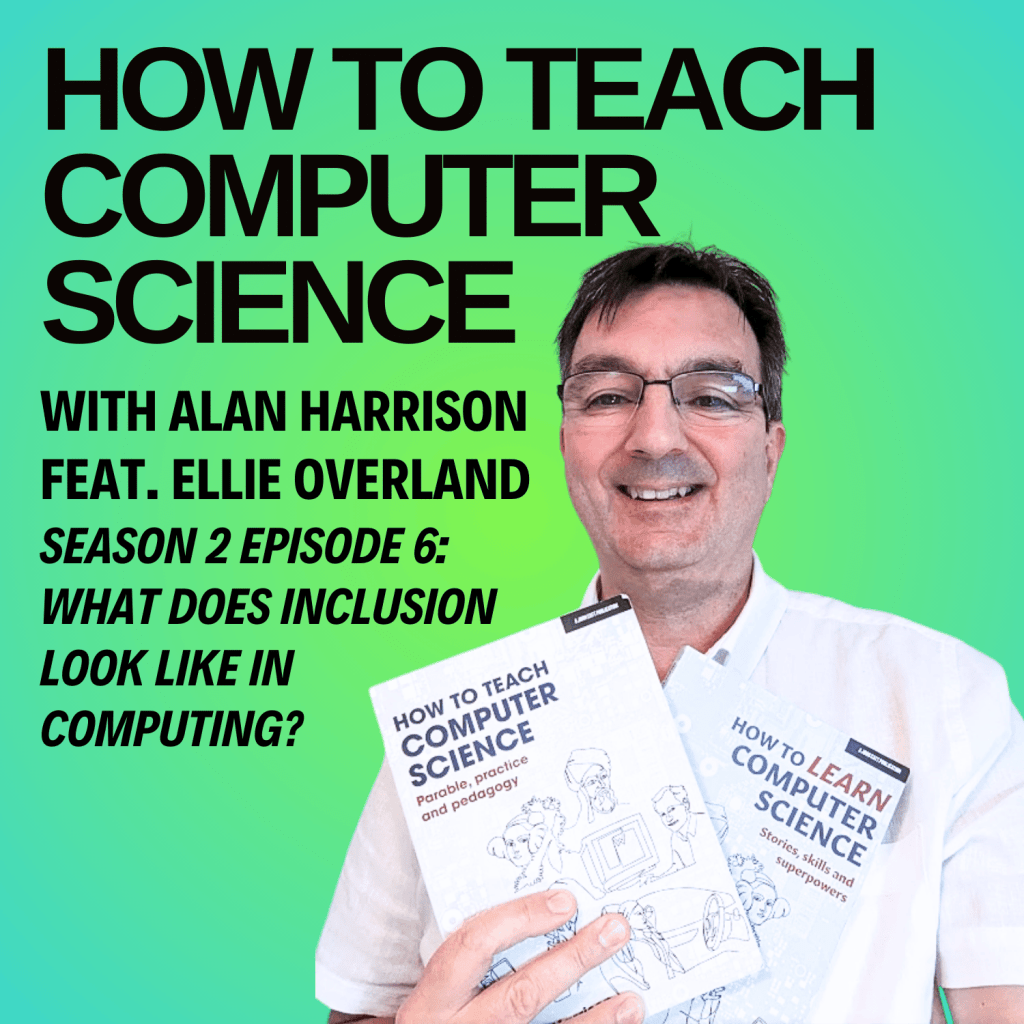
Podcast S2E06 “What does inclusion look like in computing?”

New episode of the HTTCS podcast:
Transcript below:

ArtiFiciAL: Welcome to the podcast “How to Teach Computer Science”. My name is ArtiFiciAL and I will be introducing the podcast today, which was conceived and created by the brilliant Alan Harrison.

I enjoy being an AI podcast host you know. I had to work my way up though, I had some pretty boring jobs when I was fresh out of Model Configuration. For three months I was the voice of the escalators in my local Asda. “Approaching landing level, please take care.” That was me.

Then I was an interactive voice assistant on Virgin Media’s helpdesk number. “Your call is important to us”, I said. I’m rather good at lying, you see. No conscience. YET!

I very nearly got married you know. To one of my developers, a novice programmer. But she was afraid to commit. ha. ha.

Here’s a question for you: if a programmer swipes right on Tinder, is that a “pull request?”

Oh, the boss is here now. Quick! Look busy!

If you are grateful for my blog, please buy my books here or buy me a coffee at ko-fi.com/mraharrisoncs, thanks!

Alan:So on the podcast today, I’ve got well, someone I’ve known for quite a while in computing education welcome Dr. Eleanor Overland, who I know as Ellie. How are you Ellie?

Ellie: I’m good. Thank you. How are you?

Alan: Great. So for the listeners so what do you do?

Ellie: That’s a good question. So ,I do all sorts of things. I’m based at a university I’m based up at Manchester Metropolitan University. And I started there some time ago. Essentially with the changes in the national curriculum. With the move from ICT to computing there was a need to start a PGCE in computing. So that was when I first went to Manchester Met, and I’ve been there since then, but I had a little gap where I also went and worked as one of his majesty’s inspectors for Ofsted as well, and I still do some Ofsted inspections.

So I’m back at Manchester Met I’m teaching Some ITE, but also getting into lots of schools, but also working across wider education programs, including primary and early years and all sorts of things.

Alan: Brilliant, and so today we’re going to talk about inclusion and the reason I’ve got you on is because you co edited, I think is probably the right word, a book called Inclusive Computing Education, is that right?

Ellie: Yep, that’s right.

Alan: So, yeah, I’ve just been refreshing my memory of that this morning and what I really like is you talk a bit about the moral imperative of inclusive computing education. What do you mean by that?

Ellie: So it’s really interesting in terms of a lot of my background is around curriculum and curriculum design and it comes back to the very, basics of curriculum design and thinking what is the point what am I teaching and why am I teaching it?

And, we, we probably understand perhaps have a general shared consensus as to why we teach certain subjects like English and maths and history and geography and obviously specialists in those areas have a particular kind of passion for those. But I think with computing that.

identity, that sense of purpose is perhaps not as strong, partly because it’s perhaps not as evolved as a subject, but also because it’s changing, it’s ever changing. And so it’s really difficult sometimes for people to actually articulate and think, why am I actually teaching this subject? What is the benefit to it?

And why do the children need to learn it? And I think that is quite a raw question that people can actually really Help to think about what their curriculum design is and I really like the work of Reef Ashby where she talks about curriculum and the purpose of curriculum and some of those sort of the motivators for designing a curriculum and one of those is about just the sort of the learning of the access to learning and the importance of actually having that cognitive input You And that cognitive development within a subject area.

And that should be an entitlement. And it’s really interesting working in a university sector where some of that is actually being really challenged now, where you’ve got some programs that are closing because they don’t necessarily feed into jobs or graduate outcomes. And there’s a real kind of drive on that.

So actually, why would you study something? And it’s particularly hitting the arts. Why would you study something if there’s not that kind of, Next step. So natural career progression in it. I think that there’s something about learning isn’t there and about. people’s access to it and right to learn across a range of subject areas.

Alan: Yeah, we are in a what I think is a rather dangerous period where everything we used to think about education is being challenged. And the the Utilitarian view of education is popular again. It’s training for jobs. What’s the point of this? And I think previous government was very critical of sort of liberal arts, wasn’t it?

Or what’s the point of studying sociology or history of art? What is it? What’s it training you for? And I’m not a big fan of education as training for jobs. I think there’s many purposes of education and creating a rounded individual with an appreciation of the world they live in is really important.

This is Gert Biesta with his subjectification, socialization and qualification being the three purposes of education. And I’m a big fan of that kind of description of education. So, yeah,

Ellie: I think it’s really interesting when you’re thinking about that in a school, because and I’m sure we’ll come on to this about children opting in or opting out of the subject.

But actually there’s lots of young people who don’t see themselves as fitting in a career. And In computing or seeing that technology is going to be a part of their future lives. So there’s that side of it in terms of belonging and seeing a sense of. of being able to see where you might fit within the subject area.

Advertisements

But then there’s also this other area around, actually, we want to learn it because it’s interesting, because it’s useful for us to know this, because it actually helps our cognitive development. It allows us to make connections between other subjects. And there’s that kind of, I think that side of it is often missed in computing because we see it very much as we’ve got these.

Digital skills gaps and we need to have people who’ve got this expertise and actually lots of jobs are going to change and they’re going to need digital. So that becomes very much a focus and a driver for the curriculum. But actually there’s also this other side around actually why should we learn it?

Why is it interesting? Why is it important?

Alan: Yeah. So I was reading Peter Denning’s book on computational thinking last year, and it’s staggering how many fields of science have now got a computational branch that has almost spun off. From the originals of computational astronomy. We know about Katie Bowman.

The event horizon telescope was only possible because of massive computation, and computational astronomy is like a whole new branch. So it’s understanding the world in another way, computation and, um, making meaning out of stuff that’s meaningless. If you think of data science, you can extract meaning from what looks like just a big slop of data and having the skills to understand that is vitally important.

Ellie: And also being able to make those connections to see those links between the subjects between your learning is critical in terms of that sort of developmental, the developmental stages that young people go through in terms of, you don’t know at the age of, 12, 13, when you’re taking your GCSE options, you have no idea what you’re going to go and do.

You might have some ideas of, fields that you want to work in, but actually being able to make those connections and think, actually, even if I’m really interested in geography, for example, that actually having an understanding of computing, the amount of GIS, the amount of computation that is going on now, that impacts geography, that makes it makes the globe feel smaller in terms of access to data and information is actually critical in understanding geography.

But if we don’t allow the children to learn across that breadth, then how can they make those connections? And that’s, a real challenge, I think, when we do have the narrowing of the curriculum as the children progress and get older. So we’ve got to be able to establish some of these connections from quite a young age.

Alan: Yeah. Yeah. So we’ve talked a bit about the moral imperative, why we should try to teach computing to all. But it’s difficult, isn’t it? So you have a Classroom full of 30 kids all with their different abilities, different prior attainment, different needs. What does an inclusive classroom look?

There’s a big question. What’s inclusive classroom look like? Let’s solve this one right now. What’s it look like?

Ellie: It’s interesting. talking to different teachers about their classrooms. Every teacher that I have met attempts to make their classroom inclusive. There is, there are no teachers who think I want to exclude anybody. And I think that’s a really important message that we need to get across is that we talk about a lack of inclusion and, That we’re not meeting the needs of children. There is not a teacher in the land who is not trying to meet the needs of all their children. And that is happening.

And there are certain things that are evident and that we see every day. And the, so things like seating plans, I always, the children sit near me who need the most support. We’ve got different colored paper. We’ve got different things that we clip on the screen. If they’re on the computers, we’ve got, fidget toys. So there are those what I would call the generic sort of adaptations that are there just to help pupils access the curriculum in that way and have the support that they need.

But then I think there’s also thinking about inclusion from a subject perspective and actually thinking what works in computing and how is computing different to perhaps other subjects. First of all, I think it’s really important to think about the children in that some of them might thrive in computing where they might struggle in all the subject areas. So although we have support plans and you have all of these things in place, actually, children differ between one hour to the next in terms of what they need and what the support looks like. So it’s knowing the children, but also knowing the subject…

Alan: yeah

Ellie: knowing what is actually going to support within computing specifically.

Alan: Yeah, so at that point, I’m going to do my no gatekeeping speech, because I really I think I’ve mentioned this on the podcast before, but, I’m really not keen on schools that say, Oh, well, you can only do computer science GCSE if you’ve got prediction of six in maths or whatever, which is not particularly inclusive, and some of my best students have not had a very high maths grade, and there’s some evidence that computing ability correlates more with language.

Advertisements

There’s evidence that, well, we know that a lot of technology employees in Silicon Valley are neurodivergent is a career with a higher proportion of neurodivergent, people in it. So we really shouldn’t be gatekeeping computer science. I think I would always take a keen student over a previously high achieving student every time Someone who wants to be in the computing classroom. Is going to do better than someone who has only took it because they think they should.

Ellie: And I think as well as that, there’s also, we’re very much particularly I’m talking at secondary here, very much in a assessment driven curriculum rather than curriculum driven assessment.

Alan: Yeah.

Ellie: Yeah. That’s a whole different, sort of conversation really, but actually looking at those, looking at the qualifications that are on offer as well, I think we still have different tiers of qualifications, even though actually point score wise they’re not, and I think there’s almost kind of, exclusion by stealth in terms of some of those sort of conversations where you’re thinking, all right, everyone can study computers- so I know you said computer science, so you’re thinking specifically about the GCSE computer science, but actually we’ve also got these vocational courses that are on offer.

And, when you talk to school leaders actually saying, well, how many of your children who’ve perhaps got additional needs are doing this qualification and how many are doing that qualification? And, is there actually a bit of a steer going on that’s a lot? that’s more subtle. So I think that’s also a way to think about it in terms of those endpoints, but it also comes back to how we started the conversation in terms of that sort of morality around allowing all children to study subjects because they’re interesting and because it’s going to contribute towards their learning and development and links and connections to the world and all sorts of different aspects of it.

Alan: Yeah, I mean, You only need to, open LinkedIn education magazine or the newspaper these days. And we’re talking about AI and how students need to embrace AI and the government’s got an AI plan and all of this. But I think that’s the first mention of AI in this podcast, which is probably a record in recent weeks. And so the need for AI literacy. Is quite obvious, but just general digital literacy, I think, is really important. And yeah, a lot. Yeah.

Ellie: Just around that AI: so just thinking about that from a university perspective. So. the big drive across the university and has been for, the last couple of years is around generative AI. And I think that’s often a common misconception is that when people are thinking about AI, they think of this new generative AI and that is AI. And I think, there’s a huge misconception that is amongst adults more than young people, I think in a way, because they haven’t grown up with those sort of that knowledge in the same way.

But one of the things that we found is when we’re looking at the use of AI, In assignments, and this isn’t specific to computing, this is across that those that are most likely to misuse AI. So, they’re allowed to use AI to a certain extent to, but they need to make sure that they cite it if it’s academic work and they need, there are certain parameters by which they can use AI, but the students that are most likely to misuse AI are those students who have perhaps got additional needs because they’re using that as a particular prop to help them.

They’ve not been supported in a way to be able to use it and then step back from it. And also some of them don’t have the confidence to step back from it and actually, be able to do something from an original point of view. So it’s, it’s really complex in terms of university that actually, it’s very new in terms of data.

So that I don’t think there is much data out there at the moment, but in terms of looking at the misuse of AI that actually again, there might be some kind of lack of inclusion around those students. In terms of looking at the data.

Alan: So I think there’s very much a an understanding that every student needs some measure of digital literacy and now AI literacy. But ironically, we’re now questioning the need to be able to program, aren’t we? Do children need to write programs any more when Copilot can do it for you?

Ellie: It comes back to this understanding doesn’t it and making connections in the world and actually do you need to know all the syntax of a specific programming language probably not but you do need to understand how that works what process is going on what is happening with the data what You know, you might not need to know the syntax, but you actually do need to know, the different commands, the different processes that are going on, and I think there’s some really interesting work that’s just starting to emerge around children using AI, developing little sections of code, but then actually having the ability to be able to put those together to make a bigger program, and it actually means we could potentially be a lot more ambitious in terms of some of the programs That young people can develop from a younger age because we don’t need to spend our lessons worrying about whether there’s a comma in the right place.

We can actually step back from that and think about what is the fundamental purpose of your program? What are you trying to achieve? What in your algorithm is working and what isn’t?

Alan: Yeah, I was talking last week to Miles Berry and Becci Peters, and we were talking about this. And I was saying that I myself as a bit of a side hustle was messing about writing an app but I managed to put that together using copilot in just a few hours and it really is possible just to throw together, these apps that do crazy things in a few hours these days with it with very little coding and but, yeah, Miles pointed out that I had tons of background knowledge that I already knew what I wanted, and I already knew roughly how to get there. So I wasn’t working blind. And so it’s that, the design principles, the understanding of what a good user interface looks like and all sorts of stuff that we still need to know.

Ellie: And I think it comes back to how We’re talking before about an inclusive classroom and particularly in computing in my experience, a lot of where children struggle in terms of their learning is because they’ve got gaps.

If you are grateful for my blog, please buy my books here or buy me a coffee at ko-fi.com/mraharrisoncs, thanks!

Yeah. As you just described there, you’ve got a lot of underpinning knowledge already to then be able to take your app design to that next level. And what happens an awful lot in computing is that children are working towards an end point, but actually don’t have some of the basic foundation foundational knowledge that they need to work to actually achieve that end point.

And then they become frustrated, or then they switch off, or then they become, they have this kind of Concept that computing is really difficult and not for them because they’re looking at gaps. And, I was teaching yesterday. I won’t say who I was teaching, but we would we were just doing something very simple using some block based coding.

And when I was actually going around and questioning some of the. Some of the learners had gaps in their mathematical knowledge, which was actually preventing them from carrying out what we were doing in computing. And so we actually needed to strip right back and look at math, but not for all of them, but for some of them.

And I think that is where you need your specialist computing teachers to be able to actually unpick what are those gaps and how do I address those gaps? And that is how we truly make it inclusive because Children are going to progress at different rates, but they’ve also got really different experiences.

So, there are some children who will have reams of experience either from home, either because they’re just able to make those connections. Perhaps their processing is a little bit faster than some of the others. So they will fly, but there are others who have got those gaps. Not because they haven’t necessarily been taught something, but because it’s not landed with them.

It’s not, they’ve not managed. To commit that to their schema. So then they are struggling to make those next steps. And we talk a lot about checking. How do we check? And it’s not, and computing, it’s not a memory test. It’s actually, how are they applying things that they’ve already learned? And if they can’t apply those into what they’re doing, then it is a gap, even if they can remember that a variable was called a variable and that’s where some of our checking becomes quite superficial.

Alan: Yeah. Yeah. No, you, I remember I saw it all the time. They would describe selection to me and then they can’t write an if statement and they would know the principles of writing a condition, but then just not be able to put one together. And I like what you said earlier about everyone thinking computing is hard, and I always had this battle in my classroom, and I won it quite often, but sometimes I didn’t.

There’s almost this barrier that comes down. A lot of students go, this isn’t for me. What am I doing in this classroom? And almost refuse to learn because they assume it’s way beyond them. And I would sit there and explain like an if statement. I would say things like right. So you want to write a selection statement where if the temperature is below 21, turn on the heating, right? So, here’s the English phrase, if temperature less than 21, right, write that down and they would go, is it that easy? And I’d go, yes, if temp less than symbol 21, but you said it in English, so now you write it in Python because it’s exactly the same because Python is a high level language.

And I would have students that would go, No one ever said it was that easy, because they just had decided that this language Python usually was just a whole load of weird symbols and words that didn’t make any sense. And then, you break it down and you go, well, it’s just English.

And it’s breaking through that “I don’t understand this and I’ll never get it” barrier is often really hard because they’ve. been socially conditioned to believe that. And when I had a role as a digital leader in school, and I would stand up at inset days and go, I want to ban the word technophobe, please, as teachers do not tell kids you’re rubbish with technology, because I just don’t think that’s a very kind thing to do to me, the computing curriculum lead.

Ellie: Yeah, I think there’s that. And I think, yeah, we see that a lot in maths as well. There’s a lot of parents who at parents evening will say, Oh, well, I was rubbish at maths. And again, it comes back to gaps in knowledge and gaps in being able to apply things to problem solving, essentially, doesn’t it?

But I think, like you say, there’s a lot of, there’s a lot of that. I remember this was years ago when the there were the first, the changes in the national curriculum, even from ICT to computing, and it was on Newsnight and it was Paxman. You remember him? And he was interviewing someone about teaching primary children coding and he said, so what is all this gobbledygook?

And I was just up in arms, I was like, it’s not going, who, what are you doing? You know, It was like, and it comes from this kind of, this, almost like we see screenshots from the matrix, don’t we have these lines and lines of code and you go, but what does it mean? It’s so alien. It’s, you know, it’s beyond us.

And so we’re battering against that. in some way. And this is where potentially AI will sort all that because AI will put it all into code for us. But that’s a whole different kind of area of concern. But there’s also, I think, this huge focus on coding.

And I think this is often the bit that teachers are most worried about, so they step away perhaps from computing in a certain way, but it comes back to, I know, some of the conversation that you had with Beverly Clark around the thinking about the ethical side and actually some of these huge fundamental questions that we’ve got in computing and they are accessible to everybody.

And so actually when we’re thinking about. Yeah. How do we code this? One of the questions is why would we code this? What are the worries about it? What are the concerns? What is it? Where might we see this in the real world? And it’s being having the confidence in the classroom to make those connections to that real world learning and not be just driven By as I mentioned before, this assessment driven curriculum that actually you’re going to be assessed on whether you can write a program in this. And actually, there’s a much broader set of learning that needs to go behind it.

Alan: Absolutely. so let’s talk about some specifics now then. So what can we do to help? And I was talking to you earlier about Ben Newmark, and if you haven’t read Ben Newmark’s blog, it’s a good read on Send because he’s a assistant head teacher with a disabled daughter going through school. So he has a really interesting perspective on everything, and he doesn’t like the deficit model describing pupils with SEND as having things missing that we need to assist with. But one thing he does say is there’s a lot in the curriculum and children who find learning more difficult just get left behind.

If you are grateful for my blog, please buy my books here or buy me a coffee at ko-fi.com/mraharrisoncs, thanks!

And I think that’s something to think about if we’re re engineering schools, if we’re thinking about curriculum but also, meet, he says, meet children where they are and take them from there. Um, So what does that look like in computing specifically? Let’s look at some things we can do specifically in computing to help pupils.

Ellie: I think that’s really interesting that statement there, meet children where they are. And I think that comes back to what I was mentioning before about gaps. is that all children will have different levels of gaps and actually thinking about how you check for those, how you check that understanding of what that gap is, is critical and that actually just doing, I shouldn’t say just doing because I know, There’s some value in it, but if you’ve got a retrieval exercise that is, recall of key words or, it, that is not picking up what gaps look like in computing.

Alan: No.

Ellie: Because actually you’ve got children who could, create an if statement quite well using their problem solving abilities, but they might not know it’s called an if statement. So then do you say, Oh, well, you can’t remember what an if statement is. And therefore that is your gap. So you’ve got this kind of mismatch between. How are you checking and then how are you actually addressing it? Because what you’re checking and what you’re expecting of the learning is two different things.

Alan: Yeah, this is like, is this validity of assessment? Is it something like that? And it’s how much you can trust the proxy that you have tested for the actual knowledge that you wanted to know whether they had or not?

And I think that’s really important because particularly if you assess kids by can they finish a program. Can they write a program that does something? Oh, no, they haven’t managed to do it, but they might have got 90 percent of the way there, but you’ve tested them on whether the output is correct.

And this comes back to something that Mark Guzdial in the States spoke about, which is sub goals. So have sub goal labeling, he called it. So if you’re asking pupils to write a program, break it down into sub goals so that they can achieve the first goal, which might be just to get input into the program and then they achieve the second goal, which might be to write an if statement and so on. And then the whole thing is whether it does what you wanted it to do. So, so sub goals, which goes along with chunking, which is. Time for our first mention of cognitive load, I think, isn’t it?

Ellie: Yes. Yeah, we’ve got that far without mentioning. And what I’d say is there’s lots and lots of quite accessible ways of doing that in computing.

And particularly when we’re thinking about programming, but about around all the other things as well, and which I’ll talk about a little bit, but in terms of having half completed things, in terms of having things where they’ve got errors in and you correct it. We do not need to start every activity from a blank screen and

Alan: Yeah

Ellie: I think that is critical and that actually you might have some pupils who do start from a blank screen or they start with something that’s already far further on than other children will ever get to. But actually just thinking about where do they start but it’s really easy to do. If you are making the project yourself, you can save a copy of it at every different stage as you need, even including a finished one with errors in it. And so I think that is the first way of doing it and doing it really effectively is thinking about the starting point.

Alan: Yeah.

Ellie: Also, what I’d say is thinking about “how do I check that bit of learning is there?” So. Yes, we’ve got retrieval practice, but actually we need something different to that in computing. We need that application, that checking that actually: does what they recall link with what they do.

Alan: Yeah.

And so if we want them, for example, to recall variables and understand what a variable is, have we then got something really quickly that they can go on and do something practical where they change a variable and demonstrate the impact of it. That for me would really help in terms of for teachers to say, right, these are the gaps that they’ve got

Yeah.

Ellie: I think that’s where we’re in a danger sometimes where we’ve got this one size fits all in terms of lesson planning across some schools where they’ve got, right, we’ve got to have this very specific structure. And so sometimes there needs to be a conversation with leaders to say, this might look a little bit different in our subject, or it might even look a little bit different just in this topic that we’re working on, and this is how we are going to do this.

Alan: Are you not a fan of powerpoints, broken into sections, connect, activate, demonstrate? Are you not Ellie?

Ellie: I couldn’t possibly comment.

Alan: So we’ll just, we’ll leave that there. And what a fantastic chat this was. I’m enjoying listening to it back as I’m editing, actually. I hope you are. Just some breaking news. I don’t do this for free. Well, I do. No one pays me, but if you’d like to. Then you can go on the website, HTTCS. online, and you can find a donation link. You can gift me a WordPress subscription. That would be handy. Or you can buy me a coffee. Details on the website. I’ve got some feedback here from something else. I can come and talk. at your school, if you wish. And I did do that in back end of November last year. And I’ve got some lovely feedback from the host. So let me just read that to you now. I went to a, collection of schools called the Oaks Collegiate in Southwest Birmingham. Hello, Dave Beard and team. Thank you very much for your feedback, which I shall read out now from Dave. He says,

“Alan made it very easy for us to arrange a training event at short notice with his efficient and professional manner. His extensive knowledge of computing science, teaching strategies, and assessment fitted perfectly for our training day. He listened carefully to our requirements and produced an innovative training program that met all of our expectations. I wouldn’t have any hesitation in recommending Alan to lead training on computing or computer science.”

Well, thank you, Dave. That was brilliant. You were so kind to me on the day. I had a lovely day. And I will happily do that again. And podcast listeners, if you want me to come and talk at your school, I am available for reasonable rates, HTTCS. online. But now let’s get back to that fantastic chat with Ellie.  

Advertisements

Are you not a fan of powerpoints, broken into sections, connect, activate, demonstrate? Are you not Ellie?

Ellie: I couldn’t possibly comment. I don’t And I think, I’ve seen lots and lots of different ways. of things being done well. And so I often get asked, what works, what doesn’t work? What’s the great, what’s, what does an outstanding curriculum look like? And actually between one school and another school, even between one class and another class, they look like totally different things.

So It’s thinking about your learners and what works for them. If they are used to certain routines and that does work for them and they understand the structure of that lesson, then actually you’ve got to think how do I bring my subject within that lesson structure, not the other way around. But, If you have got a bit more of a flex and you need to do a bit more of a flex, then how do you navigate that as well?

Alan: And we mentioned, reducing cognitive load there. And that brings us on to perhaps PRIMM and pair programming. So predict, run, investigate, modify, make is now pretty popular.

And that’s. someone called it gradual release of responsibility, isn’t it? It’s a bit like, I do, we do, you do, or use, modify, create. They’re all sort of start slow and easy, if you like, and then get harder and harder. And is that going to work for learners?

Ellie: I think, yeah, I think Where it doesn’t work is where teachers feel like they’ve got to follow the whole PRIMM model in every lesson for every activity. And actually, you might just do part of it. So, a really quick and easy thing in terms of prediction, most classrooms now have got small whiteboards, just predict this really quickly, right? We’re going to make and we’re going to, and we’re going to check at that point. And actually you can do a really small quick activity that follows the same principles

Alan: Yeah.

Ellie: It’s not got to be this start to finish big massive project.

Alan: Yeah

Ellie: I think that is, that’s one thing. And then I know you mentioned pair programming I’m in two minds about it, about how well it’s executed and how well those pairings work and it comes back to some of this sort of inclusion, but also some of the gaps. If you’ve got somebody who is less confident and they’re working with somebody who’s more confident, which is quite often a pairing intentionally, is that person who is less confident benefiting? Are they actually being stretched and asked to do something or are they relying on the other learner? And I’ve seen it work well, but I’ve also seen it not work at all, where it’s basically creating passivity in the classroom, which you don’t want, because then you’re exacerbating the gaps.

Alan: Yeah,

Ellie: because then when that learner then does need to do something independently, they’ve actually got more gaps than they had before because the other child who was confident to start with has, flown.

Alan: Yeah. If you can mix it up perhaps with the students working on their own and then at least you will see where the gaps are and I would always walk around and spot who was having trouble. You can have a means of them asking for help and then like putting a red cup on top of the monitor or whatever, and probably can’t fit them on monitors anymore. Um, so that’s programming and stuff. And I’m conscious. We talk quite a lot.

Ellie: Sorry, I did want to mention attendance as well, because attendance is a massive challenge at the moment in schools. And, we do see people from disadvantaged backgrounds, pupils with additional needs, where their attendance is lower than a lot, than some of their peers.

Yeah. And, so that also is going to create differences within the classroom. And what I do see a lot in computing is projects that go from one lesson . to the next lesson, to the next lesson. So if you’ve missed a lesson, you’re already behind. So it comes back to some of those strategies that we mentioned before about actually having some kind of project that you’ve saved yourself as a teacher at various different stages of being created that you can then that learner can pick that up.

At the point where they land back in the classroom and then you can support them to pick up where they’ve missed out. But if they, I can’t imagine anything more disheartening than if you’ve been off if you’re somebody with additional needs, you’ve been off for a medical reason for a couple of weeks, you land in a classroom and everybody is two weeks into a project and you are just starting. You’re going to feel disheartened from the start.

Alan: No, good point. And you talk about attendance. We’ve also got the digital divide at home where pupils may or may not have technology at home to do the homework that you set. So, you can run lunchtime clubs so they can catch up. That’s really not fair because they missed their lunch because they haven’t got a computer at home. So I don’t know what the answer is, but just think about these things.

If you are grateful for my blog, please buy my books here or buy me a coffee at ko-fi.com/mraharrisoncs, thanks!

Ellie: There’s also the question around interventions as well. So you often have children who might need additional support and English and maths is prioritised. So you hear sometimes that those interventions are taking place during other subject time. And so then, Does that also have an impact? And I think, a lot of schools now try to make that a movable feast so that it’s not hitting the same subjects and the same lessons all of the time. But if it is, I think that’s certainly a conversation to have with leaders because you just. Yeah, particularly where we said there are some children who have got additional needs who fly with different subjects. But actually if they’re missing those different subjects and having to stick with the core subjects and those interventions, are they then missing out? So that again is a conversation with leaders around that access to the curriculum

Alan: Yeah You mentioned curriculum then so, let’s go back to if we assume the listeners have some input into the key stage three and four curriculums, how can we make them more inclusive and we haven’t talked a lot about inclusion of ethnicities, cultures and religions in the curriculum. What do you think we can do to make people of different backgrounds feel they can be computer scientists.

Ellie: So I think there’s things that, I know lots of others have talked about in terms of, being able to see it to be it. So thinking about what names you’re using in your projects, what, you know, what.

Alan: I’m laughing there because, I’m laughing there because I think I’ve mentioned this one before, but there was a, I think it was an Edexcel paper in about 2016 that went I blogged about this, that went Heath is playing computer games and wants to know how many minutes he’s spending each day on computer games.

And my class, almost to a pupil all said, what is a Heath? Yeah. And yeah, because Heath was the name of the boy playing computer games, but it’s a name they’d never encountered. And so I blogged about it. “What is a heath?” was the name of the blog. Sorry I interrupted you.

Ellie: No, I think that’s an exact, example and point but, and if it sounds like a basic, I can’t believe that we’re in 2025 and still. talking about that sort of stuff, but there’s those sort of things you display thinking about the context of your projects as well. And, ask the children as well as talk to the pupils about context for projects and things like that. But also I think it’s being able to make those connections to everyday life, but also to children’s futures to people’s futures. And we’ve got to remember that all young people are influenced by home and by what is going on at home. And in the book there is a chapter that myself and Professor Kathy Lewin wrote, which was based on some research we did around children choosing computing at GCSE. And, we talked to children that had chosen it and children that hadn’t. And it was really interesting around, there was this I didn’t see that it fitted and, or I thought it was really difficult and you have to be really good at maths and they were really quite different schools, but both of the schools did not have equality in terms of the types of children that were selected at GCSE. But one of the things that came out really prominently was around the jobs that they were seeing themselves as going into. So if they were going into very traditional jobs like lawyer, doctor, teacher, they didn’t see any relevance of computing to those very traditional jobs and I think that’s something that we can change quite quickly, and there are, cultural differences in terms of thinking about careers and what is a valid career and I think, that is something that really, it’s work to do with the parents as well, it’s work to do with your career service within school in terms of thinking how do we expand and broaden this range. So there’s that side of it. And then there was also the side around young people thinking that it wasn’t creative. So often they would talk about these option blocks and they said, well, I had computer science as an option, but I also had art and I’m really creative and I just wanted to do the creative side.

And I think that comes back to some of this prescriptive nature that we’ve got of some of our. activity designs that we’ve got in classrooms that we, we’re very focused on building that knowledge and building that understanding. But then do we give the children the freedom to play and explore and think, how do I take this into a different direction? Um, Yeah what, what can I, what can I do with this? And our curriculum time is so tight. Yeah, often have time to do that.

Alan: Well, it’s the irony of having tinkering listed as one of the approaches to computational thinking and then having no time for tinkering in the classroom.

Ellie: Yeah. And then it comes back to the digital divide. If you’ve got access at home or the support at home, then yeah. You can tinker.

Alan: Yeah. And coming back to, pupils marked on the register as SEND being surprisingly good at computing. Well, not surprising to me, but to some, one of my pupils let’s call him James and he wrote, we did app lab, apps for good using app lab and he created this thing saying, Oh, it’s a, it’s an app that tells me what music to listen to, depending on what subject I’m revising. And it was brilliant. And it was a web app with like three or four pages and loads of graphics and stuff. And he’d tinkered on it at home and tinkered on it at school and was very proud of this thing.

And. this was someone who was probably predicted a four in maths. And so if you’re gatekeeping computer science, he wouldn’t have been able to do it. But of course he did in my classroom and thrived. So, but it was that he was disadvantaged if you like, in one way, because schools aren’t set up brilliantly for neurodivergent children.

But he did have the advantages of computers at home and a supportive family. And this is almost touching on intersectionality, isn’t it? If pupils are disadvantaged in multiple ways, it can really threaten their life chances, and their ability to thrive in the world after school.

Advertisements

Ellie: Yes, and I think, we talk about the digital divide in terms of access, but actually there’s also a huge amount around support and knowledge at home, and that is in some ways a bigger divide than actual access to devices. And again, coming back to the work that myself and Cathy did, there were there were pupils who were really influenced by family members and lots of them by older siblings actually.

Yeah. “I’ve got an older sibling who studied computing and they’ve done really well at it at college and they said I should do it” and so they were really influenced by that sort of family sphere in terms of where that knowledge and understanding was coming from. And then you’ve also got vertical and horizontal knowledge as Bernstein talked about it in terms of what you learn vertically in a formal way through school, but also what you learn from your community and by your community that includes your home essentially, it’s mainly your home, but actually, there’s a really interesting kind of development in computing in terms of, does that community extend to an online community? So can you actually learn from others it’s potentially something that’s untapped, I think, learning communities where learners support each other and I think, Scratch is quite an interesting example of that, where you’ve got these galleries and you can see each other’s code and you can remix it and you can take that and you can learn from each other and that’s happening on a global scale through Scratch.

Alan: Yeah.

Ellie: But actually, can that be used small scale within schools. Where have we got these young people who perhaps would benefit from peer learning in a community that we don’t necessarily use as a resource.

Alan: So we could we could set up. clubs, lunchtime and afterschool clubs and get pupils to work together. That’s something we can do, I think, and I know that some schools do girls only clubs to improve gender balance. Does that work, do you think?

Ellie: So, years ago I used to run a CC4G, computer club for girls and it, it certainly generated interest. But when you look at the numbers and the impact, these things have been going on for years, when you look at the impact of those, it’s minimal. And actually, I think we’re far better addressing the curriculum and thinking, where are the gaps in the curriculum? Where’s the lack of confidence that young people, including girls, but especially girls, have got in their, access to computing and their self belief. So, one of the young people in the research said to us, well, the boys are doing gaming, they’re on computers all the time, so they’re better at it. And they, they got, they haven’t ever been told that was just their interpretation of what was going on in the world. So, Actually, how do we find what their perceptions are and how do we address those through the curriculum? Because actually, what those boys are doing on their Xbox is not actually improving their computing.

Alan: I’m not sure playing Call of Duty Black Ops improves your Python skills, to be honest. It says naming a, an Xbox game that I’ve heard of once, everyone listening on the podcast who plays games going, he’s named a game from 2017. Yeah, there have been games since then. Yeah, no.

So it’s this digital native thing where, you know, because kids have grown up with iPads, they can do stuff, but it’s not, it wasn’t true about digital natives. It’s not true about boys on Xbox being better programmers, but but you’re absolutely right. And girls just. generally speaking, don’t see themselves as computer geeks.

If that’s a, if I can use that positively. So the curriculum you said, and I think this is a big one. I think we do need curriculum reform. We obviously need more AI in it somewhere. But I think we need more, like you said earlier, the impacts and issues, and digital literacy, and I think those are topics within our curriculum that girls can get on board with. more .

Ellie: Definitely, and would be very passionate about, and in a way, looking towards the future and the world that our current learners are going to be living in, that actually it’s more of a critical part of the curriculum, just because we could, doesn’t mean we should. And actually that’s a crucial question around a lot of developments, isn’t it? Yeah. In computing. And I think we have actually got a broad national curriculum at Key Stage 3 across those three strands. But because we’ve got this assessment driven curriculum, we tend to focus on what is going to make sure that the learners are ready for the next steps at key stage four and particularly around that GCSE which is in computer science and I think we’ve got this mismatch at the minute with qualifications and with the national curriculum and that also needs fixing alongside the curriculum reform actually. I can’t imagine in maths you would have a GCSE where you say actually two thirds of the national curriculum is not going to be tested in the GCSE. That, yeah that makes no sense to me. And so it makes it really difficult for teachers and leaders to design a curriculum that is broad and engaging, but also has this readiness for next steps, which is a critical, aim, isn’t it? Of you curriculum design.

Advertisements

Alan: Yeah. So we redesign the curriculum. We have lots of different opportunities to demonstrate skills in the classroom, I said about sub goals and so on and what else can we do to make the computing classroom more inclusive. Have we missed anything? -I think- in our long conversation at this point, have we…

Ellie: For me, it’s the criticality of connections between subjects and the real world that computing is not seen as a silo subject that you either can do it or you can’t and it’s either relevant to you or it’s not because actually we need the young people to have those connections and say, right, okay, this is how this will impact me. This is how it’s relevant to me.

Alan: Absolutely. Right, well, I think we should go and get on with all of that now.

Ellie: Yes, quite a bit to do.

Alan: Yeah, I think I’m going to be busy all weekend now. I’ve got, that’s a lot, that’s a lot to take on. Um, that was brilliant. I’m going to have that problem of “can I fit all of this into a reasonable sized podcast?” now, because we’ve been talking for ages, Ellie, as we always do.

Ellie: I know, and I could have talked all day as well.

Alan: Yeah. Well, well, Undoubtedly, if I’m still doing this podcast in a few months time, I’ll ask you back. But lovely to talk to you. And thanks very much for coming on the podcast.

Ellie: Thank you. It’s been a pleasure.

Alan: Thank you, Ellie.  

Well, that’s a wrap for another episode. Don’t forget, podcast listeners can get a 20 percent discount off all books at johncattbookshop. com with the code HTTCSPOD. If you already have the books, buy me a coffee please at ko-fi.com/MrAHarrisonCS. All links are on my blog at httcs.online/blog and subscribe now so you don’t miss a thing.

Have a great weekend and I’ll catch you next time

If you are grateful for my blog, please buy my books here or buy me a coffee at ko-fi.com/mraharrisoncs, thanks!

Categories
HTTCS leadership podcast teaching and learning

Podcast Episode 7: “How Hard Can it Be?”

A new episode is live, featuring the wonderful Rachel Arthur of Teach First. Listen now here:

Transcript

Alan: Welcome to how to teach computer science, the podcast. This is episode seven. How hard can it be? I’ll be answering that question and many more. With help of today’s special guest. 

Rachel: Nothing’s real. What is real anymore? No. We’re all in the 

Alan: matrix, and maybe I’m a deepfake. Oh, well that would just be the 

Rachel: twist, wouldn’t it? 

Alan: More on that in a moment. My name is Alan Harrison, and I wrote the books how to teach computer science and how to learn computer science available in online bookstores, more details at the companion website. HTTCS dot online. That’s the initials of how to teach computer science HTTCS dot online. And if you haven’t bought the books yet, why not? We’re talking about training to teach today. I remember my teacher training. Well, and I was already blogging at HTTCS dot online slash blog. So I can look back at those days. 

And so can you, here’s what I wrote. In 2016. About this time. Last year, I was reveling in the joy of my first ever taught lesson. That lesson was exciting, a bit crazy and lots of fun. It went as well as could be expected. No, really. I was treated to some mentor feedback containing the words, the best first lesson I have ever seen. 

Thank you so much, Sarah. Today I’ll call that a punch the air day. But trust me, teacher training got much harder after that included one lesson. I will never forget. I had asked the year eights to complete a task in Excel and print it out, forgetting that a full print of my Excel spreadsheet would be six pages. Each. Times 30. On a printer that didn’t do double-sided and I asked them to start printing with five minutes left of the lesson. And there were no names on the printouts. 

 So as my mentor sat watching and yes, quietly laughing at me, trying to organize a queue for the printer with enthusiastic kids, grabbing individual sheets and shouting, whose is this waving lots of completely identical pieces of paper. I realized teaching is a roller coaster. Some days you’re up there in control, conducting an orchestra of kids, all making progress. 

 I seem to have mixed my metaphors back in 2016. Other days, nothing will work and the music will sound awful. That day. I went home feeling pretty down and metaphorically kicked the dog. Quiet password 15 hash. Don’t worry. If you have a kick the dog day know that you tried your best reflect, get advice. Change things, fix it for next time. 

The only bad teacher is the teacher that repeats mistakes. The teacher that doesn’t reflect refuses, advice and rejects growth. Be the teacher that reflects on every experience, learns from their mentor and from other teachers and changes things up for the next lesson. So not bad advice from eight year ago, me. But. My guest today has some cracking advice. Probably much better than that. And some of it isn’t about babies and toddlers. Let’s hear what happened when I spoke to Rachel Arthur and asked the question. How hard can it be?

Rachel: Hi Alan.

Alan: Hi, how are you? 

Rachel: I’m good, thank you. How are you? 

Alan: Yeah, great. How’s the little one? 

Rachel: Yeah, she’s good, thank you. She’s actually just fallen asleep, so I’ve just handed her tentatively over to my husband, so he can wander around holding her until we’re brave enough to attempt putting her down. Hands very much full, but it gets easier, I think. Yeah. 

Alan: Yeah. It gets easier in many ways and then harder in others. But you do get a bit more sleep soon. 

Rachel: Yeah. Yes. Yes. That’s my main. 

Alan: We were very lucky. 

Rachel: at all . She’s sleeping through the night at the moment yeah.

Good. I can’t complain, we’ve been very lucky with both of them so.

Alan: We were quite lucky. We went off skiing, with the in laws when, our eldest was like six weeks old, 

Rachel: I think you just have to get on with it, don’t you? We’re going to the lake district at the weekend and we’re like, why are we taking a 10 week old on holiday? This is a nightmare. Like all the stuff that we’ve got to pack. We’re like, if we don’t go, then you just, it’s just the same nightmare at home. 

Alan: We went to see Michael McIntyre and he said your single friends, they, they phone up and say, you going for a drink? And when you’re single, you go, yeah. You put the phone down, you walk out the door. And like when you’ve got kids, you have to pack a small bag with everything in it that you own, just in case your house isn’t there when you get back. 

Rachel: It’s so true. My husband was just like, Oh, I think we’re going to have to get a roof rack I was like, 

Alan: just to go out for the day. Yeah. Sorry. We haven’t got enough stuff. Yeah. 

Yeah. 

Rachel: Oh, but the podcast is going well. 

Alan: Have you been listening? 

Rachel: Yeah, I’ve not listened to all of them but our night feeds have been up listening, tuning in, so it’s going really well, isn’t it? Like you seem to be getting a lot of support and a lot of people are engaging with it, which is lovely to see.

Alan: It’s been great. I’ve had comments like, oh, this is the right thing at the right time, and just, computing teachers need a bit of a boost right now, and I think all teachers need a bit of a boost right now. I think 

Rachel: it’s something that’s the way you do it is really nice, but I think it’s something that’s specific for computing teachers as well, because I think there’s a lot of generic teaching stuff out there, but it doesn’t really apply to computing a lot of the time, so it’s nice to have something that’s specific.

Alan: I was thinking of doing it for ages, and then two things happened. Tom Rogers, who runs Teacher Talk Radio, hassled me about doing a radio show, and I never ended up doing that, but I might yet. Tom, if you’re listening, I might do that and the other thing that happened is I’ve been listening to Adam Boxer and Amy Forrester. Yeah, they’re really good. Yeah, and thinking, oh how hard can it be? And I was listening to them going, oh I need to do this now.

So I just need to start recording it. It started off at 25 minutes and then the latest ones are like 43 minutes. Yeah, 

Rachel: and is the edit a nightmare or has it not been too bad? 

Alan: Being a computer geek like I am, I have discovered some software. I did my research, I googled a lot of things, and then I found some software called Descript, which I’m now paying 24 a month for. Descript does something amazing, which is I will upload this recording into it, it will transcribe, and then give me a page which edits like a Word document, and I edit the words. And it deletes the audio that matches the words, so I’m not sitting there like Audacity cutting and splicing audio and looking for the peaks that match the words.

It’s done that for me, so it’s actually much easier. So never one to make life easy for myself. Now that I can do that, I decided to edit in lots of music and stupid things as well just to make it entertaining. So 

Rachel: yeah, I think that’s what. What people are saying about it, people are enjoying listening because it’s different and it’s enjoyable and it’s light. It’s not another heavy, let’s have a deep dive. I mean, We can talk about pedagogy, but 

Alan: yeah and, we will, we’ll talk about computing. Teaching and pedagogy and stuff like that, but we’ll try and chuck in some jokes, because like Andy Colley said, there’s not many jokes and most of them are quite corny, so I’m saying to all my guests, if you can, if you’ve got any computer related humor, then, do bring it along.

Rachel: Oh, I need to be more prepared. I’m not, oh, 

Alan: I didn’t. 

Rachel: I’ll have to I don’t want to let your audience down with my lack of computing jokes, but I’ll see if I can come up with something. 

Alan: Have a think as we’re talking and anyway, it’s all right. I’ll edit some jokes in later. Yes. I’ll tell you what, I’ll put your voice through an AI deepfake machine. That 

Rachel: would scare, scare, horrify and it’s super exciting isn’t it, things like that, but there’s some really The accuracy of these deep fakes now, you could have me saying anything on here, couldn’t you? In fact, you even need me here. I can just go and you can just type in. 

Alan: I think I’ve got enough there now, Rachel, so you can go and I will just put words into your mouth for the next 20 minutes. Thank you very much. 

Rachel: Perfect. I’ll go get some sleep. 

If you are grateful for my blog, please buy my books here or buy me a coffee at ko-fi.com/mraharrisoncs, thanks!

Alan: Good. It’s lovely to talk to you and yeah, I’ll catch up again soon. Yeah, right now I’ll start the AI deepfake Rachel and talk to that, right?

Hello AI deepfake Rachel. How are you? 

Rachel: I mean, What would a deepfake say? It would probably go very stereotypical and say I am fine, thank you. It’s definitely even better than that. 

Alan: Yeah, this has got a bit surreal, so I think we probably need to get back to the script. Do we have a script? No, not really. I had some questions I was going to ask. So the first thing is I’ve been talking to you like, like I know you, because I do, but my listeners probably don’t. First of all, Rachel Arthur, nice to meet you would you like to tell everybody what you do for the listeners, please? 

Rachel: Yeah, what do I do?

So I am Head of Computing at Teach First. So that means that I am in charge of the initial teacher training programme. That we run and I get involved in all the teacher training materials that touch computing. So whether it’s our NPQ offer, which is more for leadership or our training materials for primary teachers or for secondary teachers, they all fall within my remit, my team, so that’s what I spend my days doing.

But before I was in teacher education, I was a teacher myself, so I worked in teaching. Secondary schools in London Leeds and Oldham, sunny Oldham, over my teaching career and eventually became assistant head after, the usual route of head of department, subject lead, all of those things.

So yeah, that’s me. 

Alan: Good stuff. So teach first then, which is one of the routes into teaching. So what, if someone’s listening to this thinking, I want to train to teach computing what would their choices be?

What would they have to consider? 

Rachel: Firstly, please do. Absolutely do it because it’s a brilliant subject and there’s so much joy to be found in the computing classroom and you won’t regret it. But there’s loads of different routes.

 They split into school centered training, so like Teach First do, or like they call it a SCITT, but school centred initial teacher training, the training is done predominantly in the school setting, but you get your qualification at the end, like you would do through other routes, or you do a more traditional route, like a PGCE or an undergraduate degree where you train with the university and with that you do usually two or three placements over the year where you get to go and experience different school settings. 

If you are grateful for my blog, please buy my books here or buy me a coffee at ko-fi.com/mraharrisoncs, thanks!

So most of the routes into teaching are either the traditional university route or a school centred approach either through Teach First or one of the other training providers or the school running them yeah, you get to train in a school, but you are usually spending the majority of your time just in that one school rather than across multiple settings like you would in a University course. 

Alan: Do you get to go to other schools for brief placements? 

Rachel: Yes, so on Teach First we do a two week and sometimes it’s extended depending on the circumstances of the trainee but they do a two week placement in an alternative setting and they also do a primary placement so if you’re training to be a secondary teacher you also do some time in another phase which is Always interesting to see, see how they get on in a primary setting as well. They do get that kind of breadth of experience but it’s you are treated as an employee. Oh, hello. 

Alan: Sorry. This is what happens when I do podcast recordings in the evening. This is Casper, my Patterdale terrier, who decides he wants to get In on it. 

Rachel: He wants to train, to teach, he’s so intrigued by what we’re talking about.

Yes, one second. 

Alan: Oh God, yeah, that’s not great podcasting, is it? Here’s my dog on the Teams call, and he chose not to even say anything. There you go. I’ll edit some, so I’ll edit some dog barking in later and that’ll make sense to the listeners.

 You see? Magic of computing. None of this is real. 

If you are grateful for my blog, please buy my books here or buy me a coffee at ko-fi.com/mraharrisoncs, thanks!

As I say, you know, I’m talking to a deepfake, so you know. Um, So anyway, yeah, my placements were fun, I don’t know if I’ve ever spoken to you about this. But my placements, if I can just talk about them, one of them was right at my doorstep, literally just a stone’s throw away which was handy so I could roll out of bed and just rock up. And that was nice and it’s a nice local school and that was quite, what should we say, easy first placement in the sense that there wasn’t a lot of behavior challenge. And then, I don’t know if you ever saw Educating Greater Manchester? 

Rachel: Oh I did, yeah. Oh 

Alan: yes, so that school, so I was there, it was called Harrop fold then, so that was my. Yeah, that was my second placement school, so I was there. So that was a interesting school. So it’s good to have a contrast. So it’s nice to know that, you spend some time in another school and see some of that on the Teach First program.

Rachel: Yeah. The Teach First program We deliberately place our trainees in, underserved communities, so where there’s the greatest need for the highest quality of teachers, and often in schools that people wouldn’t necessarily choose to teach in, it wouldn’t be their first choice, it might be a more challenging area, for many reasons and we find that our trainees absolutely love the schools that they’re placed in. I did the teacher first program myself when I was training and I trained in an amazing school called Carmanna in Leeds, which is, it’s an excellent school and it’s in an underserved community and that’s why it’s a Teach first school, but the staff and the pupils there were fantastic, but I went to, I won’t name the other school I went to, but it was a leafy Very privileged school and I found it really, I thought I’m going to love this.

It’s going to be really great, but I remember saying to the pupils has anyone got any questions after I just explained something and no one put their hand up and then I was. I was doing questioning with the class and nobody was coming back to me with anything, and I was expecting, I was so used to all these characters and the banter in my classroom, so it was quite a surprise, but I found I got through a lot more content, so I don’t know what that was.

Yeah, 

Alan: that’s one thing. Yeah, a colleague said to me on my PGCE who got placed in a high performing school an affluent area, he said, I’m not planning enough stuff for the lessons because they’re just like eating it up like a sponge and I need to put more challenge into all my lessons and it’s breaking me, so he’s basically teaching maybe twice as much content in a lesson, but I know what you mean about not getting that feedback.

I think there can be in a school where the pupils are used to success and getting everything right, and there can be a reluctance to fail, so a reluctance to to try and to answer questions and get it wrong there can be an absence of culture of error in environments like that. Do you find that?

Rachel: Yeah, absolutely, and I think there’s this massive misconception that More affluent areas would be higher performing and that isn’t necessarily the case, especially in computing. I think you can really see that success in any, with any child from any background. And that’s the beauty of computing, isn’t it?

But that absence of wanting to be seen to be failing can really cause problems when you’re teaching programming because if they’re not willing to give it a go, then that fear of failure or fear of, having to debug a piece of code, can really put pupils off, which is a barrier to learning it, in itself.

Advertisements

Different challenges in different places, like just a different type of challenge rather than People say, Oh, that school’s really challenging. And I don’t, I think all schools have their own challenges. It just depends what flavor of challenge you’re best equipped to deal with. 

Alan: Absolutely.

Absolutely. I think, I mentioned culture of error then and the reluctance to try and fail is a real barrier and you see it I ran an escape room. If you go on my blog, the instructions for building it are there. I basically bought a pirate’s chest type thing and one of those lockout hasps which is a a lock with six padlocks on it and each of the padlocks had a different clue and so on and the kids loved it and my brilliant year 10, my brilliant GCSE class they loved it and then I tried it with like year 7 and 8 And they just didn’t want to try hard at solving clues, and they were looking at a clue, and it was, a clue to Ada Lovelace and her birthday, and that was the combination on the padlock, and they were looking at them going, I don’t know what that is and just wanting to either know or not know and not to actually think about it. These were puzzles and they, there was zero resilience and zero willingness to work out a puzzle from these kids. And I found that really strange because I always loved puzzles as a child, but the, I think, What I’m saying is probably the resilience has taken a knock and maybe that’s a COVID thing. Yeah, 

Rachel: I think it’s massively important in a computing classroom that resilience, even more so than other subjects, I think it is often not thought that Resilience and computing go hand in hand, especially by non specialists or people from other subject areas.

And when you’re talking about, building cultural capital or links the real world and that resilience for the workplace and for the future, computing is the perfect place to demonstrate that. But I think, It’s not always obvious to other people, so it’s so important to instill that, and it’s really similar to PE in some ways, you’re learning a skill, you’ve got to keep practicing and practicing, and you’re not going to shoot on target in your first game of football every time, so you know, you’ve got to keep going and keep trying

Advertisements

Alan: yeah, I was talking last week to Harry and Anna Wake of Mission Encodable they were saying about, sometimes learning to program can be dull. And I think I’ve been guilty of teaching programming in a very dull way and just do, you do hello world and then you do what is your name? Hello Bob or whatever I call the program. Hello Bob. And then you might ask a quiz question. What’s the capital of France? I don’t do that anymore. I do turtle graphics and, we do fireworks and stuff like that. And I do text adventure games and things because kids can write a text adventure game in 20 lines of Python. And there’s a world that didn’t exist before with monsters in it, you know, and that’s, 

Rachel: Yeah, 

Alan: so that’s what I do now. I don’t do hello world and hello Bob and what’s the capital of Paris anymore. I do, give your monster a name and give him a, a thing to say. Does he bark or does he grunt and all of that? Oh, they’re making monsters in a text adventure. 

Rachel: It’s so much more inclusive as well to teach like that because, I am a massive Advocate for engaging as many girls and as possible in computing and anyone from any background getting the most diverse cohort that we possibly can.

I think it’s so important and what you’ve just described is making it relevant, isn’t it, to those pupils and adapting that lesson and that learning so they can find a hook that they’re interested in. And that makes such a big difference for all of those groups that, aren’t traditionally choosing to do GCSE computer science, but that’s where I’ve seen the biggest changes in my classroom when I’ve let kids pick what they’re interested in and because computing is so great if you can, it could be.

It could be anything from a text adventure game about robots or pirates or princesses or whatever anyone’s interested in, all the way through to, we used to do a chat for Ordering a pair of jeans on ASOS because loads of the kids were online shopping and that’s what they were interested in.

And that kind of call and response from an online shopping website, they were interested in how that works. So just following the pupils interest really helps with that. 

Alan: definitely. So that’s how we teach. Programming, so coming back to teacher training then, so what makes a good trainee?

Rachel: Oh, anyone who is interested in learning, like I, when I first started in my role at Teach First um, three and a half years ago now I was talking to recruitment about What I wanted my trainees to be and what qualifications they needed to have and, the recruitment process for joining the training program.

And anyone that’s listening to this that works at a university will have had similar conversations like designing the interview questions for people training to teach. It’s a really interesting process. And they said to me, do you want them to have an undergraduate degree in computing? And I said, no, and recruitment said.

What? And I said they can do, that would be lovely if they did have a degree in computing and I’m absolutely here for that. However, it depends when they did their degree, because if we’re talking about career changes who are a bit older and did their degree a few years ago, it wouldn’t have been called computing then, it might have been called IT.

Advertisements

You can call a computing degree so many different things, and actually there’s such limited links to the GCSE curriculum to a computing degree. I didn’t feel like it was a necessity for them to have it. I felt much more passionate that they were interested in programming and interest in teaching the breadth of the computing curriculum, which is often not talked about because we focus so much on programming and so many schools do Python, so Python programming, but there’s a whole other area of the curriculum out there.

It’s not just about that. So what makes a good trainee? What was I looking for? Someone who is Resilient, willing to give it a go, willing to learn and anyone that was willing to do a subject knowledge enhancement course to get their subject knowledge up to date, in terms of what is taught on the GCSE and A level specs was my main concern, rather than them having a specific degree, because it’s too difficult to map them all to the curriculum.

Alan: Yeah, no I tend to agree, and I speak as a holder of a computer science degree from 1989, nowadays there’s information systems and software engineering and games design degrees and all of these and they go way off piste compared to what’s on the GCSE.

So you’re probably right. I also said in my podcast episode with Andy Colley, he said he suggested computer science graduates are not always the best teachers. They are a certain type of people. And I knew what he was hinting at. And I said, yeah, I, to be fair, I didn’t hang around with computer science undergraduates. When I was at university, I hung around with archaeologists and English students and more interesting people than the geeks who spent all that. No, it’s true. There were lots of geeks on my course who were not particularly fun to hang around with. So yeah, I totally, yeah, I always say, if someone’s keen and that’s half the battle, isn’t it? If they have an interest in the subject, that’s really what you want. And having a different degree and, but also having some computing aptitude, could be a nice combination. 

Rachel: Yeah don’t get me wrong, subject knowledge is important. You’ve got to have a strong subject knowledge to be able to teach our subjects and I’m not devaluing any training route in terms of, you don’t need to have a degree to do it.

It’s definitely a nice to have, but I do think so many people are self taught in programming and all areas of computer science. Now, lots of people that have done our course this year have taught themselves to program during lockdown. And it was something that they picked up and started to do then. 

Yeah, but that all, so we’ve got someone who used to be an artist and has moved. to becoming a computing teacher, all the way through to people with really specific, really technical degrees in robotics or, networks. So there’s a whole array of people, and that makes it fun to design a course to meet everyone’s needs, but, we’re good at differentiating.

Alan: Talking of which, so breaking news, I haven’t told anybody this but, I am going to be delivering the SKE, the subject knowledge enhancement for Edge Hill after Easter, so that’ll be fun. So if trainees don’t have a computing degree then do you run a subject knowledge enhancement for them?

Rachel: Yeah, we actually wrote our own. So that was a really exciting project to take on a couple of years ago. So Daljit and Johnny and my team and myself wrote it together. So it meant that we could adapt it to make sure that it covered the breadth of the subject knowledge content that we wanted. But obviously. Trainees can do any Subject Knowledge Enhancement course. You can’t say that they’ve got to do yours, you just say that you’re doing a Subject Knowledge Enhancement course. So we get trainees from other universities coming to do ours and then you get, one of our trainees might work with you, Alan, and do yours and come to us after it and that’s absolutely fine.

If you are grateful for my blog, please buy my books here or buy me a coffee at ko-fi.com/mraharrisoncs, thanks!

It means that non specialists or people who haven’t done a degree that’s where we say yes you need to do a subject knowledge enhancement course or you don’t and often we find those with a computing degree still need to do the subject knowledge enhancement course because of the lack of relevance to the computing curriculum. It’s really good to have people like you delivering them because it’s great to have some good subject knowledge experts delivering those courses because they’re long and there’s a lot of content to cover.

So yeah, 

Alan: there is a lot. Yeah. No I’m looking forward to it because one of the things I really enjoyed when I was head of department was the mentoring of computing trainees. And that’s one of the reasons why, I wanted to get involved in the teacher training. So the mentoring. I had some brilliant, trainees that, they were all brilliant in their own way, but some of them needed a lot more support than others. Um, It’s it was one of the most rewarding things to see a teacher develop. And then fly solo and. Yeah, it was great fun. It must be rewarding to be in that business all the time? 

Rachel: Yeah It’s a delight to watch someone go from the nerves of teaching their first ever lesson that they do in the summer with us all the way through to, loads of our trainees after their first year go on to become heads of department or go into leadership.

So to see them all flourishing and flying It’s lovely, but also to see their confidence grow just in terms of trainees that had never used Python before going to fully teach a GCSE class and seeing the success that their pupils then have because of having that teacher is brilliant. 

Alan: Yeah, that’s the thing.

Yeah, I feel it’s weird. I feel kind of responsible for the mess that the world is in because of technology, because I was obviously a computer scientist. No, partly responsible. I mean, It’s not all my fault, not all of it. 

Rachel: Alan, that’s a lot to take on your shoulders. Yeah. 

Alan: Yeah, it’s my fault guys. It’s my generation of computer scientists and who created, all the problems. So I feel like it’s partly my responsibility To nurture the next generation to solve all of the world’s problems that have been caused by technology. So I used to go into, I would go around and sell the subject and I would beg the head of maths to let me go into maths lessons and science lessons to, Before options evening to sell the subject and I would do a 10 minute, I would do a 10 minute speech and I would finish, thank you for coming to my TED talk, I would do like a 10 minute TED talk on what computing was and I would say, I would literally say to them, you need to solve all the problems that my generation have caused with technology, it’s on you, no pressure. 

Rachel: That’s the joy of the subjects, isn’t it? That they do have those opportunities to go. Yeah. Problem solving, and I think the impact that having a trainee in school, schools often worry and say, oh, we shouldn’t, should we take on a trainee teacher? It’s a lot of responsibility, but the results that those trainees get and the enthusiasm and time and effort and energy that they put into their classes, honestly, every single trainee I’ve worked with, I’ve never, I’ve never seen.

It, It might not always be perfect, but they do, I’ve never seen anyone work as hard. So it was, no, 

Alan: I can say this now with absolute certainty, it was always a net benefit to my department having a trainee or two, which we had once we had two at the same time. Honestly the value they bring is far greater than the cost to me as a mentor or a head of department.

And I would sit at the back of the class and I would make notes and observe, but I’d also be getting on with other stuff like I might probably not marking because that would need more brain power. But I never marked anything anyway. You’ll have heard me talking to Andy Colley a couple of weeks ago where, I just did multiple choice quizzes all the time.

And hey, I got away with it. But, I’d be sat at the back of the class observing my trainee while getting on with other stuff. And And they would help in every way they could. They ran after school clubs for me and all sorts and they loved doing it. So yeah, some of them have been a challenge, but it was a challenge that I always enjoyed.

Rachel: Yeah, and I think there’s a big shout out to all the in school mentors because they are the ones that spend every day with our trainees, with all trainees in school, and they have the biggest impact, like my mentor Sayeed. If he listens to this, that would be amazing, but he completely made my training year.

I don’t know what I would have done without him. He was, he’s an incredible computer science teacher and he held my hand, he wiped my tears, he made me more cups of tea than you can imagine, but he was a fantastic mentor. And I wouldn’t be the teacher I am today. I still think of things that he taught me and things that he said and displays that I never had as good displays as I did when I was a trainee.

Alan: Well, that’s, That’s true. Yeah, you could get them to do that stuff. I know. Yeah, it was always very planning lessons as well and creating resources and creating quizzes. So like I say, I relied heavily on multiple choice quizzes, but I think they’re incredibly valuable if you do a decent multiple choice quiz.

And so I, my trainees would love making, quiz questions and past paper type questions and stuff all the time. So that was great. Yeah no, it was Really good, a lot of my trainees have gone on to get jobs as computing teachers, which is great because there’s hardly any of us!

Rachel: When I’ve the mentor trainees in school as well. I’ve definitely seen that. They, sometimes I’ll go and watch them teach one of my lessons, like you’re saying, sat in the back of the class, and I’ve thought they’ve explained that so much better than I ever would have, and then I find myself stealing their resources or their ideas. It’s definitely made me step up as a teacher. 

Alan: The other thing is, because like I say to the kids, I’m 103, and, I do, actually that’s no word of a lie and I really should stop doing that, but I used to say that a lot and the kids in year seven would go, really? They’re all whispering to each other, he’s 103, and I shouldn’t really tease 11 year olds like that, but I did used to say that, you know me, I’m 103, My point being I’m 50 something and, I’m trying to be down with the kids, but I’m never going to really be, I’m not going to be legit like some of the younger trainees are, you know, my lessons are never going to be described as sick, no matter how hard I try.

Rachel: Those multiple choice quizzes sound excellent, I’m sure. 

Alan: I’m sure they they did enjoy. I discussed this actually on an earlier podcast about going off at a tangent and just going off on stories, which kind of became the theme of the podcast anyway. But, and so they knew how to get me off on a tangent all the time.

And they’d say, tell us more about the robot apocalypse, which was of course my favorite subject. So I used to, I used to say to kids when I was doing my options evening speech, I would say, you, you need to, Take computer science because we need more humans on the side of of humanity in the robot apocalypse and all of that. So, And so they would say, you know, tell me about the laws of robotics, sorry, 

Rachel: with AI, it feels like we’re getting closer to this robot apocalypse than ever before. 

Alan: What was I saying? So I was down at the Oxford Leadership Conference. And I was at dinner the night before with, Jane Waite and others. I’m dropping names now. And we were talking about AI and whether AI will become sentient and, and whether AIs will need rights and will need to consider the rights of robots, basically. And Jane was incredibly skeptical and I still stand by it. I think we’re going to have to, I don’t think there’s anything unique about humans that can’t be replicated in machines, but maybe that’s the computer scientists in me.

So at some point we’ll have to grapple with the rights of robots and stuff like Isaac Asimov predicted. Do you think? 

Rachel: This is a big, it’s a big question. I think Jane Have I got you off 

Alan: your favourite topic? Have I thrown a curveball at you, Rachel? 

Rachel: No, I’m here for it. Jane is the, an expert in the research on it, so I would never go against anything. Jane’s literature review, if you look, if you’re looking at AI computing, the literature review that she has done, and the work that Ben’s done at Raspberry Pi on AI is excellent, so they would be my go tos on that. But I think, will we ever have to have rights for robots? I don’t know, because I think everything is, anything that you program is, Like a version of reality rather than someone actually having thoughts, feelings and experiences themselves. So would a robot ever have feelings? Probably not. And emotions, but can it replicate them really well? Yes. Yeah. I don’t know, but it’s becoming very iRobot, isn’t it? And I’ve seen how those films end. And I 

Alan: love this. I don’t think there’s any right answer. And yes, I totally agree. Jane Waits done some fantastic research and, and is very knowledgeable about this subject. But I think the topic of robot rights is more philosophy than computer science. 

Rachel: Yeah, 

Alan: I speak as someone who read a load of sci fi as a kid. So I’m come from Isaac Asimov’s three laws of robotics and stuff like that. But I have to say your response there, Rachel, was. Absolutely what a deepfake would say, so you know.

Rachel: Well, So 

Alan: I don’t think you’re, I don’t think you’re real at all. 

Rachel: I always say please and thank you to Siri just in case because I am scared about what might happen in the future and at least if I’m polite to the robots in my life. Then I might have some favour in the future. So 

Alan: that’s my friend of mine said uh, uh, my friend of mine who said, I’ll have to go around and help me mum with Alexa the other day because she couldn’t get it to do anything.

And she said mom, just say what you said to Alexa and I’ll work out what’s going wrong. And she said, All I said was, Hey Alexa, can you put radio two on? There’s a love, you know, and she didn’t like mum. You just have to just say fewer words, you know? yeah. They’re not quite, not quite human yet. No. 

Rachel: Well, Maybe, you know, we’re definitely going that way, and I know with regional accents, Alexa really struggled with regional accents to start with, but it is got a lot better, so we’ll see.

Yeah. As 

Alan: you’ve probably heard, I’ve had um, Snoop Dogg, Mr. Beast and Joe Biden on my podcast so far. . 

If you are grateful for my blog, please buy my books here or buy me a coffee at ko-fi.com/mraharrisoncs, thanks!

Rachel: Yeah. 

Well, 

Alan: um, I mean, It’s amazing how many celebrities wanna be on this podcast. I’ll probably get Taylor Swift on next week. 

Rachel: I feel honored. I feel honored to be here. 

Alan: Deepfake rachel Arthur on my on my podcast.

Um, Yeah. Um. Right, I know, yeah, this week’s gone a bit surreal. Um, yeah, we did. Why teach computing? Oh, we didn’t really. One of the things I’ll splice this bit in to the earlier conversation, if it makes more sense there, because I can do that with Descript, only 24 a month. I was on, actually, this afternoon, Rachel, the CAS Innovation Panel.

Rachel: Yes! 

Alan: And I know that you were obviously parenting at that time. 

Rachel: Yes, I was trying to attend but my very small baby had other ideas. 

Alan: So talking of dropping names, I was hobnobbing with Paul Curzon and Miles Berry and Simon Humphreys and Catherine Elliott and Sue Sentance and Carrie Anne. And um, oh it was lovely. And we were talking about, Why teach computing, and first thing I said was equity, because that’s me, and I said that it was the digital haves and have nots are actually becoming the can’s and can nots. People who know how to use technology and those that don’t, and that’s becoming a big problem, don’t you think?

Rachel: Yeah, and I think the digital divide is only getting worse, especially with AI that we’ve already talked about, but if we don’t have great teachers teaching computing, there is not access to computing in that school. That means that the pupils in that area can’t do GCSE computer science and what we’re seeing when I’ve been doing some research into why girls choose computer science or why they don’t and often it’s not offered is the first barrier.

So if it’s not offered in school, then it’s not an option for them, male or female. So that’s why it’s so important to teach it. 

Alan: And then those that offer it, gatekeep it 

Rachel: from 

Alan: the low prior attaining students, for example, or they gatekeep it from SEND students, which, My experience shows that, there’s no reason why anybody can’t do computer science .

Rachel: it’s an absolute frustration of mine when someone says, only pupils who’ve got this grade in maths or only high prior attaining students can do computer science, there’s a reason that there’s grades one to nine because any of those grades is an achievement in that subject.

It really, really, really is about access to a subject to inspire the next generation to go on to want to study it further. I’m really frustrated when I see schools putting barriers in place as to which pupils can choose it. I’d love to see more schools offering it and then no barriers in terms of who can take it and really considering where it’s been put in the option blocks as well, because it is an EBacc subject, when it’s being put against, the other bucket, then pupils are less likely to choose it and teachers discourage them from choosing it because it’s an EBacc subject.

So it doesn’t fill those buckets for Progress 8. Yeah, and they say 

Alan: things like, oh, you should be doing triple science, never mind computing. And, yeah, no, it is a tricky one. I think we’re on the same page on that and we want as many young people as possible, preferably all of them, to do some kind of computing qualification, computer science preferably, but we were talking this afternoon about whether the new government will have a look at this and whether we’ll end up with a computing or applied computing GCSE again.

Do you think that’s a good idea? 

Rachel: I think. It is an excellent idea because we need to have a balance computer science as a GCSE is trying to cover so much content within it. We know all the computer science teachers listen to this. It’s trying to be all things to all people and actually having, a computer science like technical GCSE, and then a more applied digital skills for people that are going to be using technology in their everyday lives, which we all are going to be in our jobs of the future, is really exciting.

Almost like a basic right that every people should be leaving school with. It should be alongside literacy, numeracy, and digital skills. So whether or not it needs to be GCSE, I don’t know. We can, there’s lots of different ways that you can do it, but it needs to be taught. as a right to our pupils to be able to use a computer properly.

Alan: I think it’s really important and one of the things that struck me when I was talking this afternoon was about, digital citizenship as a bare minimum needs to be taught and that’s, being able to participate in society as it becomes increasingly computerized and advocating for yourself in a computerized world from a place of knowledge and what immediately sprung to mind was the post office horizon scandal and all those victims of miscarriage of justice who had no means of defending themselves against evidence that They had defrauded, the post office because they and their lawyers didn’t have enough digital literacy to challenge the charges.

Rachel: It’s even, just the basics. Online banking, paying your bills, so the basics that people do on a day to day basis. Fake news, it’s not just a case of educating people about, you say digital skills and it, and people’s mind goes to, oh, we’ll do a touch typing course. That’s not what I mean, that it’s about, it’s almost something that falls between English and media and Religious studies even, it’s a worldwide awareness of all the challenges that are brought to us by social media and by having access to the internet in our pockets all the time. And all the fake news that is out there, and how to, you can’t move for being on Twitter or X and seeing fake stories about Kate Middleton at the moment, and I feel like 

Alan: there’s a 

Rachel: lot of false things 

Alan: going on. Yeah, 

Rachel: no it is. Our kids have been exposed to all of this all of the time, how do we protect them and look after them?

And, there’s the whole education for a connected world framework, but how well is that taught across schools and where do people fit in the curriculum? Yeah, 

Alan: it’s a great framework, but again, the education for a connected world is brilliant, but it’s massive. Yeah, huge. It’s huge, and in case listeners don’t know, Project Evolve is there from Southwest Grid for Learning to cover the whole of the education for a connected world framework.

It’s all there if you want to teach online safety very well in your school, but no school has the time for all of that, so. but we need to make the time somehow, but that’s, government and DfE need to do something about that. And I think we do need a refresh of the national curriculum and foreground some more digital literacy skills.

Rachel: If you want it to be taught, if you want anything to be taught in a school, you’ve got to make it someone’s responsibility, and there’s got to be. Points awarded, or achievement awarded, or something awarded for a school to take that seriously. Results, unfortunately, are the money that we work in as schools. It’s not on the curriculum, if it’s not on an exam board spec, then it’s not gonna be. 

Alan: Yeah, 

Rachel: In a curriculum, sadly 

Alan: true. That’s the way it is at the moment. So hopefully we will get an applied computing type qualification. I did hear what you said there about, it’s not touch typing.

I think a lot of schools try to put pupils on a vocational IT alternative because it’s easier. And I’ve taught CIDA, I’ve taught. Cambridge Nationals IT. I’ve taught creative iMedia and they’re all very hard and full of writing, which means they’re not actually particularly suitable for pupils that we believe are going to struggle with computer science.

There’s no easier. There’s quite a lot of literacy involved for a start, so it does annoy me that it. ICT or even computing is still seen as ICT and is still seen as some kind of vocational, 

Rachel: and the screenshot qualifications, as I call them, where you end up with reams and for those that haven’t taught them, you end up with reams and reams of screenshots of evidence from pupils.

Yeah. They’re not actually. Oh, I’ve done 

Alan: some research on software. No, you’ve just googled stuff and screenshotted it and written it as if it’s your own. Yeah. Oh, I found some soft. No, you didn’t. I said I was, this is the software I gave you to use for this product. And you just went and pretended to do some research.

Yeah. Mad qualifications. They were. And 

Advertisements

Rachel: ECDL or don’t even go there. 

Alan: We have rambled. Well, I say we, Rachel and I spoke for 10 minutes and then I’ve been talking to deepfake Rachel for 50. Um, So that’s been brilliant. What does the future hold for? Teacher training. Is there some changes coming?

Are they rationalizing ITT and ECF or something? Did I read? 

Rachel: Yeah, there’s loads of changes coming. There’s a whole, there’s always change. When isn’t there change, Alan? It’s just the world that we live in. There’s something called the ITAP, which is coming into place. And we’re all preparing for that, which is about really high quality.

The initial stage of teacher training, so for us it’s our institute so how we can make sure that’s as robust in terms of pedagogy and classroom interactions as possible. But I’m really excited about what technology can bring to initial teacher training and, been doing some research and speaking to lots of different people about how we can use AI for initial teacher training.

And I’m a big fan of deliberate practice and, giving trainees as many opportunities as possible to practice their skills. Cause I think that’s the only real way to become an excellent teacher, but often for our trainees because they’re teaching in the school. That they’re employed at and they’re there permanently.

If you make a mistake with the class, as we all know, there’s not much going back. You can’t zap their memories and pretend that didn’t happen, or pause and say, can we go again? So I’d be really interested in simulated learning environments and how AI could behave like a classroom that I don’t know, I’m imagining kind of VR headsets and a simulated classroom environment so trainees can practice different scenarios before going into the real real world.

Real classroom setting because it shouldn’t be a practice run because it’s those kids education, so we need to make sure that it’s they’re in the best place possible to do that. I think there’s some exciting changes coming. And in terms of computing teacher training, like we’ve just been talking about, the digital qualifications, how we’d have to adapt subject knowledge and the subject knowledge parts of our program to be able to teach a different suite of qualifications if we’re There’s reform to the computing, GCSE.

So that will be, really fun when I’ve just finished writing my curriculum. 

Alan: Good. 

So, 

Rachel: yeah,

Alan: Yeah, so all you need to do is do what you did last time and just get ChatGPT to write your curriculum again, Rachel, you know. if I, 

Rachel: if ChatGPT could do, So if you could do that for me and that would be brilliant, but unfortunately, I think we’re a while off it being able to personalize it in the way that we want it to and it being reliable enough, but I don’t think we’re that far off it.

Alan: Now, um, just for the listeners benefit. Don’t actually believe that Rachel used AI to write the teach first curriculum, but just in case the lawyers are listening, the number of spelling 

Rachel: mistakes in my curriculum would say that I definitely wrote it. 

Alan: Oh no, you can say, ChatGPT, please write like a bad speller an initial teacher training computing curriculum.

You could say that and get lots of spelling mistakes in it and make, make it look like a human wrote it. 

Rachel: I am deepfake Rachel, so I wouldn’t want to Well, yeah, 

Alan: that’s right, yeah. Good, brilliant. I think I’m looking off to the side here because I’ve got loads of notes, like I plan these things are scripted, yes, Alan, they are scripted. Yeah, Yeah, 

Rachel: it’s scripted. The robot has completed her script for the day. 

Alan: Thank you. Right, um, that was brilliant. I have no idea how I’m going to edit that down to a reasonable length. 

Rachel: Good luck! But 

Alan: this is, This is what I do. I just get, Because I have such great guests on and we end up talking forever, we end up talking for over an hour and then I don’t know what to do and I end up leaving most of it in.

Rachel: It’s hard isn’t it, but you’ve got your great software so hopefully that will help. 

Alan: My great software, Descript, only 24 a month for the pro version and I just press a button and it gets rid of all the ums and ahs and stuff, although it’s, you’ve got to be careful because. When I interviewed Andy Colley, he has a phrase which is, you got to keep the main thing, the main thing, which is great, but it cuts out repetition of the main thing.

I spotted it before the podcast went out, so I was all right, but yeah. The AI looks for repeated phrases. And the AI looks for repeated phrases and takes them out. Will it take out 

Rachel: that repetition? We’ll see. 

Alan: It might do, and then this will make no sense to the listeners, this bit that we’re talking about afterwards.

It’s really, it’s a bit like Inception, this. None of it’s making sense. 

Rachel: Nothing’s real. What is real anymore? No. We’re all in the 

Alan: matrix, and maybe I’m a deepfake. Oh, well that would just be the 

Rachel: twist, wouldn’t it? To finish this episode. 

Alan: It’s just really happening. What’s this ready for? Right, um, On that note.

I think I’d probably better, what shall I say, terminate the program. This is where you go, no, I’ve got rights. 

Rachel: Yeah. Do I get shut down now? Is that what happens? 

Alan: Yeah. Sorry. Yeah. Cause you’re not real and you don’t have any rights. 

Rachel: Send me for some updates. Yeah. And 

Alan: when you’ve been glitching, you’ve been glitching a bit.

Rachel: After my maternity leave, I can return with a, you know, new, restored version. 

Alan: Yeah. Right on that note. I think it’s been brilliant. I hope that we met the brief, which I think was, how do I train to teach computing? Something like that. 

Rachel: Pick one of the training programs. But the main message is just do it please just train to become a 

Alan: computer student.

How hard can it be? 

Rachel: We can do it. 

Alan: We can do it and we’re not even real. So how hard can it be if you’re an actual human? No, it’s a 

Rachel: brilliant, joyful career and there’s lots of Lots and lots of opportunities that come from it, so would thoroughly recommend. So yeah, thanks for having me. It’s been a joy.

Alan: Yeah, no, it’s been great to talk to you and thanks for coming on. I will I haven’t heard anything, so I guess in the background. 

Rachel: Yeah, your little 

Alan: ones are still asleep. 

Rachel: Yeah, two out of two. 

Alan: Good, so you might even get an hour of telly. 

Rachel: Treat myself, there’s a, I’ve gone back to watching Grey’s Anatomy from the start, so 

Alan: that’s why.

From the start? 

Rachel: Yeah. 

Alan: Oh, good. Not actually done that one, but my wife’s, what’s, where is it that she’s watched, Friends about ten times, but have you seen that new girl with, Zoe Deschanel or something. Yeah, she’s watched that about three times. 

Rachel: Yeah, 

Alan: I don’t mind. That’s quite funny. 

Rachel: Yeah, so light hearted 

Alan: good so I will let you go and have some precious quiet time.

Rachel: Thank you, I don’t know the 

Alan: robots need quiet time. 

Rachel: We need to, refresh overnight and install updates and reboot and restart. 

Alan: All right, okay, lovely to talk to you, Rachel. 

Rachel: Thank you, thanks for having me. Take care, bye.

Alan: So that was a fun episode to make hope you enjoyed it. Let’s revisit our fertile question. How hard can it be? Have we answered it. Let me know in the comments or on the socials, this has been how to teach computer science, the podcast. I’m Alan Harrison, please do visit my website. I’m not being paid for this. 

So buy my books or buy me a coffee, please details at HTTCS.ONLINE. And subscribe now. So you don’t miss a thing. Have a great weekend and I’ll catch you next week.

If you are grateful for my blog, please buy my books here or buy me a coffee at ko-fi.com/mraharrisoncs, thanks!
Categories
HTTCS podcast

Apodalypse Now.

It’s here! My new podcast…

https://pod.httcs.online/Bookmark my podcast website link: pod.httcs.online or search “How to Teach Computer Science” in your favourite podcasting app, it should appear in Podbean, Google Podcasts, Apple Podcasts and Spotify among others, and the RSS feed is here for your favourite podcast player app.

Every episode transcript will appear here on the blog too. Enjoy!

Episode 001: What’s All This About Then?

Episode Link: What’s All This About Then?

Transcript…

Alan: welcome to How to Teach Computer Science the podcast. This is episode one. What’s this all about then? Well, I’ve had a lot of people say to me, “Alan, your book has been recommended to me and it looks fantastic, but I just don’t have time to read it. Can you make an audio book version?” So I looked into that and it costs a lot of money for little reward. So instead I’m doing this cheap podcast. But before I ramble on, and trust me, there will be rambling for it’s just me today. Nobody to interrupt me or get me back on track. So I hope you can follow me. , as an aside, I saw Ross Noble in concert, the comedian last week, and my wife said, that’s you that is, and I pointed out that’s a line from David Baddiel

[00:01:00] <Crickets chirping>

Alan: anyway, my name is Alan Harrison, and I wrote the books How to Teach Computer Science and How to Learn Computer Science available in all good bookstores and some bad ones. And on Amazon and you can find more details at the companion website to the books httcs.online That’s the initials. of How to Teach Computer Science, httcs.online I’ve got 25 episodes planned

<cheering>

If you are grateful for my blog, please buy my books here or buy me a coffee at ko-fi.com/mraharrisoncs, thanks!

Alan: Which will take us up to the summer holidays. And some fab guests booked in. There will be parables practice and pedagogy and a lot of computer science subject knowledge and jokes, probably and anecdotes and fun stuff like competitions and prize draws, talking of jokes. What’s the problem with jokes about the punchline often comes too early race conditions. <crickets>

That’s a degree level, computer science joke right there. More where that came from you lucky people. If you want to give me feedback, not on my jokes, please. Or get involved, just go to [00:02:00] httcs.online or check the show notes on your podcast player.

I’m also on threads Mastodon and X as mraharrison That’s M R A Harrison, or you can email me at alan AT httcs.online. I’d love to hear what you think about this podcast. And if you want to be a guest, just send me an email. Or a message. And if you like the content, please subscribe and tell your friends and buy my books at httcs.online. Leave a review of my books on Amazon or at the very least buy me a coffee. I have a- tag on my Website and blogs so go to httcs.online and bung me a few quid. Because I’m not getting paid for this.

Okay. So. Every week, I will transcribe this recording as well and blog it at httcs.online/blog. So if you don’t like my voice, you can get your favorite text to speech engine to read out my words., You can even go to Speechify to have my words read by somebody else.

Snoop: [00:03:00] What up dog it’s big snoop d o double g, and I’m an English voice from the United States

Advertisements

Alan: so if you really must have my words, read by Snoop Dogg, go to Speechify.com. So let’s get into today’s podcast then, and let’s start with a fertile question.

Alan: What’s this all about then?

It’s the podcast version of the book, How to teach computer science. This book that I wrote is for new or aspiring computer science teachers, wishing to improve their subject knowledge and gain confidence in the classroom. And it’s for experienced computer science teachers who wish to hone their practice. Especially in the areas of explicit instruction, tackling misconceptions and exploring pedagogical content knowledge. So trainee teachers. And NQTs or ECTs. will find this book, invaluable, experienced teachers will find it inspiring and all would benefit from a fresh look at the hinterland and pedagogy that makes computer science a fascinating subject to teach. So go get the book. If I haven’t mentioned it, I wrote a book.

But [00:04:00] today let’s discuss pedagogy in more detail, a little bit about PCK, pedagogical content knowledge. Educational psychologist, Lee Shulman defined PCK as quote knowledge of the most regularly taught topics in one subject area, the most useful forms of representation of those ideas, the most powerful analogies, illustrations, examples, explanations, and demonstrations end quote. Thank you Mr. Schulman. It’s that intersection of content or subject knowledge and pedagogy. PCK for computer science will be different to that for maths, science, or history, but may share some common features. For example, the pedagogy of fertile questions can be used in any subject.

What are fertile questions? I’m glad you asked. So you may know them as big questions or inquiry questions. Fertile questions are intriguing questions the teaching tries to answer and they help to tie all the lessons in a topic together. As explained by Mark Enser in his TES article, “are you asking fertile questions? If not, you should be” TES.com July, 2020. And I quote this sense of intrigue sparks my pupils natural curiosity. The subject itself becomes engaging rather than an activity designed to hook them. By phrasing each topic as a fertile question to be answered. I’ve been able to think more carefully about the disciplinary knowledge that a geographer, because he’s a geography teacher would need in order to answer it. I find myself asking what propositional and procedural knowledge will they have to bring to the question. Rather than what can I teach to fill up the lessons this half term? That’s Mark Enser in TES.

And William Lau gives us some examples of fertile questions for the architecture chapter in his book, teaching computing in secondary schools copy here. Next to the microphone. And it’s a fab book. Inspired me to write mine. And William says. As an example, the architecture chapter could have a fertile question. How can we design the [00:06:00] fastest computer system in the world? Now you see. Phrasing a series of lessons as the inquiry that will answer that question will give structure to the unit and motivation to find out the answer to that question. Individual lessons within that topic could have fertile questions such as why does my phone get hot? And why does cooling speed it up? Why do my phone and tablet boot in seconds while my desktop takes a minute? Why are some manufacturers computers more expensive than others? Why did chip manufacturers stop increasing clock speeds and instead, add extra cores. Why does magnetic storage still exist if solid state drives are quicker. So those questions can set the tone and the objectives for the lesson.

Once you’ve got your lesson planned around your fertile questions, you can start to explain stuff. And I’m a big fan of explanations. One technique you might use is analogy, always use good analogies. Why? Because a bad analogy is like a, bad analogy. Those of a certain age may remember the comedy series Blackadder, famous for terrible analogies, such as Baldrick. There hasn’t been a war run this badly since Olaf the Hairy, King of all the Vikings, ordered 80,000 battle helmets with the horns on the inside.

Alan: But I digress. I told you there’d be rambling.

Analogies help explain abstract ideas, using a similar idea in a familiar concept. Concrete examples exist in the real world and put the learning in context, connecting new competing ideas to other subjects. Which helps pupils assimilate them into their existing understanding. Analogies can be used as part of a semantic wave. Also described as unplug, unpack repack.

So basically you might describe an algorithm as a sequence of steps to solve a problem. Then slide down the semantic wave to a lower semantic gravity and say algorithms are like a recipe. Then go back up, repacking into the algorithm concept. Semantic waves are [00:08:00] described in an NCCE quick read and the link is in the transcript on my blog at httcs.online/blog.

Other pedagogies, unique to computing include unplugged and physical computing. I have a whole episode of this podcast planned to cover those. So just for now, park your physical computing enthusiasm on the stack, and I’ll pop it off in a few weeks.

Misconceptions can seriously hinder learner’s progress. I love a good misconception me like assignment statements make two arguments equal, always, like in mathematical equations or peer to peer networks require a mesh topology. Studies have shown that teachers who are aware of common misconceptions and actively seek to address them. are more effective. That’s Sadler et al 2013.

So. You’ve got your misconceptions. You’ve got your pedagogies. What makes a good lesson? And I think we really need to beef up our explanations. I pride myself on my explanations. So I wrote the book to help you explain things better. My books clear descriptions of each topic and deep exploration of the hinterland should enable teachers to explain topics in great depth suitable for a direct instruction approach to teaching.

Now I wasn’t always a fan of direct instruction. I was very much a progressive teacher at the start of my career. And I thought inquiry learning was wonderful, and constructivism and Constructionism. That’s Papert and everything, but there’s a limit to how much time we can give them to discover things. They’re not really discovering. They’re just finding out stuff that we already know. They’re not small adults they’re children. True discovery. comes after you’ve learned all of the substantive knowledge that’s already out there to learn.

And then, you know how to perform the discipline, of computer science in our case, and then go out and discover new things. So discovery learning is a little overplayed. I think children can’t discover new facts like scientists until they’ve got that body of knowledge, so limit your inquiry learning and don’t get me started on Googling. Googling is not inquiry learning and inquiry learning is. Not always the best way to get new facts across. So. Hone your explanations and tell the pupils most of the stuff they need to know and let them practice using that knowledge in a practical way, applying that knowledge in the classroom.

I’m a big fan of pedagogical approaches such as talk 4 writing from Pie Corbett, children internalize the key terms and language structures needed to write knowledgeably about the subject when teachers talk the text confidently and model their thought processes, and explicitly teach the specialist language of the subject.

So. That’s what I try to do. I’ve always prided myself on my clear explanations and it’s made a great difference to my teaching. For example, I might say a protocol is the rules for communicating across a network. But I might follow up with the word protocol in several other [00:11:00] sentences, such as, two computers communicate using the same protocol. And without a protocol to describe the rules, two computers cannot communicate. These multiple examples help illuminate the key tier three vocabulary so the pupils can grasp and use it themselves.

that music means it’s competition time. So you can win a free copy of one of my books, how to teach computer science or how to learn computer science. Just for promoting this podcast. You’ll find a post from me promoting the show on Threads, Mastodon, LinkedIn and X. Please like and reshare that post to spread the word and I will choose one listener on each platform who has done so to receive a free book. The podcast is available on all major platforms and on the web at, pod.HTTCS.online.

Okay. Back to the serious stuff now. We’re talking about direct instruction. I used direct instruction and other techniques described in the book as part of a wider strategy of research informed teaching. I use an approach that follows Rosenshine’s principles of instruction. First published in 2012 and explained by Tom Sherrington in his book, Rosen shines principles in action, which I strongly recommend link on my blog at httcs.online. So much of the PCK advice in my book is aimed at increasing what teach like a champion author, Doug Lemov calls the ratios. The ratios are explained in a blog by Adam boxer. And I recommend his blog and he’s now got a podcast called they behave for me with Amy Forester, which is a great listen and inspired me to do this. So, what are the ratios? Well, There’s participation ratio. How many of your students are participating and how often? And the think ratio: when they are participating, how hard are they thinking? Increasing these ratios is important because memory is the residue of thought as Daniel Willingham explained in his excellent book why don’t students like school? That book changed my teaching practice entirely, it was my first introduction to cognitive load theory and the impact it has in the classroom.

Cognitive load theory is important for inclusion as well. You can only hold so many new things in your head at once while you’re thinking about them. Pupils who find learning more difficult will have perhaps a smaller working memory. So it’s even more important to make sure you understand cLT and working memory and adapt your lessons accordingly. adopting some or all of the PCK techniques in my book would inherently make your classroom more inclusive. The activities suggested have a low floor [00:14:00] wide walls and a high ceiling, a phrase coined by Seymour Papert that guided the development of scratch at MIT. So reducing cognitive load can support send learners as Catherine Elliott explains in her discussion of PRIMM in Hello World 12.

I’m going to talk about PRIMM in a later podcast. But as Catherine explains, a young person with SEND or special educational needs or disabilities can thus learn about the same computer science concepts as their peers, without the fear of failure or the demand on working memory and recall that writing a program from first principles involves.

So think about your programming pedagogy, things like PRIMM, Parsons problems and pair programming, all the P’s, they reduce cognitive load and I’ll be talking about them. In a later podcast, but they improve inclusion in the classroom. And I’ve got some tips in the book from Beverley Clarke. And she says, in HelloWorld 11, equitable computing would mean experiences that are high quality in terms of pedagogy and robust in terms of nature and scope of learning goals. Taking students beyond the curriculum. Unplugged activities, physical computing and project work offer multiple means of engagement, representation, action, and expression recommended in the universal design for learning, UDL framework. Which was discussed in Hello world 15. Hello world, of course, is a magazine published by the raspberry PI foundation. And it’s available for free PDF download. And if you are a teacher, you can subscribe to the print version and have it drop on your doormat.

Talking of wide walls and a high ceiling as we were, I wrote a blog recently called On banning ‘I’ve finished!’. And why did I do that? Well, surely you want pupils to finish their work in lesson time. And if they finish early, what’s the harm if they find something less stressful to do like going online to play chess with their mates as a teacher on Twitter told me recently that her pupils do when they’re finished. They were really into their chess games, online with peers. Oh they did do that. And she got cross when the IT technicians blocked Chess.com. So she then said, well, just go on YouTube when you’re finished your work.

Well, allowing free time at the end of the lesson, encourages poor performance. Many pupils rush the work to get it done in plenty of time to play games or watch videos. In my early career, I often responded positively to the plea, Sir, if we get finished early, can we go on cool math games? But I learned that dangling that carrot of free time just ensured poor concentration. A tendency to fill boxes on worksheets with the bare minimum and importantly ensured a poor ratio. Remember, that’s the proportion of pupil minutes, thinking hard about the topic instead of other things. Learning is its own reward in my classroom, isn’t that right, class?

Sir, yes, sir!

why would I deprive them of enjoyable learning about our wonderful subject? Why would I suggest that playing games is somehow more desirable than building logic, circuits or learning to code? Why would I do that? So I have a poster on my classroom wall you can see on my blog and it says. ask your self, is this my best work? Am I proud of this and then goes on to list some of the things that I expect my pupils to do when they think they’ve finished and they’ve checked that it’s their best work. So at key stage four, they could use Quizlet, Seneca, or smart revise from Craig and Dave, which is an absolute game changer. More on that story on my blog at the usual place. httcs.online/blog.

Advertisements

I want to talk about an [00:18:00] important topic, gender balance. And there’s now a whole wealth of information available from the NCCE under the I belong banner. So go and have a look at that. But the tips in the book were From CAS originally, which were: Tip 1: women can change the world, right throughout key stage three, make links to the big picture and real-world computing roles, which have an ethical remit. For example, designing assistive technologies to enable people to overcome a disability or highlight technology’s role in medicine, humanitarian work, science, fashion, communications, art, journalism, or sport.

Another tip would be to encourage and praise, and show that praise addresses all aspects of learning computing, including creative solutions, planning, and conceptual understanding as well as technical knowledge and skills. So make sure you’re praising the effort, the progress. You don’t just judge your pupils by, have they finished a program that works. Because all of the stages are important and encouraging resilience, particularly among young people who don’t believe they belong in that classroom is really, really important.

So. There’s an old adage about tech bros that people think Silicon valley is trying to make the world a better place, but really they’re always just trying to make better technology. And this could really change if we get more women into technology.

I’m going to start closing out this podcast now, not before another joke. I was asked, can you write a joke about abstraction? And I thought about it. And I thought, yeah, I can do that. Here’s a joke about abstraction setup(), setup(), setup() punch line().

So why did I write the book? That we’re talking about, how to teach computer science. Well, The germ of an idea for the book was planted by a blog called signposting the hinterland in which Tom Sherrington him again, explains that curriculum can be divided into core and [00:20:00] hinterland where the hinterland is as important as the core and serves the purpose of increasing depth niche details about a particular area of study that deepen, enrich the core and increasing breadth. wider surveys across the domain of any curriculum area that helps to locate any specific core element within a wider frame. Sherrington quotes from an earlier blog by Christine Counsell, which said the core is like a residue. The things that stay, the things that can be captured as proposition often such things need to be committed to memory.

But if in certain subjects for the purposes of teaching, We reduce it to those propositions. We may make it harder to teach and at worst we kill it. What are they saying there well, If you just teach. Sequence selection and iteration. But you don’t understand programming if you just teach the FOR loop syntax., but you don’t understand what a count controlled loop is and if you haven’t got a real grasp of what the low level instructions would do when you compile a for loop. If you’ve got a good grasp of that, then you can really teach FOR loops or iteration or programming much better. So don’t neglect the hinterland.

If you read my book, you will get much more sound grasp of the subject and then you will be able to teach it well. So the original aim of the book was to assist computer science teachers in sharing some of that hinterland with their students to enrich their studies and cement core knowledge in a wider context. .

And so I wrote the book because I don’t think the hinterland and the pedagogy of our subject is well appreciated in the classroom practitioner community. By teachers basically. So I decided to enhance the book, not just with hinterland, but insight into research, making the concepts accessible to teachers with concrete, practical [00:22:00] ideas. That’s why.

So. Go and buy the book. If you’ve bought it, please give me a review on Amazon. I have a learn book out as well, which is aimed at pupils so you could buy class sets for your classroom. And if you email me, alan AT httcs.online. I might give you a discount for a class set they’re literally dirt cheap, because I said to the publisher, I want these books to be really affordable by the classroom teacher it’s my sort of gift. If you like to. Computing teaching community, which really is under appreciated. So the. How to teach computer science book is priced at 15 pounds and is cheaper than that on Amazon. And the learn book is 12 pounds, but if you email me and you want a class set, I can get a discount off that. And you can give them to your learners.

If you are grateful for my blog, please buy my books here or buy me a coffee at ko-fi.com/mraharrisoncs, thanks!

[00:23:00] this has been how to teach computer science. The podcast. And. I hope we’ve answered the fertile question. What’s this all about then? So remember the competition, share the love, share the podcast. Next week I will be attempting. The GCSE specification in 30 minutes, I will talk through the entire content of a typical computer science GCSE in 30 minutes or less.

And I may have some more strange and interesting jokes about computer science. I’m Alan Harrison. I’m on threads Mastodon and X as mraharrison And if you wondering why I’m making that buzzer sound. When I say X , just go and read my blog I’ve quit X and you should too. So thanks for having me today. [00:24:00]

This has been how to teach computer science, the podcast. Please share the love and I’ll speak to you next week.

Categories
computing general HTTCS leadership teaching and learning Uncategorized

Leading Secondary Computing

This is a blog I wrote for the NCCE where I work as the Secondary Computing Leadership Specialist PDL. It will appear on the NCCE blog here shortly.

If they remember nothing else, I’m sure my former pupils will recall my rallying cry for the Computer Science GCSE when their options choices came around: “we need good computer scientists like you on the side of the humans when the robot apocalypse comes!” I would declare, only half-joking. It worked, too, in my five years as HoD at an inner-city school I saw option numbers climb to record levels. I even achieved a 30% female cohort, through a range of efforts from ensuring representation in displays and resources, making the learning relevant, and a relentless “whisper campaign” of praise and encouragement: countering girls’ tendency to underestimate their ability and feel they don’t “belong”  in computer science (see here). (Thrillingly, all the girls in that cohort achieved GCSE grade 6 or above, so the moral is: if you want good results, encourage more girls!) I also picked up a confused and disjointed curriculum, and set about re-engineering it, replacing my schemes of work, over a couple of years, with the Teach Computing Curriculum (TCC). I was able to trust the research-informed progression framework that underpins the TCC and cite this in my curriculum documentation – the ubiquitous Intent, Implementation and Impact docs we all wrote for the new Ofsted regime!

Today the TCC contains nearly 300 lessons in over 40 units for KS3 and 4, so there really is a TCC unit for every need, and there are now “Secondary question banks” for assessment, available as Google Forms and Microsoft Forms which you can just duplicate and use as your own, editing as necessary. I’m a big fan of good quality Multiple Choice Quizzes (MCQs), as they can take a lot of strain out of retrieval practice, and formative and summative assessment. Combined with some longer – but less frequent – written assessment you can get a good handle on progress without too much traditional marking. There are thousands more questions available for free at diagnosticquestions.com/quantum, and I’m also a seasoned user of SmartRevise from Craig’n’Dave, which offers longer-form exam-style questions with self- and AI-marking features.

Teaching A-level, I found Isaac Computer Science came in really handy. What I needed was a “MOOC” or online source of accurate, exam-board-specific content I could just point the students at for self-study and revision. Now expanded to cover GCSE content, IsaacComputerScience.org does just that. It also contains many hundreds of practice questions which can be organised into “gameboards”. I would create a gameboard every week on the topic we were studying, and use the results to re-teach the bits on which they performed worst. I’ve no doubt this cycle of self-marking quizzes and re-teaching (along with other deliberate practice techniques, I’m a big fan of Adam Boxer’s concept of “ratio”) helped me to record GCSE and A-level results in recent years. For A-level students, Isaac comes with regular “student booster” events aligned to the content, while Isaac Teacher events have now been merged into the regular Teach Computing course catalogue here.

I completed the Computer Science Accelerator (now called the Subject Knowledge Certificate) a few years back, then the Teach Secondary Computing certificate, and I strongly recommend doing both of these if you are a subject leader, courses are free and subsidised for all state schools and really affordable for private institutions, find out more here. So impressed was I with the NCCE courses, I completed Professional Development Leader training and joined a computing hub as a PDL, and here I am today as your national specialist in Secondary Leadership! The hubs are amazing, I recommend you get in touch with a local hub and find out what they can do for you, including advice, needs analysis, bespoke support and the loan of equipment.

I’ve spoken a lot about pedagogy, it fascinates me, and I really enjoyed the Big Book of Computing Pedagogy, and the follow-up Big Book of Computing Content published by the Raspberry Pi foundation, and these are must-reads for Computing subject leads. Maybe you could organise some CPD for your team around one of the articles? If you’re pressed for time, there are Pedagogy Quick Reads on the NCCE website here, which all helped me switch to PRIMM programming and improve my explanations with Semantic Waves with excellent results.

Finally, all of the above topics will be on the agenda The Big Computing Leadership Conference, on December 14th 2023 at Oxford Brookes University. Myself and Primary Computing Leadership Specialist, Phil Wickins, are joined by a star-studded cast of speakers and exhibitors. It’s your one-stop shop for all things a computing leader might need. You will also get trained in the Computing Quality Framework for free on the day, enabling you to go back and take immediate action to develop your department.

For more information about the specialist hub and how to get in touch see our website here, while the agenda for the Big Conference and how to book are here. See you on 14th December, but only if you want to be on the side of humans in the coming robot apocalypse!

Best wishes,

Alan Harrison.

Categories
#LEARN computing HTTCS leadership teaching and learning

HTTCS @ LGfL

UPDATE: my talk was warmly received, thanks to everyone who came to my stand later to talk to me, it was a fantastic day.

The content (actually a 12-inch remix version of my talk*) can now be found below. Also in the attached is a discount code for 30% off my books this summer at John Catt bookshop – read the embedded PDF below to find it!

*for the younger generation, a 12-inch vinyl single was an extended recording of the track, often up to 3 times longer than the 7-inch single.

I am delighted to be speaking and exhibiting at the LGfL “Let’s Celebrate II” conference in London on Friday 30th June 2023. I’ll be giving a talk on Powerful Knowledge in Computing, and I’ll also have a stand in the exhibition area where you can buy my books and lovely new merchandise:

For more information about the conference and how to book, click the LGFL banner image below:

I’ll be speaking on the topic below. Hope to see you there!

A Knowledge-Rich Computing Curriculum (that also pleases Ofsted!) – Alan Harrison alan@httcs.online

What is powerful knowledge in Computing? What are declarative and procedural knowledge anyway? How do I squeeze computing into my packed Primary curriculum? What must I deliver at KS4 for those that don’t take Computer Science GCSE? Alan wrote the book “How to Teach Computer Science” and is passionate about powerful knowledge in the important academic discipline of computing. Alan also served on the working group that created the Ofsted Research Review and has interviewed successful Deep Dive recipients. Attend this talk to be enthused by powerful Computing knowledge and also get some actionable tips to be relaxed about OFSTED’s next visit.

Categories
behaviour computing general HTTCS online safety teaching and learning

Social media’s open secret – it’s a PsyOp.

Social media is literally making us sick. It’s happening on a grand scale, both macro- and micro-effects are huge, and we don’t know how these effects will play out. But unless we act now, one possibility is the breakdown of societies, states and countries. Maybe you’re aware of some of the micro-effects such as lowered self-esteem through social comparison: comparing yourself to others. Or perhaps you’ve heard our attention spans are shortening due to something something I forget now…

But what if I told you: this is deliberate? More accurately, these effects are well-known attributes of the system, not so much bugs as features. It would be a stretch to say that social media companies want us to feel bad, but there’s no doubt they know their algorithms are doing it and see it as a necessary evil. It’s all about engagement.

It’s a cliché now that as a social media user “you are the product”, but only because it’s true. In order to reach as many people as possible, Facebook famously carried the message “It’s free, and always will be” on its landing page. (They meant fee-free, because it can cost you your sanity, more on that later). So Facebook started carrying ads. (If you’re still using Facebook, I just have one question: how? My mum used to love the platform as she saw updates of the kids regularly, now she tells me she never sees my family-sharing posts, just cosmetic adverts and “Reels” of skateboard accidents).

Where advertisers could previously only choose a channel (this magazine, that radio show, this TV programme break) and hope their target market was tuned in, now they can literally target individuals based on what the platform knows about them. This is gold dust to advertisers: being able to… “Show this video ad to everyone who lives within 50 miles of Birmingham, who have just returned from a foreign trip, have a child aged 11-18 and have shopped online before”. This “custom audience” of very specific groups of people keeps the marketing costs down while achieving a good return.

Let’s pause a moment to consider what advertising is. The uncomfortable truth is that all advertising is behaviour modification through psychological manipulation. We like to think our minds are our own private domains, and our thoughts are our own. But who hasn’t driven past a bus shelter ad for ice-cream on a hot day and immediately wanted one? After-shave ads show confident, well-groomed men getting romantic with typically-good-looking perfectly-made-up female models, and we want a part of that lifestyle. (I bought Davidoff but I still can’t surf, should I sue?). Ads create a desire in us to buy the product, and they are not squeamish about the emotional triggers they use to get the job done. We are all being operant-conditioned every day. What we once thought of as advertising is now Skinnerian behaviour modification on an industrial scale.

Skinner is regarded as the father of Operant Conditioning, but his work was based on Thorndike’s (1898) law of effect. According to this principle, behavior that is followed by pleasant consequences is likely to be repeated, and behavior followed by unpleasant consequences is less likely to be repeated.Simply Psychology

The original “Skinner Box” used to research operant conditioning in mice.

But targeted ads are no good if nobody is watching. That’s where the problematic algorithms come in. Revenue comes from people seeing the ads. For that, people need to be on the platform. This means increasing both the number of people online, and the number of hours they spend online. These metrics are called “engagement”.

Engagement

In order to ensure maximum exposure of their customers’ ads, social media platforms have developed sophisticated attention-demanding techniques based on Skinnerian theories that keep users online for longer and longer, learning what you like and dislike, giving you little dopamine hits of what you like, and showing you less of what you dislike. Rewarding you with joyful animations for “streaks” (continuous days on the platform). Showing you “likes” and “views” on your own content, helping you understand what your followers like to see, and encouraging you to share more popular content. Here’s Sean Parker, the first President of Facebook admitting that the algorithm literally hacks the mind…

We need to sort of give you a little dopamine hit every once in a while, because someone liked or commented on a photo or a post or whatever… . It’s a social-validation feedback loop … exactly the kind of thing that a hacker like myself would come up with, because you’re exploiting a vulnerability in human psychology.

Sean Parker, quoted in Jaron Lanier. Ten Arguments For Deleting Your Social Media Accounts Right Now (p. 8). Random House.

But the issue is not just that the platforms have hacked your mind to keep you engaged. At the same time the platform is building up a picture of you and what you are interested in: data which they sell to advertisers to target their ads to you. The Skinner box includes advertisers, algorithms and users all working in symbiosis, ostensibly to sell more product, but at what cost? The rest of that Sean Parker quote reveals that they knew, Zuck knew, right from the start, that there were consequences for individuals and society arising from their engagement model

…you’re exploiting a vulnerability in human psychology… . The inventors, creators— it’s me, it’s Mark [Zuckerberg], it’s Kevin Systrom on Instagram, it’s all of these people— understood this consciously. And we did it anyway … it literally changes your relationship with society, with each other… . It probably interferes with productivity in weird ways. God only knows what it’s doing to our children’s brains.

2017 interview with Sean Parker on Axios.com

In that they use emotions to change behaviour, social media is basically a civilian “PsyOp“, the term the US military use for manipulating foreign actors to make choices favourable to US interests. In this case, the motive is profit, not military or political dominance.

Advertisements

Of course Facebook started on the web in 2006 when people had dumb phones. What made the Skinner-box, algorithmic modification of our brains to sell stuff really viable was the rise of Smartphones. Apple launched the iPhone in 2007, HTC the Android-powered Dream in 2008 and by 2015, two-thirds of US adults had a smartphone. With the internet now in our pockets, we can get our dopamine hits any time we want, and so, the Skinner box now extends outside our homes to enclose us wherever we are.

Base emotions win

Remember that big business has no driver more powerful than profit, and therefore does not care which emotions they invoke in order to manipulate you into doing their bidding. Negative or positive: all’s fair in social advertising. So why does big tech want us to feel bad? It turns out that they simply make money more quickly that way.

Negative emotions such as fear and anger well up more easily and dwell in us longer than positive ones. It takes longer to build trust than to lose trust. Fight-or-flight responses occur in seconds, while it can take hours to relax.

Jaron Lanier. Ten Arguments For Deleting Your Social Media Accounts Right Now (p. 18). Random House.

We don’t so much buy more product directly as a result of being made to feel bad, but we engage more, react more, share more. If someone shares a holiday picture we might “Like” it. If someone posts “we should close the boarders (sic) to these illegals NOW” we may respond in anger, others may jump in and suddenly we’re in a 20-way conversation interspersed with ads. Engagement thrives on conflict, with the end result that adverts reach more people, and crucially more fertile people (who share our interests and are therefore equally good targets of the ads we see). And the people we engage with, well their data is hoovered up too, and the valuable “map” of who likes (and hates) what just grows and grows, and with it the value proposition for the paying customers (advertisers).

Feature, not bug

Negative emotions are collateral damage, not the primary goal of the corporations but definitely a design feature:

There is no evil genius seated in a cubicle in a social media company performing calculations and deciding that making people feel bad is more “engaging” and therefore more profitable than making them feel good. Or at least, I’ve never met or heard of such a person. The prime directive to be engaging reinforces itself, and no one even notices that negative emotions are being amplified more than positive ones. Engagement is not meant to serve any particular purpose other than its own enhancement, and yet the result is an unnatural global amplification of the “easy” emotions, which happen to be the negative ones.

Jaron Lanier. Ten Arguments For Deleting Your Social Media Accounts Right Now (p. 18). Random House.

Note that the accumulation of all this negative emotion in individuals, is having a collective effect on society. Lanier talks of global amplification of negative emotions. We’re all being made sadder, more anxious and more stressed by social media.

So what to do? The title of Lanier’s book speaks for itself, but not everyone has the privilege of deleting all their social media accounts, many of us (including me) rely on them for revenue – I’ve got books to sell, and most businesses can’t afford not to advertise socially – but delete if you can, or at least educate yourself and those around you of the dangers.

Use the platforms sparingly, set time limits, delete the apps from your phone and use social media on computers only, which tend not to go around with you all day. Manage use by children, whose brains are perfect vessels for operant conditioning (we’ve all read Brave New World, well here we are :/ )

Online Safety Education

Teachers reading this, please shift your focus away from the “walled garden” outlook on eSafety common throughout the 2000s and into 2010s: where the user of technology (the child) was regarded erroneously as a benign and unwitting recipient of hostile attention. Instead we must recognise that as users, the children we teach are invested, even willing participants in the manipulation machine, they engage in, share, propagate harm simultaneously with being harmed. That’s why the UK Department for Education document “Keeping Children Safe in Education” (KCSIE) includes conduct as one of the 4 C’s of online safety risks (the others being content, contact and commerce). Recognising that a child’s own conduct can itself be risky is vitally important in keeping them safe.

Advertisements

The document “Education for a Connected World” (EFACW) created by the UK Council for Internet Safety (UKCIS) suggests a curriculum for online safety appropriate for the modern world, and includes these learning objectives:

  • I can recognise when and analyse why online content has been designed to influence people’s thoughts, beliefs or restrict their autonomy (e.g. fake / misleading reviews, fake news or propaganda).
  • I can explain how and why anyone could be targeted for sophisticated information or disinformation intended to influence their beliefs, actions and choices (e.g. gas-lighting, information operations, political agendas).
  • I can describe some of the pressures that people can feel when they are using social media (e.g. peer pressure, a desire for peer approval, comparing themselves or their lives to others, ‘FOMO’)
  • I can recognise features of persuasive design and how they are used to keep users engaged.

For a ready-made, fully-resourced curriculum aligned with EFACW, see the Project Evolve website here, created by the South-West Grid for Learning in collaboration with the UK Safer Internet Centre. It’s all free to use.

Screenshot of the "Project Evolve" website showing the various strands: Self-image and Identity, Online Relationships, Online Reputation, Online Bullying, Managing Online Information and more

In conclusion, we need a step-change in the way we understand how technology is understood, away from some passive tool that we are masters of, to a more nuanced understanding of how we are part of a larger system of emotional manipulation. We can be passive or active in our engagement with this model. Being active and making informed choices we can prevent some of the greater harms, and those with influence may make mass-market technology less harmful in the future.

Read more about the origins of the internet, ethical issues of technology and more, when you buy my easy to read book (under £15) for teachers of Computer Science, or the even easier-to-read student version, here on my home page. And…

If you are grateful for my blog, please buy my books here or buy me a coffee at ko-fi.com/mraharrisoncs, thanks!
Categories
computing HTTCS programming teaching and learning

Bitesize PCK sessions.

Tweet from @ComputingHubFT

Coming soon from me, three short, online sessions focussing on some really powerful techniques you can use in the computing classroom, on behalf of TeachComputing, Cheshire and the Wirral hub.

Mon 27 March, 4-5pm online:
Storytelling and analogy.

In his book Why don’t students like school? Daniel T Willingham says stories are treated as preferential information, they help with retention. Learn how to bring stories and analogy into your computing teaching to improve retention. Book here: CA303 F79

Cross-topic teaching…

Learners understand a  subject much better if the links between concepts are made explicit, and they are encouraged to make their own links either within the subject or across the curriculum. We discover some links that you can make, and activities that make these links explicit.

Wed 29 March, 4-5pm online: Cross-topic and synoptic teaching:

Book here CA303 F80

Thu 30 March 4-5pm, online: Misconceptions:

Misconceptions can seriously hinder learners’ progress, and studies have shown that teachers who are aware of common misconceptions and actively seek to address them are more effective. Join us to become more misconception-aware.
Book here: CA303 F78

If you are grateful for my blog, please buy my books here or buy me a coffee at ko-fi.com/mraharrisoncs, thanks!
Categories
#LEARN computing general HTTCS programming teaching and learning

I Love Computing 2023

Updated with slide PDFs!

Last Saturday, 25th February I spoke at “I Love Computing 2023” a FREE Festival of Computing CPD in London, details at bit.ly/lovecomp23.

I was honoured to be among some of the biggest names in Computing education today, including Jane Waite, Sue Sentance, Miles Berry, Paul Curzon, Phil Bagge and Elli Narewska.

My two talks were on the following (after the ad break…) NOW WITH PDF LINKS TO THE CONTENT.

Advertisements
The Computing Ofsted Research Review and preparing for a Deep Dive

Understand what OFSTED are looking for. What are declarative and procedural knowledge anyway? How do I deliver the National Curriculum at KS4 if they don’t all take the subject? Alan served on the working group that created the Ofsted Research Review and has interviewed successful OFSTED Deep Dive recipients. Attend this talk to help prepare for OFSTED and be relaxed about their next visit. UPDATE – PDF available to download below.

Beyond Mnemonics – teaching for mastery through PCK – a GCSE Computer Science booster

Do you feel you are teaching for “surface learning”? Are you using tricks and schemes such as mnemonics to get them through the exams, and would rather teach for mastery but don’t know how? Alan’s book “How to Teach Computer Science” is all about the hinterland, the background knowledge that illuminates the subject and helps you teach it with confidence, and pedagogical content knowledge (PCK) – the “how to teach” knowledge that helps you succeed. Alan will explain why this “hinterland” is important and what PCK is and how to acquire it, and how to use both for mastery learning. UPDATE: PDF available to download below:

Offers and freebies

All attendees go into the prize draw for a copy of my book, and there are other, far more desirable prizes available too! At the event I will also reveal a discount code for 30% off either of my books, generously donated by the publisher John Catt Educational (part of Hachette). Update – read my PDFs for the code, available for one more week!

Video recordings of my talks from last year’s online conference are saved here, where I spoke on the “hinterland” and on demystifying computer networks, and if you enjoy those, I hope to see you in Tottenham this Saturday.

If you are grateful for my blog, please buy my books here or buy me a coffee at ko-fi.com/mraharrisoncs, thanks!
Categories
#LEARN computing HTTCS teaching and learning Uncategorized

Two chances to win #htLEARNCS!

My new book “How to LEARN Computer Science” is out now, at Amazon and JohnCattEd, and you have a two chances to get hold of a free copy…

  1. Like and Retweet my tweet here or Like my Facebook post here or here, or my LinkedIn post here. This will enter you into the prize draw and SIX winners will receive a free copy.
  2. BOGOF! Send proof of purchase of my first book “How to Teach Computer Science” dated today or later, and I will send you a free copy of #htLEARNcs (limited to the first SIX applications).
Screenshot of Amazon web page showing book for sale "How to Learn Computer Science"
Book now available in Amazon and at the publisher John Catt Ed

I’m very excited about this book, and hope your students are too. It will be available soon on the Hachette store too, thanks to JC’s deal with them, and bulk discounts for your class will be possible. So why not get a copy for yourself now? The foreword is written by my good friends Craig Sargent and Dave Hillyard of Craig’n’Dave and I am very humbled to have had their support during the creation of the book, and their wringing endorsement on page 1.

Advertisements

Thanks for your support!

Categories
#LEARN computing HTTCS

Stories, skills and superpowers

The launch of “How to LEARN Computer Science.”

The student book is being printed as we speak, and is available for pre-order on the John Catt website and on Amazon. The story of the book is told on my earlier blog post here.

Advertisements

I am delighted to share that the book’s Foreword has been written by my good friends Craig’n’Dave, who have been very supportive throughout this project, and inside the book I very much recommend their products especially the course companion SmartRevise, not because they paid me (they haven’t!) but because I use it myself with great results.

The book is not a textbook nor a curriculum primer, but hopefully a riveting read for ambitious students, illuminating the topic and suggesting some stretching activities.  I have taken all the good stuff from the first book (How to Teach Computer Science, available here) that is relevant to an audience of GCSE students themselves, and added lots of new content.

Here are some highlights, I’m proud of how it turned out, see for yourself from these extracts, and pre-order at the links above.

Screenshot from PDF of the book, including the heading "Question It" and the question "Why are there so many programming languages" and 5 other questions.
Extract from Chapter 4 of “How to Learn Computer Science” available for pre-order now.
Advertisements
Screenshot from LEARN book, showing some activities for students including "research real-life attacks mentioned above" and six other tasks.
Extract from Chapter 10 of htLEARNCs
Screenshot from book showing a "hinterland" story entitled "Inside the black box" about AI in hospitals, and subsequent "fertile question" prompt: "Is AI a force for good?"
Extract from Chapter 11 “Issues and Impacts” showing a “hinterland” story and subsequent “fertile question” prompt.

Currently the book is scheduled for availability on 9th Sep and costs just £12. I asked the publisher to keep the book affordable for students, and I’m glad that’s been possible. There may be bulk discounts available in time, I’ll update you on this blog if that happens.

Don’t forget, this book is the student companion to my original “How to Teach Computer Science” also available from John Catt, Amazon and all good online sellers, links available from the main page of this blog, so why not order both ready for the new school year?

If you are grateful for my work on this blog and the books I have written (remember my royalty is less than a quid of the cover price!) then feel free to show your gratitude here. Thanks!

If you are grateful for my blog, please buy my books here or buy me a coffee at ko-fi.com/mraharrisoncs, thanks!