Categories
Uncategorized

Podcast S2 E02 – KS4 Curriculum with Becci Peters and Andrew Virnuls

This is the transcript of podcast Series 2 Episode 2.
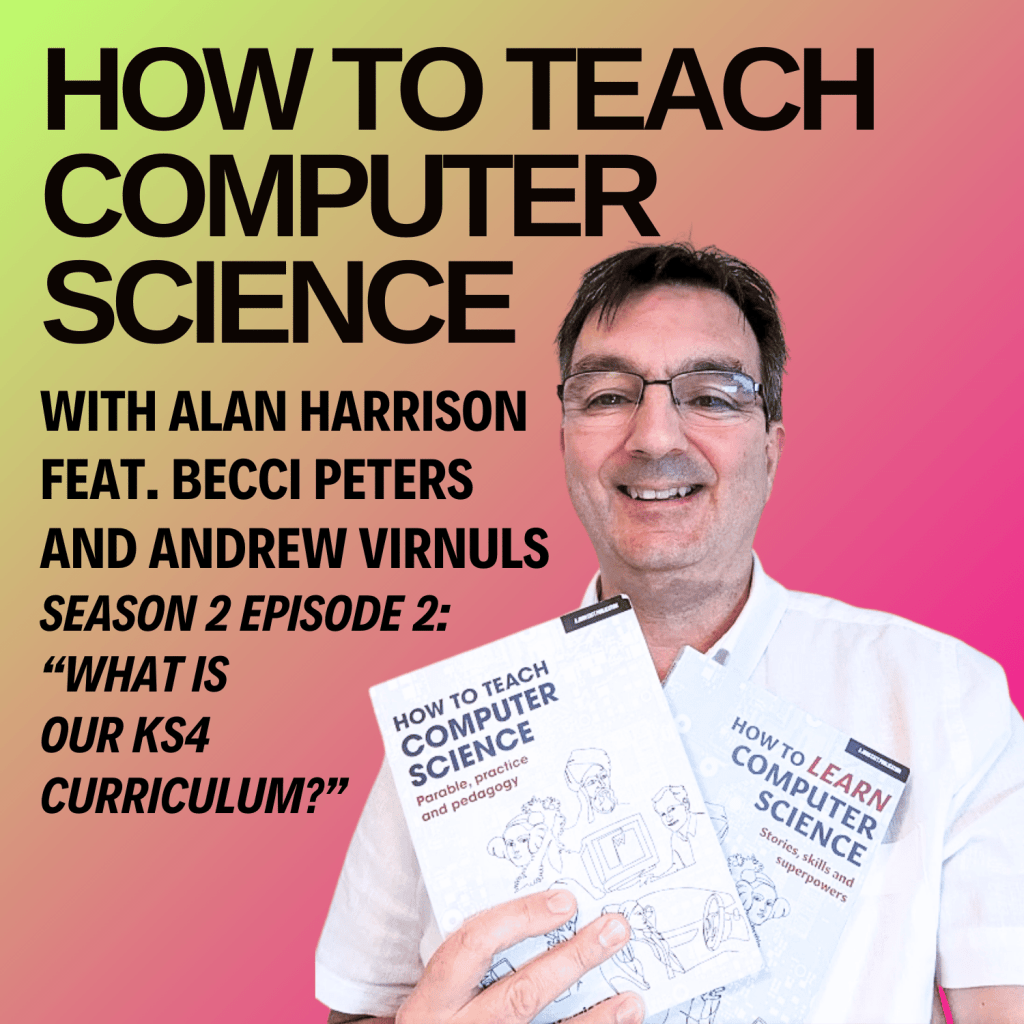
Alan: Welcome to how to teach computer science, the podcast and series two episode two, and I’m delighted to have two experts on the pod today. Becci Peters and Andrew Virnuls and me talking about the key stage four curriculum and qualifications. 

We’ve got a lot of online safety that we need to teach so that should continue into Key Stage 4, probably in PSHE lessons and assemblies. 

Becci: I would have thought a lot of it goes into PSHE. 

Andrew: I’m just looking at the Key Stage 4. The thing about the Key Stage 4 computing curriculum, it doesn’t really say a lot, does it?

Advertisements

Alan: More of that in a moment first some news. I dropped my laptop last week. And half the ASCII character set, fell out specifically all the punctuation marks in fact so I must apologize now for the lack of pauses in the scripted bit yes. It’s scripted. What do you mean? It doesn’t sound like it I’ll have, you know, I worked all week on this and now it sounds ridiculous because not only are all the commas and full stops missing, but the apostrophes too, I cant believe it. It sounds really silly ill do my best, but im struggling to be honest, let me download ASCII and start again. 

 Phew. That’s better. I hope you’re all backing up your data. I’ve got all mine in several places, multiple cloud providers and memory sticks. I bought a new memory stick last week, actually, which gave me a fright. I opened the package and it flew out buzzing loudly and saying how y’all do. Y’all got any honey. And I realized it was a US Bee. 

If you are grateful for my blog, please buy my books here or buy me a coffee at ko-fi.com/mraharrisoncs, thanks!

My name’s Alan Harrison, and I wrote the books how to teach computer science and how to learn computer science available in online bookstores. And if you like the podcast, you’ll love hearing me in-person. Visit. HTTCS dot online to find out more about my training and consultancy, and I could be speaking soon, live at your school on inset day jokes, optional. More details about this and book purchase links at HTTCS dot online. The initials of how to teach computer science.online. Listeners to the podcast, a special discount code to just type HTTCS pod in the checkout Page at johncattbookshop.com to get 20% off everything. 

That’s everything including classics, such as teaching walkthroughs by Tom Sherrington, the Huh series by Mary Myatt. And of course my two little books. 

Advertisements

Speaking of books, I’ve had an idea for a new business. Anyone want to come in with me. Audio books, right. Hear me out. But with subtitles. Yeah. Yeah. I think that’s a winner. 

Imogen: Alan, that’s just a book.

Alan: Oh, yeah. Hey. Alexa. What type of music do wind turbines like? 

Alexa: They’re big metal fans. 

Alan: Let’s meet my special guests. Becci Peters and Andrew Virnuls and ask the fertile question. What is our key stage four curriculum?

Yeah, so on the podcast today I’ve got two very experienced and clever people, so I’m going to let them do most of the talking today. First up, we’ve got a chap from episode three. Andrew Virnuls, nice to speak to you again. How are you? 

Andrew: I’m fine, thank you. 

Alan: Just remind the listeners what you do for me, please.

Andrew: For the rest of this term, I’m currently the lead teacher and computing specialist for a local authority service in Warwickshire that teaches children who are out of school for medical reasons, which I think raises some interesting issues when we talk about Key Stage 3 and GCSE later on. 

Alan: Yeah, we’re going to be talking about curriculum later on and qualifications, and an expert in such things is with me as well. The wonderful Becci Peters. How are you, Becci? 

Becci: I’m good. Thanks, Alan. How are you? 

Alan: I’m good. Remind me what your role is, please. 

Becci: So I work for CAS, Computing at School, which is part of BCS I’m the secondary computing lead. So I support computing teachers from all across the UK. So if you are not a member of CAS, come join us. It’s all completely free. And yeah, we just support teachers in any way that we can. Looking at resources, putting on free webinars just generally trying to support teachers because it is a very hard job. It’s been four years since I was in the classroom but there were some enjoyable times in there while I was in there.

Alan: Brilliant. Yeah, no, I can second that because I wouldn’t be where I am today. If it wasn’t for CAS, because I jumped in the deep end nearly 10 years ago now and joined CAS and downloaded all the resources that were free on the website and went to all the meetings and met lots of other teachers who were all doing the same thing going, “have you got something to do that? How do we do this?” And we’re all shared our experience. And then there was some brilliant free training run out of Edge Hill on behalf of CAS by The wonderful Carl Simmons and I went to like Saturday CPD for free and that was the making of me really when I was an early computing teacher. So yeah, CAS has been there for me.

So definitely if you’re listening to this, join CAS and see what they can do. I am still a CAS master teacher running occasional meetings in Manchester, but so do that. It’s great to have you both here. So we’re going to talk about the Key Stage 4 curriculum and qualifications today because we have a bit of an odd situation in our subject, don’t we, in that there’s a national curriculum and then there’s a GCSE and they don’t match.

Isn’t that right, Andrew? 

Andrew: Yes and no to a certain extent. I think one of the issues we have is when students start the GCSE because some schools within the county start in year nine and I thought what we’re going to do with that because most schools still see that as part of GCSE, but if you look at the content there is enough in common I think not to make that a problem, but yes I think in some ways what’s in the GCSE doesn’t match exactly so there’s, if you, I’ve got the list of bullet points up here, so the creative projects and those sorts of aspects is that what you’re referring to as not being in the computer science GCSE certainly.

Alan: Yeah, there’s a mention of creative projects and there’s not a lot of digital literacy in the computer science GCSE which is why maybe we’ll get some kind of alternative GCSE qualification. Becci, do you know anything about that? 

Becci: Oh, I might do. Yeah, I think that’s one of the things that’s definitely That is really bizarre about our subject, that computing at Key Stage 3 obviously has your three separate strands, your digital literacy, your IT and your computer science, and then we just do one third of that at GCSE and there’s nothing else, and I do find it really odd, and that’s one of the things that we’re lobbying for at the moment is a reform for computing qualifications at Key Stage 4.

And the idea being that we should have qualifications that cover all three aspects of the subject and not just the computer science. And making sure that, all students when they leave school, they’ve got not only the digital literacy skills that they need to go into, whatever line of work they go into, but then they’ve got that option of, the kind of the IT side of things versus the computer science side of things.

Alan: Yeah, that would be great. I was, I remember being shocked really when Michael Gove, bless his cotton socks, said that, ICT would be discontinued and I think the exam boards were shocked at the time because they had a new reformed GCSE ready to go, I believe, and then it was like, no, we’ve got to get everyone onto computer science, and then so the result was, is that overall the numbers taking a computing related qualification dropped when we lost ICT, which is a bit sad.

So the numbers are recovering a bit, I think but there are alternative qualifications at Key Stage 4. Let me see what, which ones I’ve taught over the years. Anyone remember CIDA? Certificate in digital. I remember teaching flash animation for the last couple of years before it was killed off by Adobe.

Flash was quite fun to teach. But completely useless in the end. Yeah. Any any qualifications out there that you enjoyed teaching or not? Andrew. 

Andrew: Yeah, we started, we used to have a lot of different qualifications that we had to teach at the same time because of the nature of the service teaching children from across the county.

So we had things like BTEC and we had OCR Nationals, CIDA and DIDA and working out, which bits apply to which and which. What were the requirements for the different coursework components and things like that. Then of course within those you had the different modules as well, didn’t you?

So you could choose your spreadsheets and your your kind of presentation things. Multimedia products there seemed to be a lot of I recall and finding free examples of everything from the web. 

If you are grateful for my blog, please buy my books here or buy me a coffee at ko-fi.com/mraharrisoncs, thanks!

Alan: What I remember from that from teaching CIDA and then Cambridge Nationals, I think there was a lot of describing what you do without mentioning the software you’re supposed to use in the specification, because they’re not supposed to say what software you use, and then you just ask teachers and you go, what’s this?

And, oh, that’s the PowerPoint unit. And, like, what’s this? Oh, that’s the web design unit. You need something like Dreamweaver or whatever. 

Andrew: That was always the case in ICT as well, I don’t know if you remember that, and Business and Communication Systems, I don’t know if you remember that, that was interesting.

Alan: What did that mean then, Andrew? 

Andrew: That was back in the days of ICT, it was a kind of, Half and half business studies and it, oh yeah. So you’d use your spreadsheets to do like a breakeven analysis or whatever. So I quite liked that what we liked about it as a service was there was no coursework.

’cause that was back in the days when most GCSEs were 60% coursework. And obviously portfolio based qualification is like the nationals. And cider and DDA were a hundred percent coursework, which is a bit of a headache for students who are out of school. 

Alan: Yeah. Absolutely. And in fact, we were talking about this last week Rachel Arthur and I, and she called these the screenshot qualifications where you had to do your research and you had to research potential software to deliver the product you were trying to make, which meant lots of Googling and screenshots and then pasted in and described in your own words, which were often very similar to the words off the website they Googled.

And and yeah. And we were talking about, it was in a conversation about the qualifications and who should take what and whether we should gatekeep computer science or not, as in only offer it to certain students. And Rachel and I were both vehemently against that and saying that computer science should be available to all.

It is a nine to one, level one, level two qualification. And so anyone who wants to take it should be able to take it.

Becci: I remember when the GCSE first came in and there was a lot of schools weren’t there, they would say, you’ve got to be in, top set maths or you’ve got to be predicted or whatever.

But I remember a couple of examples. There was one student who was actually not very good at maths and didn’t meet the criteria that the school had set for doing GCSE. But was actually a complete, like, had learnt to program in his spare time, was far better than all the kids, even by the end of year 11, and I was like, we are definitely going against the rules here to allow, how can we not allow this kid to do it, even though somebody set these arbitrary rules.

And another school that I taught in, And there was there was a student who got he got a grade two at the end of his GCSE, but that was a real achievement for him. You know what I mean? He got grade twos and, sometimes lower in, in subjects across the board. So for him to get a grade two in computer science, he was really proud of that at the end.

And he worked really hard to get it, so he deserved it. 

Alan: Yeah, absolutely, and we mustn’t forget that grade one, two and three can be a positive progress eight score for students as well. I think some SLTs are still stuck in the old five A star to C mindset and success is just defined by a grade four or five rather than what success means for that pupil.

Andrew: ECDL. Remember that was another one, wasn’t it? And so I warmed to that, actually. I know it had a bad name, but what I, because it was exam based. 

Alan: It was a nice little qualification, but it never should have counted as a GCSE. 

Andrew: Yeah, and that’s fair enough, but at least you had to be able to do it. One of the things that always bothered me about the portfolio I think one of the things that I think is really interesting is that, a lot of the web based qualifications is, we’d pick up a new student and they said, Oh, I’ve already done my DIDA spreadsheet module. I’ve got a distinction. And you say, Oh, can you just add these two numbers together?

And they wouldn’t be able to do it. And I think it was because they’d only ever done stuff once and they could, and because of that, there was no mastery. And I guess the retrieval stuff from our cognitive science they just didn’t remember what they’d done and none of them could ever explain how their websites work or how their spreadsheets worked or anything.

Alan: It’s a, it’s an argument against modular qualifications really, isn’t it? This is a one that I’ve argued a number of times and some very well meaning people don’t seem to get it. I think there’s a, if we get a new government, we might get another push back towards sort of modular qualifications and coursework based qualifications.

But the problem is, exactly as you say, Andrew, they they, Do the work for the upcoming test module or exam and deliver it and forget it and then move on. And I think GCSE gives you the space to do that mastery teaching with the terminal exams, meaning that you’ve got two years to really dig deep and explore a qualification and do, like you say, mastery learning.

I much prefer the terminal exams. 

Becci: I think some kind of like hybrid would be the best case scenario because we know some students really struggle with that terminal exam and trying to remember everything that they’ve learned in two years from every subject. So I think if there was some kind of, it was a modular aspect in terms of, right, we’re going to assess you on the bit that we’ve learned up till this stage, but it’s also going to be assessed in a terminal exam because they can’t just forget it and move on.

I think that kind of situation would probably be a fairer approach. 

Alan: On qualifications, the When I was talking earlier about the screenshot qualifications, as Rachel called, Rachel Arthur called it, and we, I think portfolio qualifications is another good phrase, Andrew. I think one of the problems of suggesting those qualifications for those students which are quote weaker or lower prior attainment is one, one of the problems with them I always found is there’s huge amounts of writing.

Therefore, there’s huge amounts of literacy needed. The students who are predicted a 3 in maths are unlikely to have the literacy skills to deliver a decent portfolio qualification. What do you think about that? 

Advertisements

Andrew: I also found that as a teacher, It was more difficult to know what to get them to write.

We had, last year we had a student who was doing the BTEC, what’s it called, the digital applications one. And I had to keep referring back to the school because I could understand what it was they were supposed to be doing in terms of the spreadsheet, but I wasn’t entirely sure what they should be saying about it myself, even as a teacher.

I think lots of those vocational courses had quite confusing specifications. 

Alan: They do like I said earlier, they try to lead you towards delivering, they give you a specification for a product without telling you what software you’re supposed to use. You have to work it out. You have to read between the lines of the specification a lot.

I found it really difficult. Back to the GCSE then. So we said it differs somewhat from computing, but how can you build a computing curriculum that delivers towards a decent GCSE performance? What do we do at Key Stage 3 that will help deliver the GCSE computer science results we want. 

Becci: I think part of the difficulty comes from the idea that because you only, the GCSE is only one third of the subject, so are you going to prioritise just teaching computer science because that’s what some of the students are going to go on to do.

At Key Stage 4, or what are you going to teach all of it? Which is what obviously everybody should do. Yeah, and I think that’s part of the kind of the difficulty is working out that bit. I’d like to think that everybody is teaching all of it, but at the end of the day it all comes down to time, doesn’t it?

And if the curriculum time in the school is not enough, then you’re not Really going to be able to properly teach everything and it’s a shame really. I think it needs to be, I think computing as a subject needs to be more valued within schools. Not quite sure how we do that, but I thought for a long time that computing should be as important as English and maths.

Andrew: I think it was interesting that, coming after ICT, because ICT was really explicit in terms of what you needed to do. And it’s a bit more, I don’t want to say vague, but it’s less detailed, isn’t it? And I think depending on your background, you have probably have a different interpretation of what those key stage three bullets mean.

So you and I we did O level computer studies. And with that, in our background I look at things like, be able to carry out simple operations on binary numbers. I’m just reading off the screen there. So in my head, I’m thinking about things like bitwise logic and stuff that we did when we were at school.

So in some ways I actually do probably more in Key Stage 3 than I would do in the GCSE, even in terms of computer Computer science because I look at that and I think about, he talks about communication. So I’d be thinking parity which isn’t in the GCSE. And in some ways I feel like I’m going backwards slightly when I’m going to the GCSE. 

Alan: Little bit. Yeah. So we were talking about this, weren’t we? And I remember in my computer studies O level exam writing the program in binary, we talked about that. We had an instruction set, a bit like the little man computer. But it had the binary codes and it had a. Addresses in binary and I had to literally fill in the noughts and ones to write a little program to add two numbers in binary.

And you just think, could you do that now? Could you get today’s kids to do that? And I think, like you say, one of the problems is curriculum time at key stage three. And the other one is probably, specialist teachers or lack of. So we’ve got a big headache and we’ve got Ofsted trying to Trying to drive, trying to move the needle, if you like, on numbers and curriculum time with the Ofsted Research Review, which talks about how one hour a week is the bare minimum, almost not quite those words, but that’s what they’re saying.

And GCSE, uptake, schools should be focusing on getting the numbers up and also delivering Key Stage 4 national curriculum as a bare minimum to everyone. There’s a lot of talk about that. I’ve been talking to teachers about that. A lot of schools are worried about being deep dived and not actually offering anything at Key Stage 4 to everybody.

What can schools do if they’re really short of specialist teachers? 

Andrew: It’s difficult to say because presumably we didn’t have the specialist teachers. When we were at school, I remember our computer studies teachers, one of them was a math teacher, and one of them was a biology teacher, so were teachers more engaged in teaching other subjects, or was it a kind of, were they enthusiastic hobbyists at that time?

Alan: We had one, we had, One chap that come out from industry, do you remember Plessy technology? They did electronics and stuff. So he, so I guess he was a bit like me, 40 years ago, come from industry and went into school to teach a bit of computing. And then there was a guy that came down from university, Dr. Beckman. Yeah, great name, couldn’t teach. And I felt sorry for him because the the bad kids would give him a run for his money. But he would come down from University and he’d done research projects in Fortran and stuff like that and he was trying to teach computer studies. I don’t know, Becci, what can we do?

Becci: I’ve heard of some teachers using things like the idea award and trying to map that across to the key stage four curriculum. As a way of, because it doesn’t require a specialist, the students generally should be able to access most of that on their own. They’ll get a certificate at the end of it.

No, it’s not a qualification. Does that matter? No, not really. So that’s one kind of way around it, but I think. There’s obviously parts of the Key Stage 4 National Curriculum that are computer science y, which is going to need to be taught by a specialist really, but you could do that in drop down days or, extracurricular days or something like that.

You could make it more fun as opposed to just doing, oh here’s a lesson and I’m going to teach you this topic, and they could learn those skills and that knowledge in a, in a more creative, fun environment rather than just having to go out here’s a one hour slot once a term or something ridiculous.

Alan: We’ve got a lot of online safety that we need to teach as well, so that really should continue into Key Stage 4, probably in PSHE lessons and assemblies. 

Becci: I would have thought a lot of it goes into PSHE. 

Andrew: I’m just looking at the Key Stage 4. The thing about the Key Stage 4 computing curriculum, it doesn’t really say a lot, does it? 

So it’s got three bullet points and it just says develop capability and, apply problem solving skills and there’s a bit about safety. And I was thinking about, you’re talking about Ofsted, I was thinking about when I first started teaching and we were doing the ICT. Again, ICT Key Stage 4 was quite detailed and it used to say things like, you had Develop existing knowledge and understanding of measurement, control, and modeling.

And so the course that I was talking about with the business and communication systems didn’t have any of that stuff in it. It was it was more kind of spreadsheet y and presentations and writing letters and that kind of thing. And Ofsted would not only check that you were doing ICT at Key Stage 4, but they would check that you were doing the whole thing.

So if you were doing business with the communication systems, they’d say, Oh, you’re not doing any control there. You need to do that. as well. So I think Ofsted have relaxed those sorts of requirements, but maybe because it’s not as explicit. 

Becci: I think part of it comes down to the explicit, I can’t say it, but also I Like most Ofsted inspectors will have zero computing background subject knowledge, so they’re not able to go into a school and do a deep dive for computing and be able to pick up on those things, whereas it would be easy for them to do that in any other subject, because they probably did that at school.

So I think that’s a good point. You know that’s part of the difficulty behind it. Like I remember there used to be GCSE IT and then there used to be the short course IT and everybody had to do that and you know you could opt to do the full GCSE but everyone was made to do the short version.

So I don’t know why we couldn’t have something like that where there was, it was a GCSE, but not a full GCSE, but I don’t think short courses exist anymore. Do they? 

Alan: PE does it so if you rem. Yeah. So RE maybe, possibly RE in some schools, I know PE is a national curriculum subject that needs to continue to key stage four and schools tend to do, yeah, schools give a qualification there in my experience.

Not the qualification. No. So yeah, there is, there, there is a PE GCSE and there’s sports science vocationals and stuff. And schools, we’ll often do core PE, which is like one lesson, a fortnight. And then they’ll do one of the PE or sport science type options for those that want to go into that kind of career.

If you are grateful for my blog, please buy my books here or buy me a coffee at ko-fi.com/mraharrisoncs, thanks!

And so we could have something similar to that. And I’m not sure how we get there. I think it’s, bodies like Ofsted, possibly NCCE, and possibly CAS can all move us in that direction it’s just how we get across to schools that they really need to be offering all Key Stage 4, some kind of computing education.

Becci: Yeah, I know Pete Dring’s doing a session at the CAS conference off the top of my head about Key Stage 4 qualifications and what schools can do about it. And I know other people are, there’s a computing lead in one of the maths is trying to take each of the Key Stage 4 national curriculum bullet points, all three of them, or however few there are.

I’m trying to map them with other subjects to try and see where they could be fitted in elsewhere, so it doesn’t necessarily require a specialist time, but it ticks the box to say they’ve all been done.

Alan: I think there’s a lot of value in that. And, if you think about subjects like maths and science, they could very easily put a little bit of, IT and sometimes a bit of computer science into their curriculum.

For example, in science, you could record the results of an experiment in Excel and plot the graph of, if you’re doing specific heat capacity or something of different metals and heating them up on a Bunsen burner with a thermometer in, this is one that I remember from my chemistry lessons.

Then yeah, you plot that in the, in Excel rather than just on graph paper, and that’s, that might be one way of doing it. 

Andrew: I teach maths as well and I do that. I, we use spreadsheets occasionally. Also what I do is when we’re doing exterior angles and drawing polygons, I do it in Scratch, put the, pop the pen down, move and turn and those sorts of things.

The students quite like that because you can do little experiments and it’s much quicker for them to redo stuff. In Scratch then you’d like rub it out or if they’re drawing it on paper and those sorts of things. Yeah, 

Alan: yeah, Scratch maths is a good one. I think So given where we’re at now, where we don’t have an alternative IT qualification, apart from vocationals, which aren’t suitable for everyone, I think across the curriculum, plus PSHE, plus drop down days, perhaps.

Andrew: I was going to mention PSHE, because when I worked in a school we used to do ICT certificates of competence, they were called, in PSHE. I guess IDEA would be the kind of modern equivalent of that, wouldn’t it? Do schools do that these days? 

Alan: Absolutely. Yeah so maybe schools could do like the bronze award in year 10 and the silver award in year 11 or something as part of their computing offer.

I’d love to see that. 

Becci: I don’t even think you need to wait till year, Key Stage 4 to be able to start that. I used to do bronze award. I used to start at the year 7. And then we used to, spend part of the lesson saying, this is how you log in, and this is the concept behind it, and this is what’s going to happen.

I used to set it as homework, so you could obviously easily track, how has a student done at least one badge in the last week, just downloading the data and quick comparison. And the amount of times at the end of the lesson, they’d have a quick go over one or two activities, and they’d be like, Miss, can I do this at home?

I’m like, yes, please go and do this at home. Yeah, as much as you like, you’d have some of them completed silver before the end of year eight. Some of them wouldn’t, some of them were less inclined, even if you just start that in year seven, I’d like to think that every student by the end of year 11 could at least get a bronze.

Alan: Yeah, absolutely. So that’s one way of doing it. So what else did Osted say? Have we have, we covered everything Ofsted said. 

Andrew: Digital natives, they mentioned which is interesting because in terms of digital literacy, I think probably over the last 20 years, there’s been a noticeable decline in students general ICT skills, their ability to operate the computer.

Advertisements

Yeah, I don’t know why that’s come up. What was that thing, wasn’t it, Bill Gates said that at some point, the the computer will be like a fridge or a television. It would just be a piece of equipment. And I think when I first started teaching in the 90s, they’re all very excited, and they’re all very focused on using the computers.

And then it’s, they’ve all become quite blasé because they’ve all got one at home. And then, In fact, not all students have one now because some of them have got, tablets or phones and they’re not used to filing and typing and using mice and all those sorts of things. 

Alan: So what vital digital literacy do we need? Do they need to leave school with? I was talking With my role at the NCCE there was a professional development leaders conference and I heard from the digital poverty alliance. Have you seen the work that they do? And that was eye opening, the digital divide is as big or bigger than it’s ever been, between those that can, take a full part in society and those that can’t because they don’t have access to technology.

And I don’t know if you’ve ever done any dealings with the tax office or the benefits office or any of the government agencies. If you haven’t got a smartphone and data, then you can’t do it. No one answers the phone anymore. 

Andrew: It’s that accessibility to, all the best deals on for your electricity and all those sorts of issues as well, car insurance and all manner of things.

Alan: Yeah, so it’s not a nice to have anymore. It’s having digital skills and the resources to use them as in a device and some internet at home has become vital. It’s now, like, like you say, they called the Digital Poverty Alliance for a reason. It’s a kind of poverty. 

Andrew: That was the thing about 25 years ago. That was the focus of the Blair government. They talked about the information underclass and it doesn’t seem to have got any better. 

Alan: No, it’s if anything got worse. So coming back to the positives then. What can we do? We’ve talked about delivering across the curriculum. We’ve talked about delivering, some kind of computing education to all by using cross curricular methods, using the idea badges, having drop down days, assemblies and PSHE lessons on digital literacy and online safety.

That’s what we can do at the moment. Have I missed anything? 

Andrew: I wonder whether there’s opportunities to do things in a kind of way that might appear to be non computing. So quite often, like in primary schools, there’s a focus on algorithms, isn’t there? But it doesn’t have to be related to computers. They could talk about methods for doing all sorts of things.

My son came home and said, oh, we’ve been doing algorithms today. We talked about how to get dressed. And I’m guessing some subjects would have, there must be methods for computing. Making dovetail joints in DT or whatever that you could codify in some way like a like an algorithm. 

Becci: Yeah, I’ve seen examples of like learning a dance routine. That’s an algorithm. And you’ve got subroutines when you get to a chorus and obviously you can do that in music as well. 

Alan: And that’s a good one for for subroutines. Yes, music and dance. 

Becci: Yeah, I think that’s one of the things that I find really bizarre is that in primary they don’t really have like set lessons in terms of a subject, they’ll just obviously have activities. So they might have, the Tudors as their theme and then everything is based around that. But they’re not specifically told, oh, this is English, or this is computing, or this is history. They’re obviously going to, if it’s the Tudors as the theme, there’ll be history embedded throughout, but they might be doing different things, whether it’s art, or whether it’s literacy, or whatever it might be.

And I don’t understand why we lose that quite so much in secondary, apart from the fact obviously we’ve got subject specialists that they don’t necessarily have in primaries, but I feel like that aspect of cross curricular needs to happen more in secondaries. 

Advertisements

Andrew: I think they missed opportunities as well, so my, when my daughter did the Romans, they did Caesar’s shift ciphers and they did converting to Roman numerals, but they didn’t do them in a computing sense, and they, they, I think they missed an opportunity there, they could have written down a method for doing the Caesar shift cipher, how to convert numbers to Roman numerals.

Alan: Oh, I wrote a program to convert decimal to Roman numerals with my class. It was a nightmare. It’s actually much harder than you think. 

Andrew: I did that with my daughter, so it’s on my personal website. And yeah, it is because you have to look too ahead. It’s not like the change example. Yeah, people do.

Alan: Yeah, that’s a tricky one. But yeah, no, that’s a good, that’s a good one. And it comes back to cultural capital in a way, isn’t it? So how can you put. Cultural capital into our subject. That’s mentioned in the Ofsted report. And, it’s all of these things, the Caesar cipher. What’s that mean? Caesar was a Roman emperor, and then you’re suddenly talking about that. And then you’re talking about the code breakers at Bletchley Park and so on. Any cultural capital that you’d like to put in, 

Andrew: I like to throw in some stuff at random, so if you, the sorting games on my website, for example, the merge sort, when you choose Whether you merged it from the left list or the right list, they’re colored red and green, which is the same uses of red and green as they are in the nautical world for port and starboard. Port and starboard. Which I did deliberately. 

Alan: Throwing it in everywhere. Links, everything’s linked to something else. It’s like the matrix, good stuff. Ah yeah, I think we’ve We’ve had a good chat about Key Stage 4 curriculum, qualifications, what Ofsted think, how to deliver Key Stage 4 computing across the curriculum.

I think that’s been very useful. We’ve kept to time roughly today. I think I’ve probably got, what, 40 minutes of brilliant conversation there. I’ll tell you what we are going to do. We can talk about workloads soon, aren’t we? Are you up for that? 

Becci: Sure, why not? 

Andrew: Yeah, 

Alan: why not? That’s brilliant. Thank you very much for that it’ll be a while yet. These have got a few backed up. Because you wouldn’t believe it, but I’ve got a day job as well, right, I better go. Thank you very Much for your time. 

Becci: Thanks, Alan. 

Andrew: Bye. 

Alan: Thanks, bye. 

 That’s a wrap for another pod. What a great chat. Quiet, correct horse battery staple. Just opening Microsoft Authenticator. 9 1 5, 3, 2, 2, and tap authorize. 

It took so long to teach him to wait for two factor authentication. You would not believe it. I know it sounds far fetched. Doesn’t it? 

In other news, my family were all sitting on the sofa, watching a Christmas film at the weekend. I asked them to make room for me by shifting one place to the left and. Oh, they doubled in size. Must be all the mince pies 

 don’t forget podcast listeners can get 20% discount off all books at johncattbookshop.com with a code HTTCSPOD or if you already have the books. Buy me a coffee, please. At ko-fi.com/mraharrisoncs. All links on my blog at HTTCS dot online slash blog and subscribe now. So you don’t miss a thing. Have a great week. I’ll catch you next time.

If you are grateful for my blog, please buy my books here or buy me a coffee at ko-fi.com/mraharrisoncs, thanks!
Categories
HTTCS leadership podcast teaching and learning

Podcast Episode 7: “How Hard Can it Be?”

A new episode is live, featuring the wonderful Rachel Arthur of Teach First. Listen now here:

Transcript

Alan: Welcome to how to teach computer science, the podcast. This is episode seven. How hard can it be? I’ll be answering that question and many more. With help of today’s special guest. 

Rachel: Nothing’s real. What is real anymore? No. We’re all in the 

Alan: matrix, and maybe I’m a deepfake. Oh, well that would just be the 

Rachel: twist, wouldn’t it? 

Alan: More on that in a moment. My name is Alan Harrison, and I wrote the books how to teach computer science and how to learn computer science available in online bookstores, more details at the companion website. HTTCS dot online. That’s the initials of how to teach computer science HTTCS dot online. And if you haven’t bought the books yet, why not? We’re talking about training to teach today. I remember my teacher training. Well, and I was already blogging at HTTCS dot online slash blog. So I can look back at those days. 

And so can you, here’s what I wrote. In 2016. About this time. Last year, I was reveling in the joy of my first ever taught lesson. That lesson was exciting, a bit crazy and lots of fun. It went as well as could be expected. No, really. I was treated to some mentor feedback containing the words, the best first lesson I have ever seen. 

Thank you so much, Sarah. Today I’ll call that a punch the air day. But trust me, teacher training got much harder after that included one lesson. I will never forget. I had asked the year eights to complete a task in Excel and print it out, forgetting that a full print of my Excel spreadsheet would be six pages. Each. Times 30. On a printer that didn’t do double-sided and I asked them to start printing with five minutes left of the lesson. And there were no names on the printouts. 

 So as my mentor sat watching and yes, quietly laughing at me, trying to organize a queue for the printer with enthusiastic kids, grabbing individual sheets and shouting, whose is this waving lots of completely identical pieces of paper. I realized teaching is a roller coaster. Some days you’re up there in control, conducting an orchestra of kids, all making progress. 

 I seem to have mixed my metaphors back in 2016. Other days, nothing will work and the music will sound awful. That day. I went home feeling pretty down and metaphorically kicked the dog. Quiet password 15 hash. Don’t worry. If you have a kick the dog day know that you tried your best reflect, get advice. Change things, fix it for next time. 

The only bad teacher is the teacher that repeats mistakes. The teacher that doesn’t reflect refuses, advice and rejects growth. Be the teacher that reflects on every experience, learns from their mentor and from other teachers and changes things up for the next lesson. So not bad advice from eight year ago, me. But. My guest today has some cracking advice. Probably much better than that. And some of it isn’t about babies and toddlers. Let’s hear what happened when I spoke to Rachel Arthur and asked the question. How hard can it be?

Rachel: Hi Alan.

Alan: Hi, how are you? 

Rachel: I’m good, thank you. How are you? 

Alan: Yeah, great. How’s the little one? 

Rachel: Yeah, she’s good, thank you. She’s actually just fallen asleep, so I’ve just handed her tentatively over to my husband, so he can wander around holding her until we’re brave enough to attempt putting her down. Hands very much full, but it gets easier, I think. Yeah. 

Alan: Yeah. It gets easier in many ways and then harder in others. But you do get a bit more sleep soon. 

Rachel: Yeah. Yes. Yes. That’s my main. 

Alan: We were very lucky. 

Rachel: at all . She’s sleeping through the night at the moment yeah.

Good. I can’t complain, we’ve been very lucky with both of them so.

Alan: We were quite lucky. We went off skiing, with the in laws when, our eldest was like six weeks old, 

Rachel: I think you just have to get on with it, don’t you? We’re going to the lake district at the weekend and we’re like, why are we taking a 10 week old on holiday? This is a nightmare. Like all the stuff that we’ve got to pack. We’re like, if we don’t go, then you just, it’s just the same nightmare at home. 

Alan: We went to see Michael McIntyre and he said your single friends, they, they phone up and say, you going for a drink? And when you’re single, you go, yeah. You put the phone down, you walk out the door. And like when you’ve got kids, you have to pack a small bag with everything in it that you own, just in case your house isn’t there when you get back. 

Rachel: It’s so true. My husband was just like, Oh, I think we’re going to have to get a roof rack I was like, 

Alan: just to go out for the day. Yeah. Sorry. We haven’t got enough stuff. Yeah. 

Yeah. 

Rachel: Oh, but the podcast is going well. 

Alan: Have you been listening? 

Rachel: Yeah, I’ve not listened to all of them but our night feeds have been up listening, tuning in, so it’s going really well, isn’t it? Like you seem to be getting a lot of support and a lot of people are engaging with it, which is lovely to see.

Alan: It’s been great. I’ve had comments like, oh, this is the right thing at the right time, and just, computing teachers need a bit of a boost right now, and I think all teachers need a bit of a boost right now. I think 

Rachel: it’s something that’s the way you do it is really nice, but I think it’s something that’s specific for computing teachers as well, because I think there’s a lot of generic teaching stuff out there, but it doesn’t really apply to computing a lot of the time, so it’s nice to have something that’s specific.

Alan: I was thinking of doing it for ages, and then two things happened. Tom Rogers, who runs Teacher Talk Radio, hassled me about doing a radio show, and I never ended up doing that, but I might yet. Tom, if you’re listening, I might do that and the other thing that happened is I’ve been listening to Adam Boxer and Amy Forrester. Yeah, they’re really good. Yeah, and thinking, oh how hard can it be? And I was listening to them going, oh I need to do this now.

So I just need to start recording it. It started off at 25 minutes and then the latest ones are like 43 minutes. Yeah, 

Rachel: and is the edit a nightmare or has it not been too bad? 

Alan: Being a computer geek like I am, I have discovered some software. I did my research, I googled a lot of things, and then I found some software called Descript, which I’m now paying 24 a month for. Descript does something amazing, which is I will upload this recording into it, it will transcribe, and then give me a page which edits like a Word document, and I edit the words. And it deletes the audio that matches the words, so I’m not sitting there like Audacity cutting and splicing audio and looking for the peaks that match the words.

It’s done that for me, so it’s actually much easier. So never one to make life easy for myself. Now that I can do that, I decided to edit in lots of music and stupid things as well just to make it entertaining. So 

Rachel: yeah, I think that’s what. What people are saying about it, people are enjoying listening because it’s different and it’s enjoyable and it’s light. It’s not another heavy, let’s have a deep dive. I mean, We can talk about pedagogy, but 

Alan: yeah and, we will, we’ll talk about computing. Teaching and pedagogy and stuff like that, but we’ll try and chuck in some jokes, because like Andy Colley said, there’s not many jokes and most of them are quite corny, so I’m saying to all my guests, if you can, if you’ve got any computer related humor, then, do bring it along.

Rachel: Oh, I need to be more prepared. I’m not, oh, 

Alan: I didn’t. 

Rachel: I’ll have to I don’t want to let your audience down with my lack of computing jokes, but I’ll see if I can come up with something. 

Alan: Have a think as we’re talking and anyway, it’s all right. I’ll edit some jokes in later. Yes. I’ll tell you what, I’ll put your voice through an AI deepfake machine. That 

Rachel: would scare, scare, horrify and it’s super exciting isn’t it, things like that, but there’s some really The accuracy of these deep fakes now, you could have me saying anything on here, couldn’t you? In fact, you even need me here. I can just go and you can just type in. 

Alan: I think I’ve got enough there now, Rachel, so you can go and I will just put words into your mouth for the next 20 minutes. Thank you very much. 

Rachel: Perfect. I’ll go get some sleep. 

If you are grateful for my blog, please buy my books here or buy me a coffee at ko-fi.com/mraharrisoncs, thanks!

Alan: Good. It’s lovely to talk to you and yeah, I’ll catch up again soon. Yeah, right now I’ll start the AI deepfake Rachel and talk to that, right?

Hello AI deepfake Rachel. How are you? 

Rachel: I mean, What would a deepfake say? It would probably go very stereotypical and say I am fine, thank you. It’s definitely even better than that. 

Alan: Yeah, this has got a bit surreal, so I think we probably need to get back to the script. Do we have a script? No, not really. I had some questions I was going to ask. So the first thing is I’ve been talking to you like, like I know you, because I do, but my listeners probably don’t. First of all, Rachel Arthur, nice to meet you would you like to tell everybody what you do for the listeners, please? 

Rachel: Yeah, what do I do?

So I am Head of Computing at Teach First. So that means that I am in charge of the initial teacher training programme. That we run and I get involved in all the teacher training materials that touch computing. So whether it’s our NPQ offer, which is more for leadership or our training materials for primary teachers or for secondary teachers, they all fall within my remit, my team, so that’s what I spend my days doing.

But before I was in teacher education, I was a teacher myself, so I worked in teaching. Secondary schools in London Leeds and Oldham, sunny Oldham, over my teaching career and eventually became assistant head after, the usual route of head of department, subject lead, all of those things.

So yeah, that’s me. 

Alan: Good stuff. So teach first then, which is one of the routes into teaching. So what, if someone’s listening to this thinking, I want to train to teach computing what would their choices be?

What would they have to consider? 

Rachel: Firstly, please do. Absolutely do it because it’s a brilliant subject and there’s so much joy to be found in the computing classroom and you won’t regret it. But there’s loads of different routes.

 They split into school centered training, so like Teach First do, or like they call it a SCITT, but school centred initial teacher training, the training is done predominantly in the school setting, but you get your qualification at the end, like you would do through other routes, or you do a more traditional route, like a PGCE or an undergraduate degree where you train with the university and with that you do usually two or three placements over the year where you get to go and experience different school settings. 

If you are grateful for my blog, please buy my books here or buy me a coffee at ko-fi.com/mraharrisoncs, thanks!

So most of the routes into teaching are either the traditional university route or a school centred approach either through Teach First or one of the other training providers or the school running them yeah, you get to train in a school, but you are usually spending the majority of your time just in that one school rather than across multiple settings like you would in a University course. 

Alan: Do you get to go to other schools for brief placements? 

Rachel: Yes, so on Teach First we do a two week and sometimes it’s extended depending on the circumstances of the trainee but they do a two week placement in an alternative setting and they also do a primary placement so if you’re training to be a secondary teacher you also do some time in another phase which is Always interesting to see, see how they get on in a primary setting as well. They do get that kind of breadth of experience but it’s you are treated as an employee. Oh, hello. 

Alan: Sorry. This is what happens when I do podcast recordings in the evening. This is Casper, my Patterdale terrier, who decides he wants to get In on it. 

Rachel: He wants to train, to teach, he’s so intrigued by what we’re talking about.

Yes, one second. 

Alan: Oh God, yeah, that’s not great podcasting, is it? Here’s my dog on the Teams call, and he chose not to even say anything. There you go. I’ll edit some, so I’ll edit some dog barking in later and that’ll make sense to the listeners.

 You see? Magic of computing. None of this is real. 

If you are grateful for my blog, please buy my books here or buy me a coffee at ko-fi.com/mraharrisoncs, thanks!

As I say, you know, I’m talking to a deepfake, so you know. Um, So anyway, yeah, my placements were fun, I don’t know if I’ve ever spoken to you about this. But my placements, if I can just talk about them, one of them was right at my doorstep, literally just a stone’s throw away which was handy so I could roll out of bed and just rock up. And that was nice and it’s a nice local school and that was quite, what should we say, easy first placement in the sense that there wasn’t a lot of behavior challenge. And then, I don’t know if you ever saw Educating Greater Manchester? 

Rachel: Oh I did, yeah. Oh 

Alan: yes, so that school, so I was there, it was called Harrop fold then, so that was my. Yeah, that was my second placement school, so I was there. So that was a interesting school. So it’s good to have a contrast. So it’s nice to know that, you spend some time in another school and see some of that on the Teach First program.

Rachel: Yeah. The Teach First program We deliberately place our trainees in, underserved communities, so where there’s the greatest need for the highest quality of teachers, and often in schools that people wouldn’t necessarily choose to teach in, it wouldn’t be their first choice, it might be a more challenging area, for many reasons and we find that our trainees absolutely love the schools that they’re placed in. I did the teacher first program myself when I was training and I trained in an amazing school called Carmanna in Leeds, which is, it’s an excellent school and it’s in an underserved community and that’s why it’s a Teach first school, but the staff and the pupils there were fantastic, but I went to, I won’t name the other school I went to, but it was a leafy Very privileged school and I found it really, I thought I’m going to love this.

It’s going to be really great, but I remember saying to the pupils has anyone got any questions after I just explained something and no one put their hand up and then I was. I was doing questioning with the class and nobody was coming back to me with anything, and I was expecting, I was so used to all these characters and the banter in my classroom, so it was quite a surprise, but I found I got through a lot more content, so I don’t know what that was.

Yeah, 

Alan: that’s one thing. Yeah, a colleague said to me on my PGCE who got placed in a high performing school an affluent area, he said, I’m not planning enough stuff for the lessons because they’re just like eating it up like a sponge and I need to put more challenge into all my lessons and it’s breaking me, so he’s basically teaching maybe twice as much content in a lesson, but I know what you mean about not getting that feedback.

I think there can be in a school where the pupils are used to success and getting everything right, and there can be a reluctance to fail, so a reluctance to to try and to answer questions and get it wrong there can be an absence of culture of error in environments like that. Do you find that?

Rachel: Yeah, absolutely, and I think there’s this massive misconception that More affluent areas would be higher performing and that isn’t necessarily the case, especially in computing. I think you can really see that success in any, with any child from any background. And that’s the beauty of computing, isn’t it?

But that absence of wanting to be seen to be failing can really cause problems when you’re teaching programming because if they’re not willing to give it a go, then that fear of failure or fear of, having to debug a piece of code, can really put pupils off, which is a barrier to learning it, in itself.

Advertisements

Different challenges in different places, like just a different type of challenge rather than People say, Oh, that school’s really challenging. And I don’t, I think all schools have their own challenges. It just depends what flavor of challenge you’re best equipped to deal with. 

Alan: Absolutely.

Absolutely. I think, I mentioned culture of error then and the reluctance to try and fail is a real barrier and you see it I ran an escape room. If you go on my blog, the instructions for building it are there. I basically bought a pirate’s chest type thing and one of those lockout hasps which is a a lock with six padlocks on it and each of the padlocks had a different clue and so on and the kids loved it and my brilliant year 10, my brilliant GCSE class they loved it and then I tried it with like year 7 and 8 And they just didn’t want to try hard at solving clues, and they were looking at a clue, and it was, a clue to Ada Lovelace and her birthday, and that was the combination on the padlock, and they were looking at them going, I don’t know what that is and just wanting to either know or not know and not to actually think about it. These were puzzles and they, there was zero resilience and zero willingness to work out a puzzle from these kids. And I found that really strange because I always loved puzzles as a child, but the, I think, What I’m saying is probably the resilience has taken a knock and maybe that’s a COVID thing. Yeah, 

Rachel: I think it’s massively important in a computing classroom that resilience, even more so than other subjects, I think it is often not thought that Resilience and computing go hand in hand, especially by non specialists or people from other subject areas.

And when you’re talking about, building cultural capital or links the real world and that resilience for the workplace and for the future, computing is the perfect place to demonstrate that. But I think, It’s not always obvious to other people, so it’s so important to instill that, and it’s really similar to PE in some ways, you’re learning a skill, you’ve got to keep practicing and practicing, and you’re not going to shoot on target in your first game of football every time, so you know, you’ve got to keep going and keep trying

Advertisements

Alan: yeah, I was talking last week to Harry and Anna Wake of Mission Encodable they were saying about, sometimes learning to program can be dull. And I think I’ve been guilty of teaching programming in a very dull way and just do, you do hello world and then you do what is your name? Hello Bob or whatever I call the program. Hello Bob. And then you might ask a quiz question. What’s the capital of France? I don’t do that anymore. I do turtle graphics and, we do fireworks and stuff like that. And I do text adventure games and things because kids can write a text adventure game in 20 lines of Python. And there’s a world that didn’t exist before with monsters in it, you know, and that’s, 

Rachel: Yeah, 

Alan: so that’s what I do now. I don’t do hello world and hello Bob and what’s the capital of Paris anymore. I do, give your monster a name and give him a, a thing to say. Does he bark or does he grunt and all of that? Oh, they’re making monsters in a text adventure. 

Rachel: It’s so much more inclusive as well to teach like that because, I am a massive Advocate for engaging as many girls and as possible in computing and anyone from any background getting the most diverse cohort that we possibly can.

I think it’s so important and what you’ve just described is making it relevant, isn’t it, to those pupils and adapting that lesson and that learning so they can find a hook that they’re interested in. And that makes such a big difference for all of those groups that, aren’t traditionally choosing to do GCSE computer science, but that’s where I’ve seen the biggest changes in my classroom when I’ve let kids pick what they’re interested in and because computing is so great if you can, it could be.

It could be anything from a text adventure game about robots or pirates or princesses or whatever anyone’s interested in, all the way through to, we used to do a chat for Ordering a pair of jeans on ASOS because loads of the kids were online shopping and that’s what they were interested in.

And that kind of call and response from an online shopping website, they were interested in how that works. So just following the pupils interest really helps with that. 

Alan: definitely. So that’s how we teach. Programming, so coming back to teacher training then, so what makes a good trainee?

Rachel: Oh, anyone who is interested in learning, like I, when I first started in my role at Teach First um, three and a half years ago now I was talking to recruitment about What I wanted my trainees to be and what qualifications they needed to have and, the recruitment process for joining the training program.

And anyone that’s listening to this that works at a university will have had similar conversations like designing the interview questions for people training to teach. It’s a really interesting process. And they said to me, do you want them to have an undergraduate degree in computing? And I said, no, and recruitment said.

What? And I said they can do, that would be lovely if they did have a degree in computing and I’m absolutely here for that. However, it depends when they did their degree, because if we’re talking about career changes who are a bit older and did their degree a few years ago, it wouldn’t have been called computing then, it might have been called IT.

Advertisements

You can call a computing degree so many different things, and actually there’s such limited links to the GCSE curriculum to a computing degree. I didn’t feel like it was a necessity for them to have it. I felt much more passionate that they were interested in programming and interest in teaching the breadth of the computing curriculum, which is often not talked about because we focus so much on programming and so many schools do Python, so Python programming, but there’s a whole other area of the curriculum out there.

It’s not just about that. So what makes a good trainee? What was I looking for? Someone who is Resilient, willing to give it a go, willing to learn and anyone that was willing to do a subject knowledge enhancement course to get their subject knowledge up to date, in terms of what is taught on the GCSE and A level specs was my main concern, rather than them having a specific degree, because it’s too difficult to map them all to the curriculum.

Alan: Yeah, no I tend to agree, and I speak as a holder of a computer science degree from 1989, nowadays there’s information systems and software engineering and games design degrees and all of these and they go way off piste compared to what’s on the GCSE.

So you’re probably right. I also said in my podcast episode with Andy Colley, he said he suggested computer science graduates are not always the best teachers. They are a certain type of people. And I knew what he was hinting at. And I said, yeah, I, to be fair, I didn’t hang around with computer science undergraduates. When I was at university, I hung around with archaeologists and English students and more interesting people than the geeks who spent all that. No, it’s true. There were lots of geeks on my course who were not particularly fun to hang around with. So yeah, I totally, yeah, I always say, if someone’s keen and that’s half the battle, isn’t it? If they have an interest in the subject, that’s really what you want. And having a different degree and, but also having some computing aptitude, could be a nice combination. 

Rachel: Yeah don’t get me wrong, subject knowledge is important. You’ve got to have a strong subject knowledge to be able to teach our subjects and I’m not devaluing any training route in terms of, you don’t need to have a degree to do it.

It’s definitely a nice to have, but I do think so many people are self taught in programming and all areas of computer science. Now, lots of people that have done our course this year have taught themselves to program during lockdown. And it was something that they picked up and started to do then. 

Yeah, but that all, so we’ve got someone who used to be an artist and has moved. to becoming a computing teacher, all the way through to people with really specific, really technical degrees in robotics or, networks. So there’s a whole array of people, and that makes it fun to design a course to meet everyone’s needs, but, we’re good at differentiating.

Alan: Talking of which, so breaking news, I haven’t told anybody this but, I am going to be delivering the SKE, the subject knowledge enhancement for Edge Hill after Easter, so that’ll be fun. So if trainees don’t have a computing degree then do you run a subject knowledge enhancement for them?

Rachel: Yeah, we actually wrote our own. So that was a really exciting project to take on a couple of years ago. So Daljit and Johnny and my team and myself wrote it together. So it meant that we could adapt it to make sure that it covered the breadth of the subject knowledge content that we wanted. But obviously. Trainees can do any Subject Knowledge Enhancement course. You can’t say that they’ve got to do yours, you just say that you’re doing a Subject Knowledge Enhancement course. So we get trainees from other universities coming to do ours and then you get, one of our trainees might work with you, Alan, and do yours and come to us after it and that’s absolutely fine.

If you are grateful for my blog, please buy my books here or buy me a coffee at ko-fi.com/mraharrisoncs, thanks!

It means that non specialists or people who haven’t done a degree that’s where we say yes you need to do a subject knowledge enhancement course or you don’t and often we find those with a computing degree still need to do the subject knowledge enhancement course because of the lack of relevance to the computing curriculum. It’s really good to have people like you delivering them because it’s great to have some good subject knowledge experts delivering those courses because they’re long and there’s a lot of content to cover.

So yeah, 

Alan: there is a lot. Yeah. No I’m looking forward to it because one of the things I really enjoyed when I was head of department was the mentoring of computing trainees. And that’s one of the reasons why, I wanted to get involved in the teacher training. So the mentoring. I had some brilliant, trainees that, they were all brilliant in their own way, but some of them needed a lot more support than others. Um, It’s it was one of the most rewarding things to see a teacher develop. And then fly solo and. Yeah, it was great fun. It must be rewarding to be in that business all the time? 

Rachel: Yeah It’s a delight to watch someone go from the nerves of teaching their first ever lesson that they do in the summer with us all the way through to, loads of our trainees after their first year go on to become heads of department or go into leadership.

So to see them all flourishing and flying It’s lovely, but also to see their confidence grow just in terms of trainees that had never used Python before going to fully teach a GCSE class and seeing the success that their pupils then have because of having that teacher is brilliant. 

Alan: Yeah, that’s the thing.

Yeah, I feel it’s weird. I feel kind of responsible for the mess that the world is in because of technology, because I was obviously a computer scientist. No, partly responsible. I mean, It’s not all my fault, not all of it. 

Rachel: Alan, that’s a lot to take on your shoulders. Yeah. 

Alan: Yeah, it’s my fault guys. It’s my generation of computer scientists and who created, all the problems. So I feel like it’s partly my responsibility To nurture the next generation to solve all of the world’s problems that have been caused by technology. So I used to go into, I would go around and sell the subject and I would beg the head of maths to let me go into maths lessons and science lessons to, Before options evening to sell the subject and I would do a 10 minute, I would do a 10 minute speech and I would finish, thank you for coming to my TED talk, I would do like a 10 minute TED talk on what computing was and I would say, I would literally say to them, you need to solve all the problems that my generation have caused with technology, it’s on you, no pressure. 

Rachel: That’s the joy of the subjects, isn’t it? That they do have those opportunities to go. Yeah. Problem solving, and I think the impact that having a trainee in school, schools often worry and say, oh, we shouldn’t, should we take on a trainee teacher? It’s a lot of responsibility, but the results that those trainees get and the enthusiasm and time and effort and energy that they put into their classes, honestly, every single trainee I’ve worked with, I’ve never, I’ve never seen.

It, It might not always be perfect, but they do, I’ve never seen anyone work as hard. So it was, no, 

Alan: I can say this now with absolute certainty, it was always a net benefit to my department having a trainee or two, which we had once we had two at the same time. Honestly the value they bring is far greater than the cost to me as a mentor or a head of department.

And I would sit at the back of the class and I would make notes and observe, but I’d also be getting on with other stuff like I might probably not marking because that would need more brain power. But I never marked anything anyway. You’ll have heard me talking to Andy Colley a couple of weeks ago where, I just did multiple choice quizzes all the time.

And hey, I got away with it. But, I’d be sat at the back of the class observing my trainee while getting on with other stuff. And And they would help in every way they could. They ran after school clubs for me and all sorts and they loved doing it. So yeah, some of them have been a challenge, but it was a challenge that I always enjoyed.

Rachel: Yeah, and I think there’s a big shout out to all the in school mentors because they are the ones that spend every day with our trainees, with all trainees in school, and they have the biggest impact, like my mentor Sayeed. If he listens to this, that would be amazing, but he completely made my training year.

I don’t know what I would have done without him. He was, he’s an incredible computer science teacher and he held my hand, he wiped my tears, he made me more cups of tea than you can imagine, but he was a fantastic mentor. And I wouldn’t be the teacher I am today. I still think of things that he taught me and things that he said and displays that I never had as good displays as I did when I was a trainee.

Alan: Well, that’s, That’s true. Yeah, you could get them to do that stuff. I know. Yeah, it was always very planning lessons as well and creating resources and creating quizzes. So like I say, I relied heavily on multiple choice quizzes, but I think they’re incredibly valuable if you do a decent multiple choice quiz.

And so I, my trainees would love making, quiz questions and past paper type questions and stuff all the time. So that was great. Yeah no, it was Really good, a lot of my trainees have gone on to get jobs as computing teachers, which is great because there’s hardly any of us!

Rachel: When I’ve the mentor trainees in school as well. I’ve definitely seen that. They, sometimes I’ll go and watch them teach one of my lessons, like you’re saying, sat in the back of the class, and I’ve thought they’ve explained that so much better than I ever would have, and then I find myself stealing their resources or their ideas. It’s definitely made me step up as a teacher. 

Alan: The other thing is, because like I say to the kids, I’m 103, and, I do, actually that’s no word of a lie and I really should stop doing that, but I used to say that a lot and the kids in year seven would go, really? They’re all whispering to each other, he’s 103, and I shouldn’t really tease 11 year olds like that, but I did used to say that, you know me, I’m 103, My point being I’m 50 something and, I’m trying to be down with the kids, but I’m never going to really be, I’m not going to be legit like some of the younger trainees are, you know, my lessons are never going to be described as sick, no matter how hard I try.

Rachel: Those multiple choice quizzes sound excellent, I’m sure. 

Alan: I’m sure they they did enjoy. I discussed this actually on an earlier podcast about going off at a tangent and just going off on stories, which kind of became the theme of the podcast anyway. But, and so they knew how to get me off on a tangent all the time.

And they’d say, tell us more about the robot apocalypse, which was of course my favorite subject. So I used to, I used to say to kids when I was doing my options evening speech, I would say, you, you need to, Take computer science because we need more humans on the side of of humanity in the robot apocalypse and all of that. So, And so they would say, you know, tell me about the laws of robotics, sorry, 

Rachel: with AI, it feels like we’re getting closer to this robot apocalypse than ever before. 

Alan: What was I saying? So I was down at the Oxford Leadership Conference. And I was at dinner the night before with, Jane Waite and others. I’m dropping names now. And we were talking about AI and whether AI will become sentient and, and whether AIs will need rights and will need to consider the rights of robots, basically. And Jane was incredibly skeptical and I still stand by it. I think we’re going to have to, I don’t think there’s anything unique about humans that can’t be replicated in machines, but maybe that’s the computer scientists in me.

So at some point we’ll have to grapple with the rights of robots and stuff like Isaac Asimov predicted. Do you think? 

Rachel: This is a big, it’s a big question. I think Jane Have I got you off 

Alan: your favourite topic? Have I thrown a curveball at you, Rachel? 

Rachel: No, I’m here for it. Jane is the, an expert in the research on it, so I would never go against anything. Jane’s literature review, if you look, if you’re looking at AI computing, the literature review that she has done, and the work that Ben’s done at Raspberry Pi on AI is excellent, so they would be my go tos on that. But I think, will we ever have to have rights for robots? I don’t know, because I think everything is, anything that you program is, Like a version of reality rather than someone actually having thoughts, feelings and experiences themselves. So would a robot ever have feelings? Probably not. And emotions, but can it replicate them really well? Yes. Yeah. I don’t know, but it’s becoming very iRobot, isn’t it? And I’ve seen how those films end. And I 

Alan: love this. I don’t think there’s any right answer. And yes, I totally agree. Jane Waits done some fantastic research and, and is very knowledgeable about this subject. But I think the topic of robot rights is more philosophy than computer science. 

Rachel: Yeah, 

Alan: I speak as someone who read a load of sci fi as a kid. So I’m come from Isaac Asimov’s three laws of robotics and stuff like that. But I have to say your response there, Rachel, was. Absolutely what a deepfake would say, so you know.

Rachel: Well, So 

Alan: I don’t think you’re, I don’t think you’re real at all. 

Rachel: I always say please and thank you to Siri just in case because I am scared about what might happen in the future and at least if I’m polite to the robots in my life. Then I might have some favour in the future. So 

Alan: that’s my friend of mine said uh, uh, my friend of mine who said, I’ll have to go around and help me mum with Alexa the other day because she couldn’t get it to do anything.

And she said mom, just say what you said to Alexa and I’ll work out what’s going wrong. And she said, All I said was, Hey Alexa, can you put radio two on? There’s a love, you know, and she didn’t like mum. You just have to just say fewer words, you know? yeah. They’re not quite, not quite human yet. No. 

Rachel: Well, Maybe, you know, we’re definitely going that way, and I know with regional accents, Alexa really struggled with regional accents to start with, but it is got a lot better, so we’ll see.

Yeah. As 

Alan: you’ve probably heard, I’ve had um, Snoop Dogg, Mr. Beast and Joe Biden on my podcast so far. . 

If you are grateful for my blog, please buy my books here or buy me a coffee at ko-fi.com/mraharrisoncs, thanks!

Rachel: Yeah. 

Well, 

Alan: um, I mean, It’s amazing how many celebrities wanna be on this podcast. I’ll probably get Taylor Swift on next week. 

Rachel: I feel honored. I feel honored to be here. 

Alan: Deepfake rachel Arthur on my on my podcast.

Um, Yeah. Um. Right, I know, yeah, this week’s gone a bit surreal. Um, yeah, we did. Why teach computing? Oh, we didn’t really. One of the things I’ll splice this bit in to the earlier conversation, if it makes more sense there, because I can do that with Descript, only 24 a month. I was on, actually, this afternoon, Rachel, the CAS Innovation Panel.

Rachel: Yes! 

Alan: And I know that you were obviously parenting at that time. 

Rachel: Yes, I was trying to attend but my very small baby had other ideas. 

Alan: So talking of dropping names, I was hobnobbing with Paul Curzon and Miles Berry and Simon Humphreys and Catherine Elliott and Sue Sentance and Carrie Anne. And um, oh it was lovely. And we were talking about, Why teach computing, and first thing I said was equity, because that’s me, and I said that it was the digital haves and have nots are actually becoming the can’s and can nots. People who know how to use technology and those that don’t, and that’s becoming a big problem, don’t you think?

Rachel: Yeah, and I think the digital divide is only getting worse, especially with AI that we’ve already talked about, but if we don’t have great teachers teaching computing, there is not access to computing in that school. That means that the pupils in that area can’t do GCSE computer science and what we’re seeing when I’ve been doing some research into why girls choose computer science or why they don’t and often it’s not offered is the first barrier.

So if it’s not offered in school, then it’s not an option for them, male or female. So that’s why it’s so important to teach it. 

Alan: And then those that offer it, gatekeep it 

Rachel: from 

Alan: the low prior attaining students, for example, or they gatekeep it from SEND students, which, My experience shows that, there’s no reason why anybody can’t do computer science .

Rachel: it’s an absolute frustration of mine when someone says, only pupils who’ve got this grade in maths or only high prior attaining students can do computer science, there’s a reason that there’s grades one to nine because any of those grades is an achievement in that subject.

It really, really, really is about access to a subject to inspire the next generation to go on to want to study it further. I’m really frustrated when I see schools putting barriers in place as to which pupils can choose it. I’d love to see more schools offering it and then no barriers in terms of who can take it and really considering where it’s been put in the option blocks as well, because it is an EBacc subject, when it’s being put against, the other bucket, then pupils are less likely to choose it and teachers discourage them from choosing it because it’s an EBacc subject.

So it doesn’t fill those buckets for Progress 8. Yeah, and they say 

Alan: things like, oh, you should be doing triple science, never mind computing. And, yeah, no, it is a tricky one. I think we’re on the same page on that and we want as many young people as possible, preferably all of them, to do some kind of computing qualification, computer science preferably, but we were talking this afternoon about whether the new government will have a look at this and whether we’ll end up with a computing or applied computing GCSE again.

Do you think that’s a good idea? 

Rachel: I think. It is an excellent idea because we need to have a balance computer science as a GCSE is trying to cover so much content within it. We know all the computer science teachers listen to this. It’s trying to be all things to all people and actually having, a computer science like technical GCSE, and then a more applied digital skills for people that are going to be using technology in their everyday lives, which we all are going to be in our jobs of the future, is really exciting.

Almost like a basic right that every people should be leaving school with. It should be alongside literacy, numeracy, and digital skills. So whether or not it needs to be GCSE, I don’t know. We can, there’s lots of different ways that you can do it, but it needs to be taught. as a right to our pupils to be able to use a computer properly.

Alan: I think it’s really important and one of the things that struck me when I was talking this afternoon was about, digital citizenship as a bare minimum needs to be taught and that’s, being able to participate in society as it becomes increasingly computerized and advocating for yourself in a computerized world from a place of knowledge and what immediately sprung to mind was the post office horizon scandal and all those victims of miscarriage of justice who had no means of defending themselves against evidence that They had defrauded, the post office because they and their lawyers didn’t have enough digital literacy to challenge the charges.

Rachel: It’s even, just the basics. Online banking, paying your bills, so the basics that people do on a day to day basis. Fake news, it’s not just a case of educating people about, you say digital skills and it, and people’s mind goes to, oh, we’ll do a touch typing course. That’s not what I mean, that it’s about, it’s almost something that falls between English and media and Religious studies even, it’s a worldwide awareness of all the challenges that are brought to us by social media and by having access to the internet in our pockets all the time. And all the fake news that is out there, and how to, you can’t move for being on Twitter or X and seeing fake stories about Kate Middleton at the moment, and I feel like 

Alan: there’s a 

Rachel: lot of false things 

Alan: going on. Yeah, 

Rachel: no it is. Our kids have been exposed to all of this all of the time, how do we protect them and look after them?

And, there’s the whole education for a connected world framework, but how well is that taught across schools and where do people fit in the curriculum? Yeah, 

Alan: it’s a great framework, but again, the education for a connected world is brilliant, but it’s massive. Yeah, huge. It’s huge, and in case listeners don’t know, Project Evolve is there from Southwest Grid for Learning to cover the whole of the education for a connected world framework.

It’s all there if you want to teach online safety very well in your school, but no school has the time for all of that, so. but we need to make the time somehow, but that’s, government and DfE need to do something about that. And I think we do need a refresh of the national curriculum and foreground some more digital literacy skills.

Rachel: If you want it to be taught, if you want anything to be taught in a school, you’ve got to make it someone’s responsibility, and there’s got to be. Points awarded, or achievement awarded, or something awarded for a school to take that seriously. Results, unfortunately, are the money that we work in as schools. It’s not on the curriculum, if it’s not on an exam board spec, then it’s not gonna be. 

Alan: Yeah, 

Rachel: In a curriculum, sadly 

Alan: true. That’s the way it is at the moment. So hopefully we will get an applied computing type qualification. I did hear what you said there about, it’s not touch typing.

I think a lot of schools try to put pupils on a vocational IT alternative because it’s easier. And I’ve taught CIDA, I’ve taught. Cambridge Nationals IT. I’ve taught creative iMedia and they’re all very hard and full of writing, which means they’re not actually particularly suitable for pupils that we believe are going to struggle with computer science.

There’s no easier. There’s quite a lot of literacy involved for a start, so it does annoy me that it. ICT or even computing is still seen as ICT and is still seen as some kind of vocational, 

Rachel: and the screenshot qualifications, as I call them, where you end up with reams and for those that haven’t taught them, you end up with reams and reams of screenshots of evidence from pupils.

Yeah. They’re not actually. Oh, I’ve done 

Alan: some research on software. No, you’ve just googled stuff and screenshotted it and written it as if it’s your own. Yeah. Oh, I found some soft. No, you didn’t. I said I was, this is the software I gave you to use for this product. And you just went and pretended to do some research.

Yeah. Mad qualifications. They were. And 

Advertisements

Rachel: ECDL or don’t even go there. 

Alan: We have rambled. Well, I say we, Rachel and I spoke for 10 minutes and then I’ve been talking to deepfake Rachel for 50. Um, So that’s been brilliant. What does the future hold for? Teacher training. Is there some changes coming?

Are they rationalizing ITT and ECF or something? Did I read? 

Rachel: Yeah, there’s loads of changes coming. There’s a whole, there’s always change. When isn’t there change, Alan? It’s just the world that we live in. There’s something called the ITAP, which is coming into place. And we’re all preparing for that, which is about really high quality.

The initial stage of teacher training, so for us it’s our institute so how we can make sure that’s as robust in terms of pedagogy and classroom interactions as possible. But I’m really excited about what technology can bring to initial teacher training and, been doing some research and speaking to lots of different people about how we can use AI for initial teacher training.

And I’m a big fan of deliberate practice and, giving trainees as many opportunities as possible to practice their skills. Cause I think that’s the only real way to become an excellent teacher, but often for our trainees because they’re teaching in the school. That they’re employed at and they’re there permanently.

If you make a mistake with the class, as we all know, there’s not much going back. You can’t zap their memories and pretend that didn’t happen, or pause and say, can we go again? So I’d be really interested in simulated learning environments and how AI could behave like a classroom that I don’t know, I’m imagining kind of VR headsets and a simulated classroom environment so trainees can practice different scenarios before going into the real real world.

Real classroom setting because it shouldn’t be a practice run because it’s those kids education, so we need to make sure that it’s they’re in the best place possible to do that. I think there’s some exciting changes coming. And in terms of computing teacher training, like we’ve just been talking about, the digital qualifications, how we’d have to adapt subject knowledge and the subject knowledge parts of our program to be able to teach a different suite of qualifications if we’re There’s reform to the computing, GCSE.

So that will be, really fun when I’ve just finished writing my curriculum. 

Alan: Good. 

So, 

Rachel: yeah,

Alan: Yeah, so all you need to do is do what you did last time and just get ChatGPT to write your curriculum again, Rachel, you know. if I, 

Rachel: if ChatGPT could do, So if you could do that for me and that would be brilliant, but unfortunately, I think we’re a while off it being able to personalize it in the way that we want it to and it being reliable enough, but I don’t think we’re that far off it.

Alan: Now, um, just for the listeners benefit. Don’t actually believe that Rachel used AI to write the teach first curriculum, but just in case the lawyers are listening, the number of spelling 

Rachel: mistakes in my curriculum would say that I definitely wrote it. 

Alan: Oh no, you can say, ChatGPT, please write like a bad speller an initial teacher training computing curriculum.

You could say that and get lots of spelling mistakes in it and make, make it look like a human wrote it. 

Rachel: I am deepfake Rachel, so I wouldn’t want to Well, yeah, 

Alan: that’s right, yeah. Good, brilliant. I think I’m looking off to the side here because I’ve got loads of notes, like I plan these things are scripted, yes, Alan, they are scripted. Yeah, Yeah, 

Rachel: it’s scripted. The robot has completed her script for the day. 

Alan: Thank you. Right, um, that was brilliant. I have no idea how I’m going to edit that down to a reasonable length. 

Rachel: Good luck! But 

Alan: this is, This is what I do. I just get, Because I have such great guests on and we end up talking forever, we end up talking for over an hour and then I don’t know what to do and I end up leaving most of it in.

Rachel: It’s hard isn’t it, but you’ve got your great software so hopefully that will help. 

Alan: My great software, Descript, only 24 a month for the pro version and I just press a button and it gets rid of all the ums and ahs and stuff, although it’s, you’ve got to be careful because. When I interviewed Andy Colley, he has a phrase which is, you got to keep the main thing, the main thing, which is great, but it cuts out repetition of the main thing.

I spotted it before the podcast went out, so I was all right, but yeah. The AI looks for repeated phrases. And the AI looks for repeated phrases and takes them out. Will it take out 

Rachel: that repetition? We’ll see. 

Alan: It might do, and then this will make no sense to the listeners, this bit that we’re talking about afterwards.

It’s really, it’s a bit like Inception, this. None of it’s making sense. 

Rachel: Nothing’s real. What is real anymore? No. We’re all in the 

Alan: matrix, and maybe I’m a deepfake. Oh, well that would just be the 

Rachel: twist, wouldn’t it? To finish this episode. 

Alan: It’s just really happening. What’s this ready for? Right, um, On that note.

I think I’d probably better, what shall I say, terminate the program. This is where you go, no, I’ve got rights. 

Rachel: Yeah. Do I get shut down now? Is that what happens? 

Alan: Yeah. Sorry. Yeah. Cause you’re not real and you don’t have any rights. 

Rachel: Send me for some updates. Yeah. And 

Alan: when you’ve been glitching, you’ve been glitching a bit.

Rachel: After my maternity leave, I can return with a, you know, new, restored version. 

Alan: Yeah. Right on that note. I think it’s been brilliant. I hope that we met the brief, which I think was, how do I train to teach computing? Something like that. 

Rachel: Pick one of the training programs. But the main message is just do it please just train to become a 

Alan: computer student.

How hard can it be? 

Rachel: We can do it. 

Alan: We can do it and we’re not even real. So how hard can it be if you’re an actual human? No, it’s a 

Rachel: brilliant, joyful career and there’s lots of Lots and lots of opportunities that come from it, so would thoroughly recommend. So yeah, thanks for having me. It’s been a joy.

Alan: Yeah, no, it’s been great to talk to you and thanks for coming on. I will I haven’t heard anything, so I guess in the background. 

Rachel: Yeah, your little 

Alan: ones are still asleep. 

Rachel: Yeah, two out of two. 

Alan: Good, so you might even get an hour of telly. 

Rachel: Treat myself, there’s a, I’ve gone back to watching Grey’s Anatomy from the start, so 

Alan: that’s why.

From the start? 

Rachel: Yeah. 

Alan: Oh, good. Not actually done that one, but my wife’s, what’s, where is it that she’s watched, Friends about ten times, but have you seen that new girl with, Zoe Deschanel or something. Yeah, she’s watched that about three times. 

Rachel: Yeah, 

Alan: I don’t mind. That’s quite funny. 

Rachel: Yeah, so light hearted 

Alan: good so I will let you go and have some precious quiet time.

Rachel: Thank you, I don’t know the 

Alan: robots need quiet time. 

Rachel: We need to, refresh overnight and install updates and reboot and restart. 

Alan: All right, okay, lovely to talk to you, Rachel. 

Rachel: Thank you, thanks for having me. Take care, bye.

Alan: So that was a fun episode to make hope you enjoyed it. Let’s revisit our fertile question. How hard can it be? Have we answered it. Let me know in the comments or on the socials, this has been how to teach computer science, the podcast. I’m Alan Harrison, please do visit my website. I’m not being paid for this. 

So buy my books or buy me a coffee, please details at HTTCS.ONLINE. And subscribe now. So you don’t miss a thing. Have a great weekend and I’ll catch you next week.

If you are grateful for my blog, please buy my books here or buy me a coffee at ko-fi.com/mraharrisoncs, thanks!