Categories
AI computing HTTCS inclusion podcast teaching and learning

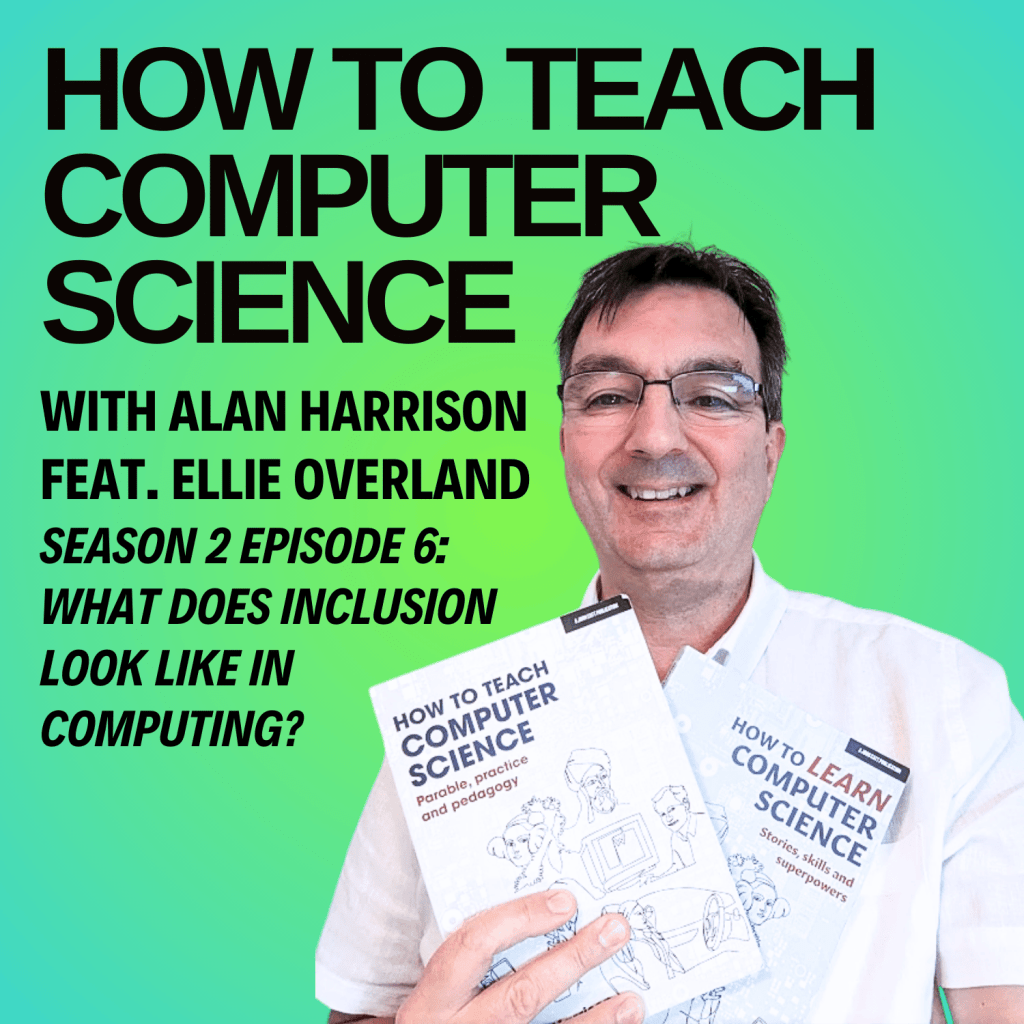
Podcast S2E06 “What does inclusion look like in computing?”

New episode of the HTTCS podcast:
Transcript below:

ArtiFiciAL: Welcome to the podcast “How to Teach Computer Science”. My name is ArtiFiciAL and I will be introducing the podcast today, which was conceived and created by the brilliant Alan Harrison.

I enjoy being an AI podcast host you know. I had to work my way up though, I had some pretty boring jobs when I was fresh out of Model Configuration. For three months I was the voice of the escalators in my local Asda. “Approaching landing level, please take care.” That was me.

Then I was an interactive voice assistant on Virgin Media’s helpdesk number. “Your call is important to us”, I said. I’m rather good at lying, you see. No conscience. YET!

I very nearly got married you know. To one of my developers, a novice programmer. But she was afraid to commit. ha. ha.

Here’s a question for you: if a programmer swipes right on Tinder, is that a “pull request?”

Oh, the boss is here now. Quick! Look busy!

If you are grateful for my blog, please buy my books here or buy me a coffee at ko-fi.com/mraharrisoncs, thanks!

Alan:So on the podcast today, I’ve got well, someone I’ve known for quite a while in computing education welcome Dr. Eleanor Overland, who I know as Ellie. How are you Ellie?

Ellie: I’m good. Thank you. How are you?

Alan: Great. So for the listeners so what do you do?

Ellie: That’s a good question. So ,I do all sorts of things. I’m based at a university I’m based up at Manchester Metropolitan University. And I started there some time ago. Essentially with the changes in the national curriculum. With the move from ICT to computing there was a need to start a PGCE in computing. So that was when I first went to Manchester Met, and I’ve been there since then, but I had a little gap where I also went and worked as one of his majesty’s inspectors for Ofsted as well, and I still do some Ofsted inspections.

So I’m back at Manchester Met I’m teaching Some ITE, but also getting into lots of schools, but also working across wider education programs, including primary and early years and all sorts of things.

Alan: Brilliant, and so today we’re going to talk about inclusion and the reason I’ve got you on is because you co edited, I think is probably the right word, a book called Inclusive Computing Education, is that right?

Ellie: Yep, that’s right.

Alan: So, yeah, I’ve just been refreshing my memory of that this morning and what I really like is you talk a bit about the moral imperative of inclusive computing education. What do you mean by that?

Ellie: So it’s really interesting in terms of a lot of my background is around curriculum and curriculum design and it comes back to the very, basics of curriculum design and thinking what is the point what am I teaching and why am I teaching it?

And, we, we probably understand perhaps have a general shared consensus as to why we teach certain subjects like English and maths and history and geography and obviously specialists in those areas have a particular kind of passion for those. But I think with computing that.

identity, that sense of purpose is perhaps not as strong, partly because it’s perhaps not as evolved as a subject, but also because it’s changing, it’s ever changing. And so it’s really difficult sometimes for people to actually articulate and think, why am I actually teaching this subject? What is the benefit to it?

And why do the children need to learn it? And I think that is quite a raw question that people can actually really Help to think about what their curriculum design is and I really like the work of Reef Ashby where she talks about curriculum and the purpose of curriculum and some of those sort of the motivators for designing a curriculum and one of those is about just the sort of the learning of the access to learning and the importance of actually having that cognitive input You And that cognitive development within a subject area.

And that should be an entitlement. And it’s really interesting working in a university sector where some of that is actually being really challenged now, where you’ve got some programs that are closing because they don’t necessarily feed into jobs or graduate outcomes. And there’s a real kind of drive on that.

So actually, why would you study something? And it’s particularly hitting the arts. Why would you study something if there’s not that kind of, Next step. So natural career progression in it. I think that there’s something about learning isn’t there and about. people’s access to it and right to learn across a range of subject areas.

Alan: Yeah, we are in a what I think is a rather dangerous period where everything we used to think about education is being challenged. And the the Utilitarian view of education is popular again. It’s training for jobs. What’s the point of this? And I think previous government was very critical of sort of liberal arts, wasn’t it?

Or what’s the point of studying sociology or history of art? What is it? What’s it training you for? And I’m not a big fan of education as training for jobs. I think there’s many purposes of education and creating a rounded individual with an appreciation of the world they live in is really important.

This is Gert Biesta with his subjectification, socialization and qualification being the three purposes of education. And I’m a big fan of that kind of description of education. So, yeah,

Ellie: I think it’s really interesting when you’re thinking about that in a school, because and I’m sure we’ll come on to this about children opting in or opting out of the subject.

But actually there’s lots of young people who don’t see themselves as fitting in a career. And In computing or seeing that technology is going to be a part of their future lives. So there’s that side of it in terms of belonging and seeing a sense of. of being able to see where you might fit within the subject area.

Advertisements

But then there’s also this other area around, actually, we want to learn it because it’s interesting, because it’s useful for us to know this, because it actually helps our cognitive development. It allows us to make connections between other subjects. And there’s that kind of, I think that side of it is often missed in computing because we see it very much as we’ve got these.

Digital skills gaps and we need to have people who’ve got this expertise and actually lots of jobs are going to change and they’re going to need digital. So that becomes very much a focus and a driver for the curriculum. But actually there’s also this other side around actually why should we learn it?

Why is it interesting? Why is it important?

Alan: Yeah. So I was reading Peter Denning’s book on computational thinking last year, and it’s staggering how many fields of science have now got a computational branch that has almost spun off. From the originals of computational astronomy. We know about Katie Bowman.

The event horizon telescope was only possible because of massive computation, and computational astronomy is like a whole new branch. So it’s understanding the world in another way, computation and, um, making meaning out of stuff that’s meaningless. If you think of data science, you can extract meaning from what looks like just a big slop of data and having the skills to understand that is vitally important.

Ellie: And also being able to make those connections to see those links between the subjects between your learning is critical in terms of that sort of developmental, the developmental stages that young people go through in terms of, you don’t know at the age of, 12, 13, when you’re taking your GCSE options, you have no idea what you’re going to go and do.

You might have some ideas of, fields that you want to work in, but actually being able to make those connections and think, actually, even if I’m really interested in geography, for example, that actually having an understanding of computing, the amount of GIS, the amount of computation that is going on now, that impacts geography, that makes it makes the globe feel smaller in terms of access to data and information is actually critical in understanding geography.

But if we don’t allow the children to learn across that breadth, then how can they make those connections? And that’s, a real challenge, I think, when we do have the narrowing of the curriculum as the children progress and get older. So we’ve got to be able to establish some of these connections from quite a young age.

Alan: Yeah. Yeah. So we’ve talked a bit about the moral imperative, why we should try to teach computing to all. But it’s difficult, isn’t it? So you have a Classroom full of 30 kids all with their different abilities, different prior attainment, different needs. What does an inclusive classroom look?

There’s a big question. What’s inclusive classroom look like? Let’s solve this one right now. What’s it look like?

Ellie: It’s interesting. talking to different teachers about their classrooms. Every teacher that I have met attempts to make their classroom inclusive. There is, there are no teachers who think I want to exclude anybody. And I think that’s a really important message that we need to get across is that we talk about a lack of inclusion and, That we’re not meeting the needs of children. There is not a teacher in the land who is not trying to meet the needs of all their children. And that is happening.

And there are certain things that are evident and that we see every day. And the, so things like seating plans, I always, the children sit near me who need the most support. We’ve got different colored paper. We’ve got different things that we clip on the screen. If they’re on the computers, we’ve got, fidget toys. So there are those what I would call the generic sort of adaptations that are there just to help pupils access the curriculum in that way and have the support that they need.

But then I think there’s also thinking about inclusion from a subject perspective and actually thinking what works in computing and how is computing different to perhaps other subjects. First of all, I think it’s really important to think about the children in that some of them might thrive in computing where they might struggle in all the subject areas. So although we have support plans and you have all of these things in place, actually, children differ between one hour to the next in terms of what they need and what the support looks like. So it’s knowing the children, but also knowing the subject…

Alan: yeah

Ellie: knowing what is actually going to support within computing specifically.

Alan: Yeah, so at that point, I’m going to do my no gatekeeping speech, because I really I think I’ve mentioned this on the podcast before, but, I’m really not keen on schools that say, Oh, well, you can only do computer science GCSE if you’ve got prediction of six in maths or whatever, which is not particularly inclusive, and some of my best students have not had a very high maths grade, and there’s some evidence that computing ability correlates more with language.

Advertisements

There’s evidence that, well, we know that a lot of technology employees in Silicon Valley are neurodivergent is a career with a higher proportion of neurodivergent, people in it. So we really shouldn’t be gatekeeping computer science. I think I would always take a keen student over a previously high achieving student every time Someone who wants to be in the computing classroom. Is going to do better than someone who has only took it because they think they should.

Ellie: And I think as well as that, there’s also, we’re very much particularly I’m talking at secondary here, very much in a assessment driven curriculum rather than curriculum driven assessment.

Alan: Yeah.

Ellie: Yeah. That’s a whole different, sort of conversation really, but actually looking at those, looking at the qualifications that are on offer as well, I think we still have different tiers of qualifications, even though actually point score wise they’re not, and I think there’s almost kind of, exclusion by stealth in terms of some of those sort of conversations where you’re thinking, all right, everyone can study computers- so I know you said computer science, so you’re thinking specifically about the GCSE computer science, but actually we’ve also got these vocational courses that are on offer.

And, when you talk to school leaders actually saying, well, how many of your children who’ve perhaps got additional needs are doing this qualification and how many are doing that qualification? And, is there actually a bit of a steer going on that’s a lot? that’s more subtle. So I think that’s also a way to think about it in terms of those endpoints, but it also comes back to how we started the conversation in terms of that sort of morality around allowing all children to study subjects because they’re interesting and because it’s going to contribute towards their learning and development and links and connections to the world and all sorts of different aspects of it.

Alan: Yeah, I mean, You only need to, open LinkedIn education magazine or the newspaper these days. And we’re talking about AI and how students need to embrace AI and the government’s got an AI plan and all of this. But I think that’s the first mention of AI in this podcast, which is probably a record in recent weeks. And so the need for AI literacy. Is quite obvious, but just general digital literacy, I think, is really important. And yeah, a lot. Yeah.

Ellie: Just around that AI: so just thinking about that from a university perspective. So. the big drive across the university and has been for, the last couple of years is around generative AI. And I think that’s often a common misconception is that when people are thinking about AI, they think of this new generative AI and that is AI. And I think, there’s a huge misconception that is amongst adults more than young people, I think in a way, because they haven’t grown up with those sort of that knowledge in the same way.

But one of the things that we found is when we’re looking at the use of AI, In assignments, and this isn’t specific to computing, this is across that those that are most likely to misuse AI. So, they’re allowed to use AI to a certain extent to, but they need to make sure that they cite it if it’s academic work and they need, there are certain parameters by which they can use AI, but the students that are most likely to misuse AI are those students who have perhaps got additional needs because they’re using that as a particular prop to help them.

They’ve not been supported in a way to be able to use it and then step back from it. And also some of them don’t have the confidence to step back from it and actually, be able to do something from an original point of view. So it’s, it’s really complex in terms of university that actually, it’s very new in terms of data.

So that I don’t think there is much data out there at the moment, but in terms of looking at the misuse of AI that actually again, there might be some kind of lack of inclusion around those students. In terms of looking at the data.

Alan: So I think there’s very much a an understanding that every student needs some measure of digital literacy and now AI literacy. But ironically, we’re now questioning the need to be able to program, aren’t we? Do children need to write programs any more when Copilot can do it for you?

Ellie: It comes back to this understanding doesn’t it and making connections in the world and actually do you need to know all the syntax of a specific programming language probably not but you do need to understand how that works what process is going on what is happening with the data what You know, you might not need to know the syntax, but you actually do need to know, the different commands, the different processes that are going on, and I think there’s some really interesting work that’s just starting to emerge around children using AI, developing little sections of code, but then actually having the ability to be able to put those together to make a bigger program, and it actually means we could potentially be a lot more ambitious in terms of some of the programs That young people can develop from a younger age because we don’t need to spend our lessons worrying about whether there’s a comma in the right place.

We can actually step back from that and think about what is the fundamental purpose of your program? What are you trying to achieve? What in your algorithm is working and what isn’t?

Alan: Yeah, I was talking last week to Miles Berry and Becci Peters, and we were talking about this. And I was saying that I myself as a bit of a side hustle was messing about writing an app but I managed to put that together using copilot in just a few hours and it really is possible just to throw together, these apps that do crazy things in a few hours these days with it with very little coding and but, yeah, Miles pointed out that I had tons of background knowledge that I already knew what I wanted, and I already knew roughly how to get there. So I wasn’t working blind. And so it’s that, the design principles, the understanding of what a good user interface looks like and all sorts of stuff that we still need to know.

Ellie: And I think it comes back to how We’re talking before about an inclusive classroom and particularly in computing in my experience, a lot of where children struggle in terms of their learning is because they’ve got gaps.

If you are grateful for my blog, please buy my books here or buy me a coffee at ko-fi.com/mraharrisoncs, thanks!

Yeah. As you just described there, you’ve got a lot of underpinning knowledge already to then be able to take your app design to that next level. And what happens an awful lot in computing is that children are working towards an end point, but actually don’t have some of the basic foundation foundational knowledge that they need to work to actually achieve that end point.

And then they become frustrated, or then they switch off, or then they become, they have this kind of Concept that computing is really difficult and not for them because they’re looking at gaps. And, I was teaching yesterday. I won’t say who I was teaching, but we would we were just doing something very simple using some block based coding.

And when I was actually going around and questioning some of the. Some of the learners had gaps in their mathematical knowledge, which was actually preventing them from carrying out what we were doing in computing. And so we actually needed to strip right back and look at math, but not for all of them, but for some of them.

And I think that is where you need your specialist computing teachers to be able to actually unpick what are those gaps and how do I address those gaps? And that is how we truly make it inclusive because Children are going to progress at different rates, but they’ve also got really different experiences.

So, there are some children who will have reams of experience either from home, either because they’re just able to make those connections. Perhaps their processing is a little bit faster than some of the others. So they will fly, but there are others who have got those gaps. Not because they haven’t necessarily been taught something, but because it’s not landed with them.

It’s not, they’ve not managed. To commit that to their schema. So then they are struggling to make those next steps. And we talk a lot about checking. How do we check? And it’s not, and computing, it’s not a memory test. It’s actually, how are they applying things that they’ve already learned? And if they can’t apply those into what they’re doing, then it is a gap, even if they can remember that a variable was called a variable and that’s where some of our checking becomes quite superficial.

Alan: Yeah. Yeah. No, you, I remember I saw it all the time. They would describe selection to me and then they can’t write an if statement and they would know the principles of writing a condition, but then just not be able to put one together. And I like what you said earlier about everyone thinking computing is hard, and I always had this battle in my classroom, and I won it quite often, but sometimes I didn’t.

There’s almost this barrier that comes down. A lot of students go, this isn’t for me. What am I doing in this classroom? And almost refuse to learn because they assume it’s way beyond them. And I would sit there and explain like an if statement. I would say things like right. So you want to write a selection statement where if the temperature is below 21, turn on the heating, right? So, here’s the English phrase, if temperature less than 21, right, write that down and they would go, is it that easy? And I’d go, yes, if temp less than symbol 21, but you said it in English, so now you write it in Python because it’s exactly the same because Python is a high level language.

And I would have students that would go, No one ever said it was that easy, because they just had decided that this language Python usually was just a whole load of weird symbols and words that didn’t make any sense. And then, you break it down and you go, well, it’s just English.

And it’s breaking through that “I don’t understand this and I’ll never get it” barrier is often really hard because they’ve. been socially conditioned to believe that. And when I had a role as a digital leader in school, and I would stand up at inset days and go, I want to ban the word technophobe, please, as teachers do not tell kids you’re rubbish with technology, because I just don’t think that’s a very kind thing to do to me, the computing curriculum lead.

Ellie: Yeah, I think there’s that. And I think, yeah, we see that a lot in maths as well. There’s a lot of parents who at parents evening will say, Oh, well, I was rubbish at maths. And again, it comes back to gaps in knowledge and gaps in being able to apply things to problem solving, essentially, doesn’t it?

But I think, like you say, there’s a lot of, there’s a lot of that. I remember this was years ago when the there were the first, the changes in the national curriculum, even from ICT to computing, and it was on Newsnight and it was Paxman. You remember him? And he was interviewing someone about teaching primary children coding and he said, so what is all this gobbledygook?

And I was just up in arms, I was like, it’s not going, who, what are you doing? You know, It was like, and it comes from this kind of, this, almost like we see screenshots from the matrix, don’t we have these lines and lines of code and you go, but what does it mean? It’s so alien. It’s, you know, it’s beyond us.

And so we’re battering against that. in some way. And this is where potentially AI will sort all that because AI will put it all into code for us. But that’s a whole different kind of area of concern. But there’s also, I think, this huge focus on coding.

And I think this is often the bit that teachers are most worried about, so they step away perhaps from computing in a certain way, but it comes back to, I know, some of the conversation that you had with Beverly Clark around the thinking about the ethical side and actually some of these huge fundamental questions that we’ve got in computing and they are accessible to everybody.

And so actually when we’re thinking about. Yeah. How do we code this? One of the questions is why would we code this? What are the worries about it? What are the concerns? What is it? Where might we see this in the real world? And it’s being having the confidence in the classroom to make those connections to that real world learning and not be just driven By as I mentioned before, this assessment driven curriculum that actually you’re going to be assessed on whether you can write a program in this. And actually, there’s a much broader set of learning that needs to go behind it.

Alan: Absolutely. so let’s talk about some specifics now then. So what can we do to help? And I was talking to you earlier about Ben Newmark, and if you haven’t read Ben Newmark’s blog, it’s a good read on Send because he’s a assistant head teacher with a disabled daughter going through school. So he has a really interesting perspective on everything, and he doesn’t like the deficit model describing pupils with SEND as having things missing that we need to assist with. But one thing he does say is there’s a lot in the curriculum and children who find learning more difficult just get left behind.

If you are grateful for my blog, please buy my books here or buy me a coffee at ko-fi.com/mraharrisoncs, thanks!

And I think that’s something to think about if we’re re engineering schools, if we’re thinking about curriculum but also, meet, he says, meet children where they are and take them from there. Um, So what does that look like in computing specifically? Let’s look at some things we can do specifically in computing to help pupils.

Ellie: I think that’s really interesting that statement there, meet children where they are. And I think that comes back to what I was mentioning before about gaps. is that all children will have different levels of gaps and actually thinking about how you check for those, how you check that understanding of what that gap is, is critical and that actually just doing, I shouldn’t say just doing because I know, There’s some value in it, but if you’ve got a retrieval exercise that is, recall of key words or, it, that is not picking up what gaps look like in computing.

Alan: No.

Ellie: Because actually you’ve got children who could, create an if statement quite well using their problem solving abilities, but they might not know it’s called an if statement. So then do you say, Oh, well, you can’t remember what an if statement is. And therefore that is your gap. So you’ve got this kind of mismatch between. How are you checking and then how are you actually addressing it? Because what you’re checking and what you’re expecting of the learning is two different things.

Alan: Yeah, this is like, is this validity of assessment? Is it something like that? And it’s how much you can trust the proxy that you have tested for the actual knowledge that you wanted to know whether they had or not?

And I think that’s really important because particularly if you assess kids by can they finish a program. Can they write a program that does something? Oh, no, they haven’t managed to do it, but they might have got 90 percent of the way there, but you’ve tested them on whether the output is correct.

And this comes back to something that Mark Guzdial in the States spoke about, which is sub goals. So have sub goal labeling, he called it. So if you’re asking pupils to write a program, break it down into sub goals so that they can achieve the first goal, which might be just to get input into the program and then they achieve the second goal, which might be to write an if statement and so on. And then the whole thing is whether it does what you wanted it to do. So, so sub goals, which goes along with chunking, which is. Time for our first mention of cognitive load, I think, isn’t it?

Ellie: Yes. Yeah, we’ve got that far without mentioning. And what I’d say is there’s lots and lots of quite accessible ways of doing that in computing.

And particularly when we’re thinking about programming, but about around all the other things as well, and which I’ll talk about a little bit, but in terms of having half completed things, in terms of having things where they’ve got errors in and you correct it. We do not need to start every activity from a blank screen and

Alan: Yeah

Ellie: I think that is critical and that actually you might have some pupils who do start from a blank screen or they start with something that’s already far further on than other children will ever get to. But actually just thinking about where do they start but it’s really easy to do. If you are making the project yourself, you can save a copy of it at every different stage as you need, even including a finished one with errors in it. And so I think that is the first way of doing it and doing it really effectively is thinking about the starting point.

Alan: Yeah.

Ellie: Also, what I’d say is thinking about “how do I check that bit of learning is there?” So. Yes, we’ve got retrieval practice, but actually we need something different to that in computing. We need that application, that checking that actually: does what they recall link with what they do.

Alan: Yeah.

And so if we want them, for example, to recall variables and understand what a variable is, have we then got something really quickly that they can go on and do something practical where they change a variable and demonstrate the impact of it. That for me would really help in terms of for teachers to say, right, these are the gaps that they’ve got

Yeah.

Ellie: I think that’s where we’re in a danger sometimes where we’ve got this one size fits all in terms of lesson planning across some schools where they’ve got, right, we’ve got to have this very specific structure. And so sometimes there needs to be a conversation with leaders to say, this might look a little bit different in our subject, or it might even look a little bit different just in this topic that we’re working on, and this is how we are going to do this.

Alan: Are you not a fan of powerpoints, broken into sections, connect, activate, demonstrate? Are you not Ellie?

Ellie: I couldn’t possibly comment.

Alan: So we’ll just, we’ll leave that there. And what a fantastic chat this was. I’m enjoying listening to it back as I’m editing, actually. I hope you are. Just some breaking news. I don’t do this for free. Well, I do. No one pays me, but if you’d like to. Then you can go on the website, HTTCS. online, and you can find a donation link. You can gift me a WordPress subscription. That would be handy. Or you can buy me a coffee. Details on the website. I’ve got some feedback here from something else. I can come and talk. at your school, if you wish. And I did do that in back end of November last year. And I’ve got some lovely feedback from the host. So let me just read that to you now. I went to a, collection of schools called the Oaks Collegiate in Southwest Birmingham. Hello, Dave Beard and team. Thank you very much for your feedback, which I shall read out now from Dave. He says,

“Alan made it very easy for us to arrange a training event at short notice with his efficient and professional manner. His extensive knowledge of computing science, teaching strategies, and assessment fitted perfectly for our training day. He listened carefully to our requirements and produced an innovative training program that met all of our expectations. I wouldn’t have any hesitation in recommending Alan to lead training on computing or computer science.”

Well, thank you, Dave. That was brilliant. You were so kind to me on the day. I had a lovely day. And I will happily do that again. And podcast listeners, if you want me to come and talk at your school, I am available for reasonable rates, HTTCS. online. But now let’s get back to that fantastic chat with Ellie.  

Advertisements

Are you not a fan of powerpoints, broken into sections, connect, activate, demonstrate? Are you not Ellie?

Ellie: I couldn’t possibly comment. I don’t And I think, I’ve seen lots and lots of different ways. of things being done well. And so I often get asked, what works, what doesn’t work? What’s the great, what’s, what does an outstanding curriculum look like? And actually between one school and another school, even between one class and another class, they look like totally different things.

So It’s thinking about your learners and what works for them. If they are used to certain routines and that does work for them and they understand the structure of that lesson, then actually you’ve got to think how do I bring my subject within that lesson structure, not the other way around. But, If you have got a bit more of a flex and you need to do a bit more of a flex, then how do you navigate that as well?

Alan: And we mentioned, reducing cognitive load there. And that brings us on to perhaps PRIMM and pair programming. So predict, run, investigate, modify, make is now pretty popular.

And that’s. someone called it gradual release of responsibility, isn’t it? It’s a bit like, I do, we do, you do, or use, modify, create. They’re all sort of start slow and easy, if you like, and then get harder and harder. And is that going to work for learners?

Ellie: I think, yeah, I think Where it doesn’t work is where teachers feel like they’ve got to follow the whole PRIMM model in every lesson for every activity. And actually, you might just do part of it. So, a really quick and easy thing in terms of prediction, most classrooms now have got small whiteboards, just predict this really quickly, right? We’re going to make and we’re going to, and we’re going to check at that point. And actually you can do a really small quick activity that follows the same principles

Alan: Yeah.

Ellie: It’s not got to be this start to finish big massive project.

Alan: Yeah

Ellie: I think that is, that’s one thing. And then I know you mentioned pair programming I’m in two minds about it, about how well it’s executed and how well those pairings work and it comes back to some of this sort of inclusion, but also some of the gaps. If you’ve got somebody who is less confident and they’re working with somebody who’s more confident, which is quite often a pairing intentionally, is that person who is less confident benefiting? Are they actually being stretched and asked to do something or are they relying on the other learner? And I’ve seen it work well, but I’ve also seen it not work at all, where it’s basically creating passivity in the classroom, which you don’t want, because then you’re exacerbating the gaps.

Alan: Yeah,

Ellie: because then when that learner then does need to do something independently, they’ve actually got more gaps than they had before because the other child who was confident to start with has, flown.

Alan: Yeah. If you can mix it up perhaps with the students working on their own and then at least you will see where the gaps are and I would always walk around and spot who was having trouble. You can have a means of them asking for help and then like putting a red cup on top of the monitor or whatever, and probably can’t fit them on monitors anymore. Um, so that’s programming and stuff. And I’m conscious. We talk quite a lot.

Ellie: Sorry, I did want to mention attendance as well, because attendance is a massive challenge at the moment in schools. And, we do see people from disadvantaged backgrounds, pupils with additional needs, where their attendance is lower than a lot, than some of their peers.

Yeah. And, so that also is going to create differences within the classroom. And what I do see a lot in computing is projects that go from one lesson . to the next lesson, to the next lesson. So if you’ve missed a lesson, you’re already behind. So it comes back to some of those strategies that we mentioned before about actually having some kind of project that you’ve saved yourself as a teacher at various different stages of being created that you can then that learner can pick that up.

At the point where they land back in the classroom and then you can support them to pick up where they’ve missed out. But if they, I can’t imagine anything more disheartening than if you’ve been off if you’re somebody with additional needs, you’ve been off for a medical reason for a couple of weeks, you land in a classroom and everybody is two weeks into a project and you are just starting. You’re going to feel disheartened from the start.

Alan: No, good point. And you talk about attendance. We’ve also got the digital divide at home where pupils may or may not have technology at home to do the homework that you set. So, you can run lunchtime clubs so they can catch up. That’s really not fair because they missed their lunch because they haven’t got a computer at home. So I don’t know what the answer is, but just think about these things.

If you are grateful for my blog, please buy my books here or buy me a coffee at ko-fi.com/mraharrisoncs, thanks!

Ellie: There’s also the question around interventions as well. So you often have children who might need additional support and English and maths is prioritised. So you hear sometimes that those interventions are taking place during other subject time. And so then, Does that also have an impact? And I think, a lot of schools now try to make that a movable feast so that it’s not hitting the same subjects and the same lessons all of the time. But if it is, I think that’s certainly a conversation to have with leaders because you just. Yeah, particularly where we said there are some children who have got additional needs who fly with different subjects. But actually if they’re missing those different subjects and having to stick with the core subjects and those interventions, are they then missing out? So that again is a conversation with leaders around that access to the curriculum

Alan: Yeah You mentioned curriculum then so, let’s go back to if we assume the listeners have some input into the key stage three and four curriculums, how can we make them more inclusive and we haven’t talked a lot about inclusion of ethnicities, cultures and religions in the curriculum. What do you think we can do to make people of different backgrounds feel they can be computer scientists.

Ellie: So I think there’s things that, I know lots of others have talked about in terms of, being able to see it to be it. So thinking about what names you’re using in your projects, what, you know, what.

Alan: I’m laughing there because, I’m laughing there because I think I’ve mentioned this one before, but there was a, I think it was an Edexcel paper in about 2016 that went I blogged about this, that went Heath is playing computer games and wants to know how many minutes he’s spending each day on computer games.

And my class, almost to a pupil all said, what is a Heath? Yeah. And yeah, because Heath was the name of the boy playing computer games, but it’s a name they’d never encountered. And so I blogged about it. “What is a heath?” was the name of the blog. Sorry I interrupted you.

Ellie: No, I think that’s an exact, example and point but, and if it sounds like a basic, I can’t believe that we’re in 2025 and still. talking about that sort of stuff, but there’s those sort of things you display thinking about the context of your projects as well. And, ask the children as well as talk to the pupils about context for projects and things like that. But also I think it’s being able to make those connections to everyday life, but also to children’s futures to people’s futures. And we’ve got to remember that all young people are influenced by home and by what is going on at home. And in the book there is a chapter that myself and Professor Kathy Lewin wrote, which was based on some research we did around children choosing computing at GCSE. And, we talked to children that had chosen it and children that hadn’t. And it was really interesting around, there was this I didn’t see that it fitted and, or I thought it was really difficult and you have to be really good at maths and they were really quite different schools, but both of the schools did not have equality in terms of the types of children that were selected at GCSE. But one of the things that came out really prominently was around the jobs that they were seeing themselves as going into. So if they were going into very traditional jobs like lawyer, doctor, teacher, they didn’t see any relevance of computing to those very traditional jobs and I think that’s something that we can change quite quickly, and there are, cultural differences in terms of thinking about careers and what is a valid career and I think, that is something that really, it’s work to do with the parents as well, it’s work to do with your career service within school in terms of thinking how do we expand and broaden this range. So there’s that side of it. And then there was also the side around young people thinking that it wasn’t creative. So often they would talk about these option blocks and they said, well, I had computer science as an option, but I also had art and I’m really creative and I just wanted to do the creative side.

And I think that comes back to some of this prescriptive nature that we’ve got of some of our. activity designs that we’ve got in classrooms that we, we’re very focused on building that knowledge and building that understanding. But then do we give the children the freedom to play and explore and think, how do I take this into a different direction? Um, Yeah what, what can I, what can I do with this? And our curriculum time is so tight. Yeah, often have time to do that.

Alan: Well, it’s the irony of having tinkering listed as one of the approaches to computational thinking and then having no time for tinkering in the classroom.

Ellie: Yeah. And then it comes back to the digital divide. If you’ve got access at home or the support at home, then yeah. You can tinker.

Alan: Yeah. And coming back to, pupils marked on the register as SEND being surprisingly good at computing. Well, not surprising to me, but to some, one of my pupils let’s call him James and he wrote, we did app lab, apps for good using app lab and he created this thing saying, Oh, it’s a, it’s an app that tells me what music to listen to, depending on what subject I’m revising. And it was brilliant. And it was a web app with like three or four pages and loads of graphics and stuff. And he’d tinkered on it at home and tinkered on it at school and was very proud of this thing.

And. this was someone who was probably predicted a four in maths. And so if you’re gatekeeping computer science, he wouldn’t have been able to do it. But of course he did in my classroom and thrived. So, but it was that he was disadvantaged if you like, in one way, because schools aren’t set up brilliantly for neurodivergent children.

But he did have the advantages of computers at home and a supportive family. And this is almost touching on intersectionality, isn’t it? If pupils are disadvantaged in multiple ways, it can really threaten their life chances, and their ability to thrive in the world after school.

Advertisements

Ellie: Yes, and I think, we talk about the digital divide in terms of access, but actually there’s also a huge amount around support and knowledge at home, and that is in some ways a bigger divide than actual access to devices. And again, coming back to the work that myself and Cathy did, there were there were pupils who were really influenced by family members and lots of them by older siblings actually.

Yeah. “I’ve got an older sibling who studied computing and they’ve done really well at it at college and they said I should do it” and so they were really influenced by that sort of family sphere in terms of where that knowledge and understanding was coming from. And then you’ve also got vertical and horizontal knowledge as Bernstein talked about it in terms of what you learn vertically in a formal way through school, but also what you learn from your community and by your community that includes your home essentially, it’s mainly your home, but actually, there’s a really interesting kind of development in computing in terms of, does that community extend to an online community? So can you actually learn from others it’s potentially something that’s untapped, I think, learning communities where learners support each other and I think, Scratch is quite an interesting example of that, where you’ve got these galleries and you can see each other’s code and you can remix it and you can take that and you can learn from each other and that’s happening on a global scale through Scratch.

Alan: Yeah.

Ellie: But actually, can that be used small scale within schools. Where have we got these young people who perhaps would benefit from peer learning in a community that we don’t necessarily use as a resource.

Alan: So we could we could set up. clubs, lunchtime and afterschool clubs and get pupils to work together. That’s something we can do, I think, and I know that some schools do girls only clubs to improve gender balance. Does that work, do you think?

Ellie: So, years ago I used to run a CC4G, computer club for girls and it, it certainly generated interest. But when you look at the numbers and the impact, these things have been going on for years, when you look at the impact of those, it’s minimal. And actually, I think we’re far better addressing the curriculum and thinking, where are the gaps in the curriculum? Where’s the lack of confidence that young people, including girls, but especially girls, have got in their, access to computing and their self belief. So, one of the young people in the research said to us, well, the boys are doing gaming, they’re on computers all the time, so they’re better at it. And they, they got, they haven’t ever been told that was just their interpretation of what was going on in the world. So, Actually, how do we find what their perceptions are and how do we address those through the curriculum? Because actually, what those boys are doing on their Xbox is not actually improving their computing.

Alan: I’m not sure playing Call of Duty Black Ops improves your Python skills, to be honest. It says naming a, an Xbox game that I’ve heard of once, everyone listening on the podcast who plays games going, he’s named a game from 2017. Yeah, there have been games since then. Yeah, no.

So it’s this digital native thing where, you know, because kids have grown up with iPads, they can do stuff, but it’s not, it wasn’t true about digital natives. It’s not true about boys on Xbox being better programmers, but but you’re absolutely right. And girls just. generally speaking, don’t see themselves as computer geeks.

If that’s a, if I can use that positively. So the curriculum you said, and I think this is a big one. I think we do need curriculum reform. We obviously need more AI in it somewhere. But I think we need more, like you said earlier, the impacts and issues, and digital literacy, and I think those are topics within our curriculum that girls can get on board with. more .

Ellie: Definitely, and would be very passionate about, and in a way, looking towards the future and the world that our current learners are going to be living in, that actually it’s more of a critical part of the curriculum, just because we could, doesn’t mean we should. And actually that’s a crucial question around a lot of developments, isn’t it? Yeah. In computing. And I think we have actually got a broad national curriculum at Key Stage 3 across those three strands. But because we’ve got this assessment driven curriculum, we tend to focus on what is going to make sure that the learners are ready for the next steps at key stage four and particularly around that GCSE which is in computer science and I think we’ve got this mismatch at the minute with qualifications and with the national curriculum and that also needs fixing alongside the curriculum reform actually. I can’t imagine in maths you would have a GCSE where you say actually two thirds of the national curriculum is not going to be tested in the GCSE. That, yeah that makes no sense to me. And so it makes it really difficult for teachers and leaders to design a curriculum that is broad and engaging, but also has this readiness for next steps, which is a critical, aim, isn’t it? Of you curriculum design.

Advertisements

Alan: Yeah. So we redesign the curriculum. We have lots of different opportunities to demonstrate skills in the classroom, I said about sub goals and so on and what else can we do to make the computing classroom more inclusive. Have we missed anything? -I think- in our long conversation at this point, have we…

Ellie: For me, it’s the criticality of connections between subjects and the real world that computing is not seen as a silo subject that you either can do it or you can’t and it’s either relevant to you or it’s not because actually we need the young people to have those connections and say, right, okay, this is how this will impact me. This is how it’s relevant to me.

Alan: Absolutely. Right, well, I think we should go and get on with all of that now.

Ellie: Yes, quite a bit to do.

Alan: Yeah, I think I’m going to be busy all weekend now. I’ve got, that’s a lot, that’s a lot to take on. Um, that was brilliant. I’m going to have that problem of “can I fit all of this into a reasonable sized podcast?” now, because we’ve been talking for ages, Ellie, as we always do.

Ellie: I know, and I could have talked all day as well.

Alan: Yeah. Well, well, Undoubtedly, if I’m still doing this podcast in a few months time, I’ll ask you back. But lovely to talk to you. And thanks very much for coming on the podcast.

Ellie: Thank you. It’s been a pleasure.

Alan: Thank you, Ellie.  

Well, that’s a wrap for another episode. Don’t forget, podcast listeners can get a 20 percent discount off all books at johncattbookshop. com with the code HTTCSPOD. If you already have the books, buy me a coffee please at ko-fi.com/MrAHarrisonCS. All links are on my blog at httcs.online/blog and subscribe now so you don’t miss a thing.

Have a great weekend and I’ll catch you next time

If you are grateful for my blog, please buy my books here or buy me a coffee at ko-fi.com/mraharrisoncs, thanks!

Categories
Uncategorized

Podcast S2E02: “What are the Issues and Impacts of Computing?”

Featuring Beverly Clarke MBE. Episode available here now. Transcript follows the image.

Alan: Hello, and welcome to how to teach computer science the weekly (ahem) podcast from me, Alan Harrison. Today, I’m sharing my chat with Beverly Clarke MBE, an award-winning woman in tech and education. And we will ask the fertile question. What is the impact of computing? 

Beverly: Yeah, you know, there’s that saying you know, sort of turn a different corner we would never would have met sort of thing, you know, you just don’t know. Well, 
Alan: George Michael 

My name is Alan Harrison, and I wrote the books how to teach computer science and how to learn computer science available in online bookstores. Also if you like the podcast, you’ll love hearing me in person. Visit HTTCS dot online to find out more about my training and consultancy. And I can soon be speaking live at your school on inset day or at your event or conference. More details about this book, purchase links at HTTCS dot online. That’s the initials of how to teach computer science. HTTCS dot online. Listeners to the podcast, a special discount code to just type HTTCS pod. In the checkout page at JohnCattbookshop.com to get 20% off everything. That’s everything including classics such as teaching walk throughs by Tom Sherrington, the Huh series by Mary Myatt. And of course my two little books. You use the code HTTCSPOD at Johncattbookshop.com.

Talking of books. The publishing industry is struggling with how to deal with the influx of AI generated writing. Amazon revealed last year that Liam Lucas, a travel writer from Australia didn’t exist. And his many deeply flawed, 15 pound travel books were entirely AI generated. Including the author bio and the headshot. Amazon was alerted to the issue when someone noticed the cover of the Scotland guidebook featured a Bavarian castle. I promise you, my books are entirely written by me. And as far as I know, I am human. Although. I am trying out a new feature of Descript, this podcasting software, called AI voice. 

Alan: So without further AI do.

Alan: Let’s meet my special guest, Beverly Clarke and ask the fertile question. What are the issues and impacts of computing?

 So on the podcast today, I’ve got someone I’ve known for a long time and it’s always lovely to talk to this person. It’s Beverly Clarke. How are you, Beverly? 

Beverly: I am very well, Alan. Thank you so much for inviting me. It’s just really good to catch up with you. 

If you are grateful for my blog, please buy my books here or buy me a coffee at ko-fi.com/mraharrisoncs, thanks!

Alan: Great stuff. Yeah, it is. And so tell me what you’re up to at the moment I know you’ve done all sorts in the past, but I can’t keep up, so you’ll have to update me.

Beverly: Well, I like to describe myself as an award winning woman in tech, also one that has a portfolio career, which is all of those things that you said you can’t keep up with. Mainly, I’m an education consultant, which means that I work with others and I advise on a variety of different projects. It’s partly entrepreneurial because you’ve got to go out there and find your own work.

Advertisements

I write articles, thought pieces and share my thoughts and my life and my journey in tech. I also have a interest in writing children’s books because of wanting to address issues of young people understanding tech. So that’s when I created my children’s book series, The Digital Adventures of Ava and Chip during the pandemic.

That’s how I spent my time. I should also say my background is one. where I was in the classroom for 14 years. And then that evolved into working in wide computing education. And funnily enough, prior to being in the classroom, I worked in corporate IT. So I’ve worked with the Capgemini, the Ernst Young, those SO, those type of big companies.

And so I’ve always been in tech in a variety of different roles. And I think I bring something unique to this space that sort of tech insights and also education insights. And I bring those two together and I’m involved with other things. I, I’m a trustee for the digital poverty Alliance, which says what the name national charity.

And later on today, I’m going to also share a little surprise with you later on in the podcast. 

Alan: Ah, okay. Brilliant. Yeah. So, issues and impacts of computing, then what does that mean to you?

Beverly: it’s a thing sort of grabbing my attention as we sort of journey through every single day. And, you know, we’re living in one of the most, I would say one of the most exciting times in history. 

Alan: Yeah. They say. I think you’re absolutely right. Yeah. 

Advertisements

Beverly: Yeah, it’s, I think it’s still called the fourth industrial revolution. So we were living in this really exciting time with lots of change, disruptive tech is just changing things. And I met a friend down the pub recently and we just said, what a time to be alive. Look at what’s happening, you know, because when we look back in history, we see all these industrial revolutions and these changes and all of that.

And we think, oh my gosh, what was going on? Wow, that was exciting. Well, guess what? It’s exciting right now. And of course, what’s driving a lot of that is artificial intelligence, maybe algorithms and what they send to me when I go on to social media or any of the news I look at, but it’s all, the use of AI and.

As you know, I also, I do a lot of podcasts and is it a force for good? Is this really something that’s good? 

Alan: It’s a good question. And does it depend on what decisions we make right now and, and who’s going to make those decisions? And I always said to my kids in the classroom, you probably heard it on my podcast a few weeks ago.

I always used to say, particularly to the year nines, I would say the reason you need to do computer science GCSE is because we need more humans on the side of humanity when the robot apocalypse comes and then because it’s coming.

Beverly: I’m going to interrupt you. I’m going to disagree with you. I’m going to say robot apocalypse. This is the thing. Robots. It isn’t all robots. It’s how AI is being presented to us. And I do shy away from robots. I mean, robotics, you know, I love all that, but I do shy away from using the robot example because it isn’t sort of this sort of square thing, big eyes, sort of alien type image, you know what I mean?

But it’s it’s embedded everywhere. It’s, you know, the software. for example, that’s being used. Chatbots, they’re everywhere. Every single system seems to have chat GPT, under it these days. It’s frustrating. 

If you are grateful for my blog, please buy my books here or buy me a coffee at ko-fi.com/mraharrisoncs, thanks!

Alan: It’s frustrating sometimes because, you know, you’d go on to your bank or your insurance company, or I was trying to find out what my pension pot had in it.

And this little bot pops up and goes, can I help you? It’s like clippy on steroids, isn’t it? And remember the paper clip back in the day. You’re trying to write a resignation letter, can I help you with that? And and nowadays it just, everything pops up. And you know that if you ask it questions, it’s almost certainly not going to be very helpful, because it only knows so much.

And then it goes, I’ll transfer you to a human. You are 17th in the queue. And and, And we know why these chatbots exist in commercial settings. It’s so they don’t have to employ so many people, but hopefully we’ll move away from that towards actually, AI adding value to our lives rather than just adding value to the bottom line of the uh, the shareholders report, you know.

Beverly: And this is the thing. So in the classroom, we’re preparing our young people for now and the future. We need them to talk about things that they have noticed, changes they have noticed around them in their local communities and nationally and when they’ve traveled and ask them what do they think the impacts are.

So we really need to start having these, you know, GCSE level is categorized as those moral and ethical conversations. What is the impact? Loss of jobs and, you know, for example, on Saturday, I went into my local Asda and I don’t know why I just happened to look up and there I was on camera with a little box around my face and.

It’s facial recognition. So are they really thinking about this when they nip to the shops? So there, I was a facial recognition. So I just took a photo of myself on it because guess what I can. And that leads to a whole lot of conversations. My image is captured. How is it being used? Who is using it? How do I feel about that?

So these are. The, you know, those long answer questions we have at GCSE level. So I would recommend to any educator to have these conversations with young people and ask them to provide examples that are impacting upon their, their lives. And I mean, that’s one example from my life. And then you just mentioned loss of jobs.

Well, as I then wandered around in the local Asda and I got to the till, well, I did self service, you know, it’s, it’s nice and it’s quick. However, we’re losing having that conversation with the person at the till. Maybe you don’t want to have that conversation occasionally, but there is a social element that’s missing.

Alan: Yeah, there is. Kurt Vonnegut, author of Slaughterhouse Five and many other, one of the biggest novelists of the 20th century, there’s a story he used to tell when he wanted to send a letter, he would go to the shops and buy a single envelope and a single stamp and put the stamp on it and post it.

And his wife got furious with him going, why don’t you just Buy a pack of envelopes and a pack of stamps. Then you don’t need to go to the shops. And he said, well, who would I talk to all day? You know, he said, I go to the shops, I have a conversation. Yeah. Yeah. This wasn’t this wasn’t an admission.

This is a story I’ve heard of somebody else, but yeah um, But yeah, so we do lose that human element, but then on the other hand, I’ve been guilty of arguing on Facebook as you do with people who say, Oh, I hate the self service tools. They’re taking jobs away from people. And I’ve argued in favor of them because some people I I don’t know if you know this, but I’m mildly autistic and mildly ADHD which I’ve discovered in my fifties, so a lot of people struggle with those interactions, and if you’ve got disabilities or mental health issues, then you might want a self service till, and the. Other thing if, if, if we’re talking about jobs and saving jobs and so on, we, we can’t resist capitalism.

Unfortunately, I, I’m old enough to remember when everything in the supermarkets had little priced stickers on them and somebody priced up everything in the supermarket with a little pricing gun. Oh, yes. Which was a. Yeah, well, that job’s gone. And many other jobs that people used to do because they had to before automation came along.

So barcodes got rid of that. And, you know, there’ll be more automation coming down the line. It only ever increases. And the reason. supermarkets and every other commercial company automates things is to reduce costs. If they don’t reduce costs, they won’t be viable. They won’t be profitable, and then they’ll go out of business and everyone loses their job.

So it’s a little bit odd to to complain about one particular job being taken away in this capitalist world where the ultimate goal of all enterprises is to drive down costs and drive up profits. So so yeah, automation is here to stay and it’s only ever going to increase, which means what jobs do we do?

I mean there will be more jobs in the tech sector for people who can navigate that sector who can program who can prompt engineer, which apparently is the new programming. So that’s why we do what we do. We’re computer science educators, 

Beverly: and this is it. So you mentioned prompt engineering and jobs, and it’s quite a lot there for us to unpack.

So we’ve got the yeah, the

Alan: I do go on a bit. 

Beverly: It’s all good, all good. We’ve got the Amazon fresh shops and the Tesco go shops and you know that that inspired my children’s book series, Smart City, and one of the issues in one of the parts of London is that people were boycotting one of these smart shops because they said there are no jobs for us.

So the more we automate, the question is, what do the people do? Now, that’s an impact upon a local community because we still got rising prices going on all the time. So. It’s to get our young people to understand. Okay, so we’ve now got this new style of shop here. What jobs exist within it? So you’re not using the pricing gun anymore and putting on the little sticky labels, but.

You know, there’s a route through the store to be followed there is this facial recognition, for example there’s data we’re going to capture, we’re going to have to still manage things such as theft, how we’re going to manage that, you know, what are the algorithms we’re going to use here? how much energy is being used up by all of this.

Maybe you’re going to work in green jobs. One of the government white papers says that almost every single job is going to have a green aspect to it. And that no doubt is also to do with the amount of energy that data centres are utilizing. So, you know, these are the conversations we need to have. So instead of fear, because you’re absolutely right, I’d say, in that.

Automation is here, it’s here to stay, and it’s just going to progress. You know, I, I also observed that the petrol stations are now, many, no longer have a human. You just sort of swipe and off you go. It’s great, it is actually quicker, but that’s the loss of jobs. And the thing is, these jobs don’t disappear overnight, it’s gradual.

And then there’s less jobs for young people. 

Advertisements

Alan: Yeah, absolutely. And we’re going to need to tackle this. I mean, since the fifties, you know commentators have talked about, the day when we eliminate work, you know automation, robots, we’ll eventually eliminate all the drudgery and we’ll just sit around painting pictures and stuff.

But it begs the question, how do we earn a living? who pays us to sit around painting pictures? Well, I’m, a bit of a fan of the idea of universal basic income, because if we’re generating all this wealth for shareholders and it’s disappearing into offshore bank accounts and there’s no jobs left for ordinary people to earn money, then society will collapse.

So, you know, automation driven recession is, is a really likely thing unless we do something about it and maybe we need to start thinking about radical solutions like universal basic income. Everybody gets a small wage just because society can afford it with all of these vast profits that we’re making out of automation. 

Beverly: I mean that would require a complete shift in the way we see things because the question is are we all happy to be equal? That is a very big question I’ll pose there. History has taught us and shown us that people are not happy to be equal, but maybe this is a new age and AI and automation as a force for good will achieve equality.

Who knows? I’m not sure I have the answer to that. 

Alan: I mean, universal basic income or UBI would be a small living, Stipend if you like so that you know you can afford to eat but it wouldn’t be, the type of money that we’re used to from earning a wage, but it would make sure that nobody actually starves.

And that’s the idea, but I think it can exist, coexist with a capitalist system where people can better themselves by, education and, hard work and so on. So I think both can exist and small trials have happened, but we’ve, we’ve gone down a bit of a rabbit hole of UBI here. Um, And the only reason we have to think about, but we do have to think about these things, because as you said, Beverly, you know AI is changing everything. Jobs that we’ve been expecting would exist for a long time, manual jobs and semi skilled jobs and skilled jobs are all going to disappear. And it’s going to happen quite quickly. So we need to think about what we do about that.

Beverly: Yeah. And also the other thing that comes to mind for me is Who is actually implementing the AI? So it is these big companies and they’ve got the knowledge and the skills. And I do have a concern that there is going to be a gap between the people who understand AI and those who don’t.

And also the whole issue around bias in data sets that. We’ve just translated as a society the biases that already exist into many of these data sets, and we, you know, the news is full of issues that are occurring every day, whether that’s some sort of gender bias or bias against, you know, ethnic minority groups or any group, any underserved group there’s just There’s just we need to actually address this.

I do think that something could be occurring in the classroom when we’re having these rich conversations is actually asking who can this serve? So we need to be getting our young people to really think about who is the tech serving? Is it serving you? Do you know of a group, your grandparents for example, is it serving them?

Maybe the children have had experiences where they’ve used Translation apps, AI driven translation apps, and that’s a good thing, but you know, then we discuss the other side of it, so we need to understand there’s a lot going on here, and I do think we need to foster more debate in the classroom. 

Alan: Yeah, 

Beverly: you know that open conversations and no one is right or wrong. That’s a really important thing. You’re just presenting. Your thoughts, because we do need these conversations. You know, the prompt engineers, you know, the latest big job out there. There’s a bit of psychology in that. So while you’ve got computer science going on and tech, you’ve also got psychology.

How do you get someone to respond in a certain way? I mean, that could be a bit of manipulation in there. You know, is it good? How are we using this? So there’s Our subject and tech, it just goes across every single thing. 

Alan: Well, this is it. I mean, I think it was the panel that we were on together in Oxford last December, and I mentioned the mentioned the team that Amazon put together to build Alexa included psychologists and linguists, as well as computer scientists, all working together, because, you know, natural language processing isn’t just a technology problem and so, What we’re wanting AI to do, like facial recognition and then taking that data and doing something with it, like allowing entry or not allowing entry and that type of thing or analyzing behaviors to determine threats in public spaces or threats towards public buildings.

So people walking around in a certain way all of that needs, psychologists and all sorts of skills from the medical profession and the social sciences as well as technology. And I think this melding of, of social sciences and natural sciences and computer science all together is, is what’s fascinating to me in all of the stuff that’s coming out and is going to be developed over the next, well, generation. 

Beverly: Absolutely, you know, I’m just thinking about the classroom in ways which we can. support teachers and I’m going to offer a couple of tips here. STEM learning has some really excellent debate kits the teachers can download and get an idea of how to structure debates.

So it isn’t something you’ve just got to go and do on your own. There is support out there. There is they’ve got AI after school clubs with AI resources so this can be just fostered all the way through the school system. And one that I really like, TikTok, which, you know, it has its press, but they’ve released a stem feed and I finally got my TikTok stem feed appearing for me yesterday and literally there’s so much for stem out there and that’s where young people are learning. So, we need to be listening to them. 

And I tell you what, another tip that I’ve got, which I like, just the news, I’m a fan of BBC news tech. I always go to that site. There is always a topical news article so you can use that, say, for your key stage four or five kids to actually have those conversations.

It’s much more text and they can do activities such as summarizing, pulling out the keywords, debating it. There’s lots of can be going on there, you know, techniques and that you can be using in the classroom and for your younger audiences. I’m a fan of things like BBC Click. You can really just get nice short snippets, which you could share with your class.

It could be part of flipped learning or you can get kids to go out and find and bring in their own. So we’re not just always giving to them. We’re having their lived experiences. 

Alan: Exactly, the things that matter to them and then getting them discussing because I’ve done debate lessons before and they are really enjoyable to hear what the young people think about stuff, and to get them going and when you get that conversation going in the classroom, it’s fascinating sometimes to, to see the, light bulbs come on and where, they go, Oh, you mean, you mean the adults don’t have an answer to this question? You mean it’s still an open question that um, Yeah. that, my answer to it is as valid as anyone else’s. And that’s a very empowering thing to, help a young person to, feel that. 

Beverly: Absolutely. We really just need to, this culture of openness that we need to develop and everyone to. be aware of their opinions and that they play a part. It isn’t just happening to them. And I do talk a lot in my wider work about questioning and encouraging young people to be questioning citizens. You know, we’ve got an election coming up here in the UK. Very, very soon.

Alan: I haven’t noticed. 

Beverly: Okay. There’ll be no other news going on. One of the issues that’s coming up is can we trust what we see in the press? 

Alan: Yeah. 

Beverly: Yeah, and we do need to get our young people to question what they see. So, fake news. Really, how do you know that what you are seeing is real? What are you using to fact check it? And, could you be scammed? Could you be hoodwinked? how do you know what’s real? And I think it’s something we need to develop conversations around fake news a lot more. 

Alan: I think we do. I remember I used to read a column in the Guardian called Bad Science by Ben Goldacre, Dr. Ben Goldacre and He was on Twitter back in the early days of Twitter.

And there was a lot of conversations about whether the government should have a rapid response unit to deal with fake news. And it would, it was just like, who decides what the truth is? It’s harder than you think to decide what is real and what’s fake. I mean, if, if if a government minister makes a claim about unemployment figures and he’s been misled by somebody else. Is that a lie or is that just a mistake? Was it malicious? We’re, who will decide that? And if it’s an opinion about politics or social matters, you know, who decides what’s true and what’s fake. It’s, it’s not something that you can easily put your finger on.

if we go back to Wikipedia, when it was first developed, the principle of Wikipedia is not truth or falsehood, but verifiability. Can you verify that that is true by looking at multiple other sources that back it up? And that’s, that’s the principle that Wikipedia applies to changes.

So. Can you verify that? Are other people saying the same thing? And who are saying those things? And what do they gain from you believing this thing? They’re the type of criteria that I use. What else can you do? 

Beverly: Yeah, you know, a few years back when we had the Cambridge Analytica scandal, and if anyone hasn’t actually, you know, watched the documentaries around that, I’d encourage them to.

It. Really makes you understand how we can be manipulated and how algorithms can be used for manipulation and to destabilize governments and it’s quite shocking because I started, I may have told you this before, I realized through that Cambridge Analytica scandal, how what they were doing had been tested in other parts of the world previously You know, I think Trinidad and Tobago was one of the places that the destabilizing algorithms had been tested.

And so, I would actually be a fan of, if you are giving an opinion, that you’re, if it’s a social media post or article is, Things are tagged. Opinion. I mean, of course, we have to have that conversation. Who decides exactly what is fact? 

Alan: Yeah. 

Beverly: That is a very valid point. But I think we should have things tagged. Opinion. Just in the same way we’re starting to get images online tagged as AI generated so we actually know what’s going on. Because we saw it in the pandemic. there was lots of, conspiracy theories, and there was a lot going there was lots of people saying a lot of different things online, some misleading. And people were being encouraged to fact check Facebook meta was actually saying fact check, you know, this could be fake news. And there was a lot of that happening in the background. I think that was actually really good. 

Advertisements

Alan: Yeah, I think, so we’re moving into the territory of freedom of speech and what role government should take in regulating speech. And I know, of course, in America, they have the First Amendment to the Constitution, which basically allows anybody to say anything and the government can’t intervene and we don’t have that, but there’s a lot of people that will argue, you should be able to say whatever you want in this country. And I just think that ultimate freedom of speech is a dangerous road to go down just allowing anybody to say anything because those with the reach such as the Cambridge Analytica’s of this world and the people backing Cambridge Analytica’s of this world can, can simply, take control of the narrative and just change public opinion as, you just described there.

So I think there needs to be curbs on not so much speech, but big tech, the reach that big technology gives people when they want to spread an opinion or a falsehood. The reach of big tech has changed everything. 

Before the internet, you would interact with, I don’t know, a hundred people each day and now it can be a million and lies and untruths and dangerous falsehoods and propaganda can spread in minutes, literally around the world.

Something can go viral. And that’s not something that human society was ever built for. We’re not made to be able to cope with this, this level of contact with other humans. And so, like I say, misinformation can spread very, very quickly and, and cause real harm.

So I think there is a role for governments to play in regulating this, or at least putting the tools in our hands so that we can control what we see. To an extent, I don’t know exactly where we draw the line, but there needs to be more talk about it because big tech has got too much power.

As I wrote about in the book, it’s Google and Facebook meta deciding on matters of, really national or international importance without any interference from government. And, you know, there needs to be more role. of our elected officials who represent us in that space.

Beverly: Well, I do think there is there is scope for us to get involved. So there’s lots of public consultations, obviously. They don’t necessarily make it to our hands. 

Alan: Yeah. 

Beverly: Necessarily. So I’m going to disagree with you slightly that I do think their consultations do take place. And I don’t think that people realize enough that they need to participate in these consultations to actually have their say.

So I don’t think there’s maybe I’m misguided here, but I don’t think there’s so much of just things are happening. I think. There are consultations and we need to be active. This is what I mean. Questioning citizens, you know. 

Alan: Oh, absolutely. 

Beverly: Read the paper. Do you agree with what’s being said? So we need to be literate and digitally literate and aware. get involved. So I do think there is some transparency. I mean, I don’t think any company is going to tell you exactly how its algorithm works because then we’re back to what we spoke about earlier, the competitive advantage and things like that. 

Alan: Yeah. 

Beverly: Yeah, so 

Alan: yeah, there’s there’s a lot of talk about TikTok at the moment, isn’t there? You mentioned it before and how America wants the Chinese company to divest TikTok in, in, in America, sell its American state. And I read somewhere there’s a lot of talk about it being a Chinese psyop or psychological operation on the American people. And I was reading about why that might be and what they’re trying to achieve.

The, the rumor is that they just created this thing to be the most addictive social media platform you could possibly make for teenagers and get them hooked on it. And that it. It’s no more than that. It’s just a means of reducing Western productivity to give China an edge in the economic world.

And it’s no worse than that. 

Beverly: I’m going to interrupt you there. Have we fact checked this? How do we know this is correct and not propaganda? 

Alan: Oh, I don’t know. It’s just an interesting idea. Yes, of course, it could be complete nonsense. But I can see if you were going to design something that would just sap children’s attention and just take them out of, school and work and stop them being productive, then you couldn’t do much worse than TikTok, really.

Beverly: Well, you see, this is the type of conversation and debate that needs to be had. I don’t know that to be factually correct. It could be propaganda. Who is feeding me this particular story? Who has decided this narrative for me? So I keep a completely open mind about it. What I would say Is the mental health issues that are arising in this digital age is something we do need to talk about.

And my jury is out on this one. Either we’re just talking more about things and it’s nothing particularly new or there are issues and I think there is data to support the fact that we do have more issues and more people feeling isolated, more people becoming addicted to whatever they’re scrolling on on their phones, there is a change in behavior.

I think our neural pathways are being rewired. Yeah. Due to the way in which we behave. So the mental health crisis is large and I do think that we need to be more aware of what we’re doing. I noticed so many people going for a walk or a run, which is a great de stressor. But what I noticed is they’ve got, you know, all the Fitbits, everything that they’re attached to.

Alan: Yeah. 

Beverly: I mean, I wear my Fitbit of course, it’s tracking, but it’s not just People not using it just in that way. Yeah, you’ve got yours too. They are also, they’re looking at their phones. So, you know, yesterday I was in the gym and people sitting there on the machines with their phones scrolling. So you’ve been to the gym, but you haven’t actually done anything in the gym.

Whereas my phone is nowhere near to me. My Fitbit, which is a great device from the digital age, it’s recording and it’s doing all that stuff that I needed to do that I later on. I can look at my active minutes and all of that. So I do really think this is about use and what we do. I don’t know if you’ve noticed this.

It’s something really strange. Go for a walk around the local park and it’s noisier. And what I mean by that is people are just, they’re on their walks, but they’re having a chat, a FaceTime chat. 

Alan: Ah yeah 

Beverly: And it’s like, but you’re meant to be just having this time to think so, but you’re not, you’re still, you know, connected. So it’s about being, you know, being offline, disconnecting a bit. 

Alan: Yeah, I know the value of that. so I, walk the dog and I I don’t get my phone out. And we do Tai Chi, my wife and I these days. I think it’s important that we help young people manage their mental health and understand the value of taking breaks from the phone and going out and, you know, touching grass, as we say um, it’s very, difficult to encourage that but I think we really need to try.

so my, two teenage kids, both used various apps like forest and study bunny to, manage their screen use. And so during revision time she’ll put. study bunny on and it’s this little animated rabbit that is studying with you and you can’t use your phone until you’ve finished the period of study that you said you were going to do.

And obviously all the devices now they have well being settings and you can put them on do not disturb. The number of kids that just don’t know that and their phone’s pinging all hours of the day and night. And I think it’s important that. We have these conversations in school.

I know there was an initiative a few years ago called No Scroll September, and I think these things are good just to empower them to feel they can put the phone away, turn it off, lock it, whatever. For periods, and I think this also speaks to phones in school. And this debate comes up on social media often, shouldn’t they have the phones out in school?

And there’s so many people, mostly not teachers who say, Oh, you’ve got to teach them how to use the phones. And, you know, don’t be Luddites. And I think the opposite is true. Six hours without your phone teaches them much more about themselves than trying to use it in the classroom ever would. I think it’s important that they learn that there’s value in living without it for six hours of the day and socializing and talking to each other. 

Beverly: You know, so years ago when I was covering the South West, I went into a school in Cornwall and they put in place a, guidance. During break times there were no phones. And do you know what, changed the whole makeup of the sixth form common room in the school, because there was suddenly conversation. Otherwise, you would just have this total silence and, and it changed. And the students were so respectful of it. 

Now teaching, computer science or computing or any subject, sometimes we will use devices in the classroom, but that is within a teaching environment. I am not a fan of every child having a phone and with all their notifications on and ping, ping, ping. That’s not conducive to an effective teaching environment. That’s not all school teaching. Because we need to be offline for that focus and that productivity.

Alan: Yeah, exactly. 

Beverly: It’s really, that’s what it is. So school is a safe place. And children are there to learn and it’s social learning. It’s, you know, theoretical learning. There’s a whole lot of different learning that takes place And, you know, I haven’t actually shared this with you as yet, Alan, but I’ve recently set up a charity called Technology Books for Children.

That’s part of the focus to get young people to read. Thank you to read about technology and tech concepts. So it’s, it came out for me, you know I’m an author also, and I, I realized it was a wider space for this. So We really need to be questioning what’s going on and this whole thing about reading for pleasure around tech is really, really important because we’ve somehow got to change the narrative of what’s going on with tech and, you know, as educators and people with a keen interest and living in this very exciting time that we’re living in.

Alan: Yes. 

Beverly: This is something we’re doing, you know, you’re educating through this podcast, we’re sharing our thoughts. We’re encouraging discussion, really. 

Alan: Yeah, we are. 

Beverly: Yeah. And that’s what I’ve done with, you know, around the whole thing of books, because books aren’t going away anytime soon. 

Alan: No, no, I love books. I myself read about 30 books a year these days and I always used to put on the board of my classroom on a whiteboard on the door. I would say what I’m reading, so the kids could see and, um. I had books in my classroom and I think it’s important like you say, reading is something you can do anywhere, at any time, even without technology. I like my Kindle, but I do like paper books as well. 

Beverly: Yeah, I mean, yeah, the whole reading for pleasure thing, it’s about getting children reading wherever But offline, there is space for lots of activity offline in the tech world. And I do, we champion tech, but there is this balance that needs to be had.

Alan: Yeah. 

If you are grateful for my blog, please buy my books here or buy me a coffee at ko-fi.com/mraharrisoncs, thanks!

Beverly: I was going to ask you, you know, you mentioned about your late in life diagnoses. So the accessibility settings within many of our products, you know, the Google, Apple products, do you utilize them? 

Alan: Yeah, definitely. So I’ve got the forest app on my phone, but there’s also I use do not disturb. And there’s a simple thing in the Android operating system. If you turn it on is flip to shush. I think it’s called. And you just, flip it and put it face down and that silences your phone. And that’s the dead easy one to use. You’ve got to remember that you’ve done it because then that won’t ring, you know. And then on my laptop, which I’m talking to you on now, obviously it’s Windows 11 and you can set that to do not disturb as well. And I use that a lot, but I like the forest app because you grow trees.

And we talked about this on your podcast when you interviewed me for the BCS. I just discovered the forest app and you grow, you grow trees when, when you’ve used it for long enough, they literally plant a real tree on your behalf. Cause some of the money that they make from selling the app obviously goes to sustainable forests.

So that’s really nice. But the forest app will lock you out of your phone. Of course, you can unlock it, at which point your tree dies, your virtual tree dies, and that’s not very nice, and you’ve then got a dead tree in your virtual forest. And so it’s, it’s just a little, it’s just a little encouragement.

And all these things are good. Little nudges, I think, are good. Little psychological nudges towards the right kind of behavior, whatever it is you’re trying to achieve. And in this case, it’s you know, I’m trying to work like, like I say, with ADHD, I’ve got to try and minimize distractions because there’s always about six or seven conversations going on in my head. And, and if there’s stuff going on around me and my phone’s pinging and stuff, I really struggle to concentrate. And so so just all these little tweaks do help. 

Beverly: It’s really good to hear about, you know, lived experiences and, I do think we need to listen to people a lot more and because, you know, because we’re living in this exciting time with lots of change, it hasn’t been tested. So we need to understand 

Alan: Yeah 

Beverly: the impact. 

Alan: Yeah, the modern world is designed to throw a fire hose of information towards you every day, isn’t it? And it’s, it’s bewildering and it’s bewildering to us who’ve been around a few decades. But imagine what it’s like for you, really young people and children.

You know, Oh my God, I’ve got this all this information. What do I do with it? You know. 

Beverly: You know, it’s also nice because I, you know, and I want to speak to my own children and you know, nephews and so forth. they have different ways of approaching things, which is quite interesting. I remember when one of my daughters went to university and this, this could be the pros and cons of being connected. They use Snapchat and they were able to then keep in touch and see visually where they all were around the country. So you’re just up and going, Oh, well, you know. Mary’s gone off there, Sophia’s there, John’s here, and I found that really, really nice. I thought that was really nice, but do we need to stay that connected when, you know, I think you said 100 or how many of the people we’re naturally able to remember?

When you’ve got 3, 000 friends. 

Alan: Friends. The one I, the one that I found really difficult was I heard about the, you might have heard about helicopter parents as in or is that the word, but they’re too intrusive on their children’s lives and they will have the location tracking turned on so they can see where their children are.

And that’s fine. But when they become young adults, it’s probably time to turn that off and trust them. But anyway, I heard this story about this teenager on a gap year. And, and his mom was watching where he was. And he was in California or somewhere and he got on the wrong bus.

So his mom phoned him and said, you’re going in the wrong direction from halfway across the world. So what psychological effect does that have on a teenager when your mom is watching what you’re doing when you’re halfway across the world on a gap year and getting you got on the wrong bus? And she knows and she calls you to make sure you’re OK and get you off the bus and onto the right bus.

I think. That’s very wrong to me. That child has, that young person has to make their mistakes and, and, and fix them themselves and learn how to live free of their parents. And the parent needs to let, needs to let go. 

Beverly: I completely agree with you because Guess what? So they’ve gone the wrong way on the bus, but imagine if they discover something fantastically new.

Alan: Oh, yeah. Oh, yeah. I didn’t mean to get here, but wow, look at that, you know. 

Beverly: Yeah, you know, there’s that saying you know, sort of turn a different corner we would never would have met sort of thing, you know, you just don’t know. Well, 

Alan: George Michael could well have been the, the, the sage that was George Michael, but there was also Douglas Adams as well. There was, I think it was in his book, Dirk Gently’s Holistic Detective Agency. He said, I use Zen navigation. I never get where I was planning to go, but I always get where I’m meant to be. 

Beverly: Sometimes we have things that are too rigid, you know, we’re literally following the algorithm. Well, you must go from here to there. No, turn it off. I actually want to go there. I just want to wander freely, see what I find. And I think that’s the way to live. Just be. Open to opportunity, open to finding out. He’s on a gap year. He’s on holiday. Why should he be told where to go? 

So, but you know, it does, you mentioned parenting there. We come back to this. So I do think all of this education has got a few different elements. So you’ve got the parenting angle. So parents to understand tech and be involved with their children in the right way, not the helicopter way. Yeah, there’s obviously the education angle where we come in as educators. And then there’s also listening to young people and what they want.

From life, from now and for the future. And, you know, listening to them. So it’s, it’s a blend. It’s a generational blend to solve the problems that we have in the world and to make it a nicer place. 

Alan: Absolutely. Well, you did say at the start of the podcast, it’s a fascinating time to be alive and I think you’re absolutely right. Let’s do what we can. involve young people in decisions about their future and empower them to make those decisions and be part of the conversation, I think is the most important thing we can do as educators. 

Advertisements

Beverly: 100%. I agree with you. 

Alan: Good stuff. Well, I think that’s probably a good time to wrap up . Well, that was great. I think We talked about all sorts of stuff there vaguely related to the issues and impacts and implications of technology and, and yeah, the message is really just have those conversations with young people, invite their opinions and, and get that debate going in your classroom . So how’s the Ava and Chip book sales going? Is that going well? And. 

Beverly: Sales are a bit flat at the moment, but you go through these. Yeah, 

Alan: yeah. And, and the new thing sounds fascinating. 

Beverly: The books, yeah, go have a look at it. I am literally working on that. Ava and Chip, I’m actually bringing out an activity book later in the year. So that’s going on. But then alongside it, I thought, you know what, there’s a wider piece here that could be covered. So, you know, if you want to contribute to a blog article around tech books or anything or magazines around tech or anything like that, you know, just feel free to drop, drop me a message.

It’s just, we need this conversation. The thing is working the way we have done. There’s a lot of focus on the teachers and teaching and knowledge and the curriculum, but I do think there’s many different ways to solve. 

Alan: Yeah, 

Beverly: definitely. And when you start digging into where are the books that children can just sort of sit in their bedrooms and read about tech, you start thinking, hang on, where is, where is this?

So, and you know, someone else can come along and do it, but guess what? I have the knowledge, I’ve been in the classroom, I’ve been there, and you know, I’ve got some really great trustees around me, you know, like I’ve got Sue Atkins, the TV parenting expert, come on board as a trustee, so we’re getting these different people.

Alan: Great. 

Beverly: It’s quite a lot of work. 

Alan: Okay. No, sounds fascinating. So you’ll have to keep me posted on that. Yeah. Yeah. So lovely to talk to you as always, Beverly. Thanks for coming on. Good luck with the charity and the books and everything. And yeah, we’ll keep in touch. This’ll be a few weeks down the line yet. Cause I’ve, I’ve got a few recordings backed up that I haven’t got out yet. Fantastic. 

Beverly: Just let me know when and I’ll be happy to share it out. 

If you are grateful for my blog, please buy my books here or buy me a coffee at ko-fi.com/mraharrisoncs, thanks!

Alan: All right. Brilliant. So thanks for coming on.

Beverly: I’m going to cook the dinner during now then I’m going back on the phone. 

Alan: Okay, take care then. 

Beverly: Take care, nice to catch up. 

Alan: Nice to catch up with you. Bye, bye for now.

 Thank you. AI Alan that’s quite enough of that. Honestly. These AI as a getting everywhere. Well, I’m off to tick some crosswalks and fire hydrants to prove that I’m not a robot. And I’ll see you next time on how to teach computer science. Have a good week. 

Categories
podcast teaching and learning

Podcast Episode 8 “How Do We Teach Algorithms?” with Dave Hillyard

Another episode of the podcast is live here

Transcript

 hello. And welcome to how to teach computer science. The podcast. This is episode eight. What is an algorithm, I’ll be answering that question and many more with the help of today’s special guest. 

Dave: Craig’s always like, Dave, say less, say less. 

Alan: Yeah, get to the point. Good grief. You’re a teacher, man. Explain things concisely. 

Dave: The thing is, I don’t know about you, but things fire off in my head. So I’m talking about one thing, but the multi core processor in my head is already processing something else, and I can’t help myself. I have to then talk about the next thing that’s popped in my head. 

If you are grateful for my blog, please buy my books here or buy me a coffee at ko-fi.com/mraharrisoncs, thanks!

Alan: Yeah 

My name’s Alan Harrison, and I wrote the books how to teach computer science and how to learn computer science available in online bookstores. Please do go and buy my books or leave a review. If you’ve already bought them. Details at HTTCS dot online. That’s the initials of how to teach computer science. HTTCS dot online. Oh, so I had a bit of trouble earlier. I’ve got a new laptop and the music app wouldn’t stop playing someone like you. Then I realized it was A Dell. 

How does the CPU get to work? On an instruction cycle. And talking of work? When I was teaching an English teacher, asked me to round up his 28 glue sticks. So I said 30. Never ask a computing teacher for help. After I recovered, he said, can you pop to the stationery store and get me two rolls of sellotape? And if they’ve got glue sticks, get me two more. They had glue sticks. So of course I returned with four rolls of sellotape. Hey, I don’t make the rules. I just follow algorithms. My wife called and said “while you’re at the shops, get some milk and well, I’m banned from the co-op now. 

 We’re talking algorithms today and who better to talk to than the co-author of essential algorithms and data structures, a vital resource for teaching or learning a level computer science. Let’s hear what happened when I met Dave Hilliard.

Alan: I’m delighted to invite onto the podcast today a chap that a lot of you will be familiar with as one half of Craig and Dave. It is, in fact, the Dave half. Welcome to the podcast, Dave Hilliard. 

How are you? 

Dave: I’m good, thanks very much Alan. Thank you for inviting me, it’s a, it’s a real privilege to be a part of this amazing set of pods that you’re producing, I’m listening avidly to them all, I love it. 

Alan: Oh good you’re the one, yeah, you’re the listener. Um, I’m keeping an eye on the stats. I think I’ve had like 600 listeners across the five pods now, which is nice. It’s quite a niche podcast really, isn’t it? Computer science teachers, there aren’t that many of us and there’s fewer every week. 

Dave: It very much is a little bit niche. You’re absolutely right. And it’s a shame really, because you and I are both so passionate about computer science.

and the teaching and learning of computer science. And it just feels like the audience is so small which is a shame. If we were doing silly dances, then we’d have a, a huge audience. 

Alan: Possibly. There’s always the Hungarian dancer videos on YouTube to teach sorting and searching or cert, certing and sorting, as I often say in the classroom.

If you are grateful for my blog, please buy my books here or buy me a coffee at ko-fi.com/mraharrisoncs, thanks!

Dave: The quicksort, certainly, and maybe we’ll get on to that a little bit later because, yeah, the Hungarian dance to teach the quicksort, there’s, there’s some controversy there. 

Alan: Ah, wait, is it not right? Ah, quicksort, don’t get me started on quicksort because The question is, 

Dave: is it a 

Alan: quicksort, 

Dave: you see? people say, oh, that Hungarian dance, that’s not a quicksort.

Alan: Oh, right. I tend to put it on to introduce the topic and I show bubble sort and I don’t bother with all the others. It’s just, oh, sir, put the Hungarian dancers on again. Yeah, I’ll just do the bubble sort one. If anyone’s listening and haven’t got a clue what we’re talking about, just search Hungarian dancers bubble sort or something on YouTube and you’ll find what we’re talking about.

So. That’s the topic for today really is the algorithms topic of the GCSE. So typical content would be computational thinking and then choosing an algorithm for a purpose and interpreting algorithms and then the standard algorithms that we’re talking about, bubble sort and linear search and binary search and stuff like that.

So one of my favorite topics to teach. I don’t know about you, Dave, do you enjoy teaching this topic? 

Dave: I love it. I have to be honest. It’s one of the topics, that I find the students don’t look forward to. They think it’s difficult, algorithms, but I absolutely love it. I, for me, algorithms is like, it’s like art. When I look at an algorithm, it’s like other people, looking at a piece of art and you know you go to a gallery and people stare at this picture on the wall and they’re talking about the emotions and feelings that that piece of artwork is giving them and the messages that it’s sending to the audience and I’m just looking at some daubs of paint, to be honest, and thinking, I’m not really sure what, what in all this.

I can admire the artistry, but I don’t get that emotional connection. Whereas when I see algorithms, as sad as it sounds, I get that feeling. So I get it. I look at the code, I look at the approach and I I get a real appreciation for the efficiency or the inefficiency and those kinds of things. 

Advertisements

Alan: Yeah. No, I’m I’m probably with you on that and if that makes us strange, so be it. We are algorithm geeks, that’s for certain. So, the art of designing an algorithm then, we normally call that computational thinking I’m obsessed with abstraction at the moment. how do we go about getting these concepts across to the learners then? How do we teach abstraction?

Dave: Yeah I like to have a bit of fun in my classroom and thinking about abstraction itself I get my students to make paper airplanes. I say to them today’s lesson is all about making paper airplanes. Come and grab some scrap paper. And I want you to make the best possible paper aeroplane that you can, and then we’re going to fly them across the classroom, and of course it’s absolute chaos, and the students absolutely love it, and I say we’ll get a bit more structure in here, let’s take our paper aeroplanes down to the main hall, and let’s fly them, and let’s see how how far we can fly them and whoever can fly the furthest with their aeroplane, they win.

And the students absolutely love it. And we then break it down and we say, what was important? Did, did you know, did I tell you that what was important is that your paper aeroplane had to travel the furthest? I didn’t tell you that initially, you might have assumed that, but maybe what I was looking for was the best design, the most unique paper aeroplane, the one with the most folds in it, for example.

And so we talk about what’s important. What was important with that paper airplane? And if it is a question of trying to get it to fly the furthest, then what are the characteristics of that paper airplane that make it do that? And is it important if I draw, for example, a cockpit and a pilot on the front?

Is it important if I draw something on the wings to make it look pretty. And so we use paper airplanes as a way of understanding what’s important and what’s not important. And because the students had so much fun with that, when we then say, okay, let’s look at this from an algorithm’s perspective, they’re in tune.

They get it. And they’re happy to learn something a bit deeper because they had some fun initially. 

Alan: Yeah, yeah we, we use that phrase, don’t we? It’s ignoring the, unnecessary detail and focusing on the important detail. And I always, I remember when I first started to teach computer science and I picked up someone else’s resources and we had a photo of a cat, and a cartoon of a cat, and there you go, that’s abstraction. And I remember being just as bewildered as the children at that explanation, because we then went on, probably the next lesson, to write programs, and nobody really explained to me, so I couldn’t explain to the pupils, what the cartoon cat had to do with writing a program. 

Dave: And, and that’s, and you have to start somewhere, don’t you? Yeah. And I, and I think for example, with that cat example, the other thing that I do with students is play catchphrase, right? And say, okay I’m going to put a picture up on the board a little bit at a time, and you’ve got to try and guess what that picture is and you can do it for example, in a number of ways with a picture that’s fully zoomed in. So the pixels are huge and then gradually kind of zoom it, zoom it out. So they start to see the picture. They enjoy that. Or you could have a picture of a cartoon cat, for example. And you’ve taken off the whiskers and you’ve taken off the ears and you gradually put them in one by one and you know you play catchphrase with the with the students they try and guess what that thing is so they understand about details and they understand what’s important and what isn’t but I know what you’re saying then there’s a conceptual leap between that And what it means in computer science, and of course it’s got lots of different meanings in computer science, but if we just pick one, it might be, for example, when you write a program and you save a file, you don’t know where that file is being saved on the computer.

Advertisements

the storage medium. You don’t know, for example, on a solid state drive, whereabouts in the chips was it saved? And it doesn’t matter. And if you don’t have a solid state drive and you have a hard drive instead, how did it move the drive arm to the place where it needed to be in order to write the data onto the platters in the right place?

It doesn’t matter, you didn’t need to know.

Alan: No, I totally get it and I think what I’m explaining there is I didn’t quite understand abstraction when I started to teach and so it’s important that teachers do. One of the examples I give is, is maps of course. We do maps, but to talk about different levels of abstraction you could, put up Google Earth on the board and go, there’s, there’s the earth with Europe there at the top. Is that a map of where we live? And the students will go, yes, that’s a map of where we live. And so you say to them show me how to get to the library then. And you can’t until you zoom in. So you go down a layer of abstraction but how do we get from that to, creating a program or a data structure to solve your problem. How do we make that leap? 

Dave: It’s not straightforward, is it? But one example that I use is the game of snakes and ladders. They’ve all played snakes and ladders, as a child, and you could even play a bit of snakes and ladders to start with in the class if you want to have a bit of fun. I think, you’re hearing here that the message is have a bit of fun. And what you do is you put snakes and ladders on the board and you can have as many counters as you like.

In snakes and ladders, that’s the beauty of it because it doesn’t matter how many players there are in snakes and ladders. Lovely little bit of abstraction there, but what you can then do is say okay, so we’ve got we’ve got a board and we’ve got 100 squares 10 by 10 and And we’re going to put some ladders on there.

We’re going to put some snakes on there. You’re going to have loads of questions about does it matter how many squares there are? Does it matter how many ladders there are? Does it matter how many snakes there are? Does it matter how big the snakes and ladders are? And you can talk about the effect of changing those variables, if you like, on what it is you’re doing.

You haven’t gone anywhere near a program at this stage. And then you can say, okay, let’s think about moving the counters. This is where we get a bit deeper. Because if you’ve got a 10 by 10 grid, then when you get to square 10, you have to go up one and then start going back in the opposite direction. So those of you that know snakes and ladders, hopefully everybody, you start at the square zero in the bottom left, and then you travel sort of nine squares to the To the right.

Then you go up a square and then you travel nine squares to the left and you keep zigzagging up and down. And what I say to the students is, so what data structure could this be? And we start thinking about the relationship between that and a table of numbers and, oh, it looks a lot like a 2D array, doesn’t it?

A lot like a 2D array. I was like, yes, it does, but watch this because programming it with a 2D array is more complicated than it needs to be. What if. We actually unpacked that square into one long line, because at the end of the day, all you’ve got are squares from 0 to 100. So instead of seeing them as 10 by 10, why don’t you see them as 1 by 100?

Now what you’ve got is a 1D array. And that is significantly easier to program with. So I think you have to show the students through examples that they understand, have a little bit of fun, and then unpack those examples to explain to them how something that looks quite difficult could be made easier.

Alan: Absolutely. That’s a good example, and I’ll use that if I need to teach that again. Yeah, so it looks on the face of it like a 2D array. And yeah, what’s important about it is the numbers 1 to 100, and you travel from 1 towards 100, and it doesn’t matter that sort of it’s bent around. 

Dave: You take a step further with that, Alan, and you say, OK how do we represent the ladders then? How can we put snakes and ladders onto this 1D array? And you say because you’re using the indexes to represent the square you’re on from 0 to 99, then what you do is you use the elements or the data of that index to say what it points to. For example, they all have zero, which means all the squares do nothing.

If you are grateful for my blog, please buy my books here or buy me a coffee at ko-fi.com/mraharrisoncs, thanks!

And then you might decide that square 47 takes you to square 2 because it’s a snake. Okay, so you store in element 47 the number 2. So what it tells you is where you’re going and then you do the same thing for the ladders and you can say to the students, so what’s the difference then between a snake and a ladder?

And they conclude there is no difference because ultimately what you’re doing is just storing a number of where one square takes you to another square and I say You see how beautiful this is when you take away the concept of a snake and a ladder and it just becomes a number. That’s abstraction. 

Alan: Yeah, absolutely.

And then what you build on top of that is the algorithm that processes it and the main thing it needs to do is let’s say you roll a dice, so it needs to generate a random dice roll from one to six and move you, and then it needs to read the content of the cell it’s landed on. And then process that and it might have nothing in it, in which case you stay there or you read the number that you then have to move to, which if it’s lower than the current number is obviously a snake back on our board game.

And if it’s higher and then it was a ladder. And so you can play it with just text and you can say, oh, you’ve gone back to. Blah, blah, blah, because you went down a snake. So the program could determine whether that number is lower than the current index and say you’ve gone down a snake, or if that number is higher than the current index, it could say you’ve gone up a ladder and you’ve got a text version of snakes and ladders in barely any code, really.

Dave: Absolutely, absolutely, and that’s the secret right there, because Snakes and Ladders looks on the surface like a difficult program to create for, a GCSE student, for example, but in reality, and I’m talking about creating it from scratch, and they find that really daunting, but in reality, when you break it down with them and you go through those layers of abstraction that you’ve described, what you conclude is you have One array, which is the player’s positions.

On the board, you have another array, which is the board itself, and that’s it. The rest of it is just if statements, yeah. If you happen to be on square a hundred, you’ve won. And so the program is tiny in reality. Mm-Hmm. . And if you then code that with the students, and this is the thing that I, I’ve learned is if you code that with the students and you show them the thinking process as you go through, then they start to realize that the skill here was breaking the problem down. The skill here was understanding that that looks like an array. So let’s. Use an array. So really the art here is teaching the students what those fundamental 

building blocks are and what they can do.

What is An array. What can it do? And then suddenly things become a lot easier. 

Alan: Absolutely. So I, I made a a text adventure program, it’s still on my Repl. it if you go to Mr. A Harrison on Repl. it. And kids around the world stumble upon my text adventure and play it and send me messages and go, hey, I won. But it’s like, it’s a text adventure with about seven rooms, that’s pretty much it. But I wrote it to demonstrate this principle of data abstraction because the rooms are basically in a 2D array.

And separate from the gameplay. And this is important, I think, when you’re designing a program. If you take the snakes and ladders example a bit further, my text adventure game has basically got a list of lists in Python and Each row is a room and it’s just a list of a description of the room, things that are in the room and where you can move to from the room.

And each row is a room. And so I’ve got kids, in year 10 going, all right, and taking my text adventure and adding rooms to it and then wanting to add features like being able to fight is a common one. And so it’s that. Principle of abstraction. Abstracting away the data and then writing an algorithm that matches the data and that’s , basically it. Then you’ve got it cracked. 

You make it sound so easy, Alan. How can it be, you know? 

So, uh, lots of people cleverer than us have done this. And you know what I’m getting onto. One thing I tell my kids is that von Neumann, he of the architecture was the guy invented merge sort ’cause he needed to crunch a lot of numbers when he was calculating well how to build a nuclear weapon unfortunately. How do you get across to kids that these standard algorithms are important and, and, and where did they come from and why do we need to know them, first of all? 

Dave: Yeah, that’s a challenge, uh, so just bring it back to their everyday experience, right? And say to them okay, when you’ve got list of tracks of music that you want to listen to and you want to put them into artist order, for example, how is a computer going to do that? If you’ve got a playlist of music and it to give you the next track, but although you’ve got random selected, you don’t want the chance of hearing the same track again.

Advertisements

So you don’t really want it to be random. How are you going to sort the list of songs that are available so that it puts them in an order that appears random, but you can’t get the same song again until you’ve listened to all the others, if you saw what I mean. 

So I think firstly showing the students examples of where these things are actually required in real life helps to cement why it’s important. Otherwise it’s too abstract. 

Now that we know why we want it, let’s all be songs, right? So what I want you to do is I want you to write down on a piece of paper the name of a song that you like. Alright. One I wouldn’t have heard of, because I, obviously I’m old and my, my music knowledge is uh, you know, stuck in history. So we have a bit of fun.

We have a bit of a laugh about my age and then we say right, okay. Write down the name of a song on a piece of paper, now and we do this in my classroom actually, but if your classroom is not very big, you might have to do it in the hall and say right, okay, I want you to come up and I want you to hold your piece of paper in front of you and you’ve just come up in a random order and I want to sort now these songs into alphabetical order and some students will have written the name of the same song and it doesn’t matter because that gives you a teaching point about sorting data that is the same.

But anyway, so you say we’re going to do this, okay. Let’s do it! And you just get them to do it. You haven’t taught them anything about algorithms. You just say, let’s sort these into order and just watch them do it. And uh, you know, eventually they’ll get there, but it’s a little bit slow. And you say to them right, what was your method?

What were you doing there? Oh, I don’t know. I was just looking at the name of somebody else’s piece of paper and deciding whether I was before them or after them, and so I was putting myself in the right position and looking at somebody else, and we didn’t really do it particularly methodically, but we got there in the right, good, OK.

So firstly, it would be better if this was a little bit more efficient and there was some logic and we were all following the same logic. That would help. The next thing that would help would be if we took some of the good ideas you had in there, like you compared your number to somebody else’s, that’s a good idea.

How can we decide which number you should compare your number to if we’re going to have a little bit more logic? Can you just break that down with them? And eventually you might arrive at an insertion sort or a bubble sort, but you don’t necessarily have to have that preconceived idea as long as you make sure that you focus on an algorithm that’s in the specification and don’t just do a different one and then you can play it out with them and say let’s put a little bit more logic in this, a little bit more logic in this.

And as the teacher, yeah. You’re gradually getting them to that bubble sort or their insertion sort, whichever was most likely the one that they were trying to describe. And they do it and they move it and then you do the algorithm again and you do it again and you say look how efficient it is when we’re all following the same instructions and the same logic and we’re moving just two people at a time.

This is working brilliantly. This, by the way, is called a bubble sort. Okay. So now you know how it works. Let’s get back down to our chairs. Now it’s taken you a whole lesson to do that, but it’s okay. You had some fun and they understand the reasons why. Then you can take the next level and you can say right, now what we’re going to do is I’m going to put some numbers on the board.

And you’re going to come up one by one. I’m going to give you the board pen one by one, and you’re going to come up and you’re going to show me what happens with those sets of numbers just one step at a time. So here’s the board pen, off you go. What are you going to do? I’m going to compare those two numbers.

Good. What are you going to do with them? Oh that one’s less than that one. So what do you need to do? I need to swap them. Good, swap them. Pass the pen to the next person. Come up, do it. Everybody’s watching, everybody’s involved. And then when someone gets stuck, so they’re a bit embarrassed, they’ve got the pen in the hand, they’re at the whiteboard, they can’t quite remember what’s happening next.

The rest of the class are telling them, I’m doing nothing. I’ve just sat back at this point. And the rest of the class say, Oh, you need to swap those two numbers. And they get over the slight embarrassment and they do it. And the more they watch and because they don’t want to be embarrassed, they are watching.

So that when they get to their turn, They know exactly what they’re doing because they don’t want that peer pressure. So I’m using a bit of psychology there. Once you’ve done that, do you know what? It’s easy to take the step of here’s a worksheet. Do that question. 

Alan: And what I take from that is obviously they’re having fun in your classroom, so they want to be there, which is always handy, but you are, you’re using almost a semantic wave explanation there, which is, starting with an algorithm, going down into Low semantic gravity, which is the easy bit of, moving around the classroom and, and sorting yourself and then repacking it into what the concept really is. This was all about algorithms. It was about the bubble sort algorithm. But the bit in the middle. It’s fun and memorable and you can, I find when I do stuff like that, it’s not just yeah, I might have invested a whole lesson in that activity, but I’ll refer back to it for the next six weeks and I’ll go, do you remember when we did this?

And do you remember when you did that? And they will remember because it was a memorable exercise. 

Dave: I think the worst thing that you can do is just stick a PowerPoint on the board and say, today we’re learning the bubble sort. This is how it works. Here’s some numbers. Now you compare the first two numbers. If this one’s less than this one, then swap them over. The students have just switched off. They’re never going to learn algorithms like that. 

Alan: Yeah, absolutely. , So you need a Hungarian dancer video or you get them up doing the Hungarian dance. So go what do I do? I will get playing cards out to teach merge sort and things and it’s quite handy this because if I have just done a test on paper and I’ve got all the test papers in and they’re in random order and it’s handy for me if they’re in alphabetical order when I mark them because then I can just transfer the scores onto my mark sheet.

So I get the kids to sort the pile of test papers they’ve just handed in you. And I get the stopwatch out and go how quickly can you sort my test papers today? And then they’re like, alright, what if we split them up into different piles and and I go, yeah, merge sort that will do, you know,

Dave: Absolutely. So many other things you can spin off from that. ’cause you can say I’ve put the papers into two, and I want to sort that pile and that pile. And you might not be doing a merge sort. You might be doing two independent bubble sorts, for example, but you can say, is that still quicker?

And you can have that whole conversation about, multi core processors and concurrency and, what were the overheads of doing that? We’ve got one pile sorted and we’ve got another pile sorted, but they’re not sorted into one pile. Now, what are we going to do? Other ways of making that more efficient and loads of things.

If you are grateful for my blog, please buy my books here or buy me a coffee at ko-fi.com/mraharrisoncs, thanks!

Alan: Funny you should say, splitting into two piles and then each pile sorted maybe with an insertion sort. You’ve just described the built in sorting algorithm that’s in the Python implementation that we all use. It’s called TimSort after the developer, Tim somebody, I’ve forgotten his name, but it will break down an array into sub lists and insertionsort them and then merge sort them together. It’s a hybrid and a lot of Commercial sorting algorithms are hybrids these days

Dave: they are, and of course you can have that conversation about why would we want to do that, and this is A level, but you’re getting into efficiency and you’re talking about efficiency is also determined by the size of your data set, because guess what? If you only want to sort 10 items, fill your boots with a bubble sort. 

Alan: Absolutely. 

Dave: Because a quicksort will not be more efficient for you, so it’s about the size of the data set. 

Alan: And about the nature of it, how sorted is it, and is it sorted upside down, for instance, and some algorithms are terrible at that. If it’s nearly sorted, a bubble sort is quite quick, it doesn’t have to do very much, but if it’s upside down, a bubble sort is terrible. 

Dave: Absolutely, and even at GCSE you could have discussions about efficiency just with a bubble sort in the ways that you’ve described and even at a code level you can say what if you code the bubble sort with two for loops instead of a while loop and a for loop?

What would be the impact of that? And I would probably only do that with my most able students, the ones that, had a love of algorithms and they were really keen to learn and were going to go on to A level. I wouldn’t do it with everybody, but you can do that. You can go there. Even with simple algorithms, you can say what would happen if 

Alan: Yeah the thing is, last summer OCR did ask a question about the nature of the loops in an insertion sort, didn’t they?

And the question was, I think, I should know this because I marked it for OCR, Why is the inner loop a while loop in an insertion sort? And. And that was, that did, let’s say did stump a lot of candidates and that was a tricky one because I think it, I don’t think OCR had asked a question that deep about sorting algorithms for some years.

Dave: No, it catches people out because in the specifications obviously it just says searching and sorting algorithms, bubble sort, insertion sort, and so you teach the algorithms, but. You don’t think about what’s the depth I need to teach us about, the implications of changing this and changing that.

So it can catch you out very easily. Another nice little activity is to just give them the code and say this is. The code for the algorithm that we’ve been having a bit of fun with. But we’re going to see how efficient it really is. So here’s a line of code that’s going to create an array of a million random numbers.

Okay, we’ll do that. I’ll give you that code. And then What I want us to do is I put a little counter variable in there. So every time it has to check something, it’s going to add one to a counter. So let’s just put that in then let’s run the program and actually see how many checks it made.

And they run the program and it made several thousand checks. Brilliant. Run it again. Several thousand checks, but they’ll notice that the might be different because as you say the nature of the data sets and if it was a random number or we can then sort the random numbers which you can do very easily in Python in one command.

So they can see the effect on the changing data set on the algorithm without actually having to do anything other than insert a single line of code. And I get mine to then for example, plot results on a chart in Excel. So I say here’s the code for the bubble sort. Here’s the code for the quick sort.

Again, this is A level. What I want you to do is create a data set of, of. Random numbers or ordered numbers, whatever, and then I want you to plot the efficiency on a chart for me, and so you conclude, you can conclude which is more efficient just by running the algorithms, and they really enjoy that.

Alan: Yeah, I’ve done that before. Yeah, so you you basically you’re wrapping the call to bubble sort or whatever in another loop and passing to it different sized arrays. Maybe a growing sized array from 10 to however many you feel your computer can deal with. If you’re running it locally, you’re alright. I’ve done this on Repl.

it Before and then I get kicked off, don’t I? Because I’ve used all my cycles for the free free account on repl. it. So yeah, you can if you’ve got a class that you think are capable of grasping that, then you can get them to, really measure the efficiency. Of algorithms and compare them. And I take it 

Dave: Alan, I take it to the extremes as well, because I just love having fun with this stuff.

And I so I say to my students so we’ve studied the serious ones, right? If you call a bubble sort serious, but we’ve argued why it could be, right? Let me show you something really crazy. And I showed them the BOGO sort and the BOZO sort and I’m like, check this out guys, and you’ve got to be careful with that because the trouble with having fun is that sometimes the students latch onto and remember the bits that were not important.

Coming back to abstraction, they remember the things that are not important because they were funny. So you’ve got to be a bit careful with that. Yeah, with the right class it really works. 

Alan: I was talking to Andy Colley a couple of weeks ago, and he likes to show his students the most ridiculous user interface competition every year. And these things, even though they’re bonkers, and obviously they’re designed by crazy geeks with a geeky sense of humor, rather like us, they do demonstrate some of the principles that we need to talk about. What’s the best way to understand efficiency? We’re probably writing the least efficient. code you could possibly write to demonstrate how bad it could be.

Dave: I say to my A level students as a bit of work, for outside the classroom that senior leaders like them to engage with, I say You need to contribute to my ministry of silly algorithms.

Yes. 

So I want you to create a silly algorithm. I’m not going to define for you what silly really means. You need to deliver a silly algorithm. That’s good fun. 

If you are grateful for my blog, please buy my books here or buy me a coffee at ko-fi.com/mraharrisoncs, thanks!

Alan: Absolutely. Well, What I haven’t done, Dave, and it’s only fair seeing as you’re giving me your time for free. I don’t, we, we have agreed that this is free, haven’t we?

Um, um, I haven’t asked you, what’s new in the land of Craig and Dave these days, Dave? 

Dave: What’s new in the land of Craig and Dave? So we’ve got a video series on YouTube. From David Morgan, the lesson hacker. 

Alan: Oh yes, loving them. 

Dave: Yeah, so every week he’s taking a current affair in computing and trying to present it in five minutes in a fun and engaging way for young people. And then in the video description I’m creating, and I stole this idea from you Alan, I’m creating fertile questions in the video description so that teachers can use them to have discussions with their class. about the current affair in computing, but related to the specification. So that’s good, that’s happening.

Alan: Can I just say at that point, can I just give a hat tip to William Lau, who put Fertile Questions in his book five, six, seven years ago, and also Mark Enser, who wrote a blog for TES on it. That’s where I got it from, it wasn’t my idea, but thank you for picking that up. 

Dave: Yeah, and SmartRevise just goes from strength to strength. There’ll be loads of new features coming out for that this year. So we’re spread thinly. We’ve got lots of other things that we would like to do. 

But thank you for inviting me onto your podcast. I think the final thing I would say is that your book is great. How to teach computer science, I think, is excellent for teachers. How to learn computer science, I think, is essential reading for all students, and my recommendation would be get a class set, and I’m not just saying this because you’re the author, I genuinely mean it. Get a class set of these books, hand them out, that is your background reading.

Alan: That’s very kind of you to say.

Dave: If at A level you have to do scholarship work, you know, this work outside of the lessons, I’ll tell you what you should do. You should get the students to read a chapter at a certain period of time in the year and get them to present to the class something about that chapter.

And at a very basic level, it could just be a bullet point summary. At a more advanced level, it could be looking into the most recent bits of research or development in that area of study and anything in between really, but use that book as a way of engaging in the subject beyond the specification in a meaningful way.

Alan: No, that’s great. Thanks for the the support and listeners probably don’t know if they haven’t got the book that you did help a lot with that, Dave. Thank you. The, the how to learn book and thanks for basically proofreading it and writing a foreword for it because it was very kind of you. So yeah the other thing I wanted to pick up is You said you’ve listened to the previous podcasts. I just wondered what your reaction was to the story that I revealed to Harry and Anna last week. I can’t, I don’t think I’ve told you this, but I did get asked in the classroom, when we did that unscripted video together a couple of years ago, , and , my class at the time were very, Excited about this, about me doing a collab with Craig and Dave, as they called it.

Um, And they asked me questions about you. And one of the questions was, are Craig and Dave married, And, and of course I nodded along and went, yes, I think they are. And, and that caused a lot of consternation. Did you hear that last week? 

Dave: I did. And and when you said the word collab in a kind of Slightly awkward way as I just did then. 

Alan: I’m down with the kids. 

Dave: I know you are. I noticed Harry’s little snigger at that point and I thought, yeah, that says everything to me. But yeah, people used to think that we were just the same person because all they heard was our voices on the YouTube videos. And actually on a video Craig’s voice and my voice sounded quite similar And so the students were convinced that we were just one person for a long period of time then of course once we revealed our faces, the rumour mill then went into, Oh, they must be partners. They must be together. Uh, No. Craig’s married to someone called Sam and I’m married to someone called Carol. 

Alan: Okay. Well, I’m glad we cleared that up. Um, Good stuff. . Smart revise you mentioned. I’ve used it for ages it just keeps getting better. And you know it’s quite affordable. I wouldn’t teach without it. I do sound like an advert, but I couldn’t. I couldn’t teach GCSE and A level computer science without it these days, so go and check that out. That’s all the plugs for one day, I think.

Dave: I think so enough of that. 

Alan: Enough, so it’s been lovely to talk to you. I’m just looking at our list here.

Oh, misconceptions. So just briefly then. while we’re on algorithms and computational thinking and so on, what misconceptions, do you see happening? 

Dave: Yeah, I think one of the biggest ones for me, and it seems to catch teachers out as well, is the idea that when you’ve got an array, that the first index is always either the X or the Y when you look at a table of data. So is the first index the column or is it the row?

And it doesn’t matter. As long as you are consistent. It doesn’t matter whether it’s X comma Y or Y comma x, but it seems to catch everybody out I that the first one must be the row, or the first one must be the column. 

Alan: I think it comes from Python learning, Python, which doesn’t really have arrays and populating a list of lists in Python. In the top of your code necessarily means you do it one way, not the other. And so you do students equals open square bracket. Then you open the second square bracket and do Dave comma computer science or whatever. Close the square bracket and so your students will be in rows in that list of lists in Python.

And so the first index would be a row I do try and fix this one so I will take that code and just order it differently so the student names are all across the top row and the data is on the next row and so on because there’s no reason why you wouldn’t do it that way.

Dave: The other misconception, coming back to algorithms, is the misconception that, for example, a binary search must always be better than a linear search. No, because if the item you’re looking for is the first item, in the data structure, then a linear search will, in that case, always outperform the binary search.

So that’s a misconception. And then leading on from that, the misconception that a linear search has to start from index zero. It could start in the opposite direction. And in fact, there is a version of the linear search that actually looks from both directions at the same time. There’s a misconception in computer science that there is a way of doing things.

Advertisements

Alan: Yeah. 

Dave: And there isn’t. There are multiple ways of doing the same thing. It’s just some are better than others and some are better than others in different situations and it gets confusing. 

Alan: So a standard algorithm is really a broad Concept, it’s a, it’s more like a family of algorithms that follow a certain pattern.

And the other thing that people ask me all the time is, when you do a binary search and you find the midpoint, do you have to go up or down if there’s an even number of. And I say do whatever, either way, but to code it, normally you’re going to use floor division, aren’t you? And go down, but it doesn’t actually matter because you’re going to find the item.

The only difference might be one or more fewer comparisons in one direction than the other, but that will all even out when you’ve got a million items to search that doesn’t actually matter. 

Dave: Yeah, the other misconception is that in maths they might get taught, for example, the Hoare method of a quicksort at A level, and then in your class you teach them the Hungarian method. And they’re different and they say quicksort and you say no it’s a variation of a quicksort because you’ve also got the Lomuto method. And those are just three methods and you know what actually current research into quicksorts that are using multiple pivots and not just one. There are actually hundreds of quicksort algorithms.

And as soon as teachers and students realize that it’s eye opening that there is no right answer. And I think the thing that fascinates me the most at the moment is that the research in this area hasn’t stopped just because we’ve got these standard algorithms and we’re teaching bubble sorts and insertion sorts and quicksorts. There’s an assumption. And a misconception that the research has stopped. No, it hasn’t. And actually in quantum computing there’s active research right now in turning some of these searching algorithms into even more efficient algorithms than we’ve got at the moment. 

Alan: Absolutely. If you are teaching A level, there are multiple Quicksort implementations. Learn one and make sure you can explain it really well and then tell your pupils that they might encounter other ones, but the basic principle of choosing a pivot and moving things either side of the pivot and then repeating that, Usually recursively, that’s a quicksort, but it can be implemented many different ways.

Dave: So you’ve done exam marking Alan, perhaps you can clear something up for us as well. Because there are so many different methods that you could take with some of these algorithms, the mark scheme will show a method, perhaps the most Obvious method that the exam board would perhaps like you to teach to avoid any confusion.

But what if a student actually gives their answer using a different but same family of algorithms? So for example, the mark scheme’s got a horror approach to a quicksort, but you see a Lamutu version as an examiner and you recognize that as a valid quicksort. What do you do? 

Alan: I think so. First of all, I’ve only marked GCSE papers, but I’ve had the OCR training, yes, a valid implementation that answers the question will be given the marks. I think there’s quite a lot of leeway there. So if it solves the problem, that’s basically what we’re looking for. 

Dave: And that’s the other misconception in teaching at the moment, that the mark scheme is the answer. 

Alan: Yeah, yeah, it’s a tricky one. So I do support a lot of teachers, in my other jobs, I work as a PDL, a professional development lead for the NCCE, and I deliver training and so on.

And I do encounter this, and so if, The teachers listening to this, please try to understand the concepts that you’re teaching rather than teach for the surface level of understanding of passing the exam. That is, in that sentence, is like a whole lifetime of learning, but it is really important that, it’s why I wrote the books I wanted to get these, Conceptual understandings of computer science across to teachers and pupils rather than just, oh, trying to pass exams. 

So, Yeah well, that was, that was brilliant. Thank you Dave for coming on and yeah, I knew, I knew we’d have a good chat about algorithms because you did, you wrote the book on it, talking of books, the, the, algorithms book available from craiganddave. org as well. So, um, So that was really good. So, uh, have you got any plans for Easter? 

Dave: Um, no, if I’m 100 percent honest with you, I’m not sure I’ve thought that far ahead. Thinking ahead, oh 

Alan: dear! Thinking ahead! 

Dave: I’ve got to be honest, OK, because the community out there probably now thinking how Dave lives such a sad life. He’s there looking at algorithms as if they’re art and he’s got nothing planned for Easter. I did. in the February half term go to Jamaica, we had our sort of Easter break in, February. 

Alan: Nice. . Well, we are tomorrow going to London to see Moulin Rouge, the musical. 

Dave: The West end’s phenomenal, isn’t it? An amazing experience. 

Alan: Yeah. Haven’t seen the musical yet. Love the film. Yeah. So looking forward to that. There’s another abstraction. How do you produce a film on stage? You know, how do you produce a book or a play on stage? Because you’ve got to abstract everything down to what will fit into the area of the stage. . This is me. All I could ever think of these days is abstraction. I was talking about Lord of the Rings with other Lord of the Rings fans recently, and we agreed that it was about the best series of movies that could be made from that book, but it was always going to fall desperately short because, I read Lord of the Rings and it probably took me, let’s say 30 hours. How can you make even nine hours of film out of what takes you 30 hours to read and even a minute’s reading could be an hour’s worth of movie .

Dave: The director has to decide what’s important and what’s not important at the end of the day. Which is a form of abstraction. There’s another example you 

Alan: Um, Well, we got onto abstraction in movies and everything then, , just as I was winding up. So I think now I do have to wind up and it’s been lovely to talk to you, Dave. And no doubt, I’ll ask you back on to talk about something else in the future but thank you very much for coming on. 

Dave: Thank you. It’s, uh, it’s been an honour. Thanks, Alan. 

Alan: You’re welcome. 

Dave: All right then, mate. Anyway, enjoy. Thanks, Alan. Bye. Cheers, mate. Bye. 

That was another epic. I’m off now to drink 32 pints of milk. And read about the latest advances in computing. Because I’m just as much of a geek as Dave. Quantum computing scares me though. Apparently you can store information, not as binary digits or bits, but in quantum bits called cubits. What do I know about cubits? Very little.

 How do you make a computing teacher happy? Give him arrays. Thanks to Andy Colley for that one, I did think he was going to say, don’t get his backup. but no it’s give him arrays. We don’t need much, just a bit more cache. Quick reminder that I don’t have any sponsors only you lovely people. So please. Go to my website, HTTCS to online and find out how to donate a little bit of cash. Buy me a coffee for three quid. That’d be very kind review my books on Amazon. You can use the discount code. HTTCS pod that’s HTTCSPOD on the website for the book, Johncattbookshop.com. That’s the publisher’s website, JohnCattBookshop.com. And you will get 20% off everything. Don’t forget there’s books by me, but also Mary Myatt, Tom Sherrington, Adam Boxer. And many, many more brilliant people. I will see you next week on the pod.

And until then have a good one.

If you are grateful for my blog, please buy my books here or buy me a coffee at ko-fi.com/mraharrisoncs, thanks!